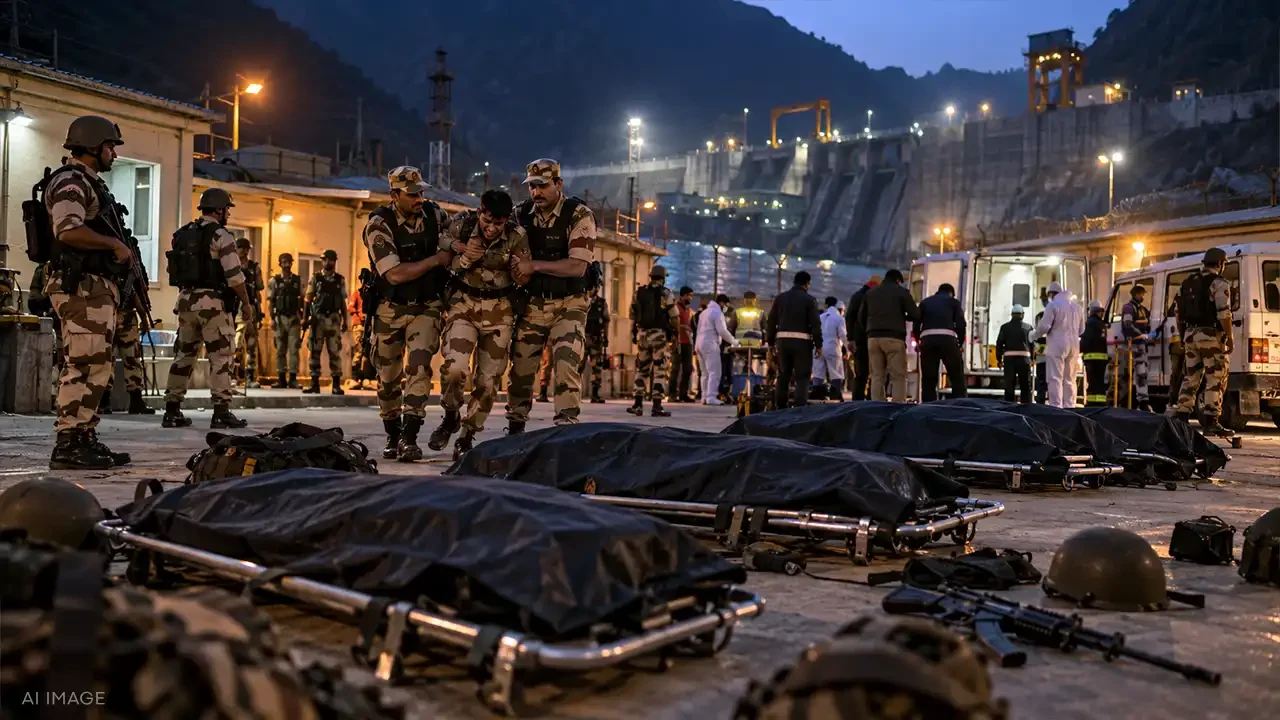
Four Dead at J&K CISF Camp: The Questions Behind the Kathua Shooting
By: Javid Amin | 29 Aug 2026
Assistant Commandant among four dead after colleague allegedly opens fire at Sewa hydroelectric project; police and CISF begin separate probes
Kathua: A security camp guarding a hydroelectric project in the remote hills of Kathua became the scene of a deadly internal shooting on Tuesday evening when a Central Industrial Security Force (CISF) Head Constable allegedly opened fire on his colleagues, killing four personnel, including an Assistant Commandant.
The incident took place at the CISF deployment at the Sewa hydroelectric project in Mashka village of the Basohli area, close to the Himachal Pradesh border. The firing was reported at around 7 pm, with some reports placing it at approximately 6:40 pm.
The four personnel who were critically injured in the firing were taken to an NHPC hospital in neighbouring Himachal Pradesh, where they later succumbed to their injuries.
Those killed were identified as Assistant Commandant Ankit Kumar Pandey, Sub-Inspector Lakshman Singh, Constable Sandeep Kumar and Constable Mohammad Rafiq.
The alleged shooter, identified in multiple reports as Head Constable Abhidesh Kumar or Avdesh Kumar Singh, was overpowered, taken into custody and handed over to the police. His service weapon was seized.
The exact circumstances behind the shooting remain under investigation.
And that uncertainty is important.
While officials have said that an argument preceded the firing, investigators have not yet established why the confrontation escalated into a fatal shooting.
A Quiet Evening Turned Into a Mass-Casualty Incident
The CISF personnel were deployed to protect a strategic hydroelectric installation in the Basohli sector.
The Sewa project lies in a geographically remote area of Kathua, close to the J&K-Himachal Pradesh boundary. Access to the site itself can involve movement through neighbouring Himachal Pradesh, according to police sources quoted by The Indian Express.
It was at this security installation that the confrontation unfolded.
Initial information indicates that a verbal altercation took place among personnel before the Head Constable allegedly opened fire with his service weapon.
The incident is being treated as an apparent case of fratricide, a term generally used for the killing of fellow members of one’s own armed or security force.
But the label describes what happened. It does not explain why it happened.
That question will have to be answered by the investigation.
Four Personnel Who Went to Work and Never Returned
The dead included an officer responsible for commanding the company deployed at the site, a Sub-Inspector and two constables.
Assistant Commandant Ankit Kumar Pandey was identified as the company commander. Sub-Inspector Lakshman Singh and constables Sandeep Kumar and Mohammad Rafiq were also killed.
According to reports, all four were initially alive after the shooting and were transported for emergency treatment.
The fact that they died later at the hospital makes the sequence even more painful for their families.
They had not been killed in a distant battlefield.
They had not been caught in an attack by an unidentified militant group.
They were allegedly shot inside their own place of duty by a colleague.
That distinction gives the incident a different character.
What Triggered the Shooting?
At present, the answer is not established.
Officials have consistently said that an argument preceded the shooting. The CISF and police are examining what happened during that confrontation and what caused it to escalate.
Some subsequent reports have carried more specific accounts about the subject of the dispute.
Those details should be treated cautiously at this stage.
The investigation has to establish the sequence independently, rather than relying on accounts circulating in the immediate aftermath.
What is known is that a disagreement occurred, a service weapon was used, four personnel died and the accused was subsequently taken into custody.
The motive remains a matter for investigators.
The Weapon Was a Service Weapon
One of the most consequential elements of the incident is that the alleged shooter was a serving CISF Head Constable and was able to use his issued weapon during the confrontation.
Reports have identified the weapon as his service rifle and said it was subsequently seized by authorities.
That naturally raises questions about weapons management during periods of interpersonal conflict.
But those questions should not be converted into conclusions before investigators establish the circumstances.
The relevant issues will include the circumstances in which the weapon was accessed, the sequence of events, whether established procedures were followed and whether anyone had prior knowledge of a situation that required intervention.
These are precisely the kinds of questions an internal inquiry and police investigation can address.
Why the Location Matters
The Sewa project is not an ordinary workplace.
It is critical infrastructure protected by a central armed security force.
That means the incident has two dimensions.
There is the human tragedy involving the four personnel and their families.
Then there is the institutional question of what happens when a serious conflict develops inside a security installation where personnel have access to firearms.
The latter does not automatically mean that the installation itself was insecure.
Indeed, the accused was reportedly overpowered and taken into custody after the firing, while police and CISF personnel secured the site.
The more relevant question is how organisations that routinely place armed personnel together can identify and manage situations that have the potential to escalate.
The Remote Location Added Another Complication
The Sewa project is located at the extreme end of Kathua district near the Himachal Pradesh border.
That geography influenced the emergency response.
The injured personnel were taken to an NHPC hospital in Himachal Pradesh rather than a facility deeper inside Kathua, according to reports.
This is a reminder of the practical difficulties of providing emergency medical care in remote security and infrastructure installations.
For any serious incident, the first priority is stabilising the injured.
But the availability of a suitable medical facility, road connectivity and the time required to reach definitive care can influence outcomes.
In this case, despite emergency treatment, all four critically injured personnel eventually died.
A Security Force Is Also a Workplace
The incident also brings attention to an aspect of security-force life that is often less visible to the public.
A security force is, at its core, a workplace populated by people.
Personnel live together, work together, operate under hierarchy and discipline, and in many postings spend long periods away from their families.
At the same time, unlike most workplaces, many of them routinely carry firearms.
That combination makes conflict-management systems particularly important.
A disagreement between two employees in an ordinary workplace can result in a complaint, suspension or separation.
Inside an armed security environment, the consequences of an uncontrolled confrontation can be dramatically different.
This is why internal discipline, command responsibility, grievance mechanisms and weapons-control procedures all become part of the broader safety architecture.
The Investigation Must Go Beyond the Immediate Trigger
Finding the immediate argument will not necessarily answer the larger questions.
Investigators will need to reconstruct the sequence of events.
What happened before the argument?
Who was present?
How did the confrontation escalate?
Were there warnings?
How was the weapon accessed?
Were standard procedures followed?
Were there any previous complaints or disciplinary issues relevant to the incident?
Did personnel at the site have mechanisms for reporting serious interpersonal conflicts?
These questions do not imply that any earlier warning existed.
They are simply the kinds of questions that become relevant whenever a workplace confrontation involving armed personnel results in multiple deaths.
Avoiding Easy Conclusions
The incident has already generated speculation about possible personal and psychological reasons.
Those possibilities should not be presented as facts.
There is currently no verified basis to independently conclude that the shooting was caused by a particular mental-health condition, personal crisis or other private factor.
Doing so would risk turning an ongoing investigation into a premature explanation.
The responsible approach is narrower:
There was an argument, alleged firing followed, four personnel died, the accused was taken into custody and authorities are investigating the circumstances.
Everything beyond that requires evidence.
What the CISF and Police Investigation Will Establish
The police investigation will examine the criminal aspects of the case.
The CISF’s internal process can examine institutional and service-related questions.
Reports have said that the force is initiating an internal inquiry alongside the police investigation.
The two processes can therefore address different but overlapping dimensions.
The criminal investigation has to establish facts relevant to the alleged offence.
The internal inquiry can examine whether procedures, command arrangements, weapons handling and other service protocols were followed and whether institutional lessons emerge.
The findings will be important not only for this particular case but also for other armed deployments.
Four Deaths, Four Families
Behind the institutional questions are four families.
An Assistant Commandant, a Sub-Inspector and two constables lost their lives within minutes of an incident that began as an alleged workplace confrontation.
Their colleagues will have to return to duty at the same installation.
Their families will have to absorb a loss that arrived without warning.
For the wider force, the incident will also be a deeply unsettling event because the people killed were not outsiders who entered the installation.
They were colleagues.
That is why the incident has resonated so strongly across the security establishment.
The Larger Lesson Is About Prevention
The immediate legal process will determine individual responsibility.
But institutions will also need to examine whether anything can be learned about preventing similar incidents.
That does not mean assuming that such an incident could have been predicted.
Rather, it means examining systems.
Armed organisations require robust mechanisms for dealing with serious interpersonal disputes because the consequences of escalation are unusually severe when firearms are present.
Clear reporting channels, effective command supervision, appropriate weapons-management procedures and timely intervention in serious conflicts can form part of that prevention framework.
The precise lessons, however, should follow evidence from the inquiry rather than precede it.
A Tragedy Inside a Security System
Jammu and Kashmir has long been associated with a heavy security presence.
Security personnel routinely guard power projects, highways, government installations and other strategic assets.
The Sewa incident is different from an external attack.
It demonstrates that security risk can also emerge from within an installation.
That does not diminish the wider security threats faced by forces operating in J&K.
It simply highlights another dimension of security that receives less public attention: the safety of the people carrying the weapons and the people working beside them.
The Questions That Now Matter
The most important questions are no longer about the shock of what happened.
They are about what the investigation finds.
What exactly triggered the confrontation?
What happened between the first argument and the firing?
Were established procedures followed?
How did the weapon come into play?
Were there any earlier indicators that command authorities were required to address?
And what changes, if any, should follow?
Those answers will take time.
They should come from evidence, not speculation.
Four Lives Lost, Many Questions Left Behind
The Sewa project will continue to require security.
The CISF will continue to perform its duties.
But four families are now mourning four personnel who went to work and did not return.
The incident is a tragedy first.
Only after the immediate grief has been acknowledged should the institutional questions be examined.
A security organisation is expected to protect critical infrastructure and the public.
It must also protect its own personnel from preventable internal risks.
The investigation into the Kathua firing now has the difficult task of establishing what happened, why the confrontation escalated and whether anything in the system needs to change.
Four personnel are dead. One colleague is in custody. And an entire security establishment is left waiting for answers.


