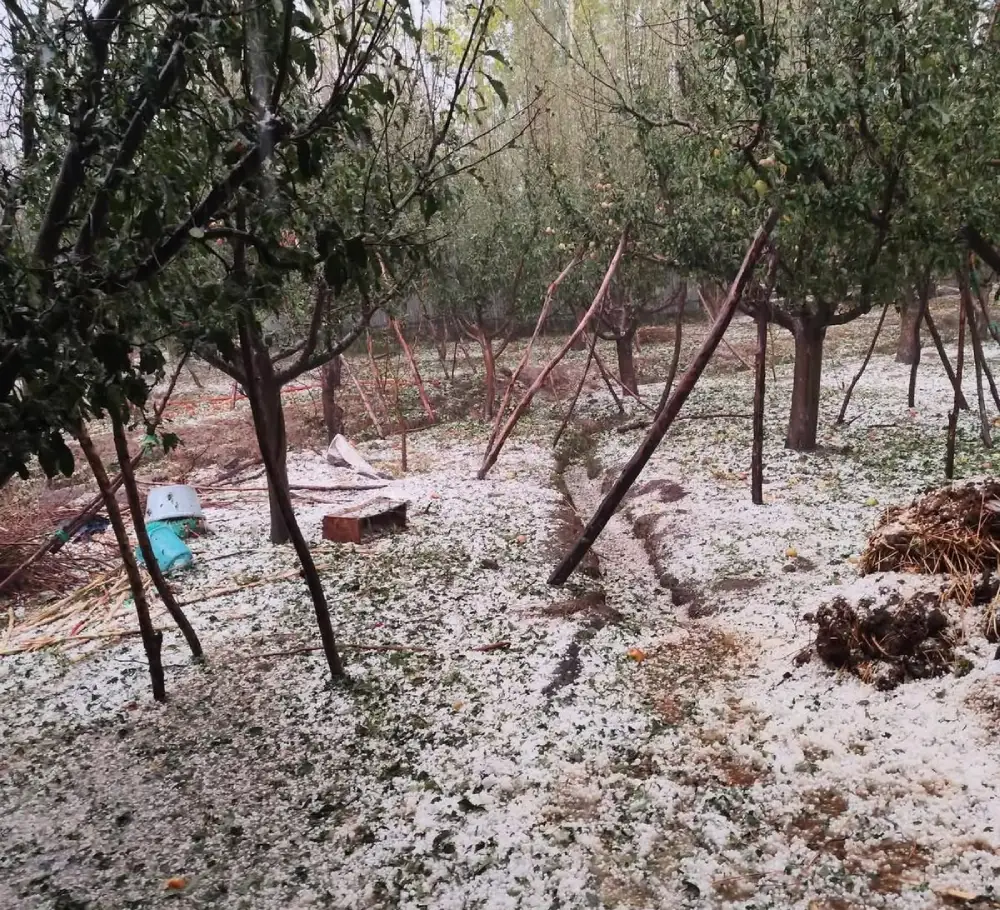
Kashmir Hailstorm Damages Apple Orchards and Paddy Crops: Bandipora Bears the Brunt as Farmers Fear Losses
By: News Desk | Srinagar | October 8, 2026
A sudden spell of hail, heavy rain and gusty winds has battered parts of Kashmir, damaging apple orchards, standing paddy crops and kitchen gardens at a critical stage of the agricultural season. Bandipora appears to have borne the brunt of Thursday evening’s weather event, while reports of crop damage have also emerged from parts of Kupwara, Baramulla and Ganderbal. The storm disrupted traffic and raised concerns about damage to trees and other local infrastructure.
For farmers and orchardists, the timing is particularly worrying. October is an important period for apple harvesting, grading and transportation in Kashmir, while paddy harvesting is also under way in many areas. Damage at this stage can affect not only the quantity of produce recovered from fields and orchards but also its market quality, the prices growers receive and the income available to farming households.
Although residents have described substantial localised damage, the overall financial impact remains uncertain. A verified, district-wide assessment of losses from Thursday’s storm was not available in the reports reviewed for this article. The immediate priority is therefore to document damage village by village, establish which crops and orchards have been affected, and determine what assistance may be available to growers.
The episode also highlights a wider concern for Kashmir’s rural economy: when severe weather strikes close to harvest, even a relatively brief storm can threaten months of agricultural work.
Bandipora worst hit as hail sweeps through orchards and fields
One report from Bandipora described a particularly intense spell lasting around 20 minutes. Residents said the combination of hail and gusty winds made the weather event especially concerning for fruit growers and farmers working through the harvest season.
The final extent of damage, however, cannot yet be established from these accounts. Reports of severe localised losses should not be treated as a confirmed district-wide estimate of crop destruction. A reliable picture will require field inspections, crop-wise damage records and information from the Agriculture and Horticulture departments.
The affected areas also differ in their agricultural exposure. A hailstorm can damage fruit hanging on trees, knock ripe apples to the ground, injure leaves and branches, or flatten standing crops. The consequences depend on the storm’s intensity, the duration of exposure, the crop’s maturity and the condition of individual orchards and fields.
For growers whose produce was ready for collection or transport, the immediate concern is whether the remaining crop can be harvested and marketed without further deterioration.
Why the timing matters for Kashmir’s apple and paddy harvest
The impact extends beyond the crop visible in an orchard or field. Farmers must pay for labour, transport, packaging, fertilisers, plant protection and other inputs. A sudden weather event can undermine the returns on those investments just as the produce is ready to generate income.
Apple growers face both quantity and quality losses
Hail damage to apples can take several forms. Direct impacts may bruise the fruit, mark its skin or cause it to fall prematurely. Strong winds can also dislodge apples or break branches, while damage to foliage can affect the tree’s condition.
The commercial consequences depend on the severity of the injury. Fruit with substantial visible damage may be downgraded, sold at a lower price or diverted away from premium fresh-fruit markets. Apples that remain on trees may still require careful inspection before grading, packing and storage.
This distinction is important because a farmer’s loss is not measured solely by the number of apples destroyed. A harvest may retain much of its physical volume but still earn less if a significant share of the fruit no longer meets the quality standards expected by buyers.
Kashmir’s apple economy is large enough for such local losses to have consequences across a wider supply chain. NITI Aayog’s Roadmap for Horticulture Development in the UT of Jammu and Kashmir identifies horticulture as a major pillar of the region’s economy, supporting approximately 3.5 million livelihoods and contributing an estimated 6–7% to the Union Territory’s GDP. The roadmap also identifies infrastructure, market access, storage and value addition as important areas for further development.
Paddy fields face a different set of risks
Paddy crops are vulnerable to strong winds and heavy rain, particularly when plants are mature and carrying grain. Wind and rain can cause lodging, a condition in which stems bend or fall over, making harvesting more difficult.
Lodged paddy may require additional labour, and wet field conditions can complicate the movement of harvesting equipment and the collection of grain. If harvested produce is exposed to prolonged moisture without adequate drying and storage, the risk of deterioration can rise.
However, the actual impact on Kashmir’s paddy crop will depend on field conditions and the stage of maturity when the storm passed through. Not every field exposed to rain will suffer serious losses, and the scale of damage cannot be established without an agricultural assessment.
For farmers already preparing to cut and collect their crop, the immediate task is to identify damaged patches, assess whether harvesting can proceed safely and protect any grain already collected.
The economic cost goes beyond damaged fruit
The consequences of a hailstorm rarely end at the orchard boundary. In Kashmir, apple production supports a network of activities involving seasonal workers, fruit pickers, packers, transport operators, commission agents, wholesalers, cold-storage facilities and retailers.
A damaged harvest can affect several of these groups simultaneously.
-
Growers: Lower yields or reduced fruit quality can cut farm-gate earnings.
-
Seasonal labourers: Damaged crops may reduce the volume of harvesting, grading and packing work available.
-
Transport operators: Lower dispatch volumes can affect the movement of fruit to markets.
-
Packing and storage businesses: Changes in the quantity and quality of marketable fruit can affect demand for packaging, sorting and storage services.
-
Local traders: Uncertainty over available supply and fruit grades can complicate purchasing and sales planning.
The effect on prices is not straightforward. Reduced marketable supply can support prices for undamaged, high-quality apples, but badly affected growers may receive lower returns if their fruit is bruised, downgraded or sold in distress. Without reliable information on the amount of damaged produce and prevailing market prices, it would be premature to predict whether the storm will push apple prices up or down.
The wider economic context makes accurate assessment particularly important. NITI Aayog’s horticulture roadmap records that fresh-fruit export quantities and revenues fluctuated between 2022–23 and 2023–24, underscoring the importance of market access and value-chain resilience in addition to production.
Traffic disruption and damage to trees add to the disruption
The storm’s effects were not limited to agricultural land. Local reports also described disruption to traffic and normal activity, with strong winds raising concerns about trees, rooftops and other exposed infrastructure. Reports from Srinagar mentioned trees being uprooted during the spell.
Damaged trees and loose branches can also create hazards for pedestrians and motorists. Where power lines or other infrastructure have been affected, local authorities and utility teams may need to inspect the damage and carry out repairs.
The extent of these secondary effects has not been quantified in the reports reviewed. It would therefore be premature to assign a monetary value to infrastructure damage or estimate the number of people affected.
Weather forecast: More unsettled conditions remain possible
The India Meteorological Department’s official forecast services provide district-level warnings and local forecasts that should guide decisions over the coming days. Its local forecast pages distinguish between the possibility of rain or thunderstorms and formal weather warnings, while the warning portal lists separate categories for hailstorms, strong winds, heavy rain and lightning.
This distinction matters for farmers. A forecast of light rain does not mean every orchard or field will experience damaging weather, but the possibility of further showers or thunderstorms makes it important to monitor local conditions and avoid unnecessary delays in harvest preparation.
Farmers should follow official advisories from the Meteorological Department and the Agriculture and Horticulture departments, especially where thunderstorm or strong-wind warnings are issued.
What farmers can do to reduce further losses
Once a storm has passed, the first priority is to assess damage without creating additional risks. Practical steps can help growers protect the remaining crop and establish a clear record of losses.
Record fallen fruit, visible hail marks, broken branches and damage to foliage. Photographs, the location of the orchard and an approximate affected area can help when reporting losses to the relevant department.
Inspect harvested and fallen fruit carefully. Separate damaged produce from sound apples and seek advice on appropriate grading, handling, storage or processing options.
Keep harvested grain and sheaves protected from additional rain. Follow local agricultural advice on drying, threshing and storage to reduce moisture-related deterioration.
Contact the relevant Agriculture or Horticulture office and local administration. An official assessment can establish the nature and extent of damage and clarify eligibility for any available relief.
These are general precautions, not a substitute for crop-specific guidance. Farmers should avoid entering unsafe areas near damaged power lines or unstable trees, and should not undertake major pruning or apply plant-protection chemicals without appropriate advice.
Compensation and official assessment: What remains unclear?
As of the reporting available for this article, a verified district-wise assessment of the damage caused by Thursday evening’s storm was not available. The reported losses therefore remain preliminary, and there is no substantiated figure for the total area affected, the number of growers impacted or the value of damaged produce.
There is also a relevant distinction between reports of damage and eligibility for government assistance.
In a separate case, Chief Minister Omar Abdullah informed the Jammu and Kashmir Legislative Assembly in September that damage caused by a September 6 hailstorm in parts of Banakoot block of Bandipora had been assessed at below 33%. According to the official account reported by Kashmir Reader, the affected areas did not qualify for input subsidy under the applicable State Disaster Response Fund norms because the assessed damage fell below the prescribed threshold.
Growers seeking support need clarity on several questions:
-
How much agricultural and horticultural land has been affected by the October 8 storm?
-
What proportion of the apple crop has suffered physical damage or quality downgrading?
-
How extensive is the damage to paddy and other standing crops?
-
Will district-level inspection teams assess individual orchards and fields?
-
What assistance, if any, will be available under the applicable relief rules or existing agricultural schemes?
The answers will depend on official inspections, the rules governing assistance and any additional measures announced by the government. Compensation should not be presented as approved or guaranteed until the relevant authorities confirm it.
For affected growers, timely inspections matter because agricultural damage can become harder to document as fallen fruit is collected, fields are harvested and damaged material is removed.
A climate-resilience challenge for Kashmir’s agriculture
The latest hailstorm is a local weather event, but it raises a broader question about the resilience of Kashmir’s agricultural economy: how can growers better protect their crops when damaging weather arrives close to harvest?
NITI Aayog’s 2026 horticulture development roadmap explicitly identifies extreme weather events, early-warning systems, post-harvest losses and climate-resilient horticulture as important areas for intervention. It also highlights the need to improve storage, marketing infrastructure, technology adoption and agricultural extension services.
These priorities are particularly relevant to an economy in which fruit production sustains livelihoods far beyond the farm itself.
Better early warnings and local advisories
Weather forecasts are most useful when they reach farmers in a form they can act on. District-level alerts, timely agricultural advisories and reliable communication between weather officials and local extension workers can help growers prepare for adverse conditions.
Forecasts cannot eliminate hailstorm damage, but advance warnings may give farmers time to secure equipment, prepare protective measures where feasible and organise the safe handling of harvested produce.
Stronger post-harvest infrastructure
Cold storage, suitable packaging, collection centres and efficient transport systems can help reduce losses after harvesting. They cannot reverse physical damage caused by hail, but better infrastructure can protect the portion of the crop that remains marketable.
For fruit growers, improved grading and processing facilities can also provide alternative outlets for produce that does not meet premium fresh-market standards, where the fruit remains suitable for those uses.
More systematic crop-damage assessments
A transparent assessment process is equally important. Field inspections should record the affected area, crop type, stage of maturity and severity of damage. Publishing consolidated findings would help farmers understand the scale of the event while giving policymakers a stronger basis for deciding whether additional support is warranted.
Over time, a consistent record of weather-related crop losses could also help identify vulnerable locations and improve agricultural planning.
Climate resilience is not simply about responding to a storm after it happens. It is about building systems that help farmers withstand shocks, preserve the value of their produce and recover more quickly when losses occur.
The road ahead: Protecting the harvest and the rural economy
For now, the immediate challenge is to establish what Thursday’s hailstorm has actually destroyed.
Bandipora has emerged as a major area of concern, with damage also reported in parts of Kupwara, Baramulla and Ganderbal. The reports point to losses involving apple orchards, paddy and other crops, alongside disruption to traffic and normal activity. Yet the absence of a verified, comprehensive damage assessment means the financial consequences remain uncertain.
The government will also need to establish whether any affected farmers qualify for assistance under existing provisions and whether further measures are justified by the verified extent of the damage.
For Kashmir’s farmers, autumn is the season when months of labour are expected to translate into income. When hail strikes just as crops are ready to be harvested, the consequences can reach well beyond a damaged orchard or a flattened field.
The final measure of the storm’s impact will not be the amount of hail that fell, but how much produce was lost, how many livelihoods were affected and how effectively the remaining harvest can be protected.