From vegetables and mutton to cooking essentials, families are struggling to stretch their incomes as questions mount over market monitoring, inflation relief and the priorities of elected representatives
By: News Desk | Srinagar | October 8, 2026
For many households across Kashmir, the pressure of rising living costs is not an abstract economic debate. It is felt every time a family visits a vegetable stall, buys cooking oil, purchases meat, pays a transport fare or prepares the monthly grocery budget.
The challenge is not necessarily that every commodity becomes more expensive every day. It is that several recurring expenses compete for the same household income, while the prices of individual items fluctuate according to season, supply, transport costs and local market conditions. When incomes fail to keep pace, even a household that manages to maintain its basic consumption can find itself with less money for education, healthcare, savings and emergencies.
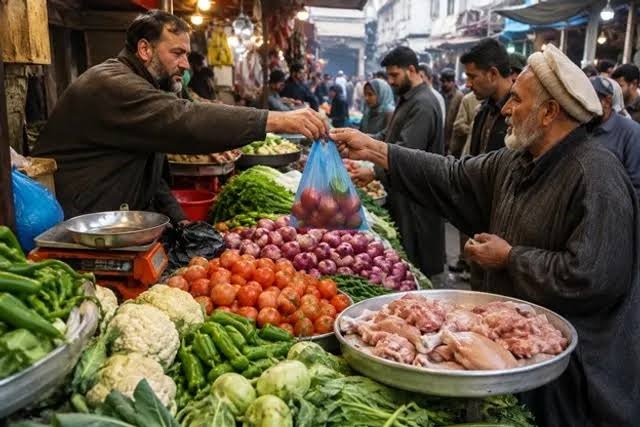
Residents have raised concerns about expensive essentials and uneven prices across markets. In July 2026, the Chamber of Commerce and Industry Kashmir (CCIK) reported that mutton was selling at around ₹800 to ₹820 per kilogram, chicken at ₹200 to ₹210, paneer at approximately ₹310 per kilogram and a tray of eggs at nearly ₹250 in several markets. The organisation said families were cutting back on protein-rich foods and called for stronger market monitoring. These were reported market prices at that time, not a verified Valley-wide average or a complete six-month price series. citeturn729536search6
The larger issue is whether the authorities are doing enough to make essential goods affordable, enforce notified prices where applicable and explain why consumers continue to face pressure.
The recent controversy over proposed salary increases for ministers and legislators has added another dimension to that debate. In September, the Jammu and Kashmir Assembly withdrew bills seeking increases in the salaries and allowances of ministers and legislators after objections from BJP members. The episode intensified scrutiny of the priorities of elected representatives at a time when households and workers continue to raise economic concerns. citeturn103522search2turn103522search4
The question facing the government is therefore bigger than whether prices are high. It is whether the administration can demonstrate, with transparent data and visible action, that consumer affordability is being treated as a serious governance responsibility.
Six months of household pressure: What has changed?
A careful assessment of the period from April to October 2026 needs to distinguish three different things: the actual change in prices, the cost of maintaining a household and the ability of families to pay.
These are related, but they are not identical.
Inflation measures the change in prices over a defined period. The cost of living is broader, incorporating food, transport, housing, utilities, healthcare and other expenses. Household affordability depends on those costs relative to income.
A family may experience a severe squeeze even when the overall inflation rate is moderate. If its earnings remain unchanged while food, transport, school expenses and medical bills rise, its available spending power declines.
Conversely, a commodity may become cheaper in one week without reversing the cumulative increase a family has experienced over several months.
For Kashmir, the most useful analysis would compare actual retail prices in April, May, June, July, August, September and early October for the same commodities, grades, units and markets. The publicly accessible reports reviewed for this article do not provide a complete, consistently comparable six-month retail-price series covering the entire Valley. It would therefore be misleading to publish a precise percentage increase for every grocery item without that underlying data.
Nevertheless, the available evidence identifies the categories requiring the closest scrutiny.
Vegetables: Seasonal relief does not automatically mean affordability
Vegetable prices are among the most visible indicators of pressure on household budgets because families purchase them frequently and cannot always postpone buying them.
In early October, publicly published Srinagar price listings showed substantial variation between commodities. One listing dated October 8 placed tomatoes at around ₹40 per kilogram and beans at approximately ₹80, while other online market trackers listed different wholesale and retail ranges. These figures should be treated as indicative market snapshots, not as official prices applying uniformly across Srinagar or the wider Valley. citeturn729536search9turn729536search1
The variation itself deserves attention.
A vegetable’s retail price can reflect the wholesale purchase price, transport, handling, wastage, storage, shop rent and the retailer’s margin. Seasonal availability and the volume arriving at local markets can also cause sharp fluctuations.
Kashmir’s own agricultural production can help supply some vegetables, but the Valley also relies on supplies transported from outside production areas for many commodities and during particular seasons. The final retail price may consequently reflect both local availability and the cost of bringing produce into the market.
However, transport costs should not become a blanket explanation for every price increase. To establish their contribution, officials would need to compare wholesale arrivals, purchase prices, freight costs and the final prices charged to consumers.
The practical problem for a family is straightforward: if the prices of several vegetables rise together, a fixed grocery budget buys less. Households may respond by buying smaller quantities, switching to cheaper varieties or reducing the range of vegetables they purchase.
These are plausible household responses, not a measured survey of every family in Kashmir. Establishing their scale would require consumer surveys or household expenditure data.
Meat, chicken, eggs and dairy: When nutrition becomes a budget decision
Food affordability is not simply a question of whether a family can buy enough calories. It is also about whether it can afford a varied diet.
The July figures reported by CCIK illustrate the pressure. Mutton was reported at ₹800 to ₹820 per kilogram, chicken at ₹200 to ₹210, paneer at around ₹310 and eggs at nearly ₹250 per tray in several markets. The traders’ body said families were reducing purchases of protein-rich foods. citeturn729536search6
For households already managing rent, school expenses, electricity bills and transport, these prices can force difficult choices.
A family may reduce the quantity of meat it buys, purchase it less frequently or replace some items with less expensive alternatives. The extent of this substitution will vary according to income, household size, dietary habits and local prices.
There is also a difference between an expensive product and an unjustified price. Mutton prices can reflect livestock supply, feed, transport, slaughtering and retail costs. Chicken and eggs follow different supply chains. Paneer prices depend partly on milk costs and processing.
Authorities should therefore investigate the specific supply chain and applicable rules rather than treating all price differences as evidence of profiteering.
At the same time, sellers should not be allowed to use general inflation as an excuse to charge above notified rates where such rates apply, misrepresent weights or engage in other unlawful practices.
The purpose of market regulation should be to distinguish legitimate cost increases from avoidable or illegal overcharging.
Cooking oil, rice, flour, pulses and other essentials
The pressure on household budgets extends beyond fresh food.
Rice, flour, pulses, cooking oil, sugar, tea, milk and fuel are recurring purchases. Even modest increases in several of these categories can produce a meaningful change in the monthly grocery bill because families buy them repeatedly.
Yet a responsible report must distinguish between products whose prices are controlled or notified in particular circumstances and goods whose prices are shaped largely by wider supply and demand. It must also distinguish a genuine price increase from a difference caused by brand, quality, pack size or retailer.
For example, comparing two cooking oils without accounting for the type and quantity can produce a misleading conclusion. The same applies to different varieties of rice, packaged flour or pulses.
Jammu and Kashmir’s Directorate of Economics and Statistics says the administration collects wholesale prices from eight districts and retail prices from all 20 districts. It also gathers daily prices for 22 essential commodities through field officials in selected districts for onward transmission to the Union government’s monitoring system. citeturn103522search3
That system should make it possible for the government to identify unusual price movements, compare wholesale and retail trends and investigate unexplained differences.
The public question is whether the data is being translated into timely, understandable action.
Consumers should be able to find out which prices have increased, which have declined, where shortages have been reported and what steps have been taken when retailers violate applicable rules.
Without transparent, comparable figures, consumers are left to rely on their shopping bills and informal comparisons, while the government risks responding to complaints without demonstrating whether its interventions have worked.
Why prices differ from one market to another
A family shopping in Srinagar may encounter different prices for the same item in different neighbourhoods. Similar differences may arise between Srinagar and other districts.
Some variation is normal. Retailers face different transport, rent, handling and storage costs. Quality and freshness also matter, particularly for perishable goods.
But not every difference is automatically justified.
If the same product is being sold at substantially different prices in nearby markets, the administration should examine whether the difference reflects genuine costs or whether consumers are being overcharged.
That requires more than occasional visits to shops. A credible monitoring system should record the commodity, grade, unit, wholesale price, retail price, notified rate where applicable, location and action taken when a violation is found.
A single inspection may catch an individual violation. A consistent dataset can reveal a pattern.
For example, repeated complaints about one commodity in several markets could point to a supply problem, an unexplained retail margin or weak compliance with notified rates. Officials could then target their inspections instead of relying only on general announcements.
The objective should not be to punish traders simply because a commodity has become expensive. It should be to identify the source of the increase and respond appropriately.
Is transport responsible for the rise?
Traders frequently cite transportation costs, supply disruptions and fluctuating market conditions when explaining higher prices.
These factors can affect Kashmir’s markets, particularly for goods brought in from outside the Valley. Fuel costs, freight rates, delays, road disruptions and handling losses can all influence the final price.
But an explanation is not the same as a verified finding.
If a trader says a price has increased because transport has become more expensive, the claim should be tested against freight costs and wholesale invoices. If the wholesale price has remained stable while the retail price has risen sharply, the administration should examine the margin and other costs.
Likewise, if wholesale prices rise across several markets because of a genuine shortage, enforcement alone cannot solve the underlying supply problem.
Effective policy requires two parallel responses: ensuring that supply chains function properly and enforcing consumer-protection rules where violations occur.
A government that focuses only on inspections may miss a supply shortage. A government that focuses only on supply may overlook unlawful overcharging.
What are the authorities doing?
Jammu and Kashmir has an established administrative framework for monitoring essential commodities.
The Food, Civil Supplies and Consumer Affairs Department is responsible for food-security programmes and monitoring the availability and prices of specified essential commodities. The official department profile describes market checks as part of efforts to curb black marketing, hoarding and profiteering. citeturn729536search10
The administration also has a Legal Metrology Department, which deals with matters such as weights, measures and compliance with relevant legal requirements. The Directorate of Economics and Statistics collects and analyses price information to help monitor fluctuations and regulate supplies. citeturn103522search3turn729536search8
These arrangements matter because the problem is not a complete absence of formal mechanisms. The central issue is whether they are adequately staffed, consistently deployed and effective in the markets where consumers are reporting difficulties.
In January 2026, The Kashmir Horizon published a report questioning the activity of the FCS&CA enforcement wing, saying that market enforcement appeared weak despite an earlier announcement about reactivating inspection teams. The report also referred to previous directions to display official price lists and take action against overpricing. This is a media assessment of enforcement, not a complete official audit of departmental performance. citeturn729536search14
In July, CCIK again complained of inadequate monitoring and inconsistent retail prices. Its statement provides evidence that concerns about enforcement were being raised by a traders’ organisation, but it does not independently establish that every market or department was inactive. citeturn729536search6
The gap between formal arrangements and public experience is therefore a legitimate subject for scrutiny.
To assess performance fairly, the administration should publish current inspection figures, the number of violations detected, penalties imposed, prosecutions initiated, complaints resolved and repeat offenders identified. It should also show whether the prices of the commodities under scrutiny have stabilised.
The available reports reviewed for this article do not provide a consolidated, up-to-date Valley-wide enforcement record for the full six-month period. Without that record, claims that the government has taken no action at all would be too broad. Equally, the existence of a department or an announced inspection drive cannot, by itself, demonstrate that consumers are receiving effective relief.
Inspections must produce results, not headlines
Market inspections are useful only when they are regular, transparent and followed by action.
A team visiting a few shops and issuing a press statement may demonstrate activity, but it does not reveal whether prices are compliant across the market or whether violations recur after inspectors leave.
A stronger system would include daily or weekly checks in major wholesale and retail markets, surprise inspections, public display of applicable rate lists, verification of weights and measures, and a simple way for consumers to report overcharging.
Officials should also publish the results.
If a shop is penalised for selling above a notified rate, the public should be told what rule was violated and what action followed, subject to applicable privacy and legal requirements. If an inspection finds no violation, that should be recorded too.
The administration should distinguish between overpricing, inaccurate weights, poor-quality goods, hoarding and genuine supply shortages. Each problem requires a different response.
There is also a need for better coordination between departments responsible for food supplies, legal metrology, district administration, transport and market management. A rise caused by a supply bottleneck cannot be resolved by issuing fines to retailers who are themselves paying higher wholesale prices.
The public deserves a system that identifies the problem rather than simply shifting responsibility between departments and traders.
The salary-hike controversy: Why it struck a nerve
The economic debate became more politically charged after the J&K Assembly considered legislation proposing higher salaries and allowances for ministers and legislators.
On September 28, 2026, Chief Minister Omar Abdullah introduced bills seeking amendments to the laws governing salaries and allowances for ministers and members of the legislature, as well as pension-related legislation for former legislators. The bills were withdrawn on September 29 after objections from BJP members. citeturn103522search5turn103522search2
The controversy matters because household affordability and public-sector remuneration became visible in the same political conversation.
For ordinary residents, the question is immediate: when food and transport consume more of a monthly income, what relief is available? For daily wagers and contractual workers, the question is often whether their wages are sufficient and whether long-pending employment or regularisation demands will be addressed.
The salary bills were not implemented, and it would be inaccurate to suggest that legislators received the proposed increases as a result of that legislation. But the proposal itself invited scrutiny of the priorities of the political establishment.
A legislative salary review can have a legitimate purpose. Members may argue that their remuneration should be reviewed periodically, and a committee may recommend changes. The existence of such a proposal is not, on its own, proof of corruption or indifference to ordinary people.
The relevant test is whether elected representatives give equal seriousness to the economic problems faced by constituents, explain the rationale and fiscal implications of their own remuneration proposals, and demonstrate progress on wages, employment, public services and consumer protection.
The public has a right to ask why remuneration proposals can move through the legislative process while the effectiveness of market monitoring remains a recurring concern.
That question should be answered with records and measurable outcomes, not partisan slogans.
The wider employment and income problem
The pressure of rising prices is particularly difficult for households whose earnings are irregular or uncertain.
A salaried household may be able to plan around a fixed monthly income, although it too can be squeezed when costs rise. A daily-wage worker, small trader, casual employee or unemployed young person has less room to absorb sudden expenses.
The J&K Assembly’s recent discussion of recruitment and application fees highlighted another aspect of economic anxiety. A report by The Indian Express, published on October 5, said the government informed the Assembly that JKPSC and JKSSB had collected a combined ₹114 crore in application fees from job aspirants between 2023 and 2026. The report also described a decline in advertised vacancies in the latest period. citeturn729536news49
Application fees are not a measure of inflation, and recruitment figures do not by themselves establish the financial condition of every household. But they illustrate why the cost of living cannot be considered separately from employment and income security.
A young person preparing for competitive examinations may have to pay application fees, travel costs, coaching expenses and household contributions while waiting for employment. A family supporting that person must manage those expenses alongside food and utility bills.
When earnings are uncertain, the same increase in grocery costs can have a much greater effect than it does on a household with a stable, rising income.
This is why the government’s response needs to combine consumer protection with employment opportunities, timely wage payments, social protection and reliable public services.
What would meaningful relief look like?
There is no single measure that can solve every cause of rising prices. The administration needs a package of practical, verifiable interventions.
First, publish a monthly essential-commodities dashboard. It should show retail and wholesale prices for a consistent basket of groceries across Srinagar and representative markets in other districts. Month-on-month and year-on-year comparisons would help establish whether prices are rising, falling or merely fluctuating seasonally.
Second, make market enforcement measurable. Publish the number of inspections, violations, penalties, cases filed and complaints resolved. Repeat violations should be tracked rather than treated as isolated incidents.
Third, improve supply-chain monitoring. For commodities showing sharp increases, officials should examine arrivals, wholesale prices, freight charges, storage costs and retail margins. This would help separate genuine supply pressure from unjustified overcharging.
Fourth, strengthen consumer complaint mechanisms. Complaint numbers and online channels should be easy to find, and consumers should receive a reference number and a clear response timeline. The administration should publish aggregated information on complaints and their outcomes.
Fifth, protect access to essential food. Public distribution arrangements and targeted food-security support should be monitored to ensure that eligible households receive their entitlements. Where shortages or distribution failures occur, authorities should identify and correct them promptly.
Sixth, review the household impact of policy decisions. Changes affecting transport, utilities, education and other recurring expenses should be assessed alongside income conditions, particularly for lower-income families, daily wagers and households with limited savings.
Finally, report results rather than intentions. A market-checking drive should be followed by evidence of compliance, lower complaint levels or corrective action. If prices remain high because of legitimate supply costs, officials should explain that too and identify what can realistically be done.
These measures would not guarantee that every commodity becomes cheaper. They would, however, make the response more transparent and allow residents to judge whether public action is effective.
What residents can do while seeking accountability
Consumers should not have to carry the burden of market regulation themselves. Nevertheless, a few practical steps can help them identify irregularities and make complaints more useful.
Keep receipts where available, compare like-for-like products and quantities, check displayed rates where notified prices apply, and record the date and location of a suspected overcharge. For disputes involving weights or packaged goods, retain the packaging or other relevant details.
Complaints are more actionable when they identify the commodity, quantity, price charged, shop location and the applicable notified rate or rule, where relevant. Consumers should use official channels and avoid making unverified public accusations against individual traders.
Authorities, in turn, should make complaint procedures accessible and report what action was taken. A system that asks citizens to complain but provides no visible response will struggle to earn public confidence.
The bottom line: Affordability must become a measurable governance priority
Kashmir’s cost-of-living debate cannot be resolved through claims that everything is becoming more expensive every day. That assertion requires commodity-by-commodity data, and prices do not necessarily move in one direction every day.
But the absence of a complete, publicly accessible six-month comparison does not make the affordability question disappear. Reports of high meat and grocery prices, concerns raised by CCIK and questions about the effectiveness of market enforcement make a strong case for greater transparency and a more systematic public response. citeturn729536search6turn729536search14
The administration already has a framework for collecting essential-commodity prices and monitoring markets. The challenge is to show how that information leads to action, whether violations are addressed and whether consumers are receiving measurable relief. citeturn103522search3turn729536search10
The salary-hike episode has sharpened the political question. The proposed increases were withdrawn, but the controversy has left a wider issue in public view: elected representatives are expected to explain their own priorities while responding to the financial pressures experienced by the people they represent.
The test is not whether ministers and legislators discuss their salaries, or whether traders blame transport costs. It is whether government departments can demonstrate that they understand the household budget, enforce the law fairly, maintain reliable supplies and respond to documented complaints.
For a family struggling to manage food, transport, education and healthcare, public statements alone are not relief.
The people of Kashmir need transparent prices, credible enforcement, reliable supplies and policies that recognise the distance between household income and household expenditure. The government should publish the data, show the action taken and allow the public to judge the results.