Panun Kashmir Adopts Historic Constitution, Reasserts Demand for Separate Homeland in Kashmir
By: Javid Amin | 24 May 2026
Jammu Convention Marks Major Turning Point in Kashmiri Pandit Movement
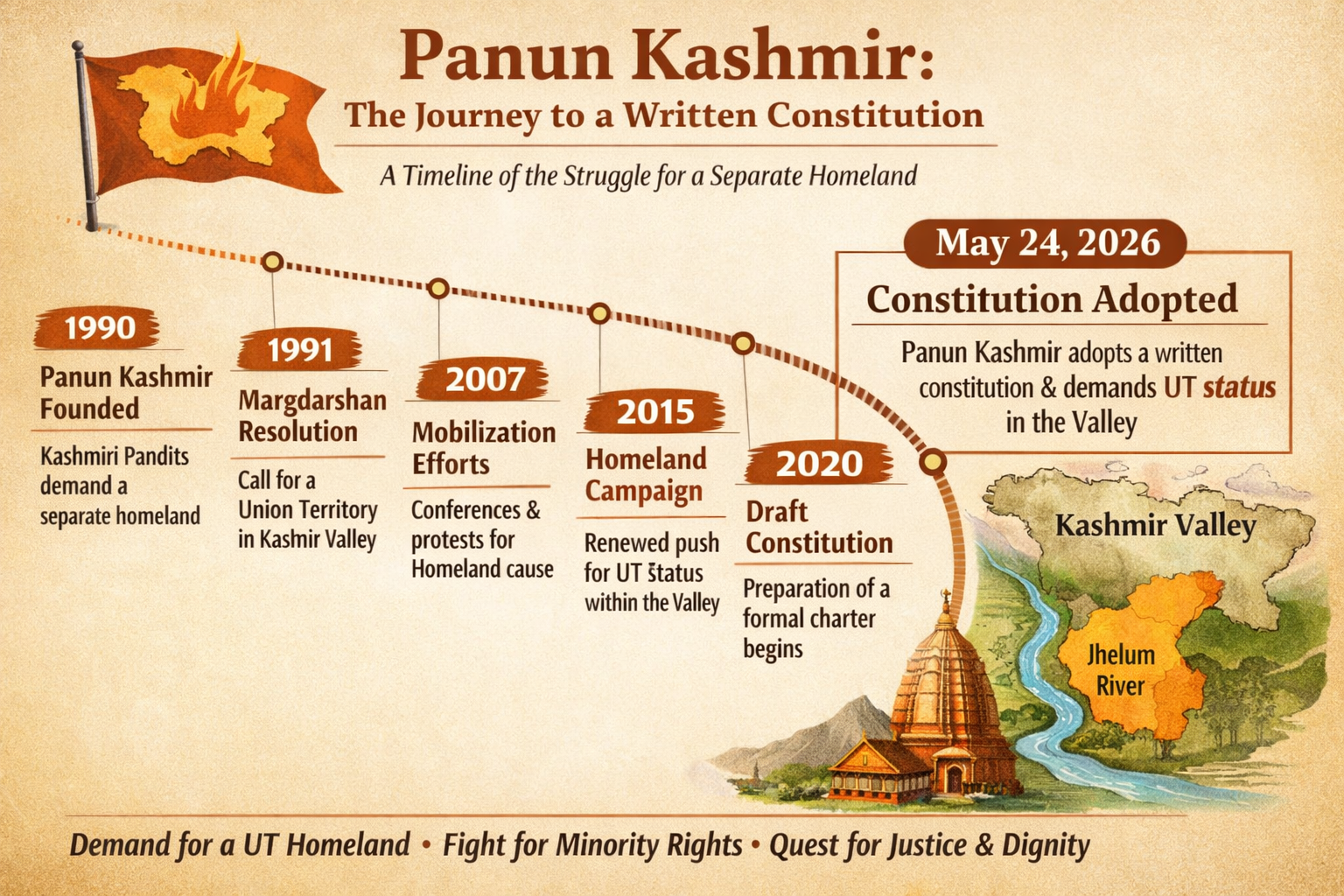
In a significant political and organisational development, Panun Kashmir formally adopted its first written constitution during a convention held in Jammu on May 24, 2026. The move marks a major institutional shift for the organisation that has represented the concerns and political aspirations of displaced Kashmiri Pandits for decades.
The convention was not merely administrative in nature. It carried strong emotional, ideological, and political symbolism. Members ceremonially performed a pooja of the newly adopted constitution before signing an affirmation register, presenting the document as both a political charter and a civilisational commitment.
The organisation also reiterated its long-standing demand for a separate homeland with Union Territory (UT) status for Kashmiri Hindus within the Kashmir Valley, specifically in areas located east and north of the Vitasta, commonly known as the Jhelum river.
The development comes at a time when debates around identity, autonomy, regional governance, and the future of displaced communities in Jammu and Kashmir continue to remain politically sensitive and nationally relevant.
From Ideological Framework to Written Constitution
For years, Panun Kashmir functioned through what its leaders described as an “unwritten ideological discipline.” The adoption of a codified constitution signals the organisation’s attempt to transition into a more structured and institutionally stable body.
Earlier this year, the organisation’s leadership had already hinted at the need for such a transformation. In March 2026, newly appointed chairman Tito Ganju publicly stressed the importance of replacing the informal framework with a written constitution to ensure organisational clarity and continuity.
The newly adopted constitutional framework is being projected as a mechanism to preserve institutional memory, streamline decision-making, and prepare future generations to carry forward the movement.
Leaders at the convention reportedly described the constitution as a “bridge between memory and future generations,” reflecting the organisation’s attempt to combine political advocacy with cultural preservation.
For many displaced Kashmiri Pandits, the move carries emotional significance because it institutionalises a struggle rooted in memories of displacement, migration, and loss after the exodus of the community from the Valley in the late 1980s and early 1990s.
Leadership Elections Signal Organisational Consolidation
The convention also witnessed key leadership appointments aimed at strengthening the organisation’s structure.
Prominent Kashmiri Pandit activist and poet Agnishekhar was elected as Convenor. Agnishekhar, whose real name is Kuldeep Sumbli, has remained one of the most recognisable faces of the Panun Kashmir movement and has consistently advocated for a separate homeland for displaced Kashmiri Hindus.
Other major appointments included:
- Tito Ganju as Chairman
- Kshama Kaul as Chairperson of Kashmira Vahini
- Kuldeep Raina as General Secretary
Additional organisational positions related to finance, publicity, culture, and coordination were also filled during the event.
The leadership restructuring follows a turbulent phase within the organisation earlier this year, including the removal of former chairman Ajay Chrungoo over alleged foreign links, after which Tito Ganju assumed leadership responsibilities.
Political observers believe the formalisation of leadership roles through a written constitution could strengthen Panun Kashmir’s ability to function as a more disciplined advocacy platform in national discourse.
The Core Demand: A Separate Union Territory for Kashmiri Hindus
At the heart of Panun Kashmir’s politics remains its demand for a separate homeland for Kashmiri Pandits inside the Kashmir Valley under Indian sovereignty.
The proposal envisions a Union Territory for Kashmiri Hindus in areas east and north of the Jhelum river. The organisation argues that such an arrangement is necessary to ensure the community’s security, cultural continuity, and political representation.
Panun Kashmir has maintained this position for decades and has consistently argued that the displacement of Kashmiri Pandits should not be viewed merely as migration, but as a forced civilisational rupture. The organisation recently reiterated that its homeland demand remains “non-negotiable.”
Supporters of the proposal argue that the community’s prolonged displacement and demographic marginalisation require a constitutional and administrative solution rather than symbolic rehabilitation packages alone.
Critics, however, contend that such a proposal could deepen regional and communal divisions within the Valley and complicate already fragile political dynamics in Jammu and Kashmir.
The demand is therefore likely to continue generating debate across political, legal, and civil society circles.
Historical Memory Continues to Shape the Movement
The Panun Kashmir movement draws heavily from the historical memory of the Kashmiri Pandit exodus that unfolded during the insurgency period in the late 1980s and early 1990s.
The organisation frames its struggle as part of a longer history of persecution and displacement faced by Kashmiri Hindus. Leaders at the convention reportedly invoked themes of survival, civilisational continuity, and historical justice while presenting the newly adopted constitution.
This framing remains central to Panun Kashmir’s identity politics. Its rhetoric often combines demands for political safeguards with broader concerns about preserving Kashmiri Hindu culture, language, traditions, and collective memory.
The organisation has also strongly supported constitutional changes made after the abrogation of Article 370 in 2019 and has viewed those developments as an opportunity to reshape discussions around the return and rehabilitation of displaced Pandits.
Political and Constitutional Implications
The adoption of a formal constitution by Panun Kashmir may appear organisational on the surface, but it carries wider political implications.
1. Institutional Maturity
The codification of organisational principles gives Panun Kashmir greater structural legitimacy. It transforms the movement from a largely personality-driven platform into a more durable institution with defined processes and leadership mechanisms.
2. Stronger Advocacy Potential
A written constitution can improve the organisation’s ability to engage with policymakers, legal institutions, international forums, and civil society networks. Structured organisations often carry greater influence in lobbying and representation.
3. Renewed Debate on Kashmir’s Political Future
The renewed demand for a separate UT inside the Valley is likely to reignite discussions around autonomy, federalism, minority rights, and territorial governance in Jammu and Kashmir.
This comes at a politically sensitive time, especially amid continuing debates over restoration of statehood to Jammu and Kashmir and evolving regional power structures after the 2019 reorganisation.
4. Community Mobilisation
The move may also energise sections of the displaced Kashmiri Pandit community, particularly younger generations seeking a more organised political articulation of their identity and aspirations.
A Defining Moment for Panun Kashmir
The Jammu convention may ultimately be remembered as one of the most consequential organisational milestones in the history of Panun Kashmir.
By adopting a formal constitution, electing a restructured leadership, and reaffirming its core ideological demand, the organisation has attempted to reposition itself for a new political era.
Whether its renewed push for a separate homeland gains wider political traction remains uncertain. However, the development clearly indicates that the Kashmiri Pandit question — particularly issues of displacement, rehabilitation, identity, and representation — continues to remain deeply embedded in the larger Kashmir discourse.
For Panun Kashmir, the message from Jammu was unambiguous: the movement intends to preserve its ideological continuity while seeking a more structured and enduring political future.
Fact Check & Verification Notes
- Panun Kashmir’s move to draft and adopt a formal constitution was publicly discussed by the organisation in March 2026.
- Agnishekhar’s role as founder-convenor and long-time advocate of a separate homeland is documented in public records.
- Tito Ganju’s leadership transition and organisational restructuring were reported by multiple publications in March 2026.
- Panun Kashmir’s demand for a separate Union Territory for displaced Kashmiri Pandits has been part of its long-standing political position.


