Omar’s Statehood Resolution Sparks Fresh J&K Assembly Clash, BJP Targets Speaker
By: Javid Amin | 28 September 2026
Speaker Abdul Rahim Rather cites 14-day notice rule as BJP-backed motion triggers fresh confrontation inside House
Srinagar: The Jammu and Kashmir Legislative Assembly descended into another round of disruption on Monday as the opposition Bharatiya Janata Party (BJP) intensified its protest against Chief Minister Omar Abdullah’s resolution seeking restoration of full statehood and moved a formal motion for the removal of Speaker Abdul Rahim Rather.
The latest confrontation has taken the dispute beyond the wording of the statehood resolution itself. The BJP is now challenging the Speaker’s handling of the resolution and has accused him of allowing it to be taken up in violation of legislative procedure.
BJP MLA R.S. Pathania told the House that the party had submitted a motion seeking Rather’s removal and claimed that 23 legislators had supported it. He argued that the Speaker should step aside until the motion was dealt with.
Rather rejected the demand for his immediate recusal, pointing to the procedure governing a motion for removal.
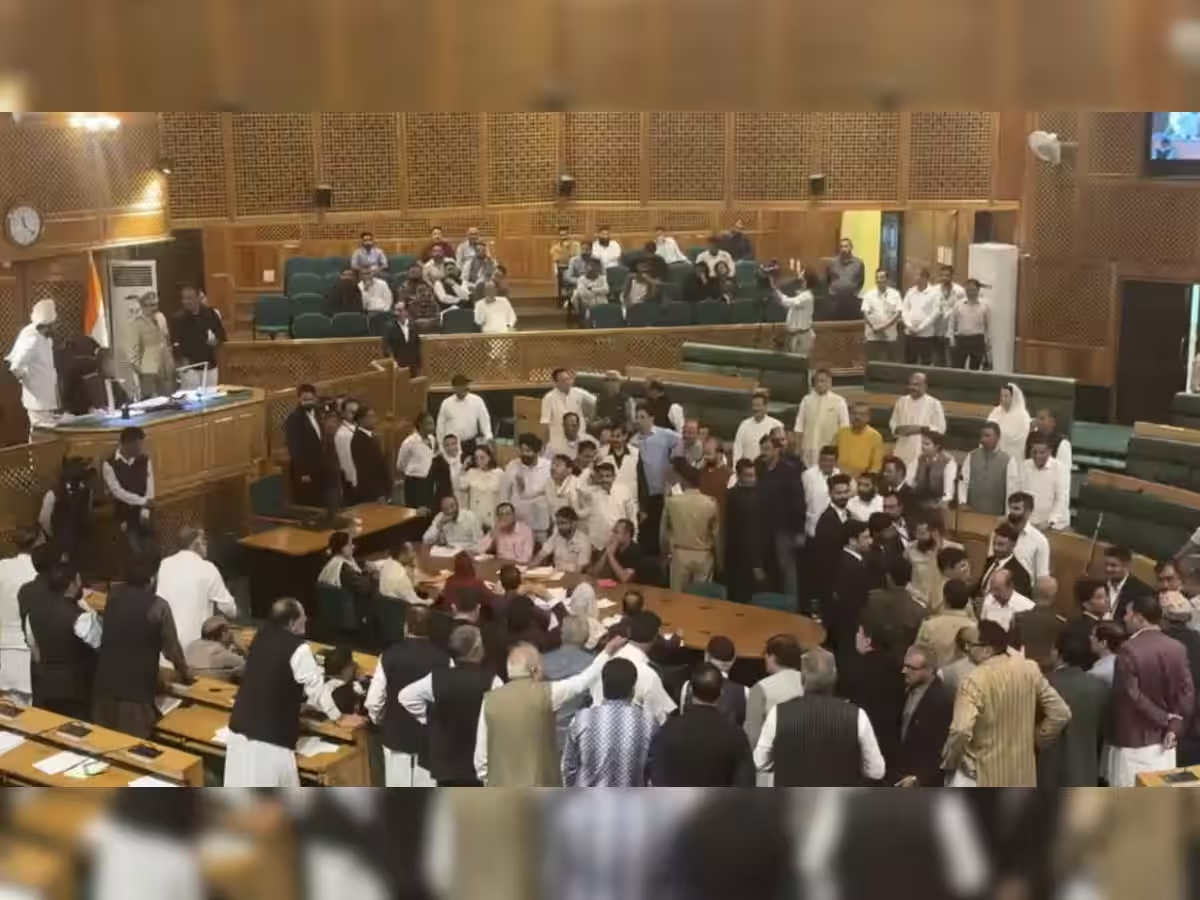
The result was another stormy sitting marked by slogans, protests and interruptions, with BJP and Congress legislators eventually being marshalled out amid the continuing uproar.
At the centre of the dispute remains a resolution that formally calls upon the Government of India to restore full statehood to Jammu and Kashmir but also refers to earlier Assembly resolutions from 2000 and 2024.
BJP Turns Statehood Dispute Into Speaker Challenge
The immediate trigger for Monday’s confrontation was the BJP’s objection to the manner in which the statehood resolution was admitted and allowed to proceed.
Pathania argued that the Speaker had permitted the Chief Minister’s resolution in relaxation of the applicable rules and questioned whether Rather could continue presiding over the proceedings while a motion seeking his removal had been submitted.
According to the BJP, 23 legislators had backed the motion. The party sought to use that support to argue that the Speaker should not continue conducting the House until the issue was resolved.
Rather took a different procedural position.
He said that he had not yet seen the motion and pointed to the rule requiring a removal motion to be entered in the list of business only after the prescribed notice period.
The Speaker told the House that the motion would come up after 14 days.
That position is supported by the Jammu and Kashmir Reorganisation Act, 2019. Section 19(2)(c) provides that a Speaker can be removed by a resolution passed by a majority of all the then members of the Assembly, but stipulates that at least 14 days’ notice must be given of the intention to move such a resolution.
What the Law Says About Removing the Speaker
The dispute over Rather’s position is therefore not simply a political disagreement.
The statutory framework contains a defined procedure.
Under Section 19 of the J&K Reorganisation Act, the Assembly can remove its Speaker through a resolution passed by a majority of all the then members. However, the law requires at least 14 days’ notice before such a resolution can be moved.
The same legislation contains another important safeguard.
Section 20 says that when a resolution for removal of the Speaker is under consideration, the Speaker cannot preside over that sitting. The Deputy Speaker, or another person designated under the Assembly’s rules, would perform the relevant functions.
The distinction between a submitted notice and a removal resolution actually being under consideration is therefore significant.
On Monday, Rather’s position was that the BJP’s notice had not yet reached the stage at which the removal motion could be taken up as business of the House.
The BJP, meanwhile, argued that the Speaker should not continue in the Chair because the motion had already been submitted.
That procedural disagreement became another source of confrontation.
Why the 2000 Autonomy Resolution Has Become the Flashpoint
The Speaker dispute cannot be separated from the controversy surrounding Omar Abdullah’s statehood resolution.
On September 25, Abdullah moved a resolution calling for the “immediate and urgent restoration of full statehood” to Jammu and Kashmir.
The resolution states that it is in addition to resolutions passed by the Assembly on June 26, 2000, and November 6, 2024, before calling upon the Government of India to restore full statehood.
The reference to the 2000 resolution immediately became the central point of BJP opposition.
That resolution was passed by the J&K Assembly when the region was a state and sought restoration of greater autonomy. Its inclusion in a new resolution focused on statehood has been interpreted by the BJP as an attempt to reopen questions concerning autonomy and the pre-2019 constitutional framework.
BJP leaders have said they support restoration of statehood but oppose linking that demand with Article 370, autonomy or special-status questions.
The National Conference’s position is different.
The party has defended the reference as an acknowledgment of earlier resolutions adopted by the House, rather than a fresh legislative attempt to restore Article 370 or reopen the constitutional changes of 2019.
Omar Abdullah: Resolution Is About Statehood
Omar Abdullah has maintained that the immediate objective of the resolution is restoration of full statehood.
The text itself calls upon the Centre to restore statehood and says the resolution should be forwarded to the Government of India.
The Chief Minister has argued that the reference to earlier Assembly resolutions does not amount to asking the House to conduct a new vote on Article 370 or special status.
This distinction has become central to the government’s defence of the resolution.
For the BJP, however, the inclusion of the 2000 autonomy resolution changes the political meaning of the document.
Thus, both sides are placing emphasis on different aspects of the same text: the government on the operative demand for statehood, and the BJP on the historical resolutions incorporated by reference.
Friday’s Uproar Set the Stage for Monday’s Crisis
The present confrontation has its roots in the Assembly proceedings of September 25.
When Abdullah introduced the resolution, BJP MLAs entered the Well of the House and protested against its contents. The Speaker repeatedly appealed to members to return to their seats before adjourning the House amid continued disorder. Reports also described physical clashes and the tearing of copies of the resolution.
The BJP’s objection was particularly directed at the reference to the 2000 autonomy resolution.
The incident immediately transformed what was formally a resolution on statehood into a wider political confrontation over Jammu and Kashmir’s constitutional history.
The issue then carried into Monday’s proceedings, when the BJP escalated its challenge from the contents of the resolution to the Speaker’s handling of it.
Monday’s Proceedings Again Disrupted
As the House met on Monday, BJP legislators objected to the Speaker continuing with proceedings and demanded that Rather vacate the Chair.
The BJP raised slogans calling on him to leave the Speaker’s position. Rather continued with the scheduled business and moved towards Question Hour despite the protests.
The disruption subsequently spread across the House.
Reports said BJP legislators entered the Well, tore business papers and conducted what was described as mock proceedings while protesting the statehood resolution and the Speaker’s handling of it.
The Speaker warned members about disciplinary action and urged them to maintain order.
Eventually, BJP and Congress legislators were marshalled out amid continued sloganeering and disruption.
The episode meant that the political dispute over the statehood resolution continued to dominate the Assembly’s proceedings.
BJP’s Argument: Statehood Should Not Be Linked to Autonomy
The BJP’s position throughout the controversy has been that restoration of statehood and the question of autonomy are separate issues.
The party has repeatedly stated that it supports restoration of statehood to Jammu and Kashmir but rejects any attempt to revive the pre-2019 constitutional arrangement or reopen Article 370.
Leader of Opposition Sunil Sharma has strongly opposed the resolution’s references to the 2000 autonomy resolution and has said the BJP would not accept a debate that brings Article 370 or autonomy back into the Assembly’s political agenda.
From the BJP’s perspective, the dispute is therefore not over whether J&K should eventually regain statehood.
It is over the terms, language and political context in which that demand is being pursued.
NC’s Position: Earlier Resolutions Remain Part of Political Record
The National Conference has defended the inclusion of the earlier resolutions.
The 2000 autonomy resolution was adopted by the Assembly during an earlier NC government and remains part of the political history of the region. The current resolution refers to it alongside the November 2024 resolution before making the fresh demand for statehood.
NC members have argued that acknowledging earlier resolutions does not itself amount to introducing a fresh constitutional demand.
This is an important distinction in understanding the present dispute.
The September 2026 resolution does not itself restore Article 370 or autonomy. It calls upon the Government of India to restore full statehood.
Its political significance, however, has been amplified by the reference to the earlier autonomy resolution.
The Speaker’s Role Has Become a Separate Political Battle
The decision to move against Rather has now introduced a second institutional dispute into the Assembly.
The Speaker’s office is expected to operate according to the Assembly’s rules and the statutory framework governing the legislature. At the same time, the Speaker is responsible for determining whether proceedings can continue when members disrupt the House.
That puts the office at the centre of the confrontation.
The BJP’s argument is that Rather’s decision to permit the statehood resolution to proceed breached procedural requirements.
Rather’s response is that the removal process itself is governed by a prescribed notice period and cannot be triggered immediately merely because a motion has been submitted.
The statutory framework confirms that the removal process requires at least 14 days’ notice.
Whether the BJP ultimately secures the required majority is a separate question.
The Assembly currently has 90 elected members, meaning removal under Section 19 would require a majority of all the then members, rather than simply the number of legislators participating in a particular sitting.
Why 23 Signatures Do Not Automatically Remove the Speaker
The BJP’s claim that 23 legislators have supported its motion is politically significant but does not by itself remove Rather from office.
The law establishes a two-stage distinction:
First, the intention to move a removal resolution must be notified with the required notice.
Second, the Assembly must actually pass the removal resolution by a majority of all the then members.
The BJP’s 23-member support claim therefore represents backing for the motion, not the completion of the removal process.
The Speaker’s reference to the 14-day period reflects this statutory requirement.
The Constitutional Question Behind the Political Fight
The confrontation is ultimately rooted in a much larger disagreement over Jammu and Kashmir’s post-2019 political status.
Jammu and Kashmir was reorganised into a Union Territory with a legislature under the Jammu and Kashmir Reorganisation Act, 2019.
The elected Assembly returned after the 2024 elections, but the Union Territory structure remains in place.
The National Conference government has repeatedly sought restoration of full statehood, arguing that the elected government should operate with the powers associated with a state.
The BJP has also publicly supported statehood restoration but has resisted attempts to connect that demand with the earlier constitutional arrangement.
The Assembly has therefore become the arena in which two related but distinct political positions are colliding.
The Resolution Cannot Itself Restore Statehood
Another important point is the legal effect of the Assembly resolution.
Even if the House passes Abdullah’s resolution, the Assembly itself cannot unilaterally restore Jammu and Kashmir’s statehood.
The resolution is an appeal to the Government of India.
Its language calls upon the Centre to restore full statehood and provides that the resolution be forwarded to the Government of India.
The Assembly debate can therefore generate political pressure and establish the elected House’s position, but the legal restoration of statehood requires action at the Union level.
This distinction is crucial because the current confrontation sometimes makes the resolution appear more immediately consequential than its formal legal function.
A Session Increasingly Defined by Confrontation
Monday’s developments are part of a wider pattern during the autumn session.
The session began on September 21 with BJP protests and disruption, while the ruling National Conference and Congress pressed the demand for restoration of statehood. The Speaker adjourned the House early on the opening day amid the disorder.
The statehood resolution on September 25 produced an even sharper confrontation.
Now, on September 28, the BJP has moved against the Speaker himself.
The progression illustrates how a dispute over one resolution has expanded into questions about legislative procedure, the authority of the Chair and the constitutional direction of Jammu and Kashmir.
What Happens Next?
The immediate procedural timeline is relatively clear.
The BJP’s notice for removal of the Speaker cannot simply be decided on the same day it is submitted if the statutory 14-day notice requirement applies as stated by the Speaker and provided under Section 19 of the Reorganisation Act.
The House may therefore continue to operate with Rather in the Chair unless and until the removal motion reaches the stage at which it is formally under consideration.
If and when such a resolution is taken up, Section 20 becomes relevant: the Speaker cannot preside over a sitting while a resolution for his removal is under consideration.
The political question will then be whether the BJP can secure the majority required to remove him.
Meanwhile, the statehood resolution remains the central political issue.
Statehood Debate Now Entangled With Institutional Conflict
What began as a demand for restoration of statehood has now produced three interconnected disputes inside the Assembly.
The first concerns statehood itself.
The second concerns the reference to the 2000 autonomy resolution and the broader constitutional history of Jammu and Kashmir.
The third concerns the Speaker’s conduct and the procedure for handling the resolution.
Each has its own legal and political dimensions.
The result is a legislative session in which procedural arguments and constitutional politics are increasingly overlapping.
For the National Conference government, the resolution provides an opportunity to formally record the elected Assembly’s demand for statehood.
For the BJP, the controversy has become a way to challenge what it sees as an attempt to associate statehood with autonomy and the pre-2019 constitutional framework.
For the Speaker, the immediate issue is whether the House’s proceedings can continue under the rules while an opposition motion seeking his removal is pending.
The Larger Test for the J&K Assembly
The latest confrontation also raises a broader question about the functioning of Jammu and Kashmir’s restored legislature.
An Assembly is expected to accommodate sharp political disagreement while maintaining procedures that allow legislative business to continue.
The current session has repeatedly struggled to maintain that balance.
The statehood question is undeniably politically consequential, but the House also has responsibility for legislation, questions to the government, budgetary scrutiny and constituency-level issues.
The more proceedings are consumed by protests and procedural confrontation, the greater the challenge of maintaining time for those functions.
For now, however, the statehood resolution remains at the heart of the political storm.
And with the BJP’s motion against Speaker Abdul Rahim Rather now formally on the record, the dispute has entered a new procedural phase—one that could keep the Assembly’s attention focused on its own functioning even as members debate the larger question of Jammu and Kashmir’s future constitutional status.

