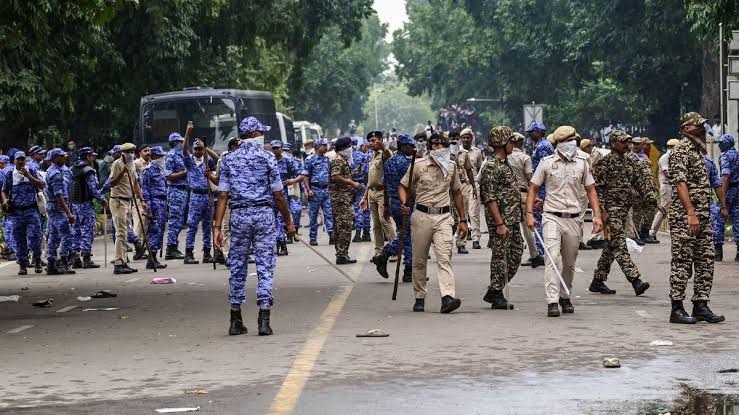
CJP 2.0: Delhi Protest Crackdown Raises Questions Over Detentions, Civil Liberties and the Right to Dissent
Javid Amin | New Delhi | 11 October 2026
The detention of Cockroach Janta Party (CJP) leaders before they could reach their proposed protest venue, sweeping restrictions on public transport, the temporary suspension of mobile internet in parts of central Delhi and the sealing of Jantar Mantar have placed the handling of political dissent under renewed scrutiny. The Supreme Court’s intervention has added a crucial legal dimension to the controversy.
What unfolded in the capital on October 10, 2026, was more than a confrontation between police and a youth-led political movement. It became a test of how authorities balance public order against the constitutional freedoms of peaceful assembly, expression and political participation.
The controversy surrounding CJP 2.0, the movement’s latest protest campaign, also exposed a difficult question: when authorities anticipate disruption, how far can preventive restrictions extend before they begin to affect people who have no connection with the proposed demonstration?
The answer matters well beyond one organisation or one day of protests. It concerns the rights of opposition leaders, journalists, lawyers, students, commuters and ordinary citizens in a democracy where public demonstrations remain an important means of demanding accountability.
News reports published on October 10 and 11 describe significant detentions and extensive security restrictions, although estimates of the number of people detained differ sharply. The distinction between detention and formal arrest, the legal basis for individual restrictions, and the precise scope of the Supreme Court’s directions are therefore central to understanding the episode.
CJP 2.0: What happened in Delhi on October 10?
The immediate dispute centred on a proposed demonstration at Jantar Mantar against Chief Election Commissioner Gyanesh Kumar and the Election Commission’s handling of the Special Intensive Revision (SIR) of electoral rolls.
CJP and its supporters alleged that the voter-list revision process had unfairly excluded large numbers of eligible voters. They demanded accountability from the Election Commission, including Kumar’s resignation. These remain political allegations that must be assessed against official electoral data, the Commission’s explanations and the applicable legal procedures.
Delhi Police denied permission for the planned demonstration, citing public-order and security concerns. Authorities subsequently imposed restrictions across parts of the capital, including barricades around the protest area, mobile internet curbs in a designated zone, Metro station access restrictions and measures affecting road and rail movement.
On October 10, The Indian Express reported that more than 2,000 people had been detained. A report published by Hindustan Times on October 11 put the figure at close to 7,000, while other reports cited different totals. These numbers should not be treated as a single verified official count: the reports may cover different stages of the operation, locations and groups of detainees.
The authorities’ stated position was that the demonstration had not been authorised and that preventive measures were necessary to maintain public order. Critics, meanwhile, questioned whether the restrictions were proportionate to the threat posed by the proposed gathering.
That disagreement is at the heart of the CJP controversy: a protest can be subject to lawful restrictions, but the existence of a security concern does not by itself settle whether every measure taken in response was necessary or proportionate.
The airport detentions that became the defining image
CJP founder Abhijeet Dipke and co-convenors Saurav Das and Ashutosh Ranka were detained after their flight from Mumbai landed in Delhi on October 10. News reports said police officers boarded the aircraft and took the three men away before they could reach Jantar Mantar. The episode was captured in video circulated by the movement and subsequently reported by national media.
For CJP supporters, the detentions became evidence that the authorities intended to prevent the mobilisation before it could gather momentum. The movement’s leaders challenged the police action publicly.
The police, however, maintained that the leaders had been subjected to preventive action because the proposed protest lacked permission. On October 11, Delhi Police said the three had been preventively arrested under Sections 126 and 170 of the Bharatiya Nagarik Suraksha Sanhita (BNSS), provisions concerning security for keeping the peace and preventive action against the commission of cognisable offences. They were produced before an executive magistrate and subsequently released on conditions.
The question is therefore not merely whether the police possessed preventive powers. It is whether the grounds, procedures and restrictions imposed on these particular individuals met the relevant legal standards.
The one-year peace condition: where preventive policing meets political freedom
The release of Dipke, Das and Ranka on October 11 brought another issue into focus.
According to reports, the three were released by an executive magistrate after furnishing a bond and surety arrangement associated with maintaining peace and good behaviour for one year. Their legal affairs head, Ratna Singh, described the condition as part of the release process.
A condition requiring someone to maintain peace is not necessarily the same as a blanket prohibition on political activity or peaceful protest. Those distinctions should be established from the actual order rather than inferred from a headline or social media post.
The broader concern is whether preventive proceedings can become so restrictive that people are discouraged from exercising lawful political freedoms even after their release.
For CJP, the condition creates an obvious test: can its leaders continue to organise peaceful political activity while complying with the order? For the authorities, the challenge is to enforce lawful conditions without treating ordinary political mobilisation as a breach of peace in itself.
The full terms of the magistrate’s order, the recorded grounds for the proceedings and any subsequent judicial review are essential to a definitive assessment.
Lawyers detained: why access to legal assistance matters
The detention of lawyers associated with the protest added a professional and constitutional dimension to the controversy.
The Indian Express reported that the Delhi High Court Bar Association condemned the detention of lawyers and what it described as excessive use of force. Senior advocate Shadan Farasat said he was trying to intervene when police moved towards activist Yogendra Yadav, after which he was allegedly pushed into a moving bus and his shirt was torn. These are his reported allegations; a complete account would require the police response and any available independent evidence.
Lawyers may attend demonstrations as participants, observers, representatives or people attempting to provide assistance to detainees. Their role can differ substantially from that of the protesters they are assisting.
Detaining a lawyer does not automatically establish a violation of the right to legal counsel. Equally, describing a gathering as unauthorised does not remove the need to examine whether individuals were given access to legal assistance when required by law.
The central questions include whether officers explained the grounds for detention, whether the required procedures were followed, whether detainees could contact lawyers and whether any force used was justified by the circumstances.
These questions are particularly important during mass operations, when people may be moved rapidly between police stations, stadiums and temporary holding facilities.
Bangla Sahib becomes a flashpoint
As access to Jantar Mantar and surrounding roads was restricted, protesters and activists were also reported near Bangla Sahib Gurudwara.
The Indian Express published photographs and reporting of police detentions near the gurdwara, including images of lawyers and CJP supporters being taken away.
Religious sites are not automatically exempt from ordinary law-and-order requirements. But their presence introduces additional sensitivities: worshippers may be present for entirely unrelated reasons, and a police operation can affect people who have no connection with a political demonstration.
The distinction between protesters assembling near a religious site and a religious institution itself becoming a venue for organised political activity must also be maintained.
There is not enough independently verified evidence in the reports cited here to establish that the authorities deliberately pushed protesters into religious spaces. That interpretation should remain a question for investigation, not a settled finding.
What is documented is that the protest-related police action reached areas beyond the main barricaded venue. That alone warrants scrutiny of how restrictions were planned, communicated and enforced.
Allegations of intimidation and the presence of political groups
The CJP summary also raises allegations that right-wing groups or individuals threatened protesters and journalists while operating under police protection.
These are serious claims, but they require careful attribution. The presence of a political group near a protest, or its apparent proximity to police personnel, does not by itself establish police complicity, coordination or official protection.
A credible investigation would need to establish the identities of the people involved, the nature of the alleged threats, the time and location of each incident, and whether officers witnessed or intervened in the conduct.
Video footage, contemporaneous journalist accounts, police logs, witness statements and any complaints filed would be particularly relevant.
If individuals threatened or assaulted protesters or journalists, those incidents should be investigated independently of the political affiliations of the people involved. If police officers failed to respond to documented threats, the reasons for that failure would also require examination.
The same evidentiary standard should apply to allegations against protesters. Any violence, obstruction or assault should be investigated on its own facts rather than used to characterise every participant in the movement.
This is one area where a definitive account remains incomplete. Allegations of intimidation should neither be repeated as established fact nor dismissed without examining the evidence.
Thousands detained: how reliable are the numbers?
The reported scale of the detentions is one of the most consequential aspects of CJP 2.0.
What published reports say
2,000+
October 10 estimate – The Indian Express reported more than 2,000 detentions during the day’s operation.
~7,000
October 11 report – Hindustan Times reported that police had detained close to 7,000 people across Delhi.
These are media-reported estimates, not a reconciled official total. The reports do not establish that every person counted remained in custody for the same duration or was formally arrested.
The variation is significant. It does not automatically mean that one report is false. Counts can change as police operations continue, detainees are transferred or released, and different agencies report figures for different locations or periods.
But the difference makes a transparent accounting essential.
How many people were detained? How many were formally arrested? How many were released within hours? How many were booked under specific legal provisions? Were any charged with identifiable offences, and what grounds were recorded for detaining those who were not?
Without answers to these questions, the public cannot properly assess either the scale or the legality of the operation.
The reported detention of students, journalists, lawyers, activists and people allegedly unconnected with the protest makes that accounting even more important. The Indian Express also reported the detention of economist and activist Jean Drèze and others near Jantar Mantar. Drèze said they had been holding posters and speaking to the media when police intervened.
Delhi Metro shutdown: when a protest affects an entire city
The Delhi Metro Rail Corporation announced restrictions on entry and exit at 45 stations from 9 pm on October 9 until 6 pm on October 10. Interchange facilities were generally retained, with an exception at New Delhi station. The restrictions were revised from an earlier advisory covering 57 stations.
For commuters, the practical consequences could extend well beyond the protest zone. Workers, students, patients, travellers and people connecting to railway stations may have had to change routes or find alternative transport.
Critics questioned whether closing so many stations was proportionate to the anticipated gathering. Authorities, for their part, faced the task of managing crowds and potential confrontations around central Delhi.
The legal issue is whether targeted measures could have achieved the same security objectives with less disruption.
The answer depends on the risk assessment available to authorities at the time, the geographic spread of restrictions, their duration and the alternatives considered.
Public transport is not merely a convenience during a political demonstration. It is essential infrastructure used by millions of people who may have no interest in attending the event. That is why restrictions on its operation deserve scrutiny separate from the decision to grant or deny permission for a rally.
Rail cancellations, traffic diversions and the wider security cordon
The restrictions did not stop at the Metro.
Reports published around the protest described train cancellations or delays, barricades at key road junctions, traffic diversions and heightened checks around approaches to central Delhi. Times of India reported that more than 250 train services were cancelled or delayed, including local and long-distance services.
This is where the public-interest calculation becomes complicated.
Police have a responsibility to prevent violence, protect people and manage gatherings that pose a credible risk. A major protest near government offices can require additional personnel, traffic controls and emergency arrangements.
However, the wider the restrictions, the greater the burden on authorities to explain why they were necessary.
Could fewer Metro stations have been restricted? Could train services have continued with localised security measures? Were commuters given timely information? Were emergency access and essential journeys protected? Were restrictions lifted as soon as the immediate risk passed?
These are concrete questions that can be answered through transport advisories, cancellation records, police orders and a review of the operational decisions.
Calling the entire episode a deliberate attempt to weaponise public infrastructure would go beyond the evidence presently established. But the disruption itself is documented, and its proportionality is a legitimate subject of public and judicial scrutiny.
Internet restrictions: security measure or obstacle to accountability?
Mobile internet services were suspended in a designated area around Jantar Mantar from 10 pm on October 9 until 10 pm on October 10, according to reporting by The New Indian Express. The restriction was not described as a blanket internet shutdown across the whole of Delhi.
Even a localised restriction, however, can have consequences beyond the immediate protest site.
Mobile connectivity allows people to communicate with family members, contact lawyers, access transport information and report incidents in real time. It also enables journalists and witnesses to transmit photographs and videos that may later become important evidence.
Authorities may argue that limiting connectivity can help prevent the rapid spread of inflammatory messages or the coordination of unlawful activity. Whether that rationale justifies a particular restriction depends on its legal basis, supporting evidence, scope and duration.
A blanket or overly broad restriction can also make independent verification more difficult precisely when it is most needed.
The question is not whether the state can ever restrict communications. It is whether the measure was demonstrably necessary, proportionate and appropriately limited.
Supreme Court intervention: the principle of proportionality takes centre stage
The judicial response was an important turning point.
On October 9, before the planned demonstration, the Supreme Court expressed concern about the extent of the restrictions being prepared for the protest. According to The Indian Express, the bench questioned the closure of numerous Metro stations and cancellation of Delhi-bound trains, emphasising the principle of proportionality and warning against using excessive measures to address a limited problem.
On October 11, subsequent reporting said the Court directed the authorities to ensure the restoration of Metro services and removal of the internet restrictions challenged before it. The precise scope of those directions should be read alongside the relevant court record and the operational orders issued by the authorities.
Article 19 of the Constitution protects freedom of speech and expression under Article 19(1)(a), and the right to assemble peacefully and without arms under Article 19(1)(b). Both rights are subject to constitutionally permitted restrictions. The right to protest is therefore neither absolute nor something the state can suspend merely because a demonstration is politically inconvenient.
The principle of proportionality asks whether a restriction serves a legitimate purpose, whether it is suitably connected to that purpose, whether a less restrictive alternative could reasonably achieve it, and whether the burden imposed is justified.
Applied to CJP 2.0, that means assessing individual measures rather than treating the entire security operation as one indivisible decision.
A lawful restriction on an assembly does not automatically justify closing dozens of Metro stations. A credible risk of violence does not automatically justify detaining everyone approaching a protest area. Equally, a peaceful political objective does not excuse unlawful conduct by individual participants.
The courts’ role is to examine the legal basis and proportionality of the measures, not to decide the political merits of CJP’s demands.
Journalists detained: the cost of restricted media access
The detention of journalists and the reported harassment of media personnel added another layer to the controversy.
The Indian Express and other outlets reported that journalists were among those caught up in the police operation. The UN Human Rights Office subsequently expressed concern about the detention of civil society members, lawyers and journalists during the protests.
Journalists may be present to document a demonstration, interview participants, record police conduct or report on public disruption. Their presence does not, by itself, establish that they are part of the mobilisation.
That does not make journalists immune from generally applicable laws or legitimate security measures. But any restriction on their work should have a clear legal basis and should not be imposed merely because their reporting is critical of the authorities.
The concern is practical as well as constitutional. When journalists cannot reach a protest site, are detained without a clear explanation or are prevented from documenting police action, the public loses an independent source of information.
The resulting gaps can fuel conflicting narratives, unverified claims and political accusations.
A credible review would establish which journalists were detained, whether they had identified themselves as members of the press, the grounds for their detention and the circumstances of their release. It should also examine any allegations of threats or physical intimidation, including claims involving individuals described as political supporters of right-wing groups.
Those allegations must be investigated on evidence, not political assumptions.
The UN raises concerns, India rejects outside criticism
The controversy moved beyond domestic politics when the UN Human Rights Office commented on the detentions.
According to The Indian Express, UN Human Rights spokesperson Thameen Al-Kheetan called on Indian authorities to respect the right to peaceful assembly and stressed that restrictions should satisfy tests of necessity and proportionality. The office also expressed concern over the detention of civil society members, lawyers and journalists.
The Indian government has a responsibility to maintain public order and enforce the law within its jurisdiction. It can reasonably argue that security decisions must account for local circumstances and the possibility of violence.
At the same time, freedom of peaceful assembly and the protection of journalists are recognised human-rights concerns. International scrutiny of how these rights are protected is not unusual, even when governments dispute the characterisation of a particular operation.
Neither a UN statement nor a government rebuttal settles the facts of every detention. Those facts still require evidence and, where challenged, legal scrutiny.
What international attention does is raise the stakes. The question becomes not only whether the police acted lawfully under domestic law, but also whether the practical treatment of protesters, journalists and other civilians was consistent with India’s broader human-rights commitments.
Opposition leaders detained across party lines
CJP 2.0 also drew participation and support from political figures outside the movement itself.
Media reports identified opposition leaders, activists and prominent public figures among those detained during the operation. The Indian Express documented detentions at several locations, including the airport, routes leading towards Jantar Mantar and other parts of the capital.
However, detention should not be confused with a finding of guilt. Nor does the detention of politicians from different parties establish that every person was detained on the same grounds or treated identically.
The relevant questions remain individual and procedural: what was the legal basis for each detention, what conduct was alleged, and what happened afterwards?
The political significance is nevertheless clear. When detentions extend beyond organisers to elected representatives, lawyers, journalists and civil society figures, the debate inevitably moves from a particular protest to the broader conditions under which political opposition can operate.
What is CJP protesting, and why does the SIR dispute matter?
The immediate demand behind the demonstration was the resignation of Chief Election Commissioner Gyanesh Kumar, alongside objections to the Special Intensive Revision of electoral rolls.
The SIR process concerns the revision and verification of voter lists. Such exercises can serve legitimate administrative purposes, including removing duplicate or otherwise ineligible entries and correcting inaccurate records. But they also require safeguards to ensure that eligible voters are not wrongly excluded.
CJP and other critics alleged that the revision had resulted in the deletion of large numbers of eligible voters and demanded accountability from the Election Commission. Reports around the protest referred to claims involving approximately 12 crore to 13 crore names, or around 120 million to 130 million.
The key questions are how many names were removed, for what reasons, how many removals were challenged or corrected, and what evidence supports allegations of partisan discrimination.
The Election Commission’s official data, explanations and applicable procedures are central to evaluating those claims. The political demand for the commissioner’s resignation is not itself proof of wrongdoing, just as an official denial would not, by itself, resolve every allegation.
This distinction matters because confidence in elections depends both on accurate electoral rolls and on a credible process for correcting mistakes. Voters who believe they have been wrongly excluded need an effective way to challenge the decision. Authorities, in turn, need to explain the process transparently enough for claims to be independently assessed.
The protest crackdown and the electoral-roll dispute are connected politically, but they remain separate questions of evidence and accountability.
Why the CJP episode matters beyond one organisation
CJP’s campaign has placed a familiar democratic tension into sharp focus: the state must manage public order, but it must also preserve space for peaceful opposition.
The implications extend across several institutions.
-
For the police: Preventive powers need clear legal grounds, documented procedures and meaningful accountability, particularly when large numbers of people are detained.
-
For the courts: Judicial review must distinguish legitimate security precautions from restrictions that impose an excessive burden on fundamental rights.
-
For journalists: Access to public events and the ability to document state action are essential to independent scrutiny.
-
For political movements: Organisers must distinguish peaceful mobilisation from conduct that creates a genuine risk of violence, while retaining the ability to challenge restrictions through lawful channels.
-
For ordinary citizens: Public-order decisions should take account of the people affected by transport disruption, road closures and communications restrictions, including those who have no involvement in a protest.
The episode also raises a question about institutional consistency. If preventive measures are justified by a particular threat, authorities should be able to explain the evidence behind that assessment and why the measures chosen were necessary.
That standard should apply regardless of which party is protesting, which government is in office or whether the demonstrators are popular.
What remains to be established?
Several important questions remain open following the October 10 operation and the developments reported on October 11.
First, a consolidated official account of the detentions is needed, distinguishing people briefly taken into custody from those formally arrested or proceeded against under preventive provisions.
Second, the orders governing the Metro restrictions, internet suspension and other transport measures should be examined alongside the Supreme Court’s directions. This would establish precisely which restrictions were imposed, which were revised and when they were lifted.
Third, allegations of excessive force, threats against protesters, journalists’ detention and interference with legal assistance require incident-specific investigation. Witness accounts and videos can provide valuable evidence, but they should be corroborated wherever possible.
Fourth, the conditions attached to the CJP leaders’ release need to be understood from the actual magistrate’s order, rather than interpreted solely through political statements.
Finally, the electoral-roll allegations that triggered the protest require their own transparent assessment through official records, correction mechanisms and evidence of any wrongful exclusions.
These questions are not peripheral details. They determine whether the controversy can be assessed on evidence rather than competing political narratives.
The bigger question: Is a new model of protest management emerging?
CJP 2.0 will be remembered not only for the leaders detained at an airport or the crowds prevented from reaching Jantar Mantar. Its significance lies in the combination of measures used to contain the mobilisation: preventive action against organisers, restrictions around the designated venue, interruptions to transport, a localised internet suspension and the detention of people from several sections of civil society.
Each measure has to be assessed on its own legal merits. Taken together, however, they raise a broader question about how the authorities intend to manage large demonstrations in the future.
A state does not lose its responsibility to maintain public order when citizens protest. Equally, a demonstration does not lose its constitutional significance simply because the administration considers it difficult to manage.
The lasting test is whether security arrangements remain targeted, evidence-based and proportionate, with effective safeguards for peaceful assembly, independent journalism and access to legal assistance.
The Supreme Court’s intervention makes proportionality central to that debate. The UN’s comments have added international scrutiny, while the government’s response has underlined the continuing disagreement over the role of external human-rights criticism.
For CJP, the immediate challenge is to sustain its political campaign within the law. For the authorities, it is to demonstrate that preventive powers are being used to address genuine risks rather than to make peaceful opposition impracticable.
For the public, the most important issue is whether the facts will be established transparently.
The defining question raised by CJP 2.0 is not simply whether the protest succeeded or failed. It is whether India can protect public order without imposing restrictions so broad that the practical exercise of democratic freedoms becomes difficult. The answer will depend on the evidence, the legal scrutiny that follows and whether future protest operations reflect the limits the Constitution places on state power.


