Ramzan to Eid 2026 in Kashmir: Lockdowns, Sermons & Solidarity
By: Javid Amin | 21 March 2026
How Faith, Politics, and Global Narratives Collided in the Valley
A Season of Faith Under Watch
In Kashmir, Ramzan is not just a month—it is a rhythm. The quiet hum of evening prayers, the collective breaking of fast, the spiritual pull of mosques filled to capacity. And Eid, the culmination, is meant to be a moment of unfiltered joy.
But in 2026, that rhythm was repeatedly interrupted.
From the house arrest of Mirwaiz Umar Farooq to the closure of Jamia Masjid Srinagar, and finally to Mehbooba Mufti invoking Iran and Palestine on Eid, the Valley witnessed a layered convergence of religion, politics, and global narratives.
This is a comprehensive, ground-verified account of how Ramzan transitioned into Eid under tension, and why it matters far beyond the Valley.
The First Friday — A Pattern Begins
The first Friday of Ramzan set the tone.
Mirwaiz Umar Farooq, Kashmir’s chief cleric, was placed under house arrest, preventing him from delivering his sermon at Jamia Masjid Srinagar.
This was not unprecedented—but what followed made it significant.
What Happened:
- Restricted from leaving residence in Srinagar
- Security forces deployed outside his home
- No formal written order, as claimed by the Mirwaiz
Why It Mattered:
Friday sermons at Jamia Masjid are not merely religious—they are public conversations. Removing the speaker changes the discourse.
Three Fridays, Same Story
The pattern continued.
- Second Friday: House arrest repeated
- Third Friday (March 20): Again restricted
Each week reinforced a perception:
👉 This was not incidental—it was systematic control
The absence of the Mirwaiz created a spiritual vacuum for many worshippers accustomed to his sermons.
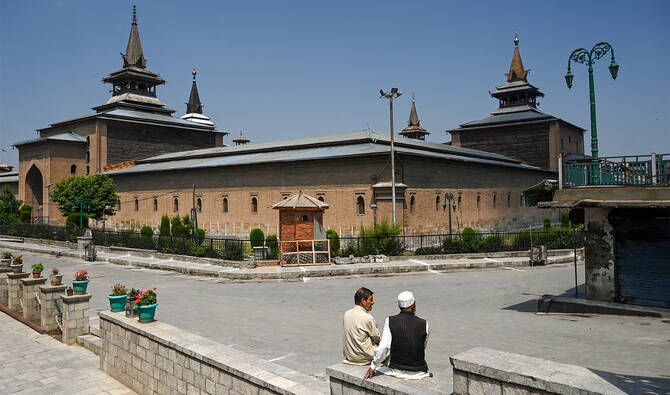
Jamia Masjid — The Locked Symbol
Instead:
- The mosque was locked
- Congregational prayers were disallowed
- Worshippers were turned away
For the seventh consecutive year, the most important Friday passed without prayers at the Valley’s most significant mosque.
Symbolism:
The closure of Jamia Masjid Srinagar is not logistical—it is deeply symbolic:
- A break from centuries-old tradition
- A visible assertion of state control
- A moment of collective emotional impact
The Man at the Center — Mirwaiz Umar Farooq
To understand the reaction, one must understand the role.
Mirwaiz Umar Farooq is:
- The 14th Mirwaiz of Kashmir
- A religious authority
- A socio-political voice linked to the Hurriyat
Dual Identity:
| Role | Function |
|---|---|
| Religious | Leads prayers, guides community |
| Political | Represents a strand of Kashmiri opinion |
This duality makes every restriction on him both religious and political.
The Public Mood — Faith Interrupted
Across Srinagar and beyond, the response was emotional.
Observed Sentiments:
- Disappointment at missing sermons
- Frustration over repeated restrictions
- Sense of disrupted tradition
For many, Ramzan felt incomplete.
Social media amplified these voices, with recurring themes:
- “Unjust”
- “Painful”
- “Politically motivated”
The State’s Calculus — Security First
Authorities have consistently framed such restrictions as:
- Preventive
- Necessary
- Based on intelligence inputs
Core Concern:
Large gatherings + political messaging = potential unrest
In a region like Jammu and Kashmir, this equation shapes policy decisions.
But this creates a recurring tension:
👉 Security vs Religious Continuity
Eid Approaches — Hope Meets Uncertainty
As Eid neared, the mood shifted.
Announcements indicated:
- Eid prayers planned at Jamia Masjid
- Mirwaiz expected to deliver sermon
Yet, recent events created doubt.
Public Psychology:
- Hope for normalcy
- Fear of last-minute restrictions
Eid became more than a festival—it became a test case.
Eid 2026 — Celebration Under Shadow
However:
- Jamia Masjid remained a point of contention
- Restrictions overshadowed celebrations
Even where prayers occurred, the context mattered.
Mehbooba Mufti’s Intervention — Expanding the Narrative
Then came a shift.
Mehbooba Mufti stated:
“We should stand with the people of Iran.”
She also:
- Criticized absence of prayers for Iran and Palestine
- Linked Kashmir’s experience to global Muslim concerns
What Changed:
The debate moved from:
👉 Local restrictions
to
👉 Global solidarity narrative
Hazratbal — The Subtle Controversy
But Mufti raised a specific issue:
- No special supplications for Iran/Palestine
This introduced a nuanced debate:
👉 Not just where people pray
👉 But what is expressed during prayer
Omar Abdullah & Opposition Alignment
Omar Abdullah echoed concern:
- Called Jamia Masjid closure “unfortunate and painful”
This created a converging opposition narrative:
- Religious restriction
- Political concern
- Emotional resonance
Global Lens — Why Iran & Palestine Matter
Invoking Iran and Palestine was not incidental.
It signals:
- Alignment with global Muslim issues
- Expansion of Kashmir’s narrative internationally
- Political messaging beyond borders
The Core Tension — Faith vs Control
At its heart, this story is about a fundamental question:
Who controls public religious space?
- The state (security lens)
- The community (faith lens)
In Kashmir, the answer remains contested.
Implications
Religious
Disruption of tradition
Political
Strengthening of competing narratives
Social
Emotional fatigue
International
Increased scrutiny
Conclusion: Eid 2026 — A Moment That Reflects a Larger Reality
Eid 2026 in Kashmir was not just a festival.
It was:
- A reflection of governance
- A test of public sentiment
- A platform for political messaging
- A link to global narratives
From Mirwaiz Umar Farooq’s house arrests
to the closure of Jamia Masjid Srinagar
to Mehbooba Mufti invoking Iran
👉 The story evolved from local to global
And in doing so, it revealed something deeper:
In Kashmir, even moments of celebration are inseparable from history, identity, and power.


