Lucknow’s Aliganj Fire Tragedy: How an Illegal Commercial Hub Became a Death Trap for 15 Young Lives
By: Javid Amin | 23 June 2026
A City in Mourning After One of Lucknow’s Deadliest Urban Fires
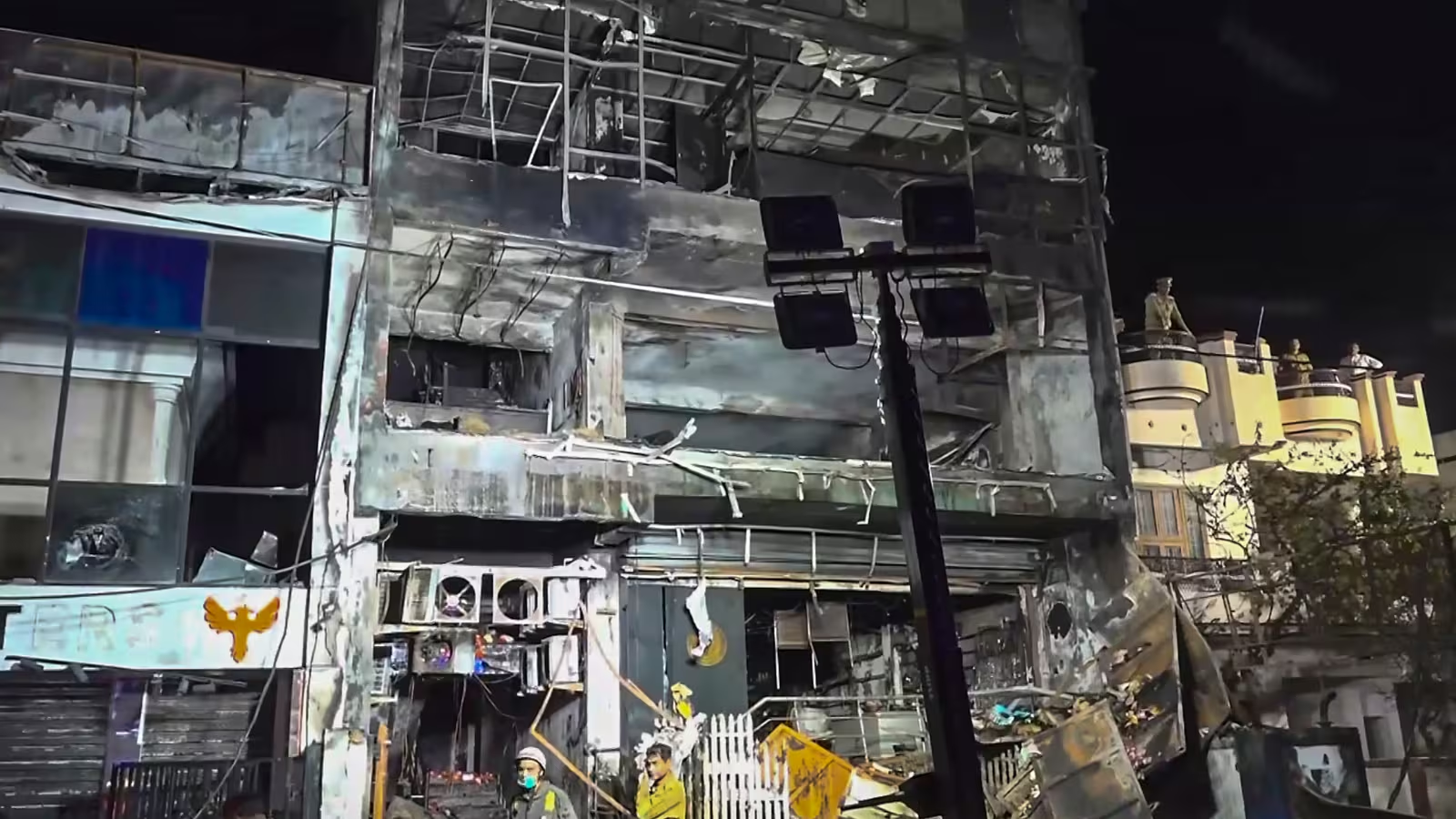
What began as an ordinary working day in Lucknow’s bustling Aliganj neighbourhood ended in unimaginable tragedy when a massive fire ripped through a three-storey building on Usha Mehta Marg, claiming 15 lives and leaving several others injured.
Most of the victims were students and young professionals between the ages of 22 and 27 who had gathered at an animation training centre and gaming facility operating inside the building. Many were trapped by thick smoke and rapidly spreading flames, while others desperately attempted to escape through windows, cables, and ledges. Eyewitness accounts describe scenes of panic, with some occupants reportedly jumping from upper floors in a bid to survive.
The incident has shocked the nation and reignited concerns over fire safety enforcement, illegal commercial operations, and regulatory oversight in urban India.
What Happened Inside the Aliganj Building?
The fire broke out on Monday afternoon in a commercial complex located in the Aliganj area of Lucknow. The building housed multiple establishments, including an animation and training centre, gaming facilities, a pet-related business, and other commercial activities.
According to preliminary investigations, the fire may have originated from an electrical short circuit. Investigators are examining multiple possibilities, including faults in an air-conditioning duct system and electrical installations linked to businesses operating on the lower floors. However, authorities have not yet officially confirmed the exact ignition point.
What investigators do agree on is that smoke, rather than flames alone, proved deadly.
As toxic smoke rapidly filled staircases and enclosed areas, occupants found themselves trapped with limited evacuation options. Rescue personnel later discovered several victims in areas where they had sought refuge from the smoke but were unable to escape.
Building Approved for Residential Use, Operated as Commercial Complex
One of the most alarming revelations emerging from the tragedy concerns the building’s legal status.
Investigators have found that the structure was originally approved for residential use but was later converted into a commercial hub housing educational, recreational, and business establishments. Reports indicate that authorities had previously identified unauthorized construction and even issued a demolition order in 2016, only for that order to be revoked less than two months later.
The discovery has raised serious questions about how a heavily occupied commercial building continued operating without attracting sustained regulatory scrutiny.
Experts argue that mixed-use and illegally converted buildings pose some of the highest fire risks because they often lack infrastructure designed to handle large numbers of occupants.
Safety Violations Under Investigation
The fire has exposed what appears to be a chain of serious safety failures.
No Fire Safety Clearance
Preliminary findings indicate that the building was functioning without the mandatory fire safety clearance required for commercial establishments. Investigators are examining whether the operators obtained any formal No Objection Certificate (NOC) from the fire department.
Limited Escape Routes
Survivors and investigators have pointed to inadequate emergency exits and evacuation arrangements. Many occupants reportedly found themselves trapped as smoke spread through the building.
Alleged Biometric Access Issues
Reports suggest that a biometric locking mechanism at the entrance may have delayed evacuation efforts. Investigators are assessing whether access-control systems contributed to the loss of life.
Regulatory Loopholes
The incident has also highlighted concerns about building classification rules that may have allowed the property to avoid stricter fire safety inspections typically required for larger commercial structures.
Massive Rescue Operation Battles Flames and Smoke
As the blaze intensified, emergency responders launched one of the largest rescue operations seen in the city in recent years.
Firefighters, police personnel, and disaster response teams rushed to the scene. Multiple fire tenders were deployed while rescue teams worked for hours to evacuate trapped occupants and bring the blaze under control.
According to eyewitnesses, many young people attempted daring escapes by climbing out of windows, descending through cables, or breaking glass panels. Videos circulating on social media captured the chaos as residents and emergency workers struggled to rescue those trapped inside.
Rescue personnel eventually managed to evacuate several injured occupants, but many victims succumbed to burns and smoke inhalation.
FIR Registered, Owners Arrested
Authorities moved quickly after the tragedy.
Police sealed the building and registered a criminal case against multiple accused persons. The FIR includes charges under several provisions of the Bharatiya Nyaya Sanhita relating to culpable homicide, negligent acts endangering life, and other offences, along with provisions of the Uttar Pradesh Fire Services Act.
Four individuals linked to ownership and management of the building have been arrested as investigators seek to establish responsibility for the safety violations and illegal commercial operations.
The arrests signal that authorities are treating the case not merely as an accident but as a potential instance of criminal negligence.
Officials Suspended as Accountability Questions Grow
The fallout has extended beyond the building owners.
The Uttar Pradesh government has suspended four officials from various departments, including the electricity department, fire services, and development authority, over alleged lapses connected to the building and its operation.
The suspensions reflect growing public concern that regulatory failures may have contributed to the tragedy.
Questions are now being asked about:
- How the building continued operating commercially despite residential approval.
- Why fire safety requirements were allegedly not enforced.
- Whether inspection mechanisms failed.
- Whether earlier violations were ignored or overlooked.
SIT Probe to Examine Systemic Failures
Recognising the seriousness of the incident, the Uttar Pradesh government has constituted a two-member Special Investigation Team (SIT) to conduct a detailed inquiry. The panel has reportedly been asked to submit its findings within a week.
The investigation is expected to examine:
Cause of the Fire
Determining the exact source and sequence of events that led to the blaze.
Regulatory Compliance
Reviewing approvals, licenses, and safety certifications linked to the building.
Administrative Accountability
Assessing whether officials failed to act on known violations.
Future Prevention Measures
Recommending reforms aimed at preventing similar disasters in educational institutions and commercial buildings.
National Leaders Express Grief
The tragedy has drawn reactions from the country’s highest offices.
Prime Minister Narendra Modi expressed condolences to the bereaved families and announced financial assistance of ₹2 lakh for the next of kin of each deceased victim and ₹50,000 for those injured.
President Droupadi Murmu also conveyed her condolences.
Defence Minister Rajnath Singh visited the site and met injured survivors undergoing treatment, assuring families that accountability would be ensured.
Meanwhile, Uttar Pradesh Chief Minister Yogi Adityanath reviewed rescue operations, ordered investigations, and directed officials to provide all necessary assistance to affected families.
A Tragedy That Exposes a National Problem
The Aliganj fire is not merely a local disaster; it reflects a broader challenge confronting many Indian cities.
Across the country, rapid urbanisation has led to the proliferation of commercial establishments operating from buildings originally approved for other purposes. In many cases, fire safety measures fail to keep pace with changing usage patterns.
Experts warn that compliance often remains reactive rather than preventive, with inspections frequently occurring only after a tragedy unfolds.
The Lucknow fire has once again highlighted the potentially deadly consequences of:
- Illegal building conversions
- Weak enforcement of fire regulations
- Inadequate emergency exits
- Overcrowded commercial spaces
- Administrative oversight failures
The Road Ahead
As grieving families prepare for funerals and injured survivors continue treatment, attention is shifting toward accountability and reform.
The SIT probe, criminal proceedings, and departmental inquiries will determine who bears responsibility for the disaster. But beyond assigning blame, the larger challenge lies in ensuring that lessons are learned.
For many citizens, the central question remains simple: could 15 young lives have been saved if basic fire safety rules had been enforced?
The answer to that question may shape future policy decisions not only in Lucknow but across India.