‘We Are Watching Your Every Move’: Fresh Threat Names Kashmiri Pandit Families, Raises Fears Over Return
By: Javid Amin | 23 Aug 2026
Srinagar: A fresh threat letter reportedly targeting Kashmiri Pandit families has brought an old fear back into the Valley’s security conversation: what happens when a community being encouraged to return and rebuild is once again told that it is being watched?
The latest communication, reported on August 24, is particularly disturbing because it allegedly goes beyond a generic threat. It reportedly names individuals, publishes addresses and warns that their movements are being monitored. The message carries the chilling line, “We are watching your every move,” followed by a warning that “calamity strikes when it must.”
The development comes only weeks after another purported threat letter, circulated in the name of the United Liberation Council (ULC), named six Kashmiri Pandit government employees and published their phone numbers. Police have been investigating that communication, while intelligence and security sources have linked the ULC to Lashkar-e-Taiba, though the exact provenance and authenticity of such communications must be established through investigation.
Taken together, the episodes raise a much larger question:
Can rehabilitation succeed if fear continues to follow Kashmiri Pandit families even outside the Valley?
The New Threat Is More Than a Warning — It Is an Exposure of Personal Information
The most troubling feature of the latest communication is reportedly not merely its language.
It is the publication of personal details.
According to reports, the letter names individuals and gives specific addresses. That changes the character of the threat from a broad ideological warning into something far more personal and intimidating.
A generic threat can be dismissed as propaganda.
A message that identifies a person, provides information about where that person lives and then claims to be watching them creates an entirely different psychological effect.
It tells the intended target:
We know who you are.
We know where you are.
We know what you are doing.
And we want you to know that we know.
That is precisely why security agencies and Kashmiri Pandit organisations are treating the disclosure of personal information as a serious issue.
At the same time, the actual authenticity, origin and operational capability behind the latest communication must be established by investigators. A threatening document circulating online is not, by itself, proof that the people or organisation claiming responsibility possess the intelligence they boast of.
That distinction is crucial.
A Second Threat Wave in the Same Month
The August 24 development cannot be viewed entirely in isolation.
Earlier this month, a separate purported ULC threat letter targeted Kashmiri Pandit employees working in the Valley.
The August 7 communication reportedly named six employees, all associated with the Revenue Department, and published their phone numbers. It allegedly claimed access to information about their families, workplaces and locations.
The police began verifying the letter’s authenticity, while security was strengthened around areas inhabited by Kashmiri Pandits.
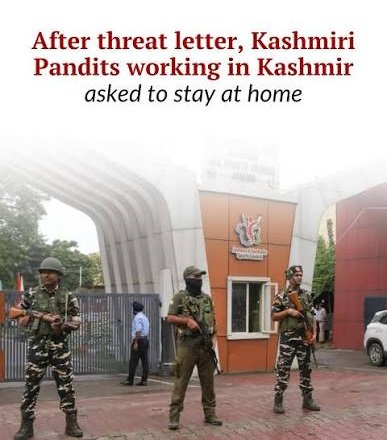
Some employees were reportedly advised to work from home or stay away from their offices temporarily, although reports differed over whether a formal government-wide order had actually been issued. The Indian Express reported that departments had issued informal instructions, while education authorities disputed the existence of a blanket formal order.
That discrepancy itself is worth noting.
The security response existed, but communication about the response was not uniform.
For vulnerable employees and their families, uncertainty can be almost as unsettling as the threat itself.
Why This Threat Hits a Particularly Sensitive Nerve
The Kashmiri Pandit community’s relationship with the Valley is inseparable from the trauma of the 1990s.
The community’s mass displacement occurred amid the rise of militancy, targeted killings, threats and an atmosphere of fear. Thousands of families left the Valley, many settling in Jammu and other parts of India.
The government subsequently introduced programmes intended to facilitate their return and rehabilitation.
The challenge has never been simply about providing employment or accommodation.
It has been about rebuilding trust.
And trust is fragile.
A family that left decades ago may be willing to consider returning because of a government job, improved infrastructure, education opportunities or changing security conditions.
But one threat letter carrying its name and address can revive a much deeper memory:
What if the conditions that forced us out can return?
That is the psychological battlefield behind these communications.
The Rehabilitation Programme Has Always Faced a Security Test
The Centre’s rehabilitation efforts included the Prime Minister’s Special Employment Package for displaced Kashmiri Pandits.
The programme created thousands of government employment opportunities and sought to encourage members of the displaced community to rebuild their lives in Kashmir.
The Indian Express reported that approximately 6,000 people received benefits under the Prime Minister’s Special Employment Package over the years, with employment tied to working in the Valley.
But that policy contains an unavoidable contradiction.
The government can provide:
- a job,
- accommodation,
- salary,
- transport,
- administrative support,
but it cannot manufacture a feeling of safety.
And when employees are threatened because of their identity or because they work for the government, the entire rehabilitation model comes under pressure.
The Question the Latest Threat Raises: What Does “Return” Actually Mean?
This is perhaps the most important issue.
For the government, rehabilitation can be measured through numbers:
How many families returned?
How many jobs were provided?
How many houses were constructed?
For the families themselves, the equation is different.
They ask:
Can my children walk to school safely?
Can my family live outside a protected camp?
Can I travel to work without being identified?
Can my address remain private?
What happens if my name appears on a threat list?
Will the government protect me after the security forces leave?
Those are not ideological questions.
They are everyday questions of survival.
Why Publishing Names and Addresses Is Particularly Serious
Security experts and community representatives have repeatedly expressed concern over the disclosure of personal information.
During the earlier August threat, Panun Kashmir called for a comprehensive threat assessment of the individuals named and their immediate families. The organisation argued that the publication of names and contact details could terrorise not only the targeted employees but the wider community.
The Kashmiri Pandit Sangarsh Samiti also questioned how the information became available.
That raises three possibilities investigators need to examine:
1. Intelligence gathering
Did an organised militant network actually obtain the information?
2. Information leakage
Was confidential personal data compromised through government departments, databases, social media or other sources?
3. Psychological warfare
Was some or all of the information publicly available and repackaged to create the impression of extensive militant surveillance?
All three possibilities have different security implications.
And all three need investigation.
The ULC Question: Who Is Behind These Threats?
The August threats were attributed to a group calling itself the United Liberation Council.
Indian intelligence sources have described the organisation as a possible front or shadow outfit linked to Lashkar-e-Taiba. India Today reported that intelligence sources characterised ULC as a front of the banned terror organisation, while police were investigating the communication.
That attribution should nevertheless be treated carefully.
A militant group’s claimed identity and an intelligence agency’s assessment are not the same thing as a judicially established finding.
The key questions for investigators are:
- Who created the letter?
- Where was it produced?
- Who circulated it?
- How did the authors obtain personal information?
- Is there an operational network behind the threats?
- Are the communications connected to earlier militant propaganda?
- Are local actors involved?
- Is the objective physical targeting, intimidation, or both?
Until those questions are answered, the safest description is a purported threat communication attributed to ULC, which authorities are investigating and which security sources have linked to LeT.
That wording matters because responsible journalism should distinguish allegations from verified facts.
The Bigger Strategy May Be Psychological, Not Merely Physical
The latest threats could be designed to accomplish something beyond attacking particular individuals.
They may be intended to discourage the idea of return itself.
That is why the wording reportedly targeting people involved in rehabilitation is significant. The communication allegedly warns those helping displaced Kashmiri Hindus return or rebuild their lives in Jammu and Kashmir.
If even a small number of families conclude that returning is too dangerous, the psychological impact spreads beyond those directly threatened.
One family tells another.
One employee calls home.
Parents become anxious.
Relatives advise against returning.
Young people reconsider government employment in Kashmir.
And eventually, the threat does not need to kill anyone to achieve its objective.
Fear itself becomes the weapon.
This Is Why “Psychological Warfare” Is an Important Lens
Security sources cited in the latest reporting have described the communications as an attempt at psychological warfare aimed at creating fear around rehabilitation and return.
That assessment makes strategic sense.
Militancy does not always need to control territory.
It can influence behaviour through fear.
If a community believes that returning to its ancestral homeland exposes it to surveillance and targeting, the community may voluntarily remain outside.
In that sense, a threat letter can have an impact far beyond the few names printed on a page.
Its real target may be the idea of return.
The 2022 Targeted Killings Still Cast a Long Shadow
The present anxiety also has a recent precedent.
In 2022, Kashmiri Pandit government employees became the focus of repeated militant attacks.
The Indian Express reported that five Kashmiri Pandits were killed in militant attacks during that period, prompting protests by employees demanding transfers outside Kashmir. The government instead relocated some employees to comparatively safer locations within the Valley.
The memory of those killings remains particularly powerful because many victims were not political activists or security personnel.
They were employees.
Teachers.
Government workers.
Ordinary people attempting to rebuild a life through the rehabilitation programme.
That history explains why today’s threat letters cannot simply be treated as anonymous pieces of propaganda.
The Earlier Killings That Changed the Security Debate
The wider history is even darker.
In October 2021, prominent Kashmiri Hindu pharmacist Makhan Lal Bindroo was killed inside his Srinagar pharmacy.
Two days later, school principal Supinder Kour and teacher Deepak Chand were killed at a school in Srinagar’s Eidgah area.
Those attacks demonstrated that militants could identify and target civilians based on profession and identity.
The lesson for many Kashmiri Pandits was devastating:
Even after returning to work, visibility could become vulnerability.
That is the fear today’s threat letters risk reviving.
Government Faces a Difficult Balancing Act
The administration now has to solve two problems simultaneously.
First: Protect the people named in the threats
This means immediate threat assessment, surveillance, protection and—where necessary—relocation or temporary work-from-home arrangements.
Second: Avoid making security restrictions permanent
If every threat results in employees being withdrawn from offices, families moved into protected accommodation and normal life suspended, the perpetrators achieve another objective.
They effectively determine where a community can live and work.
That is why the government cannot measure success simply by preventing the next attack.
It must also restore freedom of movement and confidence.
The “Safe Zone” Problem
There is an uncomfortable paradox here.
After a threat, the instinctive response is to move vulnerable people into safer locations.
That may be necessary in an emergency.
But rehabilitation cannot permanently operate on the principle that Kashmiri Pandits can return only if they live inside heavily protected enclaves.
A return that depends entirely on fortified compounds is not quite the same thing as restoring normal life.
The ultimate objective should be broader:
A Kashmiri Pandit employee should be able to live and work in Kashmir not because he or she is constantly protected as a special target, but because ordinary civilian security is strong enough to protect everyone.
That is a much harder goal.
But it is the only sustainable one.
Security Cannot Be Separated From Data Protection
One of the most overlooked aspects of this episode is the question of personal data security.
If genuine confidential information has reached a militant organisation, the issue is not merely counter-terrorism.
It is also a potential institutional security failure.
Government employees’:
- addresses,
- phone numbers,
- family details,
- workplaces,
- movement patterns,
should not become easily accessible to hostile actors.
Authorities therefore need to investigate not only who wrote the threat but also how the information was obtained.
That investigation could reveal whether the problem is:
- an intelligence leak,
- insider access,
- compromised databases,
- social-media profiling,
- physical surveillance,
- or deliberate fabrication.
Each possibility requires a different response.
What Should the Government Do Now?
A credible response should go beyond issuing another condemnation.
1. Conduct individual threat assessments
Every person named in the communication should be assessed individually, along with immediate family members.
2. Trace the digital origin
Cyber investigators should establish where the document first appeared, who uploaded it and how widely it was distributed.
3. Audit the leaked information
Authorities need to determine whether addresses, telephone numbers or family details came from government records.
4. Strengthen protection without creating permanent segregation
Temporary protective measures may be necessary, but the long-term objective should be normal civilian life.
5. Communicate clearly
If employees are asked to stay home, the government should issue clear instructions rather than allowing contradictory verbal orders to circulate.
6. Investigate the threat network
The people behind the communication—not merely the account or platform that posted it—must be identified.
7. Engage Kashmiri Pandit representatives
Community organisations should be part of security planning rather than being informed only after threats emerge.
The Political Dimension Cannot Be Ignored
The latest threat also arrives at a politically sensitive time.
The government has repeatedly projected improved security conditions in Jammu and Kashmir and has encouraged investment, tourism and normalisation.
A threat naming Kashmiri Pandit families therefore creates a difficult political question:
How secure is “normal” if a displaced minority can still be singled out through targeted intimidation?
The answer cannot simply be that security forces are present.
Normalisation is ultimately measured by whether ordinary people feel secure enough to live ordinary lives.
What Should Omar Abdullah’s Government Do?
For the J&K government, the challenge is especially delicate.
Chief Minister Omar Abdullah has repeatedly spoken about reconciliation, return and the need to restore confidence.
But this episode creates a test of those promises.
The government needs to demonstrate three things simultaneously:
Protection: Nobody named in a credible threat should be left exposed.
Accountability: Those responsible for obtaining and publishing private information must be identified.
Confidence: Security measures should eventually allow people to live normally rather than indefinitely under emergency restrictions.
A purely reactive approach will not be enough.
And What About the Kashmiri Pandits Who Never Left?
There is another dimension that often gets lost.
Not every Kashmiri Pandit left the Valley in the 1990s.
Some families remained.
The government has previously acknowledged the existence of Kashmiri Pandit families who stayed in Kashmir and made provisions for them under rehabilitation-related schemes. A 2017 Ministry of Home Affairs response, for example, recorded assistance for Pandit families who remained in the Valley.
Their experience complicates the debate.
The security question is not simply:
Can displaced Pandits return?
It is also:
Can those who stayed continue to live securely?
A comprehensive policy has to address both groups.
The Most Dangerous Outcome Would Be Another Cycle of Departure
The greatest concern is not necessarily an immediate mass exodus.
It could be something quieter.
A government employee takes leave.
Then another asks for transfer.
A family postpones returning.
A child is sent to school outside Kashmir.
A house remains locked.
A second generation grows up without a connection to the ancestral village.
And eventually, the idea of return becomes weaker with every passing year.
That is how displacement can become permanent without a single formal declaration.
This Is Bigger Than One Threat Letter
It would be tempting to dismiss the latest communication as another piece of militant propaganda.
That would be a mistake.
Even if investigators ultimately establish that the threat was exaggerated, fabricated or designed primarily as psychological warfare, the damage can still be real.
Fear does not require a successful attack.
The earlier August threat demonstrated this clearly: security was tightened, employees were advised to take precautions, and the issue triggered renewed anxiety within the community.
The August 24 communication now widens that concern from employees to families and people associated with rehabilitation.
That is why the government should treat it seriously while avoiding unverified claims about its perpetrators.
The Real Test of Rehabilitation Is Confidence
For more than three decades, the Kashmir question has been discussed through numbers, policies, packages and political promises.
But return is ultimately emotional.
A family returns when it believes:
My children will be safe.
My home will be safe.
My identity will not make me a target.
My address will not become a hit list.
The government will stand by me if something goes wrong.
Without that confidence, a rehabilitation package remains an administrative scheme rather than a genuine return process.
Conclusion: A Threat Letter Can Target a Community Without Firing a Shot
The phrase “We are watching your every move” is frightening precisely because it seeks to create the feeling that nowhere is completely safe.
For Kashmiri Pandit families, that message carries the weight of history.
The community has already lived through displacement, targeted violence and decades away from ancestral homes. The government’s rehabilitation effort has attempted to reverse at least some of that separation.
But rehabilitation cannot be sustained by jobs and houses alone.
It requires security, privacy, dignity and—above all—confidence.
The latest threat letter therefore deserves a response that is both firm and intelligent.
Find out who issued it.
Find out how personal information was obtained.
Protect every person named.
Strengthen security where necessary.
But do not allow fear to dictate where an entire community can live.
Because that is ultimately what is at stake.
The battle is not merely over the safety of a few individuals whose names appeared on a threatening letter. It is over whether Kashmiri Pandit families can once again believe that returning home is a realistic possibility rather than a security gamble.
And until that confidence is restored, the word “rehabilitation” will remain incomplete.


