From “200 Units Free” to a 6.83% Power Tariff Hike: Is J&K’s “Muft Bijli” Promise Turning Into a Jumla?
By: Javid Amin | 22 August 2026
J&K electricity tariff hike | 6.83% power tariff increase from September 1 | 200 units free electricity
The political language around electricity in Jammu and Kashmir has changed dramatically within months.
The National Conference government went to voters with a promise of 200 units of free electricity for households. In February 2026, that promise moved closer to implementation when the Centre approved a project for 2.23 lakh Antyodaya Anna Yojana (AAY) households to receive 200 free units through rooftop solar under the PM Surya Ghar Utility-Led Aggregation model.
Now comes the other side of the power equation.
The Joint Electricity Regulatory Commission (JERC) has approved an average 6.83% increase in retail electricity tariffs for Jammu and Kashmir, with the revised rates applying to consumption from September 1, 2026, through March 31, 2027, unless subsequently modified or extended.
For political opponents, the contrast is irresistible: “200 units free” then, higher electricity bills now.
But the actual story is more complicated.
The new tariff order does not mean that the government’s 200-unit solar promise has simply been cancelled. Nor does every household’s electricity bill automatically rise by exactly 6.83%.
What has changed is the regulated tariff structure, while government subsidy continues to play a major role in determining what consumers actually pay.
And that distinction is crucial.
What JERC Has Actually Approved
JERC has approved revised retail tariffs for the two J&K distribution companies:
- Kashmir Power Distribution Corporation Limited (KPDCL)
- Jammu Power Distribution Corporation Limited (JPDCL)
The utilities had originally sought a 5% across-the-board tariff increase.
Instead, after examining their revenue requirements, costs and government support, the regulator approved an average increase of 6.83%.
The revised tariff applies to electricity consumed from September 1, 2026, rather than simply to bills issued after that date. The order is presently scheduled to remain effective until March 31, 2027.
That means consumers should expect the revised rates to begin appearing in bills covering September consumption.
How Much Will Domestic Consumers Actually Pay?
This is where the headline figure of 6.83% can be misleading.
The increase is an average tariff revision across categories, not a flat 6.83% increase on every consumer’s final bill.
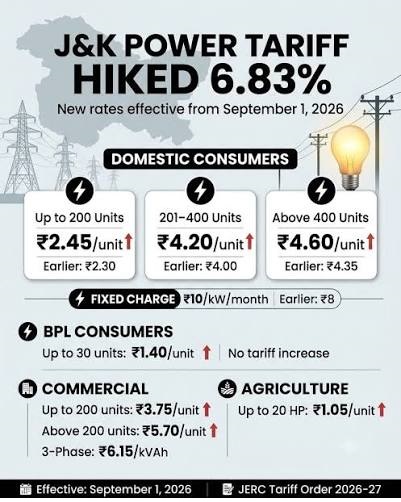
For metered domestic consumers, the revised energy charges are reported as:
| Monthly consumption | Previous rate | Revised rate from Sept. 1 |
|---|---|---|
| Up to 200 units | ₹2.30/unit | ₹2.45/unit |
| 201–400 units | ₹4.00/unit | ₹4.20/unit |
| Above 400 units | ₹4.35/unit | ₹4.60/unit |
| Fixed charge | ₹8/kW/month | ₹10/kW/month |
So a household consuming 200 units, for example, is not suddenly paying ₹2.45 × 200 plus nothing else. The final bill also depends on fixed charges, applicable subsidy, taxes or other components of the billing structure.
The revised energy charge itself rises from ₹2.30 to ₹2.45 per unit—an increase of about 6.5%.
The fixed charge, meanwhile, rises from ₹8 to ₹10 per kW per month, a proportionally larger increase.
That is why consumers should look at their actual bill structure, rather than simply adding 6.83% to their previous bill.
So, What Happened to “200 Units Free”?
This is perhaps the most important clarification.
The phrase “200 units free” has been used politically in a way that can create the impression that every J&K household would simply receive its first 200 electricity units free on its existing electricity bill.
That is not what the currently approved scheme actually says.
In February, Lt Governor Manoj Sinha announced Centre approval for a project covering 2.23 lakh AAY households, under the PM Surya Ghar scheme’s Utility-Led Aggregation model. The proposed rooftop solar systems were expected to generate approximately 200 units a month per household, effectively providing free electricity from solar generation for the operational life of the systems.
That is fundamentally different from a universal, automatic “first 200 grid units are free” electricity subsidy for every household.
And this distinction matters enormously in the current political debate.
The “Jumla” Charge: Politically Powerful, Economically Incomplete
Opposition leaders have already seized on the apparent contradiction.
PDP MLA Waheed-ur-Rehman Para questioned the government over what he described as a departure from its earlier promises.
Peoples Conference president Sajad Gani Lone called the 6.8% increase a shock for people who had been promised 200 units of free electricity.
Leader of Opposition Sunil Sharma similarly attacked the National Conference government, portraying the tariff increase as a betrayal of its electoral promise.
Politically, the argument is straightforward:
If people were promised free electricity, why are electricity tariffs going up?
But economically, the two policies are not necessarily mutually exclusive.
A government can subsidise electricity for a targeted group while simultaneously allowing the regulator to revise the underlying tariff.
The real question is therefore:
Who ultimately pays the difference?
And that takes us to the heart of J&K’s electricity problem.
J&K’s Power Problem Is Bigger Than One Tariff Order
The JERC order reveals a significant gap between what the distribution companies need and what they recover through existing tariffs.
According to reporting based on the order, the combined annual revenue requirement of KPDCL and JPDCL, after the regulator’s prudence check, is approximately ₹10,275.72 crore.
At existing tariffs, their revenue would be only around ₹7,352.87 crore.
That leaves a gap of approximately ₹2,922.85 crore.
This is the uncomfortable arithmetic behind the tariff debate.
If the entire deficit had been recovered from consumers through electricity tariffs, JERC said the increase would have been roughly 40%—a level the regulator considered a tariff shock.
Instead, the Commission factored in around ₹2,420.78 crore of financial support from the J&K government under Section 65 of the Electricity Act, 2003.
That subsidy significantly reduces the burden on consumers.
In other words:
The government is still subsidising electricity.
But consumers are also being asked to contribute more through revised tariffs.
That is the real story.
Why Is the Government Subsidising Electricity?
Because J&K’s power economics are structurally difficult.
The Union Territory has significant electricity demand but does not produce enough inexpensive power to meet its requirements throughout the year.
During peak demand periods—particularly winter—the administration depends heavily on power purchases.
At the same time, distribution losses, infrastructure requirements, billing efficiency and the cost of purchasing electricity put pressure on the utilities.
The government therefore faces a difficult three-way choice:
Option 1: Keep tariffs artificially low
Consumers benefit immediately.
But the utilities accumulate larger financial deficits.
Option 2: Raise tariffs substantially
Utilities become financially healthier.
But households, businesses and industries face a sharp shock.
Option 3: Share the burden
Raise tariffs moderately while using government subsidies to prevent a much larger increase.
JERC has effectively chosen the third route.
The problem is that subsidies ultimately come from public finances.
So even when consumers don’t pay the full cost through their electricity bills, the cost does not disappear.
It moves from the electricity bill to the government budget.
This Is Where the “Free Electricity” Debate Gets Complicated
There is a fundamental difference between:
free electricity
and
subsidised electricity.
Electricity itself is not free.
Someone pays for:
- generation;
- power purchase;
- transmission;
- distribution;
- transformers;
- substations;
- maintenance;
- employees;
- metering;
- billing;
- network expansion.
When a consumer receives electricity at a subsidised rate, the remaining cost is generally borne by the government or absorbed as a utility deficit.
That is why the more economically accurate question is not:
“Is the electricity free?”
It is:
“Who is paying the real cost of that electricity?”
The 200-Unit Promise Was More Targeted Than Many People Realised
The official 2026 Budget documents provide an important piece of context.
The J&K government said that 2.22 lakh AAY households had been sanctioned rooftop solar systems of 2 kW each under PM Surya Ghar, with systems expected to generate approximately 200 units per month per household, free of cost for the operational life of the systems.
That means the scheme is primarily linked to a targeted group, rather than automatically covering every electricity consumer in J&K.
This is an important correction to the popular political shorthand of “200 units free”.
It also changes the meaning of the tariff hike.
A beneficiary with an operational rooftop solar system could potentially offset a significant portion of household electricity consumption through solar generation, while a non-beneficiary remains exposed to the revised grid tariff.
So the real policy debate should include another question:
How quickly and effectively is the promised solar capacity actually being installed?
That is where implementation becomes more important than political slogans.
Middle-Class Families Could Still Feel the Pinch
The impact of the tariff revision will not be identical across households.
A family consuming less than 200 units will remain in the lowest metered slab, but the rate rises from ₹2.30 to ₹2.45.
Families consuming 201–400 units will pay ₹4.20 per unit in that slab.
Those using more than 400 units will face ₹4.60 per unit beyond the threshold.
This becomes particularly relevant during months when electricity demand rises.
In Kashmir, winter heating and other electrical appliances can significantly influence household consumption.
In Jammu, summer cooling demand can have a similar effect.
Therefore, a tariff increase that looks modest on paper can become more noticeable for households already operating near the upper consumption slabs.
Small Businesses May Feel the Increase More Sharply
The political debate is largely focused on households.
But the economic consequences extend to commercial consumers.
Small shops, restaurants, workshops, salons, bakeries, guesthouses and other businesses depend on electricity as an operating input.
For these businesses, electricity is not simply a household expense.
It is a production cost.
A restaurant pays for refrigeration, lighting, cooking equipment and ventilation.
A workshop needs machinery.
A hotel requires heating, cooling, water pumping, lighting and other electrical systems.
A small manufacturer faces an even more direct relationship between electricity consumption and production costs.
Even a relatively modest increase can therefore squeeze margins when combined with:
- rent;
- wages;
- raw-material prices;
- transportation costs;
- taxation;
- declining consumer demand.
Kashmir’s Tourism Industry Has Another Problem
The tariff revision comes at a time when Kashmir’s tourism sector is already dealing with rising operating costs.
Hotels and guesthouses are particularly electricity-intensive businesses.
Heating during winter can be expensive.
Large properties consume substantial electricity for:
- room heating;
- hot-water systems;
- kitchens;
- refrigeration;
- elevators;
- lighting;
- laundry;
- ventilation.
A tariff increase therefore has a multiplier effect.
The hotel may pay more.
The restaurant may pay more.
The laundry contractor may pay more.
The transport operator may pay more indirectly.
Eventually, some of these costs can be passed to tourists through room rates and service charges.
The increase may be small at the individual level, but across an entire tourism ecosystem, the cumulative effect can become meaningful.
What About Industry?
Industry is perhaps where the tariff debate becomes most economically sensitive.
Manufacturing requires reliable and affordable power.
If electricity costs rise while competitors elsewhere enjoy lower industrial tariffs, J&K businesses can lose some competitive advantage.
This is particularly important for:
- small manufacturing units;
- food processing;
- cold storage;
- handicraft production;
- sawmills;
- engineering workshops;
- pharmaceuticals;
- packaging;
- textile units.
Industry representatives have historically argued that electricity tariffs need to be considered alongside broader incentives and logistics costs.
A power tariff cannot be viewed in isolation from the cost of doing business.
The Government’s Strongest Argument: Financial Sustainability
The government’s economic argument is straightforward.
A distribution company cannot indefinitely sell electricity below cost without someone compensating it.
If tariffs remain frozen while power-purchase costs, infrastructure requirements and operational expenses increase, the deficit eventually accumulates.
That can produce another set of problems:
- delayed payments to power suppliers;
- reduced investment;
- weaker distribution infrastructure;
- transformer failures;
- inadequate maintenance;
- worsening service quality;
- greater dependence on government bailouts.
From this perspective, a moderate tariff increase can be defended as an attempt to make the electricity sector financially sustainable.
The regulator’s decision to approve 6.83% rather than allowing a much larger increase reflects precisely that balancing exercise.
But Consumers Have a Legitimate Question Too
Financial sustainability cannot become a blank cheque.
Consumers can reasonably ask:
Why should they pay more if distribution losses remain high?
How much electricity is being purchased at expensive rates?
What is being done to improve collection efficiency?
Are government departments paying their electricity bills on time?
How much subsidy is being provided and to whom?
Is the consumer receiving better reliability in return for higher tariffs?
These are legitimate public-interest questions.
A tariff increase should ideally come with greater transparency about performance.
Consumers should know not merely that electricity has become more expensive, but what the additional revenue is expected to accomplish.
The “Jumla Sarkar” Politics Will Intensify
The timing gives opposition parties an easy political weapon.
The National Conference’s electoral promise created expectations around affordable electricity.
Now the opposition can frame the issue as:
Promise → expectation → tariff hike.
That political narrative is already emerging.
But the government can counter:
Promise → targeted solarisation → subsidy support → moderated tariff increase.
Both narratives contain part of the truth.
The challenge for the government is that political promises are remembered in simple language.
Budgetary mechanisms are not.
A voter remembers:
“200 units free.”
They are less likely to remember:
“2.22 lakh AAY households under a rooftop solar Utility-Led Aggregation model.”
That communication gap is now becoming politically expensive.
Is It Fair to Call the Policy a U-Turn?
Politically, critics can make that argument. Economically, the evidence is more nuanced.
There is no evidence in the material reviewed that the government has simply abolished the 200-unit solarisation programme.
The tariff hike is also not a unilateral decision by the government: JERC, the statutory electricity regulator, approved the revised tariff after considering the utilities’ revenue requirements and government subsidy commitment.
So calling the entire development a cancellation of the free-power promise would be inaccurate.
However, there is a legitimate political criticism if voters were led to believe that all households would receive 200 grid units free, because the approved scheme is targeted primarily at AAY households through rooftop solar.
That distinction deserves much clearer public communication.
The Bigger Question: Can J&K Afford Permanent Electricity Subsidies?
This is the debate that should eventually replace the slogan war.
J&K can provide subsidies.
But subsidies have fiscal consequences.
If electricity consumption grows, the subsidy requirement can grow too.
If government finances are under pressure, the administration eventually faces difficult choices.
A sustainable electricity policy would therefore need to combine:
targeted subsidies + efficient distribution + lower losses + renewable generation + better billing + rational tariffs + consumer protection.
Simply freezing tariffs indefinitely is not a long-term solution.
But simply raising tariffs without fixing structural inefficiencies isn’t one either.
Solar Could Be the Missing Piece
The government’s 200-unit programme points toward a more interesting long-term solution: distributed solar power.
Instead of subsidising every unit of electricity indefinitely, the government can invest in infrastructure that allows households to generate part of their own electricity.
That can reduce:
- grid demand;
- subsidy requirements;
- transmission losses;
- household electricity expenditure;
- dependence on purchased power.
But the model works only if installation, maintenance and grid integration are properly managed.
A rooftop solar promise sitting on paper does not reduce a family’s electricity bill.
A functioning rooftop solar system does.
That is why implementation data will matter enormously in the coming months.
What Consumers Should Watch From September 1
Consumers should not assume that their September bill will simply be 6.83% higher.
Instead, check:
- Units consumed
- Applicable consumption slab
- Energy charge
- Fixed charge
- Government subsidy
- Any applicable time-of-day charges
- Other billing components
The regulator’s revised tariff structure means actual increases will vary by consumer category and consumption.
For domestic metered consumers, the revised energy rates are ₹2.45, ₹4.20 and ₹4.60 per unit across the three principal slabs.
The Real Test of the Government’s Power Policy
Ultimately, the success or failure of J&K’s electricity policy should not be judged solely by whether tariffs go up or down.
It should be judged by whether consumers get:
reliable electricity at a financially sustainable and socially fair price.
If subsidies remain targeted at genuinely vulnerable households, solar generation expands, distribution losses decline and electricity supply becomes more reliable, a moderate tariff increase can be economically defensible.
But if consumers pay more while outages, losses and inefficiencies remain unchanged, public frustration will be understandable.
And that is where the phrase “Jumla Sarkar” could become more than an opposition slogan.
It could become a verdict on whether promises were matched by measurable delivery.
Final Verdict: A Tariff Hike, Not the End of the 200-Unit Promise
The latest JERC order represents a real increase in J&K electricity tariffs, effective September 1, 2026.
But describing it simply as:
“200 units free → 6.83% hike”
misses several crucial facts.
The 200-unit programme approved earlier in 2026 is primarily a targeted rooftop-solar initiative for about 2.22–2.23 lakh AAY households, rather than a universal promise that every household’s first 200 grid units would automatically be free.
At the same time, JERC has now approved an average 6.83% tariff increase, while the J&K government is committing more than ₹2,420 crore in subsidy support to bridge much of the utilities’ revenue gap.
So the reality is neither simply “free electricity” nor simply “government betrayal.”
It is a much more complicated model:
Consumers pay a little more → government continues subsidising → utilities recover more revenue → vulnerable households receive targeted support → solar is expected to reduce future electricity costs.
Whether that model succeeds will depend on implementation.
And for ordinary consumers, that is the question that matters most:

