Iran at the Door of the “Islamic NATO”? The Mecca Pact Could Be Entering a Far More Complicated Phase
By: Javid Amin | 23 Aug 2026
There is a new twist in the Middle East’s rapidly changing security landscape — and it is potentially much bigger than the original Saudi Arabia-Turkey-Pakistan defence pact.
Iran says it has received an invitation to join.
Bangladesh, meanwhile, has signalled that it is open to considering participation.
If both developments eventually become formal, the agreement signed in Mecca on August 7 could evolve from a three-country defence arrangement into something considerably broader — potentially stretching from the Gulf and Anatolia to South Asia.
But there is an important warning before we get carried away:
Neither Iran’s reported invitation nor Bangladesh’s possible membership is confirmed as a formal accession.
The Iran claim comes from Mehdi Rahimi, head of the Iranian parliament-linked Khaneh Mellat news agency, who told Al Mayadeen that Tehran had received an invitation and was reviewing it. Saudi Arabia, Türkiye and Pakistan have not publicly confirmed that invitation, and Iran’s Foreign Ministry has not formally announced acceptance.
Bangladesh is in an even earlier stage. Foreign Affairs Adviser Humayun Kobir has said Dhaka has a positive approach toward the possibility of joining an economic or defence framework involving Saudi Arabia, Pakistan and Türkiye, while stressing that any decision will be based on Bangladesh’s national interests and changing global economic and trade conditions.
So the story today is not:
“Iran and Bangladesh have joined the Islamic NATO.”
The accurate story is:
A new defence framework has been created, Iran says it has been invited, Bangladesh is signalling interest, and the founding members say the arrangement is defensive and open to wider cooperation.
That distinction could prove crucial.
First, What Actually Happened in Mecca?
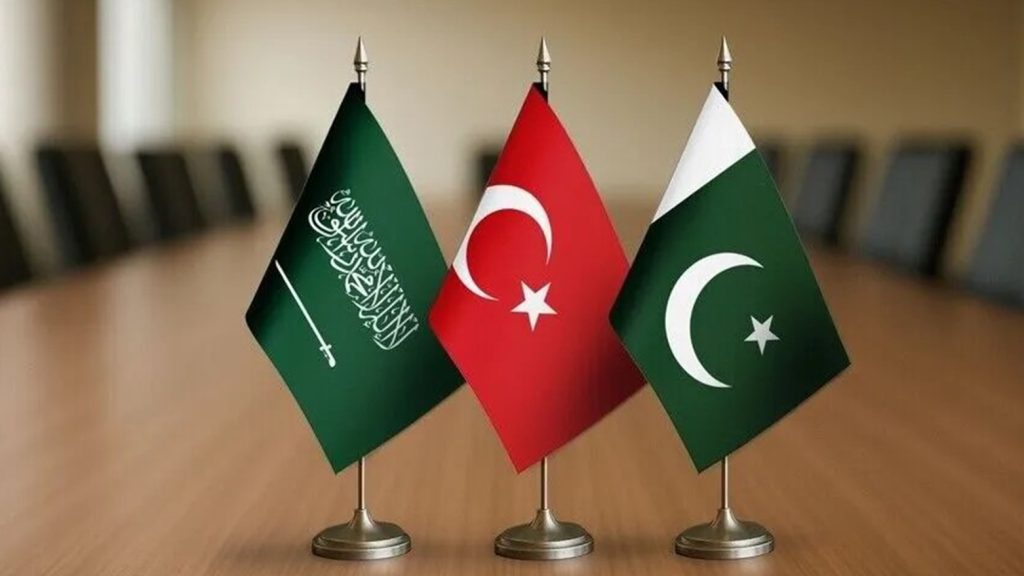
On August 7, 2026, Saudi Crown Prince Mohammed bin Salman, Turkish President Recep Tayyip Erdoğan and Pakistani Prime Minister Shehbaz Sharif met at Al-Safa Palace in Mecca and signed the Makkah Joint Defence Agreement. The official Saudi and Pakistani statements confirm the agreement.
Its central provision is striking:
An armed attack against one of the three states is to be regarded as an attack against all three.
The agreement also calls for broader defence cooperation.
That is why comparisons with NATO’s Article 5 appeared almost immediately.
But calling it “Islamic NATO” requires considerable qualification.
The agreement does not currently have NATO’s:
- integrated military command;
- permanent multinational force structure;
- common defence budget;
- decades-old institutional architecture;
- or clearly defined automatic military response mechanism.
Reuters and other reporting have highlighted precisely these limitations.
So “Islamic NATO” is a media shorthand, not the formal name of the alliance.
The official name is the Makkah Joint Defence Agreement.
Why Was the Pact Created?
The timing tells much of the story.
The agreement emerged during an extraordinary period of Middle Eastern instability, amid the ongoing US-Iran conflict, Iranian attacks affecting Gulf states and disruption to shipping through strategic waterways.
Saudi Arabia has traditionally relied heavily on the United States for its security architecture.
Turkey is a NATO member.
Pakistan has longstanding defence ties with Saudi Arabia.
Yet the three countries have now chosen to create another layer of security cooperation.
That does not necessarily mean they are abandoning Washington.
In fact, Pakistan’s Foreign Minister Ishaq Dar explicitly described the agreement as defensive, said it was not directed at a particular country and indicated that the framework could remain open to other countries.
Turkey has made essentially the same argument.
Foreign Minister Hakan Fidan said the agreement does not designate Iran — or any other state — as a common threat.
That is the official narrative.
But geopolitics is often about what governments do as much as what they say.
The Iran Question Changes Everything
And now comes the extraordinary claim.
Iran says it has been invited to join the very security arrangement that many analysts initially interpreted as part of the regional response to Iranian military pressure.
According to Mehdi Rahimi, Tehran has received an invitation and the matter is being considered.
Rahimi also portrayed the emergence of a regional security umbrella as consistent with an idea Iran has promoted for years: regional countries, rather than external powers, should take responsibility for regional security.
If confirmed, that would be one of the most remarkable diplomatic developments of the year.
Why?
Because Saudi Arabia and Iran have spent years competing for influence across the Middle East.
Their rivalry has played out through:
- Yemen;
- Iraq;
- Syria;
- Lebanon;
- Gulf security;
- energy politics;
- religious influence;
- and competing regional alliances.
A formal Saudi-Iran security arrangement would therefore represent a dramatic departure from the region’s traditional balance.
But There Is a Huge Caveat: The Invitation Is Still Unverified
This is where headlines need restraint.
The claim has not been independently confirmed by the three founding governments.
There has been no public Saudi statement saying:
Iran has been invited.
There has been no Turkish announcement confirming:
Tehran has been offered membership.
And there has been no Pakistani government announcement formally confirming an Iranian accession process.
The report originates from an Iranian parliament-linked media official speaking to Al Mayadeen and has subsequently been carried by international and regional media.
That makes the claim significant — but not yet established fact.
For a Google News-ready report, this distinction is essential.
Iran says it received an invitation. That is the fact.
Saudi Arabia, Turkey and Pakistan have not confirmed it. That is also the fact.
Anything beyond that remains analysis.
Why Would Iran Want to Join?
If the invitation is genuine, Tehran has obvious reasons to consider it.
1. A regional security architecture
Iran has long criticised US military involvement in the Gulf.
Tehran’s preferred model has generally involved regional states managing their own security.
A regional pact that includes Iran could therefore be presented domestically as a strategic victory.
2. Breaking diplomatic isolation
Iran has spent years under heavy US sanctions and intense diplomatic pressure.
Joining a Saudi-Turkish-Pakistani security mechanism would create a new channel of regional legitimacy.
It would effectively say:
Iran is not outside the regional order. Iran is part of it.
That is a powerful diplomatic message.
3. Saudi-Iran reconciliation
Saudi Arabia and Iran restored diplomatic relations in 2023 under a China-brokered agreement.
But diplomatic normalisation does not automatically eliminate strategic rivalry.
A mutual defence framework would take that relationship much further.
It would transform détente from:
“We are talking again”
into:
“We share a formal security mechanism.”
That would be historic.
But Why Would Saudi Arabia Invite Iran?
This is arguably the biggest question.
Saudi Arabia has been one of the countries most directly concerned about Iranian missile and drone capabilities.
The Gulf states have also been exposed to the consequences of the broader Iran-US confrontation.
So why bring Tehran into the room?
There are several possible explanations.
The first is deterrence.
Saudi Arabia may believe that a regional security structure involving Iran is preferable to a permanently adversarial structure confronting Iran.
The second is containment through inclusion.
Sometimes states reduce threats by bringing rivals into institutions.
The logic is:
If Iran becomes part of the security architecture, Tehran also becomes responsible for maintaining it.
The third is strategic autonomy.
Saudi Arabia increasingly appears interested in reducing its dependence on any single external power.
A regional framework could give Riyadh additional options.
The fourth is crisis management.
A security forum that includes Iran could theoretically create mechanisms for preventing accidental escalation in the Gulf.
That would be especially valuable around the Strait of Hormuz.
The Biggest Contradiction: Why Build a Defence Pact and Then Invite the Potential Threat?
This is where the entire story becomes fascinating.
If the Mecca pact was fundamentally created to deter Iranian aggression, then inviting Iran would undermine its original logic.
But the founding governments have explicitly denied that the pact is directed at Iran.
Turkey has been particularly clear on this point.
That means there are two competing interpretations.
Interpretation One: Containment
The pact is a regional deterrence mechanism designed partly because of Iranian military activity.
Under this interpretation, Iran joining would be difficult to reconcile with the pact’s strategic purpose.
Interpretation Two: Regional security umbrella
The pact is genuinely intended to build a wider regional architecture independent of external powers.
Under this interpretation, Iran’s eventual participation makes perfect sense.
Which interpretation is correct will depend on what happens next.
Bangladesh Is Watching the Same Opening
Iran is not the only country looking toward the Mecca framework.
Bangladesh has also signalled interest.
Foreign Affairs Adviser Humayun Kobir said Dhaka has a positive approach toward potentially joining an economic or defence framework involving Saudi Arabia, Pakistan and Türkiye, while emphasising that Bangladesh’s own national interests remain central.
That is important — but again, it is not a membership announcement.
Bangladesh has not joined the pact.
It has not signed the agreement.
And there is no confirmed formal invitation.
Dhaka is effectively keeping the door open.
Why Would Bangladesh Be Interested?
The answer lies partly in Dhaka’s changing foreign-policy calculations.
Bangladesh has strong economic and people-to-people ties with Gulf countries.
Saudi Arabia is an important destination for Bangladeshi workers.
Pakistan and Bangladesh have also been rebuilding bilateral relations.
Turkey has expanded its diplomatic and economic footprint across South Asia and the Muslim world.
A wider framework could therefore provide Bangladesh with:
- defence cooperation;
- access to military technology;
- training;
- intelligence partnerships;
- economic opportunities;
- stronger ties with Gulf powers;
- and greater diplomatic room for manoeuvre.
But there is another dimension.
Bangladesh is attempting to pursue what officials describe as a “Bangladesh First” approach, keeping national interests at the centre while maintaining relationships with multiple major powers.
Joining a military alliance would therefore carry costs as well as benefits.
Bangladesh’s Decision Could Be Much Harder Than It Looks
Dhaka cannot consider this pact in isolation.
It must weigh its relationships with:
- India;
- China;
- the United States;
- Japan;
- Saudi Arabia;
- Türkiye;
- Pakistan;
- and other Gulf states.
A formal military commitment could be interpreted by neighbours as a strategic realignment.
And unlike economic cooperation, collective defence creates obligations during war.
If an ally is attacked, Bangladesh could eventually face pressure to take a position.
That is a fundamentally different commitment from participating in trade or infrastructure projects.
The India Factor
For India, Bangladesh’s possible participation deserves close attention.
New Delhi would not necessarily view Bangladesh joining an economic framework involving Saudi Arabia, Türkiye and Pakistan as a major security threat.
A formal defence pact is different.
Why?
Because Pakistan is one of India’s principal strategic rivals.
A collective-defence framework linking Pakistan to another South Asian military could create new strategic complications.
That does not mean Bangladesh joining would automatically create an anti-India alliance.
There is currently no evidence that the Mecca agreement is directed against India.
But geography matters.
If Bangladesh eventually joins a defence framework containing Pakistan, Saudi Arabia and Türkiye — and Iran were also included — the strategic map of South Asia would become considerably more complicated.
Pakistan’s Role Is Bigger Than It First Appears
Pakistan is arguably the bridge between the Middle East and South Asia in this arrangement.
Saudi Arabia has deep military ties with Pakistan.
Pakistan provides training and has historically deployed personnel to Saudi Arabia.
It is also the only nuclear-armed state among the founding members.
Turkey brings a major defence-industrial base.
Saudi Arabia brings financial resources, energy influence and geographical importance.
Pakistan brings:
military manpower + strategic experience + nuclear deterrence + access to South Asia.
That combination makes the pact more consequential than a simple three-country diplomatic agreement.
And Then There Is Turkey
Turkey may be the most strategically interesting member.
It is:
- a NATO member;
- a major regional military power;
- a significant arms producer;
- connected to Europe;
- active in the Middle East;
- influential in Central Asia;
- and increasingly assertive in Muslim-world diplomacy.
Turkey’s defence industry has expanded dramatically in recent years, particularly in drones, electronic warfare, missiles and other advanced systems.
Reuters reported that the Mecca framework envisages high-level political and military coordination, joint exercises across land, sea, air and cyber domains, and deeper defence-industrial cooperation.
That makes the pact potentially much more substantial than a ceremonial alliance.
Saudi Arabia Supplies the Financial Muscle
Saudi Arabia brings something neither Turkey nor Pakistan possesses at the same scale:
financial power.
Riyadh can invest heavily in:
- defence procurement;
- domestic military production;
- technology;
- missile defence;
- drones;
- naval capabilities;
- artificial intelligence;
- and strategic infrastructure.
Saudi Arabia has also been trying to develop a more autonomous defence industry as part of its broader economic transformation.
A partnership with Turkey could accelerate that process.
Could the Pact Become a Major Arms and Technology Network?
This may ultimately be more important than the collective-defence clause.
A functioning alliance does not require its members to constantly deploy troops.
It can create power through:
joint procurement + technology transfer + exercises + intelligence + industrial cooperation.
The Turkish defence industry could become particularly important here.
Joint production arrangements could eventually involve:
- drones;
- air-defence systems;
- electronic warfare;
- missiles;
- naval systems;
- cyber capabilities;
- AI-enabled battlefield systems.
Reuters has reported that the framework envisages cooperation in advanced areas including unmanned systems, electronic warfare and artificial intelligence.
This Is Why “Islamic NATO” Is Both Catchy and Misleading
The phrase works because it immediately tells readers:
collective defence + Muslim-majority countries + NATO-style commitment.
But it hides important differences.
NATO took decades to develop.
It has:
- integrated command structures;
- standardised procedures;
- permanent institutions;
- established military planning;
- common exercises;
- interoperability;
- and an enormous combined defence capacity.
The Mecca pact has none of that at NATO’s scale.
Calling it “Islamic NATO” therefore risks exaggerating what currently exists.
A better description would be:
An emerging regional collective-defence framework centred on Saudi Arabia, Türkiye and Pakistan.
If it expands and develops permanent institutions, the NATO comparison may become more meaningful.
Not yet.
What Happens If Iran Actually Joins?
This is where the geopolitical earthquake would begin.
Imagine the pact eventually containing:
Saudi Arabia + Türkiye + Pakistan + Iran + Bangladesh
That would create an extraordinary geographic arc.
From the Persian Gulf to Anatolia.
From the Arabian Peninsula to South Asia.
It would connect major energy producers, military powers, strategic waterways and nuclear-capable states.
But it would also contain enormous contradictions.
Saudi Arabia and Iran Would Still Have Problems
Even if both joined, their rivalry would not magically disappear.
They would still disagree over:
- Yemen;
- Gulf security;
- Syria;
- Lebanon;
- Iraq;
- regional influence;
- missile programmes;
- and the role of non-state armed groups.
The pact would therefore need mechanisms for resolving disputes between its own members.
This is one of the biggest unanswered questions.
What happens if:
Member A believes Member B is threatening it?
NATO has decades of institutional experience managing disagreements among allies.
The Mecca framework is starting from scratch.
The Israel Question Is Even More Complicated
Israel is not named as an enemy of the pact.
The agreement’s official language is defensive and does not identify a particular adversary. Turkey has explicitly stressed this.
But Israel will nevertheless have to watch the development closely.
Why?
Because a broader regional defence network could affect:
- missile defence;
- air power;
- intelligence;
- drones;
- Red Sea security;
- Gulf security;
- and regional military deterrence.
If Iran joined, Israel would face a very different strategic environment.
But it is equally important not to claim that the pact is automatically an anti-Israel alliance.
The evidence does not support that conclusion.
And What About the United States?
This may be the biggest long-term question.
The United States remains deeply embedded in the security architecture of the Gulf.
Saudi Arabia remains a major American partner.
Turkey remains a NATO member.
Pakistan has a complicated but historically important relationship with Washington.
And President Donald Trump has publicly welcomed the Saudi-Turkey-Pakistan agreement, describing it as a positive development for regional unity and security.
That makes one thing clear:
Washington does not currently appear to be treating the Mecca pact as an enemy alliance.
But there is a deeper strategic concern.
If regional states increasingly believe they need their own collective security structures, American influence could gradually become less exclusive.
That is different from saying US influence disappears.
It means Washington may become one security partner among several, rather than the indispensable security provider.
China Is Another Quiet Beneficiary
China’s role should not be overlooked.
Beijing helped broker Saudi-Iran diplomatic normalisation in 2023.
China has major economic relationships with Gulf states.
It is also a major buyer of Middle Eastern energy.
A regional security structure that reduces dependence on Washington could potentially create more room for Chinese diplomatic influence.
China does not necessarily need to join the pact.
It can benefit simply from a region becoming more receptive to non-Western security diplomacy.
Russia Could Also Find Opportunities
Russia has maintained relationships with:
- Iran;
- Saudi Arabia;
- Türkiye;
- and other Middle Eastern governments.
A multipolar security architecture could create additional diplomatic space for Moscow.
But Russia’s ability to provide large-scale security guarantees is constrained by its own military commitments and economic limitations.
China therefore has greater potential to benefit economically, while Russia may benefit diplomatically.
The Strait of Hormuz Could Become the Ultimate Test
If Iran joins the Mecca framework, the Strait of Hormuz would become one of the most important tests.
The strait is vital to global energy flows.
Iran has enormous geographic leverage over it.
Saudi Arabia is one of the world’s major oil producers.
Pakistan sits near the Arabian Sea.
Türkiye connects the region to Europe.
A security mechanism involving all four would therefore have enormous strategic significance.
It could theoretically create incentives for keeping maritime routes open.
But it could also create internal contradictions if Iran and Gulf members disagree during a crisis.
What If Iran Does Not Join?
That possibility may actually be more likely in the immediate term.
The invitation itself remains unconfirmed.
And even if an invitation exists, Iran would have to decide whether joining serves its interests.
Tehran could conclude that membership:
- limits its freedom of action;
- forces it into compromises;
- legitimises Saudi leadership;
- creates unwanted military obligations;
- or constrains its relationships with its regional partners.
Iran may therefore prefer to use the invitation as diplomatic leverage without actually joining.
Iran Could Also Use the Invitation as a Strategic Message
This is another reason the claim needs careful interpretation.
By saying:
“We have been invited.”
Tehran can project a powerful narrative:
The regional security architecture cannot function without Iran.
That is strategically useful even if Tehran never signs anything.
It also supports Iran’s longstanding argument that regional countries should build their own security mechanisms instead of relying on the United States.
Bangladesh’s Interest May Be More About Strategic Autonomy
Dhaka’s position appears more cautious.
Bangladesh is not saying:
“We are joining.”
It is effectively saying:
“We are open to the idea if it serves our interests.”
That is classic strategic hedging.
Dhaka can improve relations with Pakistan and Gulf states without immediately burning bridges elsewhere.
But formal membership would be a much bigger decision.
The Real Weakness of the Mecca Pact
The greatest challenge is not money.
It is strategic coherence.
Ask five questions:
Who is the enemy?
No country is officially named.
What happens after an attack?
The treaty says an attack on one is an attack on all, but the operational response is not yet comparable to NATO’s institutionalised mechanisms.
Who commands the forces?
There is no NATO-style integrated command structure.
Who pays?
There is no NATO-style common defence budget.
What happens if members disagree?
There is no established mechanism comparable to NATO’s decades of political-military coordination.
These questions will determine whether the pact becomes a real alliance or remains a powerful diplomatic statement.
A Five-Country Version Could Become Unmanageable
Imagine the following members:
Saudi Arabia — Iran — Türkiye — Pakistan — Bangladesh
They do not have identical foreign policies.
Their relationships with Washington differ.
Their relationships with Israel differ.
Their views of China differ.
Their relationships with Russia differ.
Their domestic political systems differ.
Their strategic priorities differ.
Their threat perceptions differ.
That diversity could make the pact powerful.
It could also make it extremely difficult to operate.
The Most Important Development May Be Membership Expansion
Turkey has already indicated that the framework could expand, with Egypt mentioned as a possible future participant. Reuters reported that the arrangement is intended to remain open to additional countries.
Pakistan’s Foreign Minister has likewise described it as open to others.
That means the real story may not be the original three.
It may be the architecture that develops around them.
If Egypt, Iran, Bangladesh or other states eventually enter, the pact’s character changes.
If no serious expansion occurs, it remains a compact trilateral arrangement.
A Possible New Security Map
The emerging picture could eventually look something like this:
Old model
US-led security architecture
↓
Bilateral alliances
↓
Gulf states individually protected
Emerging model
Regional powers
↓
Collective defence
↓
Joint military technology
↓
Multiple external partnerships
↓
Less dependence on a single security guarantor
That is the larger geopolitical trend.
And it is bigger than Iran.
Three Possible Futures for the Mecca Pact
Scenario 1: It Remains a Saudi-Turkey-Pakistan Alliance
This is the most straightforward outcome.
The three states build:
- joint exercises;
- defence-industry links;
- intelligence cooperation;
- political coordination.
Impact: moderate but significant.
Scenario 2: It Expands Into a Wider Muslim Security Framework
Iran remains outside, but Egypt, Bangladesh and other states join.
The pact becomes a broad regional security organisation.
Impact: major.
It could become an important third pillar alongside existing Western and regional security structures.
Scenario 3: Iran Joins
This would be the real geopolitical shock.
Saudi Arabia and Iran would effectively move from strategic rivalry toward institutionalised security cooperation.
If Bangladesh also joined, the framework would extend deeply into South Asia.
Impact: potentially historic.
But this is also the least certain scenario today.
What Would Iran Joining Mean for Saudi Arabia?
It could represent a strategic transformation.
Saudi Arabia would gain a mechanism for direct security engagement with Tehran.
But Riyadh would also be taking a major risk.
If Iran violated the pact’s principles, Saudi Arabia would face the difficult question of how to respond.
The agreement could therefore work only if Riyadh believes Iran is prepared to accept limits on military behaviour.
That remains untested.
What Would It Mean for Pakistan?
Pakistan could become the bridge between Gulf security and South Asian security.
That would enhance Islamabad’s diplomatic weight.
It could also bring economic benefits through:
- defence contracts;
- Saudi investment;
- Turkish technology;
- military training;
- and wider diplomatic relevance.
But Pakistan would have to manage its relationship with Iran as well as India.
That is a difficult balancing act.
What Would It Mean for Turkey?
Turkey would potentially emerge as the alliance’s principal defence-industrial power.
Its military technology could become the connective tissue between the members.
Ankara could also increase its influence across the Gulf, South Asia and the wider Muslim world.
But Turkey would need to balance this against its NATO membership and relationships with Europe and the United States.
What Would It Mean for Saudi Arabia?
Riyadh would become the financial and political centre of a new regional security architecture.
That would fit Mohammed bin Salman’s broader strategy of turning Saudi Arabia into an independent regional power rather than merely an American security client.
But Saudi Arabia would still need American technology, intelligence and military relationships for the foreseeable future.
So this is more likely to be strategic diversification than a clean break with Washington.
What Would It Mean for Bangladesh?
Bangladesh could gain strategic options.
But it could also face pressure from India, China, the US and other partners to clarify what its membership actually means.
For Dhaka, the question is not simply:
“Should we join?”
It is:
“What obligations would we accept if we joined?”
That is a much harder question.
And What Does It Mean for India?
India should watch the development carefully, but without exaggerating it.
There is currently no evidence that the Mecca pact is an anti-India alliance.
However, if Pakistan becomes the gateway through which a wider defence network enters South Asia, India’s strategic planners will naturally examine:
- military interoperability;
- Pakistani-Turkish defence cooperation;
- Gulf-Pakistan security links;
- Bangladesh’s possible participation;
- Iranian participation;
- and the possibility of intelligence or technology sharing.
The most consequential scenario for India would not be Saudi Arabia and Turkey signing a pact with Pakistan.
That has already happened.
It would be:
Pakistan + Bangladesh + Iran + Gulf partners forming an interconnected defence network.
That would create a much more complicated strategic environment around India’s western and eastern neighbourhoods.
But that remains a scenario, not today’s reality.
The Most Important Fact Right Now
Strip away the sensational headlines and the current situation is actually quite precise:
Confirmed
Saudi Arabia, Türkiye and Pakistan signed the Makkah Joint Defence Agreement on August 7, 2026.
Confirmed
The pact says an armed attack against one member will be regarded as an attack against all.
Confirmed
The three countries describe it as defensive and not directed against a particular country.
Confirmed
The framework envisages deeper defence cooperation, including military exercises and defence-industrial cooperation.
Reported but unconfirmed
Iran says it has received an invitation and is considering it.
Confirmed as political interest, not membership
Bangladesh has expressed a positive approach toward the possibility of joining a Saudi-Pakistan-Türkiye economic or defence framework, while saying national interests will determine the decision.
That is where the story stands as of August 24, 2026.
Final Assessment: The Real Story Is Not “Islamic NATO” — It Is the Birth of a New Regional Security Experiment
The Mecca pact is important.
But the biggest mistake would be to assume it is already a fully functioning NATO-style alliance.
It isn’t.
What has emerged is something potentially more interesting:
a regional experiment in collective deterrence.
Saudi Arabia wants greater strategic autonomy.
Türkiye wants greater regional influence and defence-industrial reach.
Pakistan wants to convert longstanding military relationships into broader geopolitical leverage.
Bangladesh is exploring whether the framework can serve its national interests.
And Iran — if its claim is eventually confirmed — may be trying to transform itself from the perceived target of regional containment into a participant in the region’s security architecture.
That last possibility is extraordinary.
Because if Tehran really enters the room, the entire logic of the pact changes.
It would no longer simply be:
Saudi Arabia + Türkiye + Pakistan against uncertainty.
It could become:
Saudi Arabia + Iran + Türkiye + Pakistan — and potentially Bangladesh and others — attempting to build a security system that does not depend entirely on Washington.
That would not automatically mean the end of US influence.
Nor would it automatically create an anti-Israel or anti-India bloc.
But it would mark something arguably more consequential:
The Middle East and South Asia beginning to experiment with a security architecture designed by regional powers themselves.
And that is why the next few weeks matter.
Watch the invitations. Watch the membership rules. Watch whether Iran’s claim is confirmed. Watch Bangladesh’s next statement. And above all, watch whether the Mecca pact develops institutions rather than remaining a declaration.
Because the real geopolitical shock will not be Iran being invited.
It will be what the pact becomes if Iran actually walks through the door.