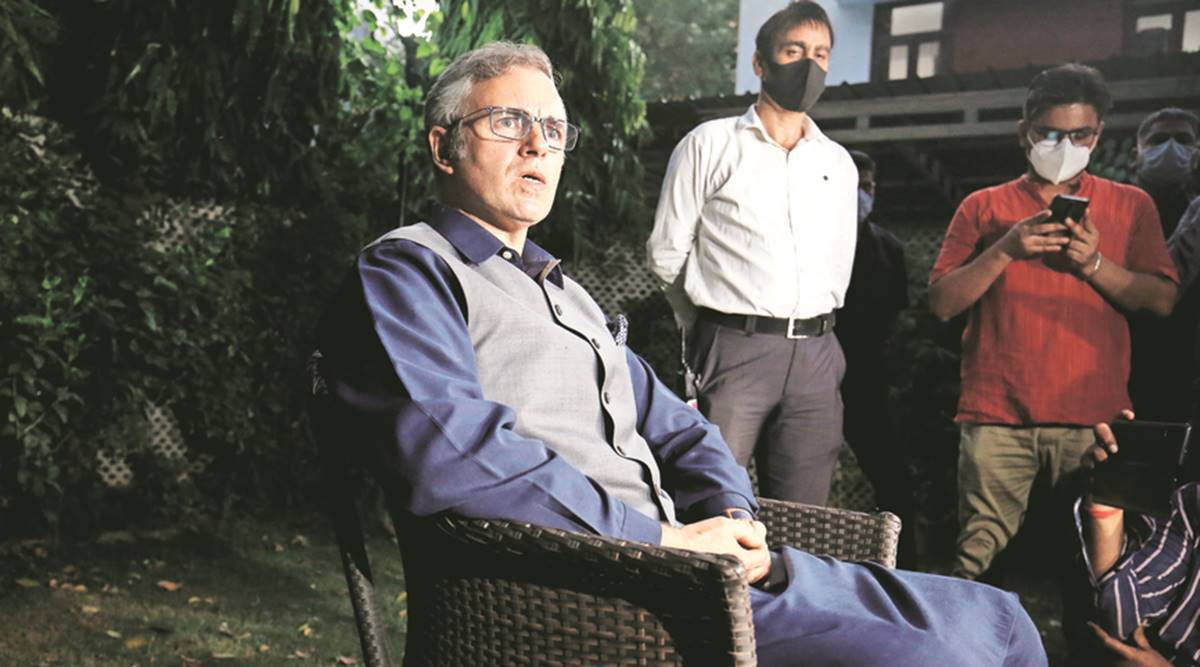
National Conference MP says the party risks drifting away from its original political mandate as differences over Article 370 and statehood become more visible
By: Javid Amin | 11 July 2026
The political debate surrounding Jammu and Kashmir’s future has intensified once again after National Conference (NC) Member of Parliament Aga Ruhullah Mehdi publicly asserted that the party’s electoral mandate was never limited to restoring statehood alone. According to Ruhullah, the National Conference sought votes on the promise of fighting for the restoration of Jammu and Kashmir’s constitutional position, particularly Article 370 and the protections that existed before August 5, 2019.
His remarks have triggered fresh discussions within political circles, as they also reveal signs of ideological differences inside the National Conference. The Srinagar MP suggested that his insistence on staying committed to the party’s original political promises has increasingly isolated him within the organisation.
The comments come at a politically significant time when the National Conference-led government continues to pursue the restoration of Jammu and Kashmir’s statehood while simultaneously navigating legal and constitutional challenges surrounding Article 370.
“Our Mandate Was Article 370, Not Merely Statehood”
Speaking on the party’s political priorities, Aga Ruhullah argued that reducing the National Conference’s agenda to statehood alone overlooks the commitments made to voters during the Assembly and parliamentary campaigns.
According to him, the party’s central promise revolved around restoring the constitutional identity and rights that Jammu and Kashmir enjoyed prior to the abrogation of Article 370.
His remarks underline an important distinction in Kashmir’s political discourse.
While statehood concerns the restoration of Jammu and Kashmir as a full-fledged state with an elected government enjoying powers similar to other Indian states, the restoration of Article 370 relates to constitutional provisions that earlier granted the erstwhile state special autonomy over several legislative and administrative matters.
For many regional political parties, these have remained interconnected issues. However, Ruhullah believes they should not be treated as interchangeable political goals.
Growing Differences Within the National Conference
One of the most striking aspects of Ruhullah’s statement was his candid acknowledgement of increasing discomfort within his own party.
He suggested that his consistent emphasis on constitutional restoration has made him increasingly “unwelcome” among sections of the National Conference leadership.
Although he did not directly accuse individual leaders, his remarks indicated frustration with what he perceives as a shift in the party’s priorities.
Political observers note that such public expressions of disagreement are relatively uncommon within the National Conference, a party traditionally known for maintaining internal discipline despite ideological diversity.
Ruhullah has, over the past year, repeatedly projected himself as a leader willing to publicly question political compromises if he believes they dilute the party’s foundational commitments.
Background: Article 370 Remains Central to Kashmir Politics
The debate cannot be viewed in isolation from the constitutional developments of August 5, 2019.
On that day, the Government of India revoked the special constitutional status granted to the former State of Jammu and Kashmir under Article 370 and reorganised the region into two Union Territories—Jammu and Kashmir, and Ladakh.
In December 2023, the Supreme Court upheld the constitutional validity of the Union government’s decision while directing that elections to the Jammu and Kashmir Legislative Assembly be conducted and observing that statehood should be restored “at the earliest.” The Court, however, did not order the restoration of Article 370. This legal position continues to shape the political debate in the region.
Since then, regional parties including the National Conference and the People’s Democratic Party (PDP) have continued to advocate for constitutional and political rights, though their approaches and priorities have occasionally differed.
Statehood Versus Constitutional Restoration
The current political conversation reflects two parallel demands that dominate Jammu and Kashmir’s public discourse.
Statehood
The restoration of statehood seeks the return of full administrative powers to an elected government, reversing Jammu and Kashmir’s present Union Territory status.
The Union Government has repeatedly stated in Parliament and before the Supreme Court that statehood will be restored at an appropriate time, though no specific timeline has been announced.
Article 370
The restoration of Article 370 represents a broader constitutional demand involving the reinstatement of the special status that existed before August 2019.
Following the Supreme Court’s judgment, this issue remains primarily a political demand rather than an ongoing constitutional process.
Ruhullah’s latest remarks suggest he believes the National Conference must continue advocating both issues instead of allowing the constitutional question to fade into the background.
Political Implications for the National Conference
The National Conference currently finds itself balancing governance responsibilities with longstanding political commitments.
As the ruling party in Jammu and Kashmir, it must engage with the Union Government on governance, development and administrative issues while simultaneously addressing public expectations regarding constitutional rights.
Ruhullah’s intervention highlights an emerging debate within the party over political messaging.
Some leaders appear to prioritise achievable administrative goals such as statehood, whereas others insist that constitutional restoration should remain at the heart of the party’s political identity.
If these differing perspectives become more pronounced, the National Conference could face increasing pressure to clearly define its long-term roadmap.
How the Opposition Could Respond
Political rivals are likely to closely monitor the developments.
The Bharatiya Janata Party (BJP), which has consistently defended the abrogation of Article 370 as a historic constitutional reform, may use Ruhullah’s remarks to argue that the National Conference remains internally divided over its political agenda.
Meanwhile, other regional parties, particularly the People’s Democratic Party, could seek to reinforce their own positions by portraying themselves as more consistent advocates of constitutional restoration.
Whether this debate benefits or weakens the National Conference will largely depend on how effectively the party addresses internal differences in the coming months.
Public Sentiment in Kashmir
Among many voters in Kashmir, Article 370 continues to hold symbolic and political significance beyond its constitutional dimensions.
For a section of the electorate, the issue represents identity, political autonomy and historical commitments.
Others place greater emphasis on governance, employment, economic growth, infrastructure, investment and the timely restoration of democratic institutions.
This evolving public sentiment explains why debates over statehood and constitutional restoration continue to occupy a central place in regional politics.
Aga Ruhullah’s Emerging Political Identity
Over recent years, Aga Ruhullah Mehdi has increasingly positioned himself as an outspoken voice within mainstream Kashmiri politics.
Rather than limiting himself to conventional party messaging, he has frequently spoken on constitutional issues, civil liberties and political accountability.
Supporters view him as a leader willing to defend ideological commitments even when they generate discomfort within his own party.
Critics, however, argue that such public disagreements may complicate the National Conference’s efforts to present a united political front.
Regardless of differing opinions, his latest remarks reinforce his growing image as one of the National Conference’s most independent voices.
What Lies Ahead for the National Conference?
The National Conference now faces a delicate political balancing act.
As governance responsibilities expand, the party will likely continue pressing the Union Government for the restoration of statehood. At the same time, voices like Aga Ruhullah’s ensure that the debate over Article 370 remains central to the party’s internal discourse and its engagement with voters.
How the leadership reconciles these priorities could shape not only the National Conference’s future electoral strategy but also the broader trajectory of politics in Jammu and Kashmir.
For now, Ruhullah’s intervention has reignited a fundamental question that has defined regional politics since 2019: Was the National Conference elected primarily to restore administrative powers—or to pursue the broader constitutional aspirations it promised to its electorate?
That debate is unlikely to fade anytime soon.