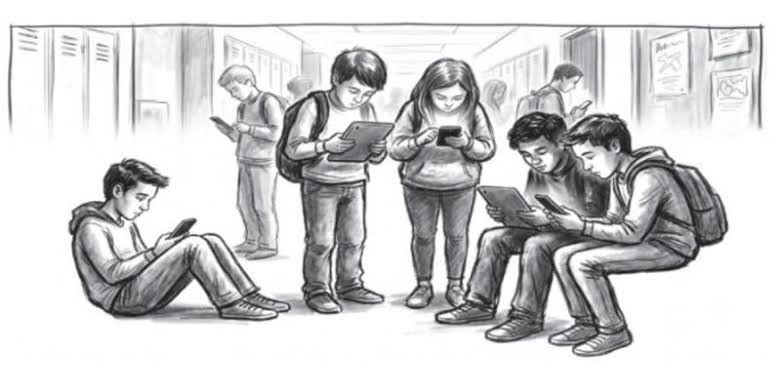
The Silent Digital Overdose: How Screens Are Quietly Rewiring Kashmir’s Classrooms
By: Javid Amin | 10 July 2026
A generation once shaped by chalk dust, storybooks and mohallah playgrounds is now growing up under the glow of a screen — and Kashmir’s teachers, doctors and parents say the shift is happening faster than anyone can control.
Walk into almost any school in the Kashmir Valley today and the change is unmistakable. Blackboards share space with interactive smart panels. Homework arrives through WhatsApp instead of a diary. And in the front row, a child who once fidgeted with a pencil now waits, almost instinctively, for the next notification. Teachers call it a “digital overdose” — not a rejection of technology, but a warning that its unchecked, unbalanced use is quietly reshaping how an entire generation learns, thinks and feels.
This is not alarmist speculation. It is showing up in survey data, hospital OPDs, staff rooms and dinner-table conversations across Srinagar, Budgam, Baramulla, Shopian, Kulgam and Anantnag. And it raises an uncomfortable question for a region still rebuilding its education system: is Kashmir’s classroom revolution helping children learn, or quietly costing them their focus, their health and their heritage?
What Exactly Is Kashmir’s “Digital Overdose”?
The term describes a pattern educators are now seeing consistently — students spending far more hours on screens, for both academic and non-academic reasons, than child-development experts consider safe. It isn’t only about smartphones. It includes tablets handed out for homework, smart boards replacing the blackboard, and the constant pull of Instagram Reels and YouTube Shorts once the school bell rings.
A survey by researchers at the Department of Public Administration and Political Science, Cluster University of Kashmir, covering 400 school-going adolescents across Shopian, Kulgam, Anantnag and Srinagar, found that three in four students now spend upwards of four hours a day glued to a screen, with heavy users far more likely to struggle with concentration and report distress when separated from their phones. More than half of the surveyed students said stress and digital distraction routinely derailed their schoolwork.
That local finding lines up with a broader pattern flagged by community health researchers in the Valley. A month-long study by the Community Medicine Department at Government Medical College, Srinagar found that nearly four in five teenagers aged 14–16, and close to two-thirds of children aged one to fourteen, in Jammu and Kashmir now use smartphones — usage rates well above the national average, with most spending roughly seven to eight hours a day on social media, gaming apps and video platforms.
Ground Reality: From Chalk-and-Talk to Touchscreens
To understand why “digital overdose” has become a talking point, it helps to look at how fast the classroom itself has changed.
The Smart Board Boom — and Its Blind Spots
Over the past two years, hundreds of government schools across Jammu and Kashmir — from Kupwara and Poonch to Leh, Tangdhar and Budgam — have been fitted with digital boards, bringing animated lessons and interactive quizzes to classrooms that once relied on chalk and rote memorisation. More than 5,000 teachers have been trained to use these tools, and in remote areas the boards have genuinely narrowed the gap between government and private schooling, letting a student in Tangdhar access the same NCERT content as a peer in Delhi.
But the same rollout has exposed gaps. In several schools, boards installed with fanfare now sit unused because of power cuts or the lack of a technician. Content libraries remain overwhelmingly in Hindi and English, leaving little for students more comfortable in Kashmiri, Dogri or Ladakhi. And at home, the digital gains often stop — many students still have no personal device, no laptop and no steady electricity, deepening rather than closing the old educational divide.
The Homework Trap
Perhaps the more consequential shift has happened quietly: many schools now route assignments, notices and study material through smartphones and messaging apps. What used to be optional screen use has, for many families, become compulsory. Parents who want to limit their child’s phone time find themselves stuck, because the school system itself now depends on that same device.
Learning Impact: Shrinking Attention, Fading Reading Habits
Teachers across the Valley describe a common classroom experience — students who once sat through a 40-minute lesson now struggle to stay focused for ten. A national survey by the National Council of CBSE Schools found that nearly 74 per cent of students spend more than two hours daily on screens for non-academic purposes, while 21 per cent spend more than four hours on social media, gaming and mobile phones; more tellingly, 69 per cent of teachers reported an outright decline in classroom concentration.
Locally, ASER-based data suggests close to 79 per cent of J&K students aged 14 to 16 use smartphones specifically for social media — not schoolwork. Short-form video content, in particular, is being blamed for training young brains to expect constant stimulation, which sits awkwardly against a classroom’s demand for patience and sustained attention. Reading habits are among the first casualties: students who once borrowed storybooks from school libraries now default to a five-second Reel between classes, and teachers say the discipline needed to finish a chapter, let alone a novel, is becoming rarer.
It Isn’t Only the Phones
Educators are careful to add an important caveat: mobile phones alone don’t explain the crisis. A shortage of well-trained teachers and uneven classroom instruction in many schools is compounding the problem, meaning the fix has to go beyond simply confiscating devices.
Health Toll: Eyes, Spines and Peace of Mind
The physical and mental cost of Kashmir’s digital overdose is now visible in hospital corridors, not just classrooms.
Digital Eye Strain and Rising Myopia
Doctors across Srinagar report a clear rise in screen-related complaints among children — eye strain, sleep disorders, poor posture and mental fatigue chief among them. Ophthalmologists say children as young as seven are now presenting with significant eye strain and short-sightedness, and cite international research suggesting every additional hour of daily screen time raises the risk of myopia by roughly 21 per cent. Health experts recommend the “20-20-20” rule — looking at something 20 feet away for 20 seconds every 20 minutes — as a basic safeguard, though few schools formally build this into the day.
Anxiety, Sleep Loss and “Virtual Autism” Warnings
The mental-health picture is more troubling still. A study published this year in the Ianna Journal of Interdisciplinary Studies, surveying 246 students from Classes 7 to 12 in Kashmir, found a clear negative link between heavy smartphone, messaging and gaming use and students’ psychological wellbeing. Separately, psychiatrists at Government Medical College, Srinagar warn that soothing toddlers with screens conditions them to see devices as comfort, a habit that often hardens into dependency by the teenage years. Some neurologists at SKIMS say they are now seeing developmental symptoms resembling “virtual autism” in children exposed to screens very early in life — a term used to describe cognitive and social delays linked to excessive early screen stimulation rather than a formal clinical diagnosis.
Paediatricians also point to secondary effects: reduced outdoor play has been linked to Vitamin D deficiency in roughly one in five urban Kashmiri children, alongside rising complaints of neck and back pain from hours spent hunched over a screen.
Cultural Shift: A Generation Losing the Pen — and the Playground
Beyond biology and grades, teachers and elders in Kashmir describe something harder to measure: a quiet erosion of everyday culture.
The Dying Art of Handwriting
As tablets and typed assignments replace notebooks, handwriting is fading as a skill many students practise regularly. Teachers say the chalk-and-talk method — where a teacher’s tone, pace and physical presence shaped a lesson — is giving way to pre-loaded slides and videos, and with it, some of the personal engagement between teacher and student that once defined Kashmiri classrooms.
Family Ties Under Strain
The mohallah playground, once the social heart of every neighbourhood, is emptying out. Winters, limited public spaces and changing family structures already made outdoor play harder in Kashmir; the smartphone has simply filled that gap. Parents describe children who once played cricket or flew kites now sitting silently with a screen, and family conversations increasingly replaced by parallel scrolling. Some educators connect this drift to a longer-term social cost — a generation raised with less face-to-face bonding with parents and grandparents may, over time, weaken the intergenerational closeness Kashmiri households have traditionally prided themselves on.
What Parents and Educators Are Saying
The concern cuts across professions. A parent from Budgam admitted her son’s phone use for schoolwork often drifts into social media and gaming, despite efforts to push him toward outdoor activity. A mother in Srinagar recalled handing her son a phone simply to keep him calm during meals, only to watch that habit turn into constant screen dependence. In Baramulla, a father put it starkly: giving children phones felt like an act of love at the time, but in hindsight, it has felt more like handing over a leash.
Educationists, meanwhile, are wary of overcorrecting. Government College professor Tariq Hussain argues the answer isn’t banning devices outright but building responsible-use habits, since smartphones are now embedded in exam preparation and study material as much as in entertainment.
Snapshot: Kashmir’s Digital Overdose at a Glance
| Aspect | Ground Reality | Impact on Students |
|---|---|---|
| Education | Smart boards and tablets increasingly replace chalk-and-talk teaching; homework now often routed via smartphones | Shorter attention spans, weaker reading habits, growing dependency on digital aids |
| Health | Doctors report rising eye strain, myopia, poor posture, disrupted sleep and anxiety among school-age children | Long-term risk to physical development and mental wellbeing |
| Culture | Handwriting practice declining; teacher-student personal engagement reducing; mohallah playgrounds emptying | Erosion of traditional learning styles and community bonding |
| Society | Majority of parents (roughly six in ten, per local surveys) believe their children are addicted to devices | Rising calls for school policy, parental limits and digital-literacy education |
The Way Forward: Building a Blended Classroom
Experts are largely united on one point: the answer isn’t rejecting technology, but rebalancing it.
What Educators and Doctors Recommend
Health professionals in Srinagar suggest a set of practical, low-cost interventions — delaying personal smartphone ownership until at least Class 12, keeping meals, bedtime and the first hour after waking screen-free, and ensuring children get at least two hours of outdoor play daily. Reviving traditional activities such as kite-flying, storytelling and neighbourhood sport is also seen as a way to rebuild the social muscle that screens have weakened.
On the academic side, some schools elsewhere have experimented with periodic “tech-free days” — reverting briefly to record players, printed articles and group discussions — and reported a noticeable spike in student engagement. Kashmir’s education planners could adapt similar low-tech resets without abandoning the genuine gains smart boards have brought to remote schools.
Policy Gaps Jammu and Kashmir Still Needs to Address
Commentators in the Valley are pushing for three concrete steps: embedding digital literacy and cyber-safety as a sustained part of the school curriculum rather than an occasional workshop; equipping both teachers and parents with basic training on managing screen time; and discouraging schools from routing homework through WhatsApp for younger, lower-class students. There are also calls for the education department to invest in community playgrounds and for smart-board content providers to expand Kashmiri-language material, so digital learning tools serve rather than sideline the region’s own linguistic identity.
Outlook: Balance, Not Rejection
Kashmir’s “digital overdose” isn’t a call to unplug the classroom — the smart boards reaching Tangdhar and Kargil have genuinely opened doors that chalk and talk alone could never open in some of the region’s most remote schools. The real challenge is designing a blended model: one that keeps the reach and interactivity of digital tools while protecting the attention spans, eyesight, handwriting and family bonds that generations of Kashmiri children grew up with.
That balance will not come from a single circular or a single parenting rule. It will need schools, doctors, parents and policymakers moving together — because as multiple studies from the Valley now confirm, the cost of inaction is no longer hypothetical. It is already showing up in eye clinics, in falling reading scores, and in playgrounds that have gone quiet.
Frequently Asked Questions
What does “digital overdose” mean in the context of Kashmir’s schools? It refers to the excessive, often unbalanced use of smartphones, tablets and smart boards among school-going children in Kashmir, linked to shorter attention spans, health complaints and declining traditional learning habits.
Are smart boards themselves the problem? Not directly — smart boards have improved access to quality teaching content in remote areas like Tangdhar and Kargil. The concern is unregulated personal screen time outside structured lessons, particularly on smartphones.
What health issues are doctors seeing in Kashmiri schoolchildren? Eye strain, early-onset myopia, poor posture, sleep disturbances and rising anxiety are the most commonly reported complaints, according to doctors in Srinagar.
What can parents do right now? Paediatricians recommend delaying personal smartphone ownership until later teenage years, keeping meals and bedtime screen-free, and ensuring at least two hours of daily outdoor activity.
This feature is based on ground reports, published survey data and statements from doctors, educators and parents across the Kashmir Valley, cross-referenced with national and international research on screen time in schools.


