Devotion vs Development: Amarnath & Vaishno Devi Pilgrimage Disaster — The Crisis of India’s Sacred Shrines 2026
By: Javid Amin | 11 July 2026
Every July, millions of souls make the same impossible bet — that the mountains will hold, the path will be safe, the divine will be waiting. In 2026, the mountains are losing that bet. And the divine, it seems, is disappearing.
On July 7, 2026 — just four days into the 57-day Amarnath Yatra — Baba Barfani was gone. The sacred ice Shiv Linga inside the Amarnath Cave, which had stood nearly seven feet tall as recently as May, had shrunk by more than 90 percent. Tens of thousands of pilgrims who had trekked for days through snowfields and mountain passes arrived at the cave to find almost nothing left. The ice formation they came to see, the one their grandparents had described towering like a frozen throne, had vanished into the mountain air before the pilgrimage had barely begun.
It was the third consecutive year the Shiv Linga failed to survive a single week. Not a drought year, not an anomaly — a pattern. A slow-motion disaster unfolding at 3,888 metres above sea level, in the heart of one of the most spiritually significant caves in the world.
Across the mountains at Vaishno Devi, the disaster was faster and more brutal. On August 26, 2025, an extraordinary monsoon landslide tore through the pilgrimage track, killing 34 people and injuring 20 more in a matter of minutes. Less than a year later, in July 2026, another landslide struck the same route, forcing the suspension of the battery car service and sending pilgrims scrambling to the older path.
Two shrines. Two disasters. One urgent, overdue question: are India’s most beloved pilgrimage routes being loved — and overwhelmed — to death?
The God of Ice Is Disappearing — Year by Year, Faster Than Ever
A Living Marvel That History Has Revered for Centuries
The Amarnath Shiv Linga is one of the most extraordinary natural phenomena on earth. Every spring, as winter loosens its grip on the Kashmir Himalayas, water seeps through the limestone roof of the Amarnath Cave and freezes — drop by patient drop — into a towering stalagmite that rises from the cave floor like a column of crystallised faith. Hindus revere it as a living manifestation of Lord Shiva himself: not carved by human hands, not placed by priests, but conjured from the mountain by forces that answer to no calendar.
For centuries, the Shiv Linga stood for months — long enough for the summer pilgrimage season to conclude, for hundreds of thousands of devotees to receive their darshan, and for the formation to retreat only as the Himalayan autumn arrived. The relationship between the pilgrim and the Shiv Linga was built on that reliability. Come, the mountain seemed to say. I will be here.
It no longer is.
The Numbers Tell a Disaster Story No One Can Ignore
The collapse of the Shiv Linga’s durability is not a matter of interpretation. It is a documented, measurable, worsening disaster with a timeline that spans decades:
In 1998, the ice Shiv Linga stood 12 to 13 feet tall — roughly the height of a two-storey building — and snow blanketed nearly a kilometre of the approach trail to the cave. The area around the shrine was quiet, largely undeveloped. Pilgrims were fewer, their footprint lighter.
In 2013, the Shivling disappeared before the Yatra even concluded.
In 2016, it melted within 10 days of the pilgrimage season opening.
In 2025, it had already begun dissolving the very day the Yatra commenced on July 3. Over 3.31 lakh pilgrims visited that season — most of them never saw the ice formation they came for.
In 2026, the Shivling — which had measured nearly seven feet tall in May — had shrunk by 99 percent by July 7. Just four days. The same formation that once lasted a full season now cannot outlast a long weekend.
This is not a climate curiosity. This is an ecological disaster at a site of irreplaceable spiritual significance.
What Is Killing the Shiv Linga
The destruction of the Amarnath Shiv Linga is the product of multiple disasters converging on a single fragile point — and each one feeds the others.
A Warming Himalaya That Is Running Out of Cold. The Himalayan region is warming faster than the global average — a fact that climate scientists have been documenting with increasing alarm for years. In 2025, Srinagar recorded its highest temperature since 1953, at 37.4°C. The cave sits at 3,888 metres, a height that once guaranteed sub-zero conditions well into summer. Those guarantees are gone. The cold that forms the Shiv Linga and holds it together is arriving later, staying shorter, and retreating faster with every passing year.
The Snow That Fed the God Is Gone. Snow is not merely scenic backdrop to the Amarnath pilgrimage. It is the raw material of the Shiv Linga itself — the frozen moisture that seeps through the cave roof and builds the stalagmite over months of patient accumulation. The Amarnath region has witnessed a 60 to 70 percent decline in snowfall and rainfall over recent decades. Less snow in winter means a smaller, weaker Shiv Linga in spring, and a formation that has almost no buffer against the summer warmth that follows. The mountain is being slowly drained of the raw ingredient of its own miracle.
The Heat of 56,000 Pilgrims. Here lies the most uncomfortable truth of the Amarnath disaster, the one that authorities are slowest to acknowledge: the pilgrims themselves are part of the problem. Over 56,000 devotees visited the Amarnath cave in the first three days of the 2026 Yatra alone — an 18.6 percent increase over the same period in 2025. During peak days, between 13,000 and 20,000 human bodies crowd into and through the enclosed cave ecosystem in a single day. Every human body generates heat. In an open field, that heat dissipates harmlessly. Inside a sealed Himalayan cave where a delicate ice formation has been building all winter, thousands of bodies radiating warmth simultaneously create a thermal assault that even a healthy Shivling would struggle to survive. A weakened one — already diminished by reduced snowfall and rising ambient temperatures — has no chance at all.
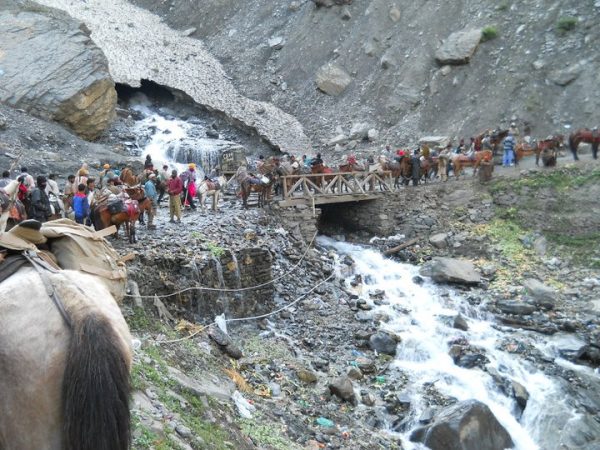
A Route Being Devoured from Within. The disaster at Amarnath is not limited to the cave. The entire pilgrimage ecosystem is in collapse. Former Principal Chief Conservator of Forests OP Sharma has documented the scale of biodiversity destruction along the Yatra route: rare Himalayan herbs — Pleurospermum, Wintergreen, Jogipadshah — are vanishing from the mountain slopes. Creeping juniper, a critical soil-binding plant at high altitudes, is being mass-uprooted for firewood by those who set up camps and langars along the route. The loss of this vegetation accelerates soil erosion, triggering the mudslides that have increasingly disrupted the Yatra. Road construction has carved unstable cuts into hillsides. Plastic waste has become a fixture of one of India’s most sacred landscapes. Helicopter traffic adds aerial pressure to a fragile mountain atmosphere.
The cave was never designed to be a transit hub. The ecosystem surrounding it was never designed to absorb an annual influx of hundreds of thousands of people. Neither has been upgraded to handle it. Both are now showing the consequences.
No Law Protects What Faith Cannot. Perhaps the most damning fact in the entire Amarnath disaster is this: the Shri Amarnath Shrine Board, which manages the pilgrimage, operates outside the framework of India’s environmental legislation. There is no Environmental Impact Assessment for the Yatra. There is no Environmental Management Plan. There is no formal compliance with the Environment Protection Act of 1986, the Water Act of 1974, the Air Act of 1981, or the Solid Waste Management Rules of 2016. A pilgrimage that puts half a million people into one of the most fragile high-altitude ecosystems in the country every year is, by law, accountable to no one for the environmental cost of doing so.
That is not a governance gap. It is a governance disaster.
Faith Does Not Melt — But the Mountain Is Exhausted
What makes the Amarnath crisis so layered, so deeply human, is the response of the pilgrims themselves. Even without the visible Shiv Linga, they come. They will keep coming.
Devotee Divyanshu Khanna, speaking at the cave entrance during the 2026 Yatra, captured the sentiment of thousands: “Baba has vanished, yet faith remains. People are still coming to the cave because it is a matter of devotion. Even if the Shivling is no longer visible, the divine presence of Baba can still be felt in every particle of that sacred place.”
Another pilgrim, Aman Chawla, was equally clear: “Baba has not disappeared. Baba resides in everyone’s heart. It depends on the faith of the devotee.”
These are not statements of resignation. They are expressions of a faith so rooted that it does not require physical confirmation. And they are, in their own way, both beautiful and devastating. Beautiful, because genuine devotion truly does transcend the visible. Devastating, because it removes the urgency that the visible disaster deserves.
When a sacred formation that took centuries of devotees to discover, that has inspired generations of pilgrims to undertake one of the most physically demanding journeys in India, disappears within four days of a 57-day pilgrimage — the mountain is not simply experiencing a weather event. It is issuing a warning that has the tone of a final notice.
Vaishno Devi: When the Sacred Path Becomes a Killing Ground
August 26, 2025 — The Disaster That Was Always Coming
If the Amarnath crisis is a slow unravelling — a God dissolving in degrees, a mountain eroding in increments — the Vaishno Devi disaster of August 2025 was a sudden, violent rupture. The kind of catastrophe that feels shocking in the moment but, in retrospect, was inevitable.
On August 26, 2025, an extraordinary monsoon event struck the Trikuta Hills of Reasi district in Jammu and Kashmir. The area received 629.4 millimetres of rainfall in a single rolling 24-hour period — nearly double the previous record of 342 millimetres. The hillsides, already saturated and weakened by decades of construction, deforestation, and the constant mechanical disturbance of millions of pilgrim footsteps, could not hold. A massive landslide tore through the Vaishno Devi pilgrimage track. Thirty-four people were killed. Twenty more were injured.
The death toll could have been higher. It is cold comfort.
Jammu and Kashmir Chief Minister Omar Abdullah publicly questioned why the Shri Mata Vaishno Devi Shrine Board had not suspended the pilgrimage despite the extreme weather conditions and advance warnings. It was the right question to ask. It was asked too late. The families of 34 people who went to seek divine blessings and never came home deserved better planning, better protocols, and better protection.
The tragedy at Vaishno Devi did not occur in isolation. On August 14, just 12 days earlier, another catastrophic landslide struck the Machail Mata Yatra pilgrimage route at Chasoti in Kishtwar district — also in Jammu and Kashmir — killing at least 66 people and leaving up to 75 more missing. Two pilgrimage route disasters. Less than two weeks apart. Same season. Same state. Same catastrophic failure of risk management on mountain terrain where millions of pilgrims are sent every year with minimal formal safety protocol.
Then, in July 2026, the warnings continued. A fresh landslide struck the Vaishno Devi track near Himkoti on the new route, forcing the suspension of battery car services and sending pilgrims back to the traditional path. No fatalities this time — but the same fragile terrain, the same monsoon pressure, the same pattern that killed 34 people less than a year before.
Why the Vaishno Devi Route Is a Recurring Disaster Waiting to Strike
The terrain of the Trikuta Hills has always been demanding. It is steep, narrow, and sits in a Himalayan zone that receives intense monsoon rainfall every summer. But the natural challenge of the terrain has been dramatically worsened by the ways in which human development has reshaped it.
Trekking paths have been widened into roads, introducing vehicular traffic and destabilising the slopes that line them. Tunnels have been bored through hillsides. Commercial facilities — hotels, food stalls, shops — have been established along the route, each one requiring its own infrastructure footprint on land that was never intended to carry permanent structures. The expansion of the pilgrimage infrastructure has, in many places, weakened the very hillsides it was built to serve.
The monsoon is not an unpredictable enemy. It arrives every year, on schedule, with rainfall intensities that are increasing as climate change accelerates. Peak monsoon rainfall across South Asia is rising faster than historical patterns anticipated. Yet millions of pilgrims continue to ascend and descend the Vaishno Devi route during the wettest months of the year, on slopes where the margin for error has been steadily eroded by decades of unplanned development.
The monsoon did not cause the 2025 disaster in isolation. It was the final straw on a hillside that had already been carrying too much for too long.
The Real Disaster: What Unchecked Development Is Doing to Sacred India
From Sacred Journey to Managed Product
There is a version of India’s great pilgrimages that is arriving without invitation — gradually, incrementally, but with the unstoppable momentum of commerce. It wears the language of accessibility and modernisation. It builds roads where there were paths, installs ropeways where there were trails, adds luxury accommodation where there was open sky. It measures success in footfall numbers and revenue figures rather than ecological health or spiritual depth.
The Amarnath Shrine Board has expanded the Yatra season significantly since it took over management in 2000-2001. Helicopter services now ferry pilgrims directly to the cave. VIP darshan queues, commercial food courts, and elaborate tent cities have colonised the cave’s surroundings. The Supreme Court has mandated a limit of 10,000 pilgrims per day at Amarnath — a limit that has been questioned, stretched, and celebrated in the breach as authorities trumpet record-breaking pilgrim numbers season after season.
A ropeway project for Amarnath is now under serious consideration — one that would allow pilgrims to ascend to the cave without trekking at all. The proponents argue for accessibility. The critics ask the obvious question: if the cave’s current human heat load is already accelerating the melting of the Shiv Linga, what happens when a ropeway multiplies visitor numbers by several times? A ropeway does not slow climate change. It pours fuel on an already burning ecological fire.
At Vaishno Devi, the transformation has been even more dramatic. What was once a challenging mountain walk over ancient terrain is now served by battery cars, tunnels, and a route that has been widened, smoothed, and commercially developed to the point where the mountain itself has become the least stable element in the system.
The hard question that no shrine board, no government, and no tourism ministry wants to answer is this: at what point does the development that was meant to serve the pilgrimage become the pilgrimage’s most dangerous enemy?
The Commercialisation Trap
Pilgrimage has always had an economic dimension. Langars and dhabas, local guides and mule handlers, guesthouses and shop owners — the ecosystem around a major shrine supports hundreds of thousands of livelihoods. That is not the problem. The problem is when the economic logic of the pilgrimage begins to override the ecological and spiritual logic that gave the pilgrimage its meaning in the first place.
When success is measured by the number of pilgrims rather than the quality of the pilgrimage experience — when the Shrine Board celebrates a record-breaking Yatra turnout in the same season that the Shiv Linga dissolves within four days — something fundamental has gone wrong. The mountain is not a venue. Faith is not a product. And the Himalayan ecosystem is not an endlessly elastic resource that can absorb whatever commercial ambition demands of it.
Luxury hotels and malls near sacred sites do not enhance devotion. They replace it with the logic of hospitality — comfort, convenience, consumption. There is nothing wrong with comfort in the right context. But the Amarnath cave and the Vaishno Devi shrine were never designed to be comfortable. They were designed, by centuries of spiritual tradition, to be transformative. The hardship of the journey was the instrument of that transformation.
When development removes the hardship, it does not make the journey easier. It makes it emptier.
What the Mountain Is Demanding: The Path to Genuine Reform
The crisis at Amarnath and Vaishno Devi is not unsolvable. But solving it requires a willingness to prioritise the long-term survival of these sacred ecosystems over the short-term optics of pilgrim numbers and revenue growth. The following are not suggestions — they are urgent necessities:
Enforce Pilgrim Limits Without Exception. The Supreme Court’s ceiling of 10,000 pilgrims per day at Amarnath must be treated as inviolable. Robust registration systems, real-time monitoring, and genuine penalties for violations are the minimum. Record-breaking Yatra numbers should be grounds for concern — not celebration.
Shorten and Re-Time the Yatra Season. Beginning the Amarnath Yatra 10 to 15 days earlier in June, when cave temperatures are lower and the Shivling has a realistic chance of surviving through the season, is a practical and achievable step. A shorter, earlier Yatra with strictly controlled numbers serves faith and ecology far better than a long, overcrowded one that most pilgrims complete without ever seeing the Shiv Linga.
Bring Shrine Boards Under Environmental Law. The complete exemption of the Shri Amarnath Shrine Board from India’s environmental legislation is indefensible. An Environmental Impact Assessment, a binding Environmental Management Plan, and mandatory compliance with existing Acts must be established immediately. The mountain deserves the same legal protection as any other ecologically sensitive area.
Establish Automatic Pilgrimage Suspension Protocols. The 2025 Vaishno Devi disaster demonstrated that voluntary restraint during extreme weather is not enough. Automatic, non-negotiable suspension of pilgrimage movement when rainfall exceeds defined thresholds — enforced without political interference — must be built into the operating framework of every Himalayan shrine.
Restore the Route Ecology. Reforestation along pilgrimage corridors, strict bans on biomass collection, the removal of unnecessary commercial structures from ecologically sensitive zones, and active management of the Himalayan herb populations being wiped out along the Amarnath route must become pilgrimage management priorities — not afterthoughts.
Invest in Safety, Not Spectacle. Reliable emergency shelters, clean water access, trained medical response teams, and early warning systems for weather events — these are the infrastructure investments that pilgrimage routes genuinely need. Luxury hotels, commercial food courts, and ropeway projects are investments in a different kind of pilgrimage entirely. The two should not be confused.
An Editorial Stand: The Mountain Is Sending a Final Warning
Five hundred years ago, a pilgrim who set out for Amarnath carried nothing but faith and a walking stick. The journey took weeks. The altitude punished. The cold was merciless. People turned back. People died on the path. And still they came — because what waited on the other side of endurance was something that could not be obtained any other way.
The journey was the prayer. The hardship was the transformation. The arrival was the proof.
Today, India’s great pilgrimages are being managed like airports — measured by throughput, optimised for capacity, designed for convenience. And the mountain ecosystems at the heart of these journeys — the cave that forms the Shiv Linga, the hillsides that carry the Vaishno Devi track — are signalling their distress in the only language available to them: disaster.
The Shiv Linga is melting in four days. The hillsides are sending pilgrims to their deaths. The rare herbs are gone. The junipers are gone. The snow is going. These are not separate problems. They are a single catastrophic message from a landscape that has been asked to absorb more than it can hold.
Devotion does not require convenience. Pilgrimage is not tourism. The sacred is not a product. Development should serve faith — not replace it. Progress should protect the mountains — not hollow them out for the sake of visitor numbers.
India’s holiest shrines are not just places of worship. They are ecological anchors, cultural inheritances, and living relationships between the human and the divine that have been maintained across centuries. They are irreplaceable. They cannot be rebuilt if we lose them. They cannot be restored if we wait too long.
The mountain is not asking for anything unreasonable. It is asking us to come — but to come with restraint. To arrive in numbers the cave can hold. To walk on paths the hillside can sustain. To leave behind only footprints and prayers, not plastic, erosion, and ecological ruin.
That is not a demand that conflicts with faith. It is what faith, at its deepest, has always asked of us.
The question is whether anyone in authority is listening. Or whether we will continue to celebrate record pilgrimage numbers until there is nothing left to pilgrim toward.
At a Glance: India’s Himalayan Pilgrimage Disaster by the Numbers (2026)
| Shrine | Crisis Indicator | Hard Facts |
|---|---|---|
| Amarnath | Shiv Linga survival (2026) | Disappeared in 4 days — 3rd year running |
| Amarnath | Shivling height: 1998 vs 2026 | ~13 feet then; barely 2 feet before melting began |
| Amarnath | Pilgrim footfall (first 3 days, 2026) | 56,000+ — up 18.6% year on year |
| Amarnath | Regional snowfall decline | 60–70% over recent decades |
| Amarnath | Daily peak pilgrims in cave | 13,000–20,000 — generating dangerous body heat |
| Amarnath | Environmental compliance | No EIA, No EMP — violates 4 Acts |
| Vaishno Devi | 2025 landslide deaths | 34 killed, 20 injured — August 26, 2025 |
| Vaishno Devi | 2025 rainfall (disaster day) | 629.4 mm/24 hrs — nearly double previous record |
| Vaishno Devi | 2026 landslide | July 8, 2026 — battery cars suspended |
| Machail Mata route | 2025 disaster | 66+ killed — August 14, 2025 |
| Both Shrines | Climate reality | Himalayas warming faster than global average |
| Both Shrines | Underlying cause | Unregulated commercial development + climate stress |
This article draws on verified ground reports, expert scientific assessments, official government data, field eyewitness accounts, and environmental research spanning August 2025 through July 2026.
