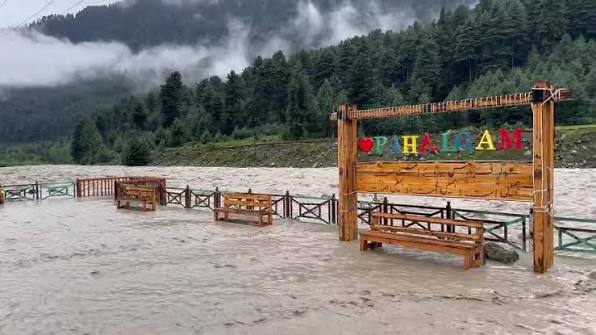
Localized Cloudburst Sends Floodwaters Through Tourist Hub, Prompting Emergency Response
By: News Desk | 11 July 2026
A sudden cloudburst over the forested hills surrounding Pahalgam in South Kashmir’s Anantnag district on Saturday evening (11 July 2026) triggered flash floods that swept through parts of the popular tourist destination, flooding hotels, residential houses and adjoining areas. The incident caused panic among residents and visitors during the peak summer tourist season, although authorities confirmed that no casualties or injuries were reported.
The heavy rainfall occurred over the upper catchments near Awoora and Dehwathu, close to the Overa Wildlife Sanctuary, sending a sudden surge of water into local streams that eventually overflowed into nearby habitations.
Swift action by the district administration, police, disaster management teams and power authorities helped prevent a larger disaster by evacuating tourists, cutting electricity supply in vulnerable areas and launching immediate rescue and assessment operations.
The incident once again highlights the growing vulnerability of Kashmir’s mountainous regions to extreme weather events that have become increasingly frequent over recent years.
Cloudburst Originated in Forest Catchment Near Overa Wildlife Sanctuary
Officials said the cloudburst struck the forested upper reaches of Awoora and Dehwathu, areas located above Pahalgam that drain into local streams feeding the Lidder River system.
A cloudburst is a highly localized weather phenomenon involving extremely intense rainfall within a very short duration. In mountainous terrain such as Kashmir, these sudden downpours can rapidly transform small streams into destructive torrents capable of carrying rocks, mud, tree debris and floodwater downstream.
Unlike seasonal floods that develop gradually, cloudburst-induced flash floods leave very little warning, making them particularly dangerous for tourists, residents and businesses located near rivers and nallahs.
Hotels, Houses and Tourist Facilities Inundated
The sudden surge of floodwater entered at least half a dozen hotels and several residential houses in and around affected localities.
Eyewitnesses described water rushing through hotel compounds, ground floors and surrounding roads, forcing hotel staff to move guests to higher floors before authorities shifted many tourists to safer accommodations.
Several boundary walls reportedly collapsed under the pressure of rushing water, while debris accumulated around buildings located close to natural drainage channels.
Although the flooding damaged private property, the absence of casualties was widely attributed to timely evacuation and the rapid response of local authorities.
Officials have begun assessing the extent of structural damage to hotels, homes, shops and public infrastructure.
Tourists Evacuated as Administration Launches Rescue Operations
Recognising the potential danger to hundreds of visitors staying in Pahalgam, district authorities immediately initiated evacuation measures.
Emergency teams coordinated with hotel operators to relocate tourists from vulnerable properties to safer accommodation away from overflowing streams.
Officials from multiple departments remained on the ground throughout the evening to monitor water levels and ensure that stranded visitors received assistance.
Pahalgam is one of Kashmir’s busiest tourist destinations during summer, attracting thousands of domestic and international visitors every week. The incident occurred during the peak tourism season when hotels are operating at high occupancy.
The swift evacuation prevented panic from escalating into a larger emergency.
Electricity Suspended to Prevent Electrocution
As a precautionary measure, the Power Development Department (PDD) shut down 11 KV electricity feeders originating from Batkoot Receiving Station.
Power supply was suspended in several vulnerable villages, including:
- Awoora
- Dehwathu (Dahwatoo)
- Laddi
- Batkoot
Officials said the temporary shutdown was necessary to eliminate the risk of electrocution in waterlogged areas and to allow rescue personnel to work safely.
Electricity restoration will depend on detailed inspections of transformers, power lines and distribution infrastructure after floodwaters recede.
District Administration Places All Departments on High Alert
Following the incident, the district administration activated emergency coordination involving several departments.
Officials deployed included:
- Sub-Divisional Magistrate (SDM), Pahalgam
- Naib Tehsildar, Sallar
- Flood Control engineers
- Revenue officials
- Power Development Department personnel
- Local disaster response teams
Their immediate priorities include:
Assessing Damage
Teams are surveying hotels, residential houses, roads and public utilities to estimate financial losses.
Monitoring Water Levels
Authorities continue monitoring streams and drainage channels as additional rainfall could trigger fresh flash floods.
Restoring Essential Services
Efforts are underway to restore electricity and ensure drinking water supply wherever infrastructure has been affected.
Providing Relief
Any families affected by property damage will be assessed for relief under applicable disaster management norms.
Agriculture Suffers Fresh Blow
While tourism received immediate attention because of visitor safety, agriculture has also suffered significant losses.
Initial reports indicate damage to:
- Paddy cultivation
- Apple orchards
- Vegetable fields
- Irrigation channels
Areas around Shangus and parts of Pahalgam have reported farmland inundation due to overflowing streams.
Agricultural experts caution that prolonged waterlogging during the growing season could reduce crop productivity if drainage is not restored quickly.
Revenue officials are expected to conduct detailed crop damage assessments before compensation proposals are prepared.
Lidder River and Mountain Streams Continue to Pose Risk
Although rainfall eased later in the evening, authorities warned that water levels remain high in several streams connected to the Lidder River.
Particular concern remains over:
- Overa Nallah
- Seasonal mountain streams
- Low-lying settlements
- Riverbank hotels
- Campsites near water channels
Even moderate rainfall in saturated catchments can trigger renewed flash flooding, especially where loose debris blocks natural drainage.
Officials have advised continuous monitoring until weather conditions stabilize.
Growing Pattern of Extreme Weather in Jammu and Kashmir
The latest cloudburst adds to a series of extreme weather events witnessed across Jammu and Kashmir over the past few years.
Environmental scientists note that the Himalayan region has experienced an increase in:
- Short-duration, high-intensity rainfall
- Flash floods
- Cloudbursts
- Landslides
- Glacial lake-related hazards
While no single weather event can be attributed solely to climate change, research indicates that a warming atmosphere can hold more moisture, increasing the likelihood of intense rainfall episodes over mountainous terrain. Combined with expanding construction near riverbanks, changing land use and fragile Himalayan geology, these events can significantly increase disaster risk.
Experts continue to stress the need for improved watershed management, scientific land-use planning, early warning systems and stricter enforcement of building regulations in ecologically sensitive tourist destinations like Pahalgam.
Tourism Sector Faces Fresh Challenge
The cloudburst comes during one of Kashmir’s busiest tourism seasons.
Although visitor safety was ensured, repeated incidents of flash floods can affect:
Hotel Operations
Ground-floor facilities and riverside accommodations remain vulnerable to sudden flooding.
Tourist Confidence
Weather-related disruptions may influence travel plans, particularly among families and elderly visitors.
Adventure Tourism
Activities near rivers, trekking routes and mountain trails may face temporary restrictions if weather conditions remain unstable.
Tourism stakeholders have appealed for better weather forecasting, improved drainage infrastructure and enhanced emergency preparedness to protect both visitors and businesses.
Safety Advisory for Residents and Tourists
Authorities have issued a fresh advisory urging the public to remain vigilant while rainfall continues across parts of South Kashmir.
For Tourists
- Avoid rivers, streams and waterfalls during rainfall.
- Stay only in authorised hotels and accommodations.
- Follow instructions issued by local authorities and hotel management.
- Postpone trekking and outdoor activities during adverse weather.
For Local Residents
- Keep away from overflowing streams and low-lying areas.
- Secure livestock and household belongings.
- Avoid unnecessary travel through flood-prone routes.
- Report damaged infrastructure immediately to local authorities.
For Drivers
- Never attempt to cross flooded roads or bridges.
- Drive cautiously on mountain roads due to the risk of landslides and falling debris.
Need for Long-Term Disaster Preparedness
Saturday’s cloudburst ended without loss of life, but it serves as another reminder of the increasing frequency of weather-related emergencies in Kashmir’s fragile Himalayan landscape.
As tourism expands and development reaches environmentally sensitive zones, experts say the focus must shift from emergency response to long-term resilience. Investments in advanced weather forecasting, flood early-warning systems, resilient infrastructure, riverbank protection, scientific urban planning and public awareness campaigns will be critical in reducing future risks.
The successful evacuation of tourists and coordinated response by multiple government agencies prevented what could have become a far more serious disaster. However, the incident underscores the importance of sustained preparedness as extreme weather events continue to test the resilience of mountain communities across Jammu and Kashmir.


