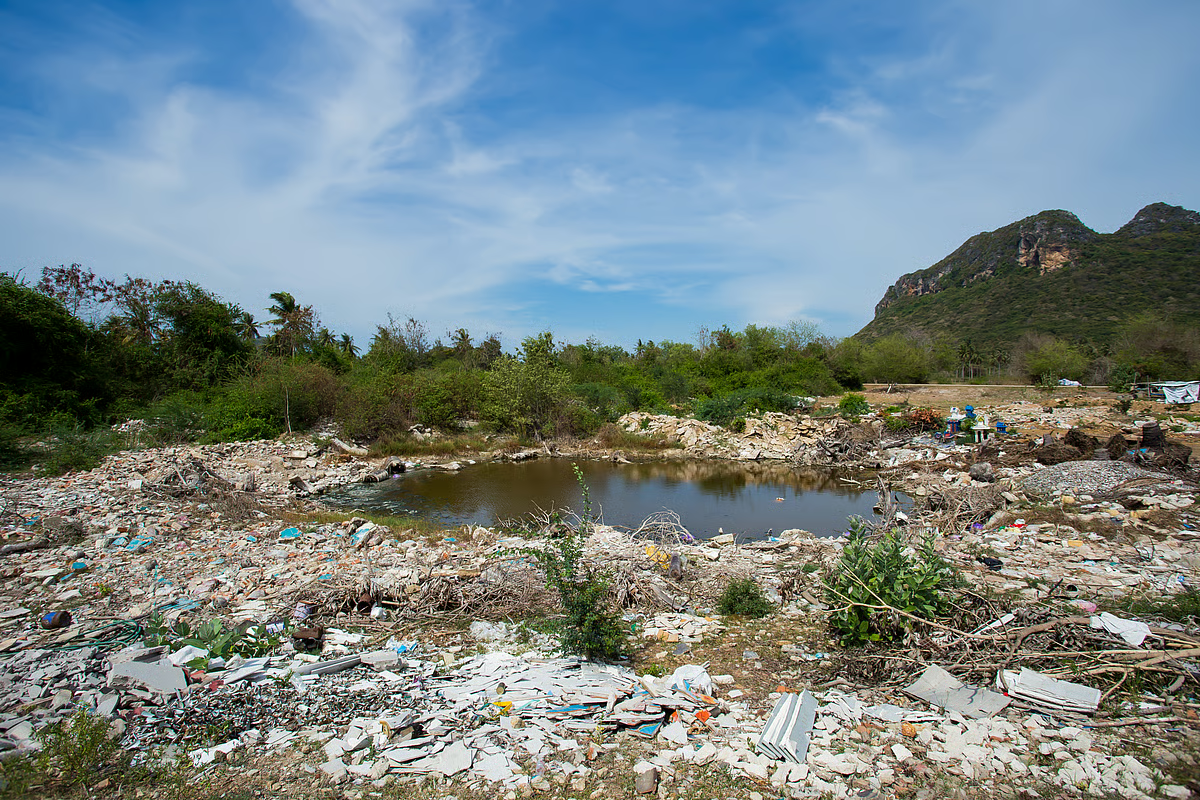
Srinagar’s Garbage Mountain: Inside the Achan Landfill Crisis Threatening Kashmir’s Tourist Capital
By: Javid Amin | 18 July 2026
The Smell That Won’t Let Srinagar Sleep
There is a particular kind of quiet that settles over Srinagar’s Syedabad and Saidapora neighbourhoods after dusk — not the peaceful hush of a Kashmiri evening, but the tight-lipped silence of families eating dinner with their windows shut. The reason sits less than a kilometre away, rising over the western edge of the city like an uninvited mountain: the Achan landfill.
For a city that markets itself to the world as India’s tourist capital — the gateway to Dal Lake, the Mughal gardens, and the snow-draped Zabarwan hills — Srinagar carries a second, far less flattering reputation. In the government’s own Swachh Survekshan 2025 rankings, Srinagar was placed 9th among India’s dirtiest cities in the over-one-million-population category, scoring just 7,488 points out of a possible high mark. It shared that uncomfortable list with cities like Madurai, Ludhiana, Chennai, and Greater Mumbai — a sobering reminder that scenic beauty and civic cleanliness don’t always travel together.
At the centre of this crisis sits Achan: a 123-acre dumping ground established in 1986, now buried under more than 11.5 lakh metric tonnes of legacy waste, still receiving roughly 550 tonnes of fresh garbage every single day. This is the story of how a wetland became a wasteland — and whether Srinagar can still turn it around.
The Scale of the Problem: What’s Actually Happening at Achan
Srinagar Municipal Corporation (SMC) generates close to 550–600 tonnes of solid waste daily, according to figures the J&K government itself has placed before the Legislative Assembly. Roughly 60 percent of this is wet, organic waste; the remaining 40 percent is dry waste — plastics, packaging, construction debris, and increasingly, biomedical waste that has no business ending up in an open dump.
Almost all of it, historically, has gone to one place: Achan. Since 1986, this single 123-acre site — originally part of the Syedpora wetland that once absorbed the overflow of the Jhelum river — has functioned as Srinagar’s only major landfill. Four decades of unscientific dumping later, the site holds an accumulated legacy waste pile officially pegged at 11.5 lakh metric tonnes, an almost incomprehensible volume that residents now literally live in the shadow of.
The gap between how much waste arrives and how much gets properly treated is where the real danger lies. Waste segregation at source — the basic first step of any scientific waste system — reportedly remains below 15 percent in practice, despite official claims of 100 percent door-to-door collection across all wards. Much of what should be sorted into wet, dry, and hazardous streams instead arrives at Achan as one undifferentiated mass, making scientific processing far harder and far more expensive than it needs to be.
A Wetland That Used to Breathe
It’s easy to treat “landfill” as an abstract policy term. On the ground, it means something specific and painful. Achan sits on land that was once part of a living wetland system feeding Anchar Lake, Khushal Sar, Gil Sar, and — downstream — the Ramsar-protected Hokersar and Shallabugh wetlands. Anchar Lake alone used to stretch across roughly 19 square kilometres. Today, choked by encroachment, sewage, and landfill leachate, it has shrunk to around 7 square kilometres.
The human cost of that shrinkage is stark. In the 1990s, fishing families around Anchar supplied 800–1,000 kilograms of fish daily to Srinagar’s markets. Today, that catch has collapsed to roughly 50 kilograms a day — most of it unsellable because of contamination concerns. Farmers growing nadru (lotus stem) and vegetables along the lake’s edges describe crops that taste different, canals that once ran clear now carrying black leachate, and harvests that weaken season after season.
Why the Landfill Is a Health and Environmental Emergency
Toxic Leachate: The Poison Nobody Sees
When organic and mixed waste decomposes in an uncovered, unlined dump, it produces leachate — a dark, foul liquid loaded with heavy metals, ammonia, and organic pollutants. At Achan, the leachate treatment plant meant to neutralise this liquid before it reaches the environment has been repeatedly flagged by inspectors as “non-functional.” The National Green Tribunal’s own review teams — comprising members from the Central Pollution Control Board, the National Wetlands Committee, and the J&K Pollution Control Committee — filed a report in mid-2024 expressing “serious concern” over the lack of segregation, the untreated leachate flowing straight into Anchar Lake, and an inadequate green buffer zone around the site.
The Jammu and Kashmir Pollution Control Committee has independently confirmed the same pattern: untreated leachate contaminating groundwater and wetlands, including the ecologically sensitive Anchar and Dal lake systems. This isn’t a hypothetical risk. It is happening, continuously, every day the plant sits idle.
The Health Toll on Nearby Families
Ask residents of Achan, Syedabad Colony, or the wider Shehar-e-Khaas (downtown) area what living next to the landfill feels like, and the answers are remarkably consistent: an “unbearable” stench that seeps through sealed windows and curtains, chronic coughing, skin irritation, headaches, and nausea. Doctors at SKIMS Soura and SMHS — two of Kashmir’s largest hospitals, both located close to the landfill — have reported rising cases of asthma and bronchitis among people in surrounding neighbourhoods.
The concern has escalated well beyond anecdote. SKIMS administration has sent repeated formal communications to the Srinagar Municipal Corporation flagging the public health risk. In response, the J&K Assembly’s Environment Committee has ordered a full health impact assessment of communities living around Achan — a rare and telling escalation for what is, on paper, a municipal solid waste issue.
Legal Accountability Is Finally Catching Up
The regulatory response has been slow but is no longer symbolic. In 2017, the NGT had originally directed the SMC to build a 5-MW waste-to-energy plant within 18 months, backed by a penalty of ₹50,000 per day for delay — a plant that, years later, still hasn’t materialised. Frustration over that failure, and a 2024 petition filed by Kashmir-based environmental activist Dr Raja Muzaffar Bhat, pushed the NGT to take the matter far more seriously.
The consequences have been real: the NGT reportedly imposed a ₹12 crore fine on the SMC over more than 1,800 days of continuous violations of Solid Waste Management norms. The J&K Pollution Control Committee has gone a step further, filing complaints against eight former municipal commissioners under the Environment (Protection) Act, 1986, for their role in the mismanagement. The Tribunal has now set a hard deadline: Achan’s legacy waste must be scientifically remediated, and leachate and odour-control systems must be fully operational, by March 2027.
The Cleanup: Can ₹361 Crore Turn Achan Around?
For the first time in years, Achan’s crisis has been matched with financing of a scale that reflects the size of the problem.
The ₹361-Crore Integrated Solid Waste Management Project
In May 2026, the J&K Council of Ministers, led by Chief Minister Omar Abdullah, approved an 800 TPD Integrated Solid Waste Management (ISWM) Project at the Saidapora Achan dump yard, carrying an estimated cost of ₹361 crore. It is being developed under a Public-Private Partnership model and forms the centrepiece of a wider ₹433-crore urban sanitation push that also covers used-water management projects in Baramulla and Rajouri.
The project’s Detailed Project Report has been technically vetted by the National Institute of Technology (NIT), Srinagar, and is designed to lift Srinagar’s scientific processing capacity to 800 tonnes per day — comfortably above current daily generation — while modernising every link in the chain: collection, segregation, treatment, resource recovery, and environmentally compliant disposal. Officials say the target is 100 percent scientific waste processing by 2027, in line with the NGT’s own deadline and the framework of Swachh Bharat Mission (Urban) 2.0.
Biomining: Digging Kashmir Out From Under Decades of Trash
Alongside the new processing facility, the SMC has launched a large-scale biomining and bioremediation programme targeting the roughly 11.5 lakh metric tonnes of legacy waste already piled at Achan. Biomining is essentially controlled excavation: old, decomposed waste is dug up, sorted using trommel machines and ballistic separators, and separated into recoverable soil, inert material, refuse-derived fuel, and recyclables — instead of simply being left to leach into the ground indefinitely.
On the ground, this work has already begun. Windrow formation and civil works are underway, and machinery — including three trommel machines and one ballistic separator — has been installed and made operational for segregating and processing legacy waste. The biomining contract has been awarded to a specialised agency, with the process expected to take roughly two years to substantially clear the historic waste pile. Alongside this, the SMC has committed to planting over 3,200 trees to create a green buffer around the facility, and is rolling out three Garbage Transfer Stations with a combined capacity of over 367 tonnes per day to support decentralised waste handling, complete with localised composting and pre-sorting units.
As recently as July 2026, J&K Chief Secretary Atal Dulloo personally visited the Achan Integrated Waste Management Facility to review progress — a sign that the project is being tracked at the highest levels of the administration, not left to drift the way earlier promises did.
What the New National Rules Could Add
Timing may work in Srinagar’s favour here. India’s Solid Waste Management Rules, updated in 2026, push cities toward a more accountable, circular model — mapping every legacy dumpsite, filing quarterly progress updates through a single online tracking portal, and applying a “polluter pays” principle that makes waste generators bear more of the real cost of disposal. For Achan, this could mean neighbourhood-level composting and recycling hubs that reduce the load reaching the landfill in the first place, private investment in waste-to-energy and material recovery facilities, and citizen-facing tools — like mobile apps — that let residents track collection and segregation in real time. Whether these frameworks translate into on-ground change in Srinagar, though, will depend entirely on implementation — historically the weakest link in the chain.
Governance Failures: Why Trust Is in Short Supply
It would be misleading to present this purely as a story of inadequate funding. Srinagar’s waste crisis has just as much to do with execution failures stretching back two decades. Ground reporting dating to 2004 has documented how successive municipal regimes failed to operationalise scientific waste disposal at Achan, even as the city’s daily waste load grew year after year. Leachate treatment plants have been built and then left non-functional. A promised waste-to-energy plant, ordered by the NGT in 2017, still doesn’t exist. Segregation infrastructure exists on paper — twin bins, transfer stations — but source segregation compliance remains under 15 percent in practice.
This history explains why many residents and civil society voices are cautiously skeptical of the new ₹361-crore project, however well-designed it looks in planning documents. Stakeholders quoted in recent reporting have called for an independent civil society oversight committee to monitor the biomining and ISWM rollout, precisely because past promises collapsed once media attention moved on. It’s a reasonable ask: a city that has watched deadlines slip for twenty years has earned the right to demand transparency, not just announcements.
The Tourism Question: Can Srinagar Afford This Image?
Srinagar’s economy leans heavily on tourism — houseboats on Dal Lake, shikara rides, the Mughal gardens, and the broader identity of Kashmir as “paradise on earth.” A landfill visible from residential rooftops, a shrinking, polluted Anchar Lake, and a national ranking among India’s dirtiest cities sit awkwardly against that branding.
The risk isn’t abstract. Visitors increasingly research destinations through the same environmental and sanitation lens they apply to hotels and flights. A city that appears in “dirtiest cities” headlines even occasionally risks reputational damage that outlasts any single news cycle — and that damage compounds every tourist season the landfill remains uncontained. For a Union Territory actively trying to grow tourist arrivals and investment, cleaning up Achan isn’t just an environmental obligation; it’s an economic one.
What Residents Are Saying
Behind every statistic in this story is a household making daily compromises most Indians never have to think about. In Syedabad Colony, families report eating dinner with windows sealed against the smell. In villages along Anchar Lake’s shrinking shoreline, fishermen like those interviewed in recent ground reports describe watching their livelihoods disappear in real time — daily catches that have fallen by 90 percent or more since the 1990s. Farmers speak of crops that taste noticeably different, a change subtle enough to dismiss until you hear it repeated by cooks and restaurant owners across the same neighbourhood.
These aren’t complaints about inconvenience. They are descriptions of a slow-moving public health and livelihood crisis that has, for years, received far less attention than Srinagar’s more photogenic landmarks.
Outlook: A Narrow Window to 2028
There is a genuine, if fragile, case for optimism here. If the biomining programme meets its roughly two-year timeline and the ₹361-crore ISWM facility comes online as planned, Srinagar could realistically reach 100 percent scientific waste processing by 2027 and begin reclaiming parts of Achan as usable, even ecologically restored, land by 2028. The NGT’s binding deadline, the Chief Secretary’s direct oversight, and a legally vetted project design all suggest this round of promises carries more institutional weight than previous ones.
But the risks of falling short remain very real. Segregation compliance needs to rise dramatically from its current low base for any downstream processing system to work efficiently. Leachate treatment has to run continuously, not intermittently, to stop the ongoing damage to Anchar Lake and connected wetlands. And accountability mechanisms — ideally including the independent civil society oversight that residents and activists are calling for — need to be built into the process from the start, not added after the next round of NGT censure.
Until then, Achan remains what it has been for four decades: a daily test of whether Srinagar’s administration can match its environmental promises with environmental performance. The city’s global image as a tourist paradise, and the health of tens of thousands of residents living in its shadow, depend on the answer.
This report draws on Legislative Assembly disclosures, National Green Tribunal filings, Swachh Survekshan 2025 data, and ground reporting on communities living around the Achan landfill and Anchar Lake.


