Mehbooba Mufti Alleges BJP Is ‘Communalizing’ 1931 Martyrs’ Legacy After House Arrest on July 13
By: Javid Amin | 13 July 2026
PDP Chief Says Restrictions on Visiting Martyrs’ Graveyard Contradict Claims of ‘Normalcy’ in Jammu & Kashmir
A fresh political confrontation unfolded in Jammu and Kashmir on July 13, 2026, after People’s Democratic Party (PDP) president Mehbooba Mufti alleged that the Bharatiya Janata Party (BJP) was attempting to “communalize the legacy of the 1931 martyrs”, following restrictions that prevented opposition leaders from participating in Martyrs’ Day commemorations.
Mehbooba Mufti, who was reportedly placed under house arrest at her Srinagar residence ahead of the observance, condemned the administration’s decision to bar political leaders from visiting the Martyrs’ Graveyard at Naqshband Sahib. Security barricades and restrictions were imposed around the area as part of heightened security arrangements.
In a strongly worded statement, the former Chief Minister paid tribute to the 22 Kashmiris killed on July 13, 1931, describing them as symbols of sacrifice against autocratic rule while accusing the BJP of attempting to reinterpret a significant chapter of Kashmir’s political history through a communal lens.
What Happened on July 13?
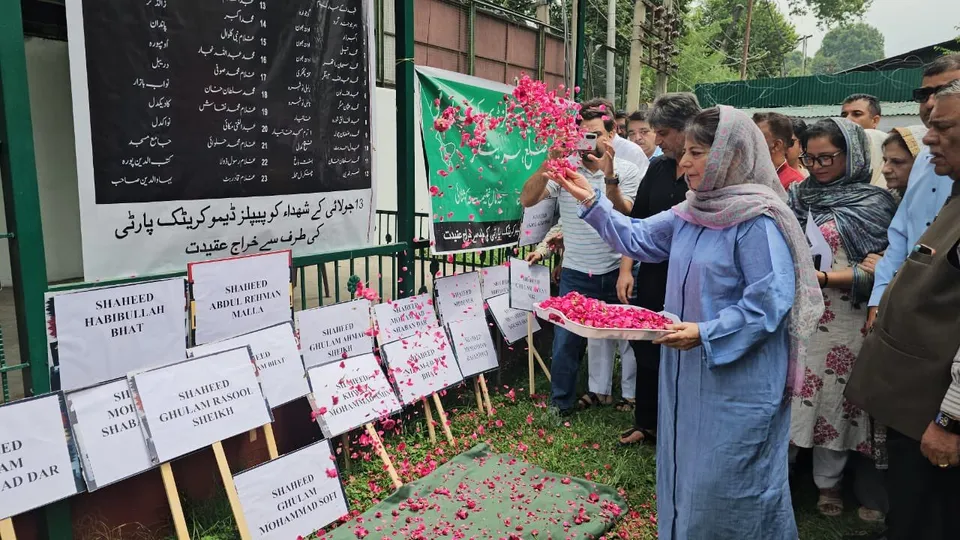
Ahead of the annual observance of Martyrs’ Day, authorities imposed preventive restrictions in parts of Srinagar, particularly around the Naqshband Sahib Martyrs’ Graveyard, where political leaders have traditionally paid floral tributes.
According to the PDP, Mehbooba Mufti was confined to her residence and prevented from travelling to the graveyard. Similar movement restrictions were also reported for several other opposition leaders.
While the administration did not immediately issue a detailed statement specifically addressing Mehbooba Mufti’s reported house arrest, security restrictions around July 13 have been imposed in previous years, with authorities citing law-and-order concerns.
Unable to attend the commemoration in person, Mehbooba issued a public statement paying homage to the 22 people who lost their lives during the events of July 13, 1931.
Mehbooba Mufti’s Accusation Against the BJP
The PDP chief accused the BJP of attempting to reshape the historical significance of the 1931 uprising by portraying it through a communal narrative.
According to Mehbooba Mufti:
- The 1931 martyrs represented resistance against autocratic governance rather than any communal cause.
- Their sacrifice should be remembered as part of Kashmir’s democratic and political history.
- Restricting commemorations weakens democratic traditions.
- Preventing elected leaders from paying respects contradicts official claims of political normalcy.
She argued that denying access to the Martyrs’ Graveyard reflects a broader attempt to control historical narratives and limit political expression.
These remarks represent Mehbooba Mufti’s political position. The BJP has consistently rejected similar accusations in the past and has maintained that administrative restrictions are imposed solely on security grounds.
Who Were the 1931 Martyrs?
A Defining Moment in Kashmir’s Political History
The events of July 13, 1931, occupy a significant place in Kashmir’s political history.
On that day, 22 protesters were killed outside Srinagar Central Jail during demonstrations against the Dogra monarchy. The incident became a turning point in the region’s political awakening and contributed to demands for representative governance and political reforms.
For decades, successive governments in the erstwhile State of Jammu and Kashmir officially observed July 13 as Martyrs’ Day, with state leaders paying tributes at the Martyrs’ Graveyard.
However, following the reorganisation of Jammu and Kashmir in August 2019, the day was removed from the official holiday calendar, and state-sponsored commemorations were discontinued.
Despite this, regional political parties such as the PDP and the National Conference continue to commemorate the anniversary, viewing it as an important part of Kashmir’s political memory.
Restrictions and the Debate Over ‘Normalcy’
Mehbooba Mufti linked the restrictions on political leaders with the government’s repeated assertions that normalcy has returned to Jammu and Kashmir.
According to her, genuine democratic normalcy should include:
- Freedom to peacefully commemorate historical events.
- Equal political rights for opposition parties.
- Freedom of movement for elected representatives.
- Respect for democratic traditions and public remembrance.
The administration, on the other hand, has consistently maintained that security measures around sensitive anniversaries are precautionary steps intended to prevent disruptions and maintain public order.
Government’s Position
Although there was no detailed official response specifically addressing Mehbooba Mufti’s criticism at the time of publication, authorities have generally defended restrictions imposed around politically sensitive anniversaries as necessary security measures.
The government has repeatedly highlighted indicators such as:
- Improved security conditions.
- Record tourism.
- Infrastructure development.
- Economic investments.
- Democratic electoral processes.
These achievements are presented by the administration as evidence that Jammu and Kashmir has witnessed increasing stability in recent years.
Political Significance of the Controversy
Competing Narratives Over History
The latest dispute illustrates a continuing political contest over how the events of 1931 should be remembered.
For regional parties like the PDP and the National Conference, the martyrs symbolize resistance against autocratic rule and the struggle for democratic rights.
The BJP and its supporters have, over the years, offered different interpretations of the historical context surrounding the events, leading to ongoing political debate.
As a result, July 13 remains one of the most politically sensitive dates in Jammu and Kashmir.
Opposition Strategy
Political analysts believe the PDP is likely to continue highlighting restrictions on political activity to reinforce its argument that democratic freedoms remain constrained in post-2019 Jammu and Kashmir.
By linking the issue to both historical memory and civil liberties, the party seeks to broaden the political debate beyond a single day’s commemoration.
Public Sentiment
Martyrs’ Day continues to evoke strong emotions among many people in Kashmir.
Supporters of commemorations argue that remembering historical events is an important part of preserving collective memory.
Others believe that security considerations justify administrative restrictions on sensitive occasions.
The differing viewpoints ensure that the anniversary remains a recurring source of political debate each year.
Political Analysis: History, Memory and Contemporary Politics
The controversy surrounding Mehbooba Mufti’s reported house arrest extends beyond administrative restrictions. It reflects the broader struggle over historical narratives, political identity and democratic space in Jammu and Kashmir.
For the PDP, the restrictions reinforce its claim that political expression is being curtailed. For the administration, preventive measures are presented as essential for maintaining law and order during sensitive anniversaries.
The dispute also highlights how historical events continue to influence contemporary politics, with different parties interpreting the legacy of 1931 in ways that align with their respective political positions.
What Happens Next?
The developments likely to be watched closely include:
- Whether the administration issues a detailed explanation for the restrictions.
- Reactions from the National Conference and other regional parties.
- Statements from the BJP responding to Mehbooba Mufti’s allegations.
- Whether political leaders continue to press for unrestricted observance of July 13 in future years.
- The broader debate over democratic freedoms, historical remembrance and public order in Jammu and Kashmir.
Conclusion
Mehbooba Mufti’s allegation that the BJP is “communalizing” the legacy of the 1931 martyrs, coupled with her reported house arrest ahead of July 13 Martyrs’ Day, has reignited debate over political freedoms, historical memory and governance in Jammu and Kashmir. While the PDP views the restrictions as evidence of shrinking democratic space, the administration has historically defended such measures as necessary to maintain law and order.
The differing interpretations of both the events of 1931 and the restrictions imposed on commemorations underscore the complex and deeply contested nature of Kashmir’s political landscape. As with many issues in the region, the controversy reflects competing narratives that continue to shape public discourse well beyond the anniversary itself.