A grocery bag that cost ₹1,000 in January now barely fills half a basket in July. Across Srinagar, Anantnag, Baramulla and beyond, families are quietly recalculating what they can still afford — and what they can’t.
By: Javid Amin | 17 July 2026
There’s a particular kind of exhaustion that comes from watching prices climb every time you step into a market. Not the dramatic kind that makes headlines overnight, but the slow, grinding kind — the sort that shows up in a shorter grocery list, a skipped chicken dinner, a school fee paid a week late. Talk to almost anyone in the Kashmir Valley right now — a shopkeeper in Lal Chowk, a mother in Nowhatta, a daily-wage mason in Anantnag — and the conversation eventually drifts to the same place: “Sab kuch mehenga ho gaya hai.” Everything has become expensive.
This isn’t just a feeling. It’s backed by numbers, by market data, and by the frustrated voices of vendors and consumers alike who have watched Kashmir’s cost of living climb sharply through the first half of 2026. This feature breaks down exactly what’s changed, why it’s happening, and what it means for the ordinary Kashmiri household trying to make ends meet.
The Big Picture: What’s Really Happening to Prices in Kashmir
India’s Wholesale Price Index (WPI) — the yardstick economists use to track how fast the cost of goods is rising nationally — climbed to 9.87 percent in June 2026, up from 9.68 percent in May, according to the Commerce and Industry Ministry. That’s a startlingly high number for a country whose retail inflation is usually managed closer to 4-5 percent. Officials pointed to petroleum products, food articles, and basic metals as the biggest drivers of this spike.
The root cause traces back to a crisis far from the Valley’s orchards and rice fields: the West Asia conflict and disruptions around the Strait of Hormuz, the narrow waterway through which most of India’s crude oil flows. The sharp rise in WPI inflation reflects the impact of the West Asia crisis and its spillover effect on food prices nationwide. Fuel and power inflation alone touched 30.33 percent in May, one of the sharpest jumps recorded in years.
For a region like Kashmir, this national shock lands with extra force. The Valley depends almost entirely on road transport through the Jammu-Srinagar highway for everything from cooking gas to medicines — a single landslide or highway closure can send local prices spiralling within days, regardless of what’s happening in Delhi or Mumbai.
Six Months, One Shrinking Rupee: A Price Comparison You Can Feel in Your Wallet
Ground reporting from local markets, cross-checked against live commodity-price trackers and news reports from Kashmir-based outlets, paints a consistent picture: prices of nearly every daily-use item have moved firmly in one direction — upward. Here’s how key essentials have shifted over roughly the last six months.
| Essential Item | Approx. Jan 2026 Price | Approx. Jul 2026 Price | Change | What’s Driving It |
|---|---|---|---|---|
| Chicken (1 kg, skinless) | ₹160–170 | ₹180–225 | Up sharply | Feed costs, unregulated retail pricing, mutton scarcity pushing demand toward poultry |
| Mutton (1 kg) | ₹740–750 | ₹785–820 | Up moderately | Livestock supply constraints, transport costs |
| Petrol (per litre, Srinagar) | ~₹100 | ~₹108–109 | Up ~8% | Crude oil price shock, dynamic daily pricing |
| Domestic LPG (14.2 kg cylinder) | ~₹969 | ~₹1,058 | Up ~9% | Global crude linkage, freight costs into the Valley |
| Tomatoes (1 kg) | ₹35–40 | Highly volatile, ₹40–80+ depending on locality | Sharp swings | Deregulated pricing, supply gaps from outside J&K |
| Private school fees (monthly) | Varies by school | Up in most reported cases | Case-by-case hikes | Institutions bypassing Fee Fixation & Regulation Committee (FFRC) norms |
| Essential medicines | Regulated NLEM drugs largely stable | Non-scheduled drugs up 10–20% in parts | Mixed | Import-dependent raw materials, West Asia supply disruption |
A quick honesty note: some figures circulating on social media claim uniform 20–40 percent jumps across every single item. Ground data tells a more textured story — chicken and vegetables have genuinely spiked hard, while regulated essentials like NLEM medicines have risen only marginally. The pain isn’t evenly spread, but it’s real almost everywhere.
The Chicken Shock: A Case Study in What’s Going Wrong
Nothing captures Kashmir’s inflation story better than what’s happened to chicken — historically the “poor man’s protein” whenever mutton got too expensive. Consumers in Srinagar are now grappling with poultry selling between Rs 180 and Rs 200 per kg in several city markets, and in some areas even higher. One Srinagar resident put it bluntly: chicken was always the budget-friendly option whenever mutton became expensive, but now even chicken has gone beyond the reach of common people.
What makes this worse is the complete absence of oversight. Retailers said there was no uniform pricing mechanism in place, allowing shops to sell chicken at varying rates without any regulation, and poultry sellers themselves admit wholesalers are supplying chicken to them at higher rates, forcing them to pass the cost down. A resident from Khanyar summed up the frustration many share: earlier there used to be rate lists and some accountability, but today every shop charges according to its own will, leaving consumers at the mercy of the market.
Vegetables: The Deregulation Effect
Kashmir’s vegetable markets tell a similar story of unpredictability rather than steady inflation. A key structural fact often missed in casual conversation: until mid-2023, the Food Civil Supplies and Consumer Affairs (FCS&CA) Department regulated prices of essential goods, issuing a fixed price list that traders had to comply with. Since that control was lifted, prices are now set independently by traders and vendors, and costs have soared to unprecedented and inconsistent levels — with items like tomatoes selling at different rates within the same city. A Srinagar resident described the change starkly: earlier the price list kept vendors in check, but now it’s different every day, with no one ensuring prices stay fair.
Officials themselves acknowledge the region’s unique vulnerability. Kashmir’s limited transportation routes and frequent road closures due to weather make it heavily dependent on outside supplies, which is exactly why price control matters more here than in most other places. Without that safety net, a single landslide on the highway can turn a ₹35 tomato into an ₹80 one almost overnight.
Fuel: The Quiet Multiplier
Fuel doesn’t just cost more at the pump — it raises the price of everything that has to travel to reach a Kashmiri kitchen. In May 2026, residents across Kashmir voiced concern over repeated petrol and diesel price hikes, with rates rising nearly Rs 5 per litre in just ten days. A Srinagar resident, Owais Ahmad, captured the anxiety plainly: this was the third hike in ten days, and prices are being increased gradually, affecting common people badly. Locals warned the hikes would make daily commuting expensive and also push up the prices of essential commodities and transportation costs across the board — a warning that, months later, has largely played out.
School Fees: Regulation on Paper, Hikes in Practice
Education costs are rising in Kashmir through a particularly frustrating route: unauthorised hikes despite clear rules against them. Officially, no private school in Jammu and Kashmir can fix, collect, or increase fees without prior approval from the Fee Fixation and Regulation Committee (FFRC), and the government has repeatedly reiterated this in the Legislative Assembly. Yet despite clear government directions, some private schools have increased fees arbitrarily, drawing criticism from parents and raising questions over enforcement. One Srinagar parent’s complaint echoes across the Valley: “They increased the fee without any explanation. We were not informed about any approval.”
The problem, as one education commentator noted, isn’t just the fee amount — it’s the absence of a simple, transparent structure, since every school is treated the same when in reality they are very different in what they can justify charging.
Medicines: A Quieter but Real Squeeze
On paper, India’s price regulator kept a lid on essential drugs — the NPPA permitted only a marginal 0.65 percent hike on regulated medicines from April 2026, tied to the wholesale price index. But that stability applies mainly to the roughly 900 scheduled formulations under the National List of Essential Medicines. Beyond that list, the picture is murkier: the government has separately discussed an emergency, one-time price increase for nearly 300 essential medicines, driven by a sharp rise in pharmaceutical manufacturing costs linked to the West Asia conflict, since these drugs depend heavily on imported active pharmaceutical ingredients and petrochemical-derived solvents, whose prices have jumped 200-300 percent. In Kashmir specifically, hospitals have also reported supply-side stress — several private hospitals and oncology centres in the Valley have struggled to source certain chemotherapy drugs, pushing some patients toward costlier substitutes or delayed treatment.
The Household Reality: What This Looks Like at the Kitchen Table
Numbers on a chart are one thing; a mother deciding whether to buy chicken or lentils this week is another. Across Srinagar and district towns, the same patterns are showing up in household after household:
- Protein is the first casualty. With chicken crossing ₹180-200/kg and mutton holding above ₹750-800/kg, many families have quietly shifted to pulses, eggs, or smaller portions of meat reserved for weekends only.
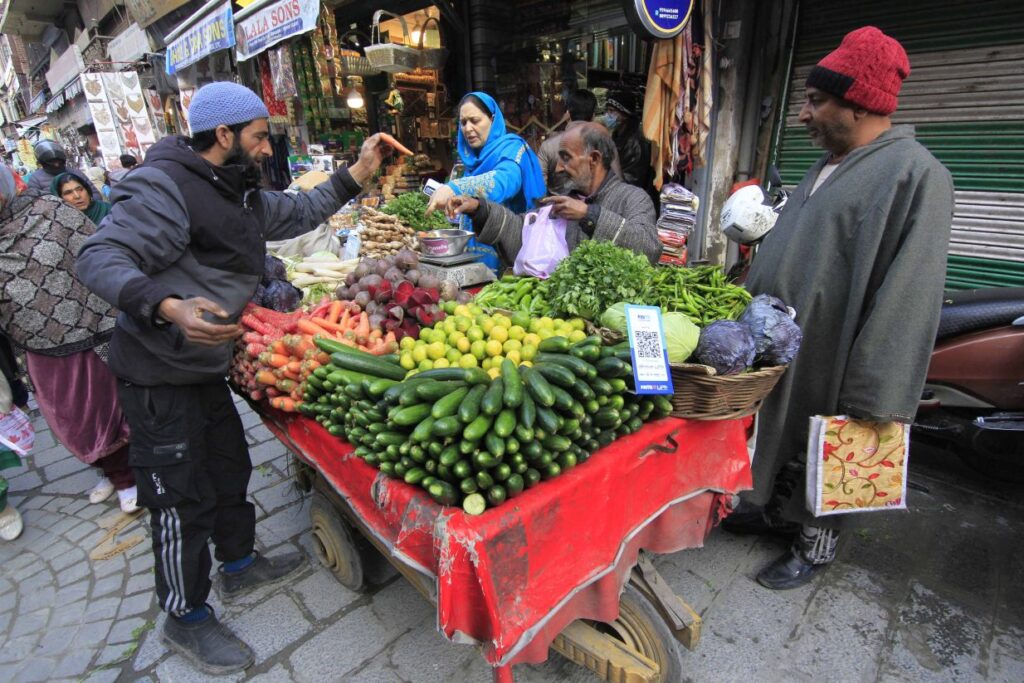
- Vegetable shopping has become a daily gamble. Because prices swing by the neighbourhood and by the day in the absence of a regulated rate list, households can no longer plan a weekly grocery budget with any real confidence.
- School fee arrears are piling up. Parents caught between unauthorised hikes and stagnant incomes are increasingly falling behind on payments, with some schools reportedly withholding results over unpaid dues — a practice the government itself has publicly criticised.
- Fuel costs ripple into everything. Every hike at the pump adds a small, invisible tax to transport-dependent goods — from LPG cylinders trucked in from outside the Valley to fruits and vegetables arriving from the plains.
- Medical bills are becoming less predictable. While regulated medicines remain broadly affordable, patients needing non-scheduled drugs or specific chemotherapy medications are facing higher out-of-pocket costs and occasional shortages.
Why Kashmir Feels Inflation Differently Than the Rest of India
Every region in India is dealing with the same national headwinds — the WPI numbers prove that. But Kashmir’s geography turns a national inflation story into something sharper and more personal.
Single-corridor dependency. Nearly everything that isn’t grown locally — cooking gas, fruits from the plains, packaged goods, medicines — travels up the Jammu-Srinagar National Highway. A landslide, a security closure, or heavy snowfall doesn’t just delay deliveries; it directly spikes prices within days, as officials themselves have acknowledged.
A regulation gap that opened at exactly the wrong time. The 2023 decision to step back from fixed-price lists for essential commodities removed a shock absorber right as national inflation pressures were building. What might have been a manageable price adjustment elsewhere in India has, in Kashmir, become an unregulated free-for-all in markets for chicken and vegetables.
A fee-regulation framework that exists but isn’t fully enforced. The FFRC mechanism for school fees looks solid on paper, but as government officials themselves admit, implementation lags behind policy — leaving parents to absorb hikes that were never technically authorised.
A local economy still finding its footing. With limited large-scale industry and a heavy reliance on seasonal tourism and agriculture, Valley households have less cushion to absorb sudden cost shocks compared to salaried populations in bigger metro economies.
What Can Actually Help: Short-Term Relief and Long-Term Fixes
There’s no single fix for a problem this layered, but a few directions consistently come up among economists, officials, and consumer advocates watching the situation:
In the short term:
- Reinstating a functional, publicly displayed price-monitoring mechanism for essential commodities like chicken, mutton, and vegetables — something closer to what existed before 2023.
- Stricter enforcement of the FFRC framework for school fees, including public disclosure of which schools have (and haven’t) received approval for hikes.
- Faster, more transparent communication of weekly rate bulletins so consumers aren’t left guessing.
In the long term:
- Investing in local production and cold-chain logistics to reduce Kashmir’s dependence on long-haul supply from outside the Valley.
- Strengthening cooperative and government-run retail outlets that can act as a price anchor when private markets overheat.
- Diversifying transport routes so a single highway closure doesn’t hold the entire Valley’s supply chain hostage.
For individual households, tracking official rate lists where they exist, buying seasonal and local produce over imported alternatives, and staying informed about FFRC-approved fee structures for schools can offer at least partial protection against the most avoidable price shocks.
The Bottom Line
Kashmir’s inflation story in 2026 isn’t a single villain — it’s not just the West Asia crisis, or just deregulation, or just fuel prices. It’s all of them, compounding in a region with less institutional cushioning and more logistical fragility than most of the country. The national WPI numbers explain part of the story; the empty rate-list boards in Srinagar’s markets explain the rest.
For the family deciding between chicken and lentils this week, none of that context makes the bill smaller. But understanding why prices are moving the way they are — and where the gaps in oversight actually lie — is the first step toward the kind of accountability that could, eventually, bring some predictability back to the Valley’s kitchens, classrooms, and clinics.
This report is based on cross-verified market data, government notifications, and reporting from Kashmir-based outlets including Greater Kashmir, Kashmir Observer, and Free Press Kashmir, alongside national commodity-price trackers and official WPI data from the Ministry of Commerce and Industry. Prices are indicative and may vary by locality, vendor, and day; readers are advised to check official Directorate of Food, Civil Supplies & Consumer Affairs (J&K) bulletins where available for the most current rates.