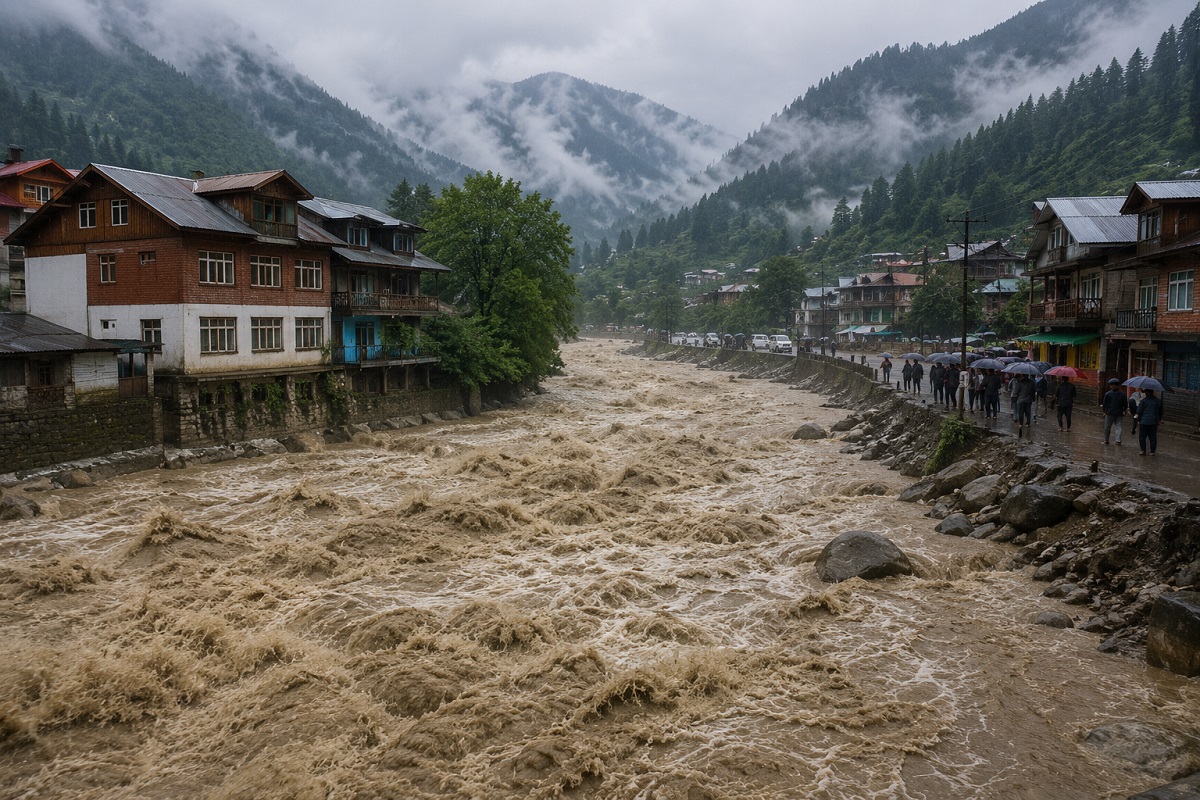
J&K Cloudbursts 2026: Inside the Himalayan Climate Crisis Killing Kashmir’s Monsoon Season
By: Javid Amin | 05 Aug 2025
There’s a particular kind of dread that’s settled over villages in the Chenab Valley this year. It’s not the sound of rain — Kashmir has always known rain. It’s the sound before the roar: a strange stillness, then a distant rumble that residents now recognise instantly as a cloudburst bearing down on them.
By early August 2026, that fear has a body count. Jammu and Kashmir has recorded more than 35 cloudburst incidents since the monsoon season began in June, and at least 31 people have lost their lives — swept away by flash floods, buried under landslides, or crushed as homes gave way in seconds. Officials, meteorologists and disaster response teams are unanimous on one point: this isn’t a bad monsoon. It’s a preview of the new normal for a warming Himalaya.
A Season Unlike Any Other
Ask anyone in Kishtwar, Poonch, or Rajouri, and they’ll tell you the same thing — the rain doesn’t behave the way it used to. It used to build. Now it arrives.
Official data shows the pattern accelerating through the season: at least 22 cloudbursts struck between June 1 and mid-July alone. Then, instead of tapering off, the second half of July and the opening days of August brought a fresh wave of extreme rainfall events, pushing the season’s total past 35. The Jammu division has borne the brunt of the fatalities, with Poonch, Rajouri, Kathua, Doda and Kishtwar emerging as the worst-affected districts, while Shopian and Kupwara in the Kashmir Valley have seen repeated flash flooding of their own.
The most devastating single stretch came over the weekend of July 19–20, when torrential overnight rain triggered simultaneous landslides and flash floods across the Poonch-Rajouri belt. Surankote tehsil in Poonch absorbed the worst of it. In one of the season’s most heartbreaking incidents, a family in Lower Murrah village lost eight members in a single night when a cloudburst-triggered landslide swept away their three-storey home. By the time rescue teams could take stock, at least 23 people were confirmed dead across the two districts, with several more reported missing as swollen rivers and damaged roads slowed search operations. Chief Minister Omar Abdullah cut short a trip to Delhi to return to Jammu as the scale of the disaster became clear.
Barely two weeks later, on August 1, a cloudburst tore through the Chatroo area of Kishtwar district, sending a wall of debris, uprooted trees and boulders crashing into homes and a local market. Houses cracked open, shops flooded, vehicles were carried off by the current, and power and mobile networks went dark for days while restoration crews worked to reconnect the area.
Further north, in Ladakh’s cold-desert terrain, cloudbursts around Drass and Kargil have caused streams to overflow their banks and blocked key roads — a sign that even the region’s drier zones aren’t immune anymore. And in Kashmir’s Lolab valley, flash flooding claimed at least one life, part of a string of incidents that have also struck Bandipora and Gurez this season.
The Season at a Glance
| Region | Cloudburst Activity | Consequences |
|---|---|---|
| Kashmir Valley (Shopian, Bandipora, Gurez, Lolab, Kupwara) | Multiple events, July–August | Flash floods, homes inundated, at least one death in Lolab |
| Jammu Division (Poonch, Rajouri, Doda, Kishtwar, Kathua) | Season’s deadliest cluster, mid-July onward | 23+ deaths in the July 19–20 disaster alone; Chatroo (Kishtwar) hit hard on Aug 1; homes, shops, bridges destroyed |
| Ladakh (Drass, Kargil) | Several events through July | Overflowing streams, road blockages |
| Overall J&K | 35+ cloudbursts since June | 31 confirmed deaths; farmland, roads, bridges and irrigation channels damaged across districts |
Why Is This Happening? The Science Behind the Sky’s Fury
To understand why Kashmir’s monsoon has turned so violent, you have to understand what’s happening thousands of feet above the valley floor — where two very different weather systems are now colliding with unusual frequency.
Monsoon meets Western Disturbance. Normally, Jammu and Kashmir experiences two distinct weather influences: the southwest monsoon, which brings moisture-laden winds up from the Arabian Sea and Bay of Bengal, and Western Disturbances, storm systems that originate over the Mediterranean and typically bring winter precipitation. These two systems aren’t supposed to overlap much. But in recent years, climatologists have observed them interacting more often during the summer months — and when a moisture-heavy monsoon current runs into a Western Disturbance over the mountains, the atmosphere becomes highly unstable. That instability is a primary trigger for the sudden, violent rainfall we call a cloudburst.
The mountains make it worse. Kashmir’s geography does the rest of the damage. As moist air is forced upward along the steep slopes of the Himalayas — a process known as the orographic effect — it cools rapidly and condenses into towering convective clouds. These clouds can dump extraordinary volumes of rain over a tiny area in a very short window; meteorologists classify a cloudburst as roughly 100mm of rainfall in under an hour, concentrated within just a few square kilometres. That combination of intensity and small footprint is exactly what makes cloudbursts so lethal and so hard to predict.
Climate change is loading the dice. Layered on top of this natural mechanism is a physical law that’s becoming impossible to ignore: for every 1°C rise in atmospheric temperature, the air can hold approximately 7% more moisture. That extra moisture doesn’t disappear — it eventually falls, and increasingly it falls all at once. Research on rainfall trends across central India has documented a threefold increase in widespread extreme rainfall events between 1950 and 2015, while Himalayan cloudburst frequency is estimated to have risen by roughly 50% when comparing the 1981–2000 period to 2001–2020. The Himalayas, notably, are warming faster than the global average — which means this region is effectively at the front line of a trend playing out more slowly elsewhere.
The Human Factor Nobody Wants to Talk About
Climate change may be loading the gun, but human activity is often what pulls the trigger on the scale of destruction. Decades of deforestation across the Himalayan foothills have stripped away the root systems and vegetation cover that once helped soil absorb sudden downpours and hold steep slopes together. Unregulated road-cutting through fragile mountainsides has destabilised terrain that was never built to withstand repeated shock. And construction on floodplains and riverbanks — often driven by tourism demand and unplanned urban growth — has placed homes, hotels and shops directly in the path of water that has nowhere else to go when a cloudburst hits upstream.
None of this causes a cloudburst. But all of it decides how much damage one does once it arrives.
What’s Still at Risk
The immediate death toll tells only part of the story. Disaster management officials have flagged several districts — including Ramban, Reasi and Kupwara — as sitting on especially vulnerable slopes, where the next intense rainfall event could trigger fresh landslides with little warning.
Agriculture has taken a quiet but serious hit. Paddy fields and orchards across multiple districts have been submerged repeatedly this season, threatening both immediate harvests and the longer-term soil health farmers depend on year after year. Tourism, one of the region’s economic lifelines, hasn’t been spared either — landslides have repeatedly cut off routes to Pahalgam, Gulmarg and parts of Ladakh, stranding travellers and disrupting an industry that much of the Valley’s economy leans on.
Perhaps the most frustrating challenge is forecasting itself. Even with Doppler radar and satellite monitoring now standard tools for India’s meteorological agencies, cloudbursts remain notoriously difficult to predict with precision. Their defining characteristic — intense rainfall concentrated over a very small, localised area — means that broader regional forecasts can be accurate while still failing to warn a specific village of what’s about to hit it. It’s a gap that scientists and disaster planners are actively working to close, but for now, it means early warning systems can only do so much.
There’s also a broader shift underway in how the monsoon itself behaves. Climate change appears to be making seasonal rainfall more erratic across the board — not necessarily reducing overall totals, but redistributing them unevenly, producing flooding in some pockets while other areas face dry spells in the same season. For a region as topographically complex as Jammu and Kashmir, that unevenness translates directly into unpredictability on the ground.
Staying Safe When the Sky Turns
With the monsoon still active and more rainfall expected in the coming weeks, disaster management authorities are urging residents and visitors alike to take precautions seriously:
- Avoid riverbanks, streambeds and mountain passes during and immediately after heavy rainfall — flash floods can arrive with almost no visible warning.
- Keep an emergency kit ready, including essentials that don’t rely on power or connectivity, since cloudbursts frequently knock out electricity and mobile networks.
- Farmers should secure livestock early and store food, fodder and essential supplies in elevated, secure locations.
- Follow official channels — district administration alerts and India Meteorological Department (IMD) bulletins remain the most reliable source of real-time warnings, and should guide decisions on travel and movement.
The Bigger Picture
Strip away the district names and death tolls, and this season tells a story that extends well beyond Jammu and Kashmir’s borders. It’s a story about what happens when a fragile mountain ecosystem — already stressed by deforestation, unplanned construction and shifting land use — collides with a climate system that’s warming faster in the Himalayas than almost anywhere else on Earth.
The overlap between monsoon currents and Western Disturbances isn’t going away. Neither is the extra 7% of atmospheric moisture that comes with every degree of warming. What can change is how prepared the region is to absorb the next cloudburst — through stronger early warning infrastructure, more careful development on vulnerable slopes, and a monsoon season that, increasingly, has to be treated less like weather and more like a recurring emergency.
For the families in Surankote, Chatroo and a dozen other villages already mourning this season, that shift can’t come soon enough.
This article is based on official data from Jammu and Kashmir’s disaster management authorities, IMD bulletins, and verified ground reports current as of early August 2026. Death tolls and incident counts reflect the most recently confirmed figures and may be revised as rescue and assessment operations continue.


