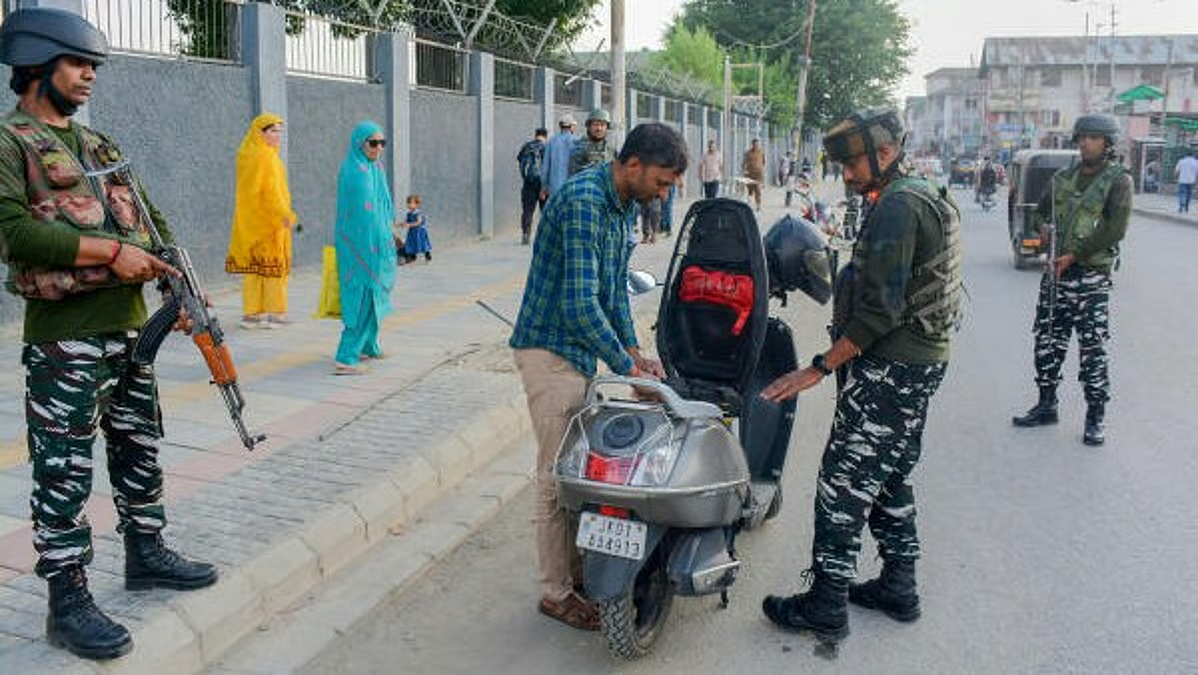
Tight Security in Srinagar as Kashmir Marks Seventh Anniversary of Article 370 Abrogation
By: News Desk | 05 Aug 2025
Srinagar remained under an extensive security blanket on August 5, 2026, as authorities stepped up preventive measures to mark the seventh anniversary of the abrogation of Article 370. With opposition parties observing the day as “Black Day”, police and security agencies intensified deployment across the city to prevent large-scale gatherings and maintain public order.
Additional contingents of the Jammu & Kashmir Police and Central Armed Police Forces (CAPFs) were deployed at key locations, while roadblocks, surveillance systems, and drone monitoring formed part of a comprehensive security strategy. Despite restrictions, opposition leaders staged symbolic protests, underscoring the continuing political significance of the anniversary.
Article 370 Anniversary Remains a Sensitive Political Milestone
August 5 marks the anniversary of the Union Government’s 2019 decision to revoke the special constitutional status of the erstwhile State of Jammu & Kashmir and reorganize it into the Union Territories of Jammu & Kashmir and Ladakh.
The constitutional move fundamentally altered the region’s administrative structure and has since remained one of India’s most debated political decisions.
While the Central Government maintains that the move strengthened national integration, improved governance, and accelerated development, several regional political parties continue to regard it as the loss of Jammu & Kashmir’s constitutional identity and democratic autonomy.
This divergence in political narratives has made August 5 one of the most closely watched dates in Kashmir’s political calendar.
Heavy Security Deployment Across Srinagar
Authorities implemented multi-layered security arrangements across Srinagar to prevent any disruption to law and order.
Large numbers of police personnel and paramilitary forces were stationed at sensitive locations throughout the city, particularly in commercial centres and areas that have historically witnessed political demonstrations.
Security deployment was especially visible in:
- Lal Chowk
- Residency Road
- Polo View
- Downtown Srinagar
- Major government installations
- Entry and exit points to the city
Senior police officers remained on the ground to monitor the situation and coordinate security operations throughout the day.
Roadblocks and Checkpoints Strengthened
Police erected barricades at strategic intersections while increasing vehicle inspections across Srinagar.
Roadblocks were established at important entry points leading to the city centre, with commuters subjected to identity verification and random vehicle checks.
Frisking operations were intensified in crowded public spaces as authorities sought to discourage unauthorized gatherings and ensure uninterrupted public movement.
Officials stated that these preventive measures were part of standard security protocols followed during politically sensitive occasions.
Drone Surveillance and CCTV Monitoring
Security agencies supplemented ground deployment with advanced surveillance systems.
Drones were deployed to monitor movement in sensitive areas, while CCTV networks across Srinagar remained under continuous observation.
Officials also maintained close monitoring of social media platforms and messaging applications to detect any attempts to organize unauthorized demonstrations or circulate misinformation that could affect public order.
The integration of technology into policing reflects an increasing emphasis on preventive security management during major political events.
Restrictions on Public Gatherings Remain in Force
Authorities had earlier declined permission for political rallies and mass demonstrations across Jammu & Kashmir ahead of the anniversary.
The administration cited law-and-order considerations while imposing restrictions on public gatherings.
Although formal permissions were denied, several political parties proceeded with limited symbolic programmes to register their opposition to the constitutional changes introduced in 2019.
Officials maintained that the restrictions were intended to ensure peaceful observance of the day and prevent any untoward incidents.
PDP Holds Candlelight Vigil Despite Restrictions
Despite the restrictions, the Peoples Democratic Party (PDP) organized a symbolic candlelight vigil and sit-in protest outside its headquarters in Srinagar.
The demonstration was led by Mehbooba Mufti, who reiterated the party’s opposition to the abrogation of Article 370 and described the anniversary as a reminder of what the PDP views as a constitutional setback for Jammu & Kashmir.
The protest remained largely symbolic and reflected the party’s effort to continue expressing its political position despite administrative restrictions.
Other regional parties, including the National Conference, Apni Party, and Awami Itihaad Party, also observed August 5 through symbolic programmes in different parts of the Valley.
Contrasting Political Narratives Continue
The anniversary once again highlighted the contrasting political narratives surrounding Article 370.
| Aspect | Current Situation | Political Significance |
|---|---|---|
| Opposition Response | Black Day observances and symbolic protests | Reinforces demand for constitutional safeguards and statehood |
| Government Position | Focus on security and public order | Emphasizes stability, governance, and post-2019 development |
| Public Sentiment | Mixed reactions across different sections of society | Reflects continuing political polarization |
| Security Strategy | Preventive deployment and surveillance | Aims to prevent unrest and maintain normalcy |
These differing perspectives continue to define political discourse in Jammu & Kashmir seven years after the constitutional changes.
Security and Politics Intersect on August 5
The anniversary illustrates the close relationship between security planning and political developments in the Union Territory.
For security agencies, the priority remains preventing violence and ensuring normal public life.
For opposition parties, the anniversary serves as an opportunity to reiterate demands for the restoration of constitutional safeguards, democratic rights, and statehood.
The coexistence of heavy security arrangements and symbolic political protests demonstrates how August 5 continues to be both a law-and-order challenge and a significant political event.
Outlook
The extensive security deployment in Srinagar reflects the administration’s continued focus on maintaining peace during one of the most politically sensitive anniversaries in Jammu & Kashmir.
While restrictions limited the scale of public demonstrations, symbolic protests—including the PDP’s candlelight vigil—demonstrated that the debate over Article 370 remains central to the region’s political discourse.
As the Central Government continues to project the post-2019 period as one of greater integration, stability, and development, regional political parties remain committed to highlighting demands for constitutional safeguards and the restoration of statehood. The anniversary is therefore expected to remain a focal point of political debate and public attention in the years ahead.
Key Highlights
- Srinagar witnessed heavy police and CAPF deployment on the seventh anniversary of the abrogation of Article 370.
- Barricades, checkpoints, frisking operations, drones, and CCTV surveillance were deployed across sensitive locations.
- Authorities denied permission for large political rallies, citing preventive security measures.
- The PDP, led by Mehbooba Mufti, held a symbolic candlelight vigil and sit-in protest despite restrictions.
- Opposition parties continued to observe August 5 as “Black Day”, while the government maintained its emphasis on law and order and post-2019 normalcy.
- The anniversary once again highlighted the continuing political divide over Article 370 and Jammu & Kashmir’s constitutional future.

