J&K Reservation Row: Iltija Mufti’s ‘Merit Apartheid’ Charge Reopens the Battle Over Jobs, Quotas and Regional Representation
By: Javid Amin | 20 September 2026
Srinagar: Jammu and Kashmir’s reservation debate has returned to the political centre stage, but this time the argument is no longer confined to percentages printed in government notifications.
It is increasingly about something far more politically sensitive: who gets a chance to enter the government system, how merit is measured, whether regional representation is being distorted, and whether a reservation framework created through successive legal and constitutional changes has gone too far for open-merit aspirants.
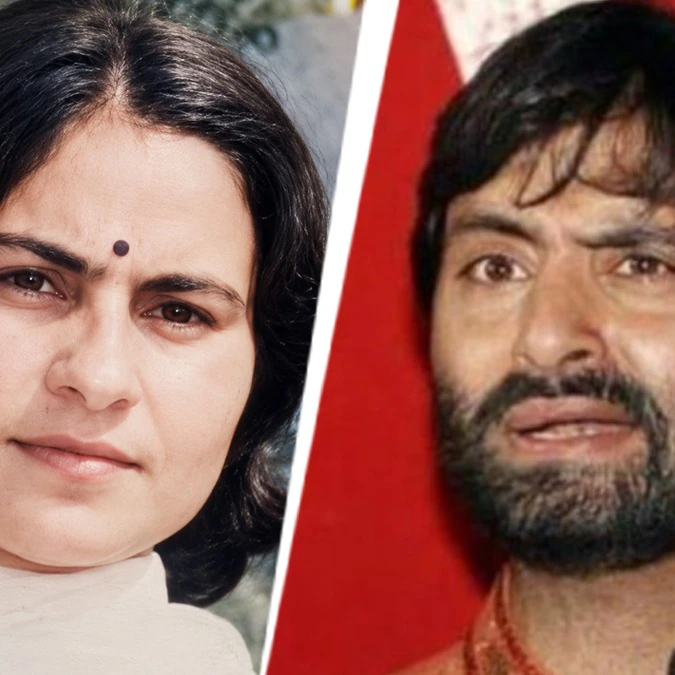
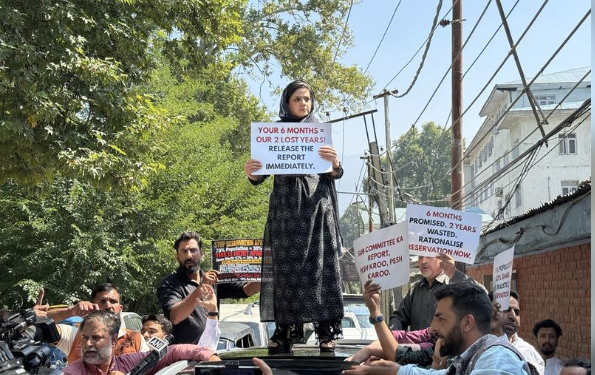
The latest flashpoint came after Peoples Democratic Party (PDP) leader Iltija Mufti accused the National Conference-led Jammu and Kashmir government of failing to resolve the concerns of open-merit candidates and demanded that the findings of the Cabinet Sub-Committee on reservation be made public.
Addressing a protest in Srinagar on September 19, Mufti described what she alleged was an “institutional” exclusion of Kashmiri youth and used the phrase “merit apartheid” to attack the existing recruitment framework. These are political allegations, not findings established by any government inquiry.
Her intervention comes at a particularly sensitive moment.
Only days earlier, Peoples Conference president Sajad Gani Lone had raised another dimension of the same controversy after the appointment of 55 officers to the Jammu and Kashmir Administrative Service and J&K Accounts (Gazetted) Service. Lone said only 10 of the 55 selected officers were from the Kashmir Valley, amounting to roughly 18 per cent of the appointments.
The two developments have converged into a single political question:
Has J&K’s reservation architecture begun producing a regional imbalance in government recruitment, or are political parties using individual recruitment results to challenge a system designed to address historic social and economic disadvantage?
The answer cannot be found in slogans alone.
It requires looking at how Jammu and Kashmir reached the present 70-per-cent reservation structure, what the review committee actually did, what the government has proposed, and what the latest recruitment data really shows.
The reservation debate is back—and this time the numbers are doing the talking
The controversy has acquired fresh momentum because two different sets of numbers have emerged.
The first concerns the reservation structure itself.
Under the framework currently applicable to direct recruitment, Jammu and Kashmir has 8 per cent reservation for Scheduled Castes, 20 per cent for Scheduled Tribes, 8 per cent for Other Backward Classes, 10 per cent for Residents of Backward Areas, 4 per cent for residents of areas adjoining the Line of Actual Control/International Border, and 10 per cent for Economically Weaker Sections.
Together, these vertical reservations account for 70 per cent, leaving 30 per cent as the open-merit share in the commonly cited recruitment structure.
The 6 per cent reservation for ex-servicemen and 4 per cent for persons with disabilities are horizontal reservations and therefore should not simply be added to the 70 per cent as though they were separate blocks of posts.
That distinction is important.
Public debate often reduces the entire system to a simple “70 per cent reserved versus 30 per cent open” formula. Recruitment rosters, however, are more complicated. Horizontal reservations cut across vertical categories, while reserved-category candidates who qualify on general merit can, subject to the applicable rules, be selected against open-merit positions rather than consuming a reserved slot.
Nevertheless, the 70:30 figure has become the central political shorthand for the grievance of open-merit aspirants.
For thousands of candidates preparing for JKPSC, JKSSB and other government recruitment examinations, the argument is straightforward: the number of positions they can directly compete for has fallen sharply compared with the older system.
That perception has become a major source of anger.
What actually changed in 2024?
One of the most important corrections to the popular narrative is that the current reservation structure did not originate with the Omar Abdullah government.
The major expansion followed legal and constitutional changes implemented during the Lieutenant Governor-led administration.
In March 2024, the J&K Administration amended the reservation rules following changes to the Scheduled Tribes framework and recommendations concerning socially and educationally backward classes.
The Scheduled Tribe share was increased to 20 per cent, divided into two broad 10-per-cent segments. The existing ST communities retained one 10-per-cent segment, while another 10-per-cent segment was created for newly added Scheduled Tribes, including the Pahari Ethnic Group, Paddari Tribe, Koli and Gadda Brahmin communities following the relevant parliamentary constitutional amendments.
At the same time, the OBC quota was increased to 8 per cent, while the broader reservation architecture retained 8 per cent for SCs, 10 per cent for RBA, 4 per cent for ALC/IB and 10 per cent for EWS.
The result was a system in which the vertical reserved share reached approximately 70 per cent, leaving 30 per cent for open merit in direct recruitment.
This is where the current political dispute begins.
It is therefore inaccurate to portray the 2024 expansion as an initiative of the present elected government. The Omar Abdullah administration inherited the framework—but later inherited the political responsibility of reviewing it.
That distinction is crucial to understanding the current PDP attack.
From Pahari reservation to a 70% quota structure
Jammu and Kashmir’s reservation story is considerably older than the latest controversy.
Over the years, different categories were introduced or expanded to address geographical isolation, social and educational backwardness, economic disadvantage and historical under-representation.
The Pahari question itself did not begin in 2024.
Pahari-speaking people had previously received a reservation under earlier arrangements, while the demand for Scheduled Tribe status continued for years. The 2024 constitutional changes subsequently brought the Pahari Ethnic Group, along with several other communities, into the Scheduled Tribe framework.
The policy therefore represents the accumulation of several different forms of affirmative action rather than one single decision.
That accumulation is precisely what open-merit organisations have challenged.
Their argument is not necessarily that reserved communities should receive no protection. Rather, many open-merit campaigners argue that the overall structure needs recalibration so that reservation does not leave an excessively small competitive pool for candidates outside the reserved categories.
The counterargument is equally important.
Supporters of the existing system contend that reservation cannot be assessed merely by counting percentages. They argue that historically disadvantaged communities, geographically isolated populations and economically weaker sections may continue to require institutional protection even where their numbers are significant.
That is why the debate is much larger than “merit versus reservation.”
It is ultimately about what constitutes a fair starting point in a society where candidates do not necessarily begin from equal social, economic or educational conditions.
Why Omar Abdullah’s government created the Cabinet Sub-Committee
The political pressure intensified after the National Conference-led government took office.
Open-merit students had already been protesting against the expanded reservation framework. In December 2024, the government constituted a Cabinet Sub-Committee to examine the issue and consider rationalisation of the reservation system.
The committee was headed by Social Welfare and Education Minister Sakeena Itoo.
The government’s stated approach was not to abolish reservation but to examine grievances and determine whether the existing distribution could be rationalised.
By June 2025, the committee had completed its work.
Itoo announced that the report had been prepared and would be placed before the Cabinet. The report was subsequently tabled before the Council of Ministers and went through further examination.
This is another point where the political narrative has become blurred.
The report was not simply sitting unfinished inside the committee for two years.
The more accurate description is that the report was completed and submitted, but the recommendations did not translate quickly into an operationally revised reservation framework.
That delay is now at the heart of the opposition’s criticism.
The report became the missing piece of the political puzzle
For students and job aspirants, the problem is not merely that the reservation system is controversial.
It is that they do not know what the government intends to do about it.
The full Cabinet Sub-Committee report has not been publicly released as a detailed policy document. That has created space for competing claims about what the committee recommended.
Reporting in 2025 indicated that the committee recommended increasing the open-merit share by reducing allocations in some other categories.
By December 2025, the J&K Cabinet approved a proposal based on the committee’s recommendations and sent it onward for consideration. Reports indicated a reduction in the EWS and RBA shares that would increase the open-merit component by 10 percentage points.
The broad proposal was therefore aimed at moving the system away from the existing 30-per-cent open-merit share.
But the precise public discussion became complicated because different reports described the proposed open-merit share differently depending on the recruitment/admission context and the way the revised categories were being calculated.
That is one reason the full report matters.
Without seeing the document, candidates are left interpreting announcements, media reports and political statements.
For a policy affecting thousands of careers, that is an uncomfortable level of uncertainty.
The Cabinet approved the proposal—but the dispute did not end there
The next stage was even more politically complicated.
In December 2025, the J&K Cabinet cleared the reservation rationalisation proposal and forwarded it for the next level of approval.
By March 2026, the government told the Legislative Assembly that the Cabinet Sub-Committee report was still under consideration before the competent authority and that no specific implementation timeline had been fixed.
In June, Chief Minister Omar Abdullah said the J&K government had responded to clarifications sought by the Centre and that the Cabinet would consider the response. He said the elected government had completed its responsibility and that the proposal had been referred onward after the Cabinet approved it.
That sequence is politically significant.
It means the reservation file has passed through several stages:
Committee review → report submission → Cabinet consideration → Cabinet approval → further scrutiny/clarifications → continued uncertainty over implementation.
For students, however, bureaucratic distinctions matter less than the outcome.
Until a revised notification takes effect, the existing framework continues to govern recruitment.
And that is why protests have not disappeared.
Then came the 55-officer recruitment controversy
The reservation debate received another jolt in September 2026 after the government distributed appointment orders to 55 newly selected officers.
The appointments included 28 Junior Scale JKAS officers and 27 Accounts Officers of the J&K Accounts (Gazetted) Service. Chief Minister Omar Abdullah distributed the appointment orders at an official function on September 15.
Soon after, Sajad Lone highlighted the regional composition of the selection.
According to Lone, only 10 of the 55 selected officers were from the Kashmir Valley.
That works out to approximately 18.2 per cent.
Lone contrasted that figure with the Valley’s roughly 56 per cent share of the population and described the outcome as “recruitment apartheid.”
PDP leaders subsequently raised similar concerns.
But this number needs careful interpretation.
The 55 officers were selected through a competitive examination—not through a regional quota system. The fact that only 10 candidates came from the Valley does not, by itself, establish that candidates were excluded because they were Kashmiri.
A recruitment outcome can be regionally uneven for many reasons, including the number of applicants, examination performance, category composition, preferences, vacancies, cut-offs and the operation of reservation rosters.
Therefore, the 18 per cent figure is a fact about the composition of that particular selection as reported by political leaders; the claim that it proves institutional discrimination is an interpretation that requires additional evidence.
That distinction is essential.
The deeper data point: Open Merit selections have also fallen
The regional representation controversy is not the only data point putting pressure on the government.
A more directly relevant figure has emerged from the Jammu and Kashmir Public Service Commission’s annual reporting.
According to reporting based on the JKPSC annual report, the Commission recommended 623 candidates in 2025-26 under recruitment based exclusively on written examination.
Of these, 275 were from the Open Merit category, representing 44.14 per cent.
The comparable figure in 2024-25 was 286 Open Merit candidates out of 407 recommendations, or 70.27 per cent.
That represents a substantial year-on-year change in the composition of recommendations.
But even this figure needs context.
The total number of recommendations increased from 407 to 623—an increase of more than half. At the same time, selections across several reserved categories also rose.
For example, recommendations in RBA increased from 24 to 68; SC recommendations increased from 25 to 55; ST-I recommendations rose from 37 to 69; and ST-II recommendations went from zero in the previous year to 68 in 2025-26.
In other words, the fall in the Open Merit percentage occurred alongside a major expansion in the number of candidates recommended across multiple categories.
That makes the data politically important—but it does not by itself establish why each candidate was selected or rejected.
It does, however, strengthen the case for the government to publish comprehensive recruitment data.
Why “merit” is more complicated than a cut-off mark
The political power of the word “merit” comes from its apparent simplicity.
A candidate studies for years, sits an examination and obtains a score.
But public recruitment in a reservation system does not operate as one giant ranking list.
Candidates are considered under different categories and rosters. Reserved-category candidates may also qualify on general merit. Horizontal reservations can cut across vertical categories. Vacancies can differ from one recruitment cycle to another.
This means that a candidate securing a particular rank cannot always assume that the same rank would produce the same outcome under a different category or recruitment year.
The problem becomes particularly difficult when the public does not have access to complete data.
A transparent debate would require publication of:
- total applicants by category;
- candidates qualifying at each stage;
- category-wise cut-offs;
- final selections;
- open-merit selections;
- reserved-category candidates selected on open merit;
- district/division-wise representation;
- vacancy distribution;
- backlog vacancies; and
- the number of posts affected by horizontal reservations.
Without that information, both sides can selectively use numbers that support their preferred narrative.
Jammu versus Kashmir: The regional dimension cannot be ignored
The latest controversy has also exposed a second layer beneath the reservation debate: the long-running question of regional representation.
The Kashmir Valley has a larger population than the Jammu region according to the 2011 Census-era population distribution, while government employment is distributed through category, roster and recruitment rules rather than a simple population-proportion formula. Official Census data provides the underlying district-level population framework, but there is no rule that every government recruitment batch must mirror the population share of each region.
This distinction matters because comparing 18 per cent recruitment representation with 56 per cent population share is a political argument, not a legal test of fairness.
A population-proportional system would itself be a different policy choice.
The reservation system was created primarily around social and educational categories, not a straightforward Jammu-versus-Kashmir regional quota.
Yet the regional effect of the policy is increasingly becoming impossible to ignore.
Some of the communities receiving substantial reservation benefits have historically been concentrated in particular geographical areas. That can produce regional consequences even when the law is formally category-based rather than region-based.
This is why the current debate has become politically explosive.
What looks like a technical quota question in a government notification can quickly become a question of regional power.
PDP’s attack puts Omar Abdullah’s government in a difficult position
The PDP’s criticism is politically sharper because the National Conference had promised to rationalise reservation.
The party now in government therefore cannot simply point to the previous administration and walk away from the controversy.
At the same time, the NC government inherited a framework shaped by decisions taken before it returned to office.
This creates a political paradox.
The government is being held responsible for a reservation structure it did not create, while simultaneously being held responsible for failing to change it quickly.
For the PDP, this is an opportunity to challenge the NC on youth employment and governance.
For the NC, the challenge is more delicate.
It must balance the anger of open-merit aspirants with the interests of communities that regard their reservation as an important safeguard against under-representation.
Any significant reduction in one quota immediately creates a political constituency that feels it is losing something.
That is why the government has moved cautiously.
The beneficiaries of reservation have a different argument
The open-merit debate can easily become one-sided if the other half of the policy argument is ignored.
Reservation exists because governments have historically found that formal equality does not necessarily produce substantive equality.
A candidate from a socially disadvantaged community may technically be eligible for the same examination as everyone else while having had very different access to schooling, coaching, infrastructure, economic security or professional networks.
The same logic applies differently to communities living in remote or frontier areas.
Jammu and Kashmir’s reservation architecture therefore reflects several different policy objectives at once.
The challenge is that these objectives have accumulated over time.
The government must now determine whether the combined structure remains proportionate and evidence-based.
That is exactly where the Cabinet Sub-Committee’s report should become important.
The missing ingredient is reliable, publicly available data
One of the most striking features of the controversy is how little comprehensive data is available to the public.
The Union government told Parliament in 2026 that reservation data for states and Union Territories is not centrally maintained in one consolidated database, while also detailing the reservation structure applicable in J&K. The government further said no fresh socio-economic or caste-based census had been conducted in the UT after the recent reservation amendments.
That creates a structural problem.
How can policymakers determine whether a quota is excessive, insufficient or properly calibrated without current data on representation?
How can they establish whether a community remains under-represented?
How can they determine whether the benefits are reaching the intended population?
And how can citizens judge whether the system is working?
These are not merely political questions.
They are questions of public administration.
What the government should put in the public domain
Whatever decision ultimately emerges, the political temperature could fall considerably if the government releases the underlying evidence.
The most consequential document is the Cabinet Sub-Committee report.
But publication of the report alone may not be enough.
A credible transparency package would ideally include the committee’s methodology, category-wise representation data, recruitment outcomes, vacancy rosters and the rationale for every proposed percentage.
The government could also explain precisely why particular categories were chosen for reduction or retention.
Such transparency would allow the public to move away from competing slogans—“merit apartheid” on one side and “social justice” on the other—and examine the policy on evidence.
That would not eliminate disagreement.
But it would make the disagreement more meaningful.
What happens next could shape J&K’s recruitment politics for years
The reservation dispute is unlikely to disappear with one notification.
Even if the open-merit share is increased, questions about regional representation will remain.
If reservation is retained at its current level, open-merit organisations are likely to continue demanding further review.
If the government reduces EWS or RBA allocations, communities dependent on those categories may challenge the decision.
If the ST structure is left untouched, the political argument surrounding its 20-per-cent share will continue.
And if the government ultimately introduces a revised system, the new rules themselves could become the subject of litigation or political mobilisation.
The debate is therefore entering a phase where the government needs more than political messaging.
It needs a defensible policy architecture.
The real test is not whether one side wins the reservation argument
Jammu and Kashmir’s reservation controversy cannot be reduced to a contest between “merit” and “quota.”
The real policy challenge is more difficult.
The administration has to reconcile social justice, constitutional protections, regional representation, economic disadvantage and competitive opportunity within a single recruitment framework.
That requires evidence rather than rhetoric.
The latest political attacks have made the issue impossible to ignore. Iltija Mufti’s demand for publication of the reservation review report has put transparency back at the centre of the debate, while the 55-officer recruitment figures and the latest JKPSC annual-report data have supplied fresh ammunition to those questioning the existing structure.
But the numbers also demand caution.
Ten Kashmir Valley candidates out of 55 is a striking regional outcome, yet it does not by itself prove discrimination. A 44.14-per-cent Open Merit share in one year’s written-examination recommendations is a significant change, but it does not by itself establish that merit was deliberately suppressed.
Those conclusions require a much larger dataset.
And that is ultimately why the Cabinet Sub-Committee report matters.
For students who have spent years preparing for government examinations, the report is not merely another government file.
It represents the possibility of finally understanding what the government believes is wrong with the present system—and what it intends to do about it.
Until that becomes public and the revised policy, if any, is formally notified, Jammu and Kashmir’s reservation debate will remain exactly what it has become over the past two years: a contest over percentages on paper, but underneath it, a much deeper argument about opportunity, representation and the future of the region’s educated youth.