‘Political SRO-43 Beneficiary’: Sunil Sharma’s Attack on Omar Abdullah Opens a New Front in J&K Politics
By: News Desk | 17 September 2026
Srinagar: The political confrontation between Jammu and Kashmir Chief Minister Omar Abdullah and Leader of Opposition Sunil Sharma has taken a distinctly personal turn, with the BJP leader describing the Chief Minister as a “political SRO-43 beneficiary” and questioning whether Omar Abdullah’s political standing would remain the same without the Abdullah family name.
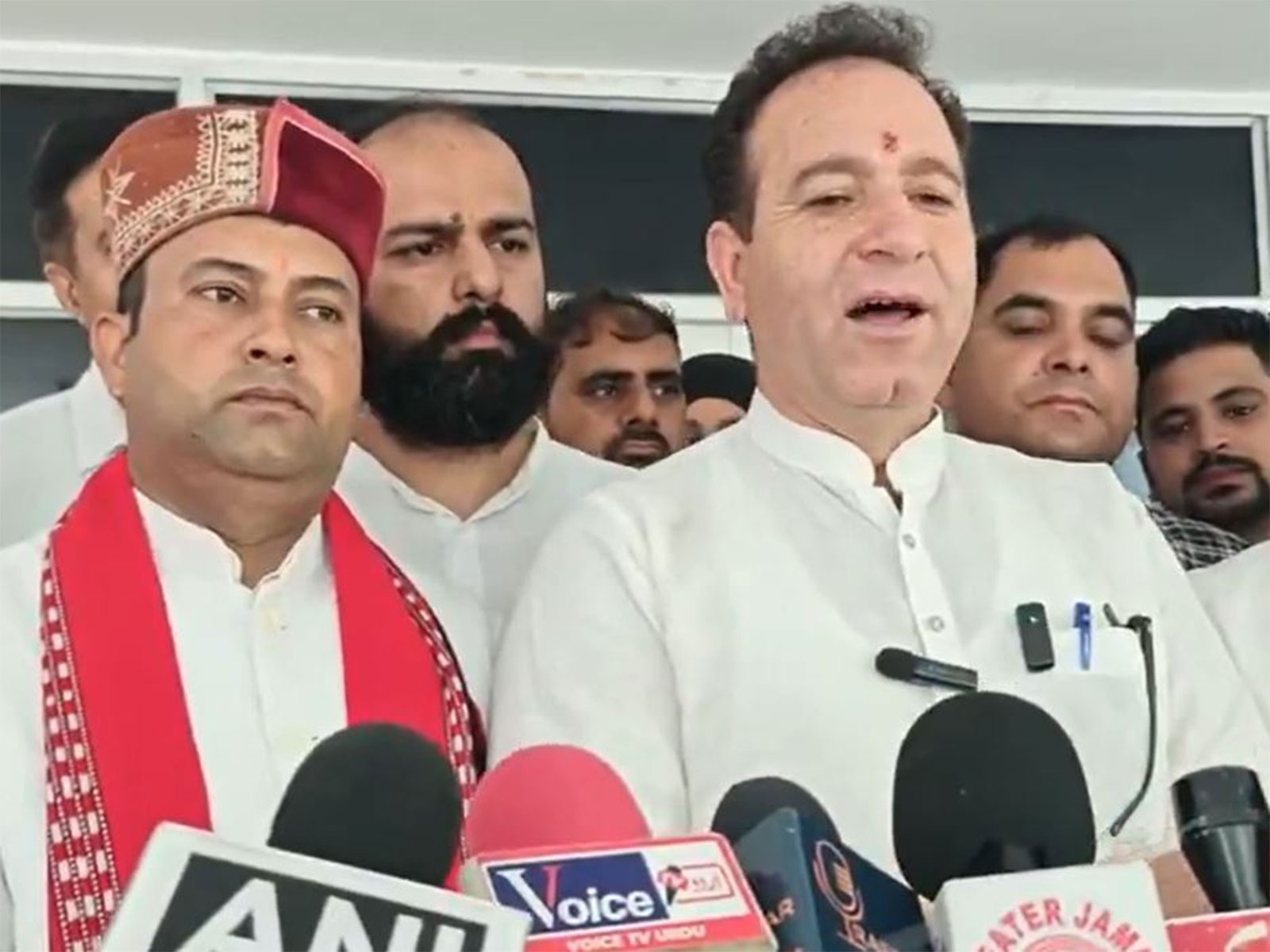
Sharma made the remarks on September 16 while speaking to reporters in Baramulla, launching a broader attack on the National Conference government and its political leadership. He contrasted what he described as his own middle-class background with Omar Abdullah’s family legacy, accused the Abdullah family of being “power hungry” and argued that the NC government was using the demand for restoration of statehood to deflect attention from governance questions.
The phrase “political SRO-43 beneficiary” was clearly intended as a political metaphor rather than a literal claim that Omar Abdullah received an appointment or financial compensation under SRO-43.
That distinction matters.
SRO-43 of 1994 is a government framework for compassionate appointments, primarily intended to provide employment to eligible family members of persons killed in militancy-related incidents and certain other qualifying circumstances. The Jammu and Kashmir General Administration Department continues to process applications under SRO-43, with verification notices issued as recently as 2026.
Sharma’s attack therefore uses the emotional weight of a policy associated with families affected by violence to make a much broader argument about political inheritance, dynasty and the legitimacy of the Abdullah family’s continued influence in J&K politics.
What exactly did Sharma mean?
Sharma’s argument was not that Omar Abdullah had literally benefited from SRO-43.
Rather, he used the expression to portray the Chief Minister as someone whose political career has benefited from circumstances and family legacy rather than having been built solely through individual political struggle.
According to reports of his remarks, Sharma said Omar considers himself a “prince” while Sharma comes from a middle-class background. He then questioned why Omar should not respond to questions from the Leader of Opposition and described him as a “political SRO-43 beneficiary.”
The political message is straightforward:
Sharma is trying to turn the Abdullah family’s long association with J&K politics from an asset into an issue of political entitlement.
The attack is therefore less about SRO-43 itself and more about the longstanding question of dynastic politics in the National Conference.
What is SRO-43 actually?
The reference has considerable emotional and political weight because SRO-43 is not an ordinary government employment scheme.
The Jammu and Kashmir Compassionate Appointment Rules, 1994 were notified through SRO-43 dated February 22, 1994. The rules provide a mechanism for compassionate appointment of eligible family members in circumstances specified by the government, including deaths connected with militancy.
The policy was designed around a particular reality of J&K: families could lose their principal breadwinner because of militancy-related violence or certain forms of service-related death.
Government records show that the policy has continued to operate decades later.
The J&K General Administration Department was still issuing notices in 2026 for verification of the character and antecedents of applicants seeking compassionate appointments under SRO-43.
Government departments also continue to issue individual appointments under the framework. The J&K Prisons Department, for example, recorded a compassionate appointment under SRO-43 in June 2026.
That continuing administrative use is important because it demonstrates that SRO-43 is not simply a historical political slogan.
It remains part of J&K’s administrative landscape, even as newer rehabilitation and compassionate-assistance mechanisms have also been introduced.
Why invoke SRO-43 in an attack on Omar?
The answer lies in the symbolism.
SRO-43 is associated with loss, militancy and government assistance to affected families.
By attaching the word “political” to “SRO-43 beneficiary,” Sharma turns that administrative concept into a metaphor for political inheritance.
The underlying allegation is that Omar Abdullah’s political position has been sustained through circumstances beyond ordinary political competition.
That fits into a much older BJP criticism of the National Conference: that the Abdullah family has exercised disproportionate influence over the party and J&K politics across generations.
Sheikh Abdullah dominated the early history of the National Conference. Farooq Abdullah later became the party’s central political figure and served multiple terms as Chief Minister. Omar Abdullah subsequently inherited both the party leadership and the family’s political legacy.
For supporters, that represents continuity and an established political tradition.
For critics, it represents dynastic politics.
Sharma’s latest remark clearly belongs to the second interpretation.
The Abdullah family question is not new
The attack on Omar’s family background is not an entirely new line of political criticism.
The National Conference has repeatedly faced allegations of dynastic politics because of the succession from Sheikh Abdullah to Farooq Abdullah and then Omar Abdullah.
Omar became Chief Minister at the age of 38 in 2009, succeeding his father Farooq Abdullah’s generation of leadership.
He returned as Chief Minister after the 2024 Assembly elections, when the National Conference emerged as the largest party and formed the government.
The political significance of the family name is therefore difficult to separate from Omar’s career.
But there is another side to the argument.
Omar Abdullah has also contested elections and exercised political authority through electoral institutions. His current position as Chief Minister derives from the 2024 Assembly election and the subsequent formation of a government.
Therefore, Sharma’s “political SRO-43 beneficiary” formulation is a political characterization, not evidence that Omar’s office was obtained through a government welfare scheme.
That distinction should remain clear.
Sharma’s broader attack is about governance
The SRO-43 remark came as part of a much wider criticism of the Omar Abdullah government.
Sharma accused the NC administration of using the statehood issue to divert attention from governance failures.
He also questioned the short duration of the upcoming Assembly session, arguing that seven sittings were insufficient to address the concerns of all 90 constituencies. He referred to issues including delayed local-body elections, electricity costs, corruption and grievances involving NHM workers, daily wagers and Anganwadi staff.
This gives the personal attack a larger political purpose.
The BJP’s argument is essentially that the government should be judged by delivery and administration, not only by the political demand for restoration of statehood.
The NC’s position has been that statehood is itself an important unresolved political issue and that the Centre must fulfil its commitment regarding restoration.
The two narratives are now competing for political space:
Statehood and constitutional restoration versus governance and service delivery.
The Assembly session has become another battleground
The SRO-43 controversy also comes amid a separate confrontation over the forthcoming Assembly session.
Sharma has argued that seven sittings are insufficient for legislators to adequately represent all 90 constituencies.
That criticism is consistent with his broader effort to portray the NC government as insufficiently accountable.
Omar Abdullah, meanwhile, has defended the Assembly schedule and rejected BJP criticism of the session’s duration.
The result is that the Assembly is becoming an increasingly important arena for the NC-BJP contest.
The opposition is attempting to use legislative scrutiny to focus attention on governance.
The government is attempting to keep the political debate centred on its electoral mandate, statehood and the unfinished constitutional transition.
The personal exchanges between Omar and Sharma are an extension of that larger confrontation.
From policy criticism to political inheritance
There is a notable shift in the language being used.
Criticising a government over unemployment, electricity tariffs, recruitment or infrastructure is conventional opposition politics.
Questioning a chief minister’s political lineage is different.
Sharma is essentially asking voters to consider whether Omar Abdullah’s political authority can be separated from the Abdullah surname.
That argument has particular relevance in J&K because political families have played unusually important roles in the region’s electoral history.
The Abdullah family is one example, but the broader phenomenon of political families extends beyond one party.
The important question for voters is therefore not simply whether a politician comes from a political family.
It is whether electoral legitimacy, administrative performance and political accountability can be separated from inherited political influence.
Sharma’s attack seeks to make that distinction a central part of the debate.
Why the language is politically provocative
The phrase “SRO-43 beneficiary” carries a meaning far removed from the technical language of government rules.
A person actually receiving compassionate appointment under SRO-43 is generally doing so because of a family tragedy and within eligibility criteria established by the government.
That is fundamentally different from inheriting political influence.
Using the same phrase metaphorically therefore deliberately collapses two very different concepts:
government assistance following personal loss and political inheritance through family legacy.
That is precisely what makes the remark rhetorically sharp.
But it also means that the phrase should not be interpreted literally.
There is no evidence in the reporting examined here that Omar Abdullah received any SRO-43 benefit.
The available reporting shows Sharma used the expression as a political insult aimed at Omar’s family-based political standing.
The political history behind the metaphor
The National Conference’s history gives Sharma’s criticism a ready-made political backdrop.
Sheikh Abdullah remains one of the defining figures of modern J&K politics.
Farooq Abdullah continued the family’s political presence and remains an important NC figure.
Omar Abdullah subsequently became the face of a younger generation of the Abdullah political lineage.
That continuity has two possible readings.
For NC supporters, it represents a political tradition stretching across generations and anchored in the party’s historical role in J&K.
For opponents, it represents concentration of leadership within one family.
Neither interpretation changes the basic electoral fact: Omar Abdullah currently holds office through the functioning electoral and legislative system established after the 2024 Assembly elections.
The political argument is therefore over what should count most in assessing his leadership—family legacy, electoral mandate, governance record or some combination of these.
Why the attack matters beyond Omar
Sharma’s statement is also an attempt to redefine the opposition’s political language.
The BJP has to compete with a National Conference government that has made restoration of statehood one of its central political themes.
Directly challenging statehood demands can sometimes leave the opposition debating the Centre’s constitutional decisions rather than the J&K government’s performance.
By shifting the discussion towards jobs, electricity, recruitment, local-body elections and administrative delivery, Sharma is trying to make the NC government itself the principal subject of scrutiny.
The attack on Omar’s family then adds another layer:
Is the NC government accountable for today’s problems, or is it relying on its historical political legitimacy?
That is the argument Sharma is attempting to construct.
The other side of the political equation
For the National Conference, the obvious response is that Omar Abdullah does not govern merely because of his surname.
He heads a government formed following an election.
The party can point to its legislative mandate and argue that the electorate—not a political family’s historical reputation—determines who holds office.
There is also a practical distinction between political legacy and political accountability.
A politician can inherit a party position or family name, but still be held accountable through elections, the Assembly, opposition scrutiny, courts and public opinion.
That is the institutional mechanism through which democratic legitimacy is tested.
Consequently, whether Sharma’s attack resonates politically is ultimately a question for voters and future electoral contests, not something that can be established from the phrase itself.
SRO-43 is bigger than political rhetoric
There is also a danger in allowing a welfare and rehabilitation policy to become merely a political insult.
For families who have actually depended on compassionate appointment after losing a relative, SRO-43 is not a metaphor.
It can represent a government job, household income and some measure of economic security following an otherwise devastating loss.
The continued appearance of SRO-43 applications and appointments in government records demonstrates that the underlying need has not disappeared.
In 2026, the government is simultaneously processing applications under the older SRO-43 framework and newer Jammu and Kashmir Rehabilitation Assistance Scheme-2022 mechanisms. The General Administration Department has issued multiple verification notices under both systems.
That suggests the more substantive policy debate should concern questions such as:
- How quickly are eligible families receiving assistance?
- Are applications being processed transparently?
- Are eligibility rules being applied consistently?
- How many cases remain pending?
- Does the current system adequately support families affected by militancy?
- Should compassionate employment remain the primary form of assistance?
- What reforms are needed in the newer rehabilitation framework?
Those questions affect real families far more directly than political name-calling.
The changing language of J&K opposition politics
The Sharma-Omar confrontation reflects a broader change in J&K politics after the 2024 Assembly elections.
For years, much of the region’s political debate was dominated by the constitutional changes of 2019, Article 370, statehood and the relationship between J&K and New Delhi.
With an elected government now in office, opposition parties can also directly scrutinise the administration.
That inevitably changes the nature of political competition.
The BJP can ask:
What has the government delivered?
The NC can ask:
When will the Centre restore statehood?
Both questions can exist simultaneously.
For the public, however, the more consequential test is whether either argument translates into improvements in employment, infrastructure, healthcare, electricity, recruitment and other everyday governance issues.
Personal attacks may grab headlines, but governance remains the real test
Calling Omar Abdullah a “political SRO-43 beneficiary” is designed to grab attention because it combines three emotionally powerful themes in J&K politics: militancy, government assistance and political dynasty.
But the metaphor should not obscure what SRO-43 actually is.
It is a compassionate-appointment framework created to assist eligible families affected by specified forms of loss, particularly militancy-related deaths. It remains active in government administration decades after its creation.
Omar Abdullah is not documented as an SRO-43 beneficiary in the literal administrative sense. Sharma used the phrase to attack his political lineage.
That makes the remark significant as political rhetoric, but not as evidence of how Omar obtained his office.
The larger NC-BJP battle will ultimately be fought on more substantive ground: statehood, governance, unemployment, recruitment, public services and the performance of the elected government.
For Sharma, the challenge is to turn opposition rhetoric into sustained legislative scrutiny.
For Omar Abdullah, the challenge is to ensure that the government’s electoral mandate translates into visible governance outcomes while continuing to press its political demands.
And for J&K’s electorate, the distinction between political inheritance and political performance is likely to become increasingly important as the region’s elected politics settles into a new post-2019 phase.