Altaf Bukhari Turns Up Heat on Omar Abdullah Over J&K Jobs, Reservation and Governance
By: News Desk | 20 September 2026
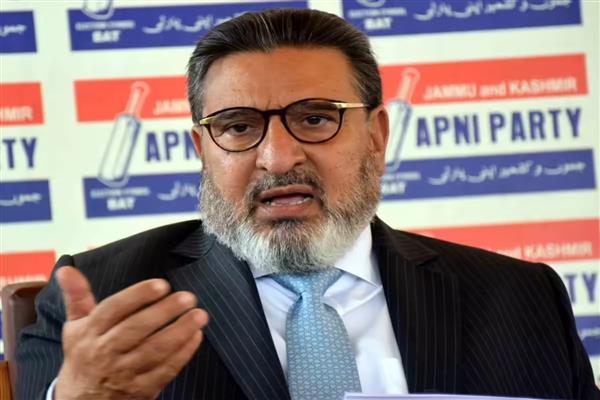
Srinagar: The political temperature in Jammu and Kashmir is rising ahead of the autumn Assembly session, and Apni Party president Altaf Bukhari has placed Chief Minister Omar Abdullah and his National Conference government firmly in his line of fire.
Bukhari’s criticism is not limited to one policy dispute. His recent interventions have brought together several issues that are increasingly dominating J&K’s political conversation — unemployment, government recruitment, reservation, merit, governance, statehood and the question of how much political attention the elected government should devote to issues beyond the Union Territory.
The timing is significant. The Jammu and Kashmir Assembly’s autumn session begins on September 21, with opposition parties preparing to challenge the government over governance, reservation, employment and statehood. The National Conference, meanwhile, has been preparing its own legislative strategy and has instructed its legislators to focus on constituency-level public concerns.
At the heart of Bukhari’s argument is a straightforward political message: the people of Jammu and Kashmir want their government to concentrate on the problems they face at home.
But the larger political story is more complicated.
Omar Abdullah’s engagement with Delhi has largely revolved around issues directly connected to J&K — particularly restoration of statehood and governance arrangements. Bukhari, therefore, is not simply questioning whether the Chief Minister travels to Delhi or participates in wider political conversations. His criticism raises a deeper question about priorities: how should an elected government balance national-level political engagement with the everyday demands of its own electorate?
Bukhari’s attack comes as reservation becomes a political flashpoint
Few issues have generated as much anxiety among students and government-job aspirants in J&K as the reservation debate.
Bukhari has recently called for a review and rationalisation of the existing reservation framework, arguing that reservation should be based on population ratios to ensure what he described as fair and equitable representation.
His intervention has added another political voice to a debate that has already involved the National Conference, PDP, BJP, various social groups and youth organisations.
The reservation question is particularly sensitive because government employment remains highly valuable in Jammu and Kashmir, where public-sector jobs have traditionally been seen as one of the most secure avenues of employment.
For an unemployed graduate, therefore, the reservation formula is not an abstract administrative matter. It can determine how many posts are available under different categories and how an individual candidate experiences a competitive recruitment process.
That is why political language around “merit”, “representation” and “quota” carries such weight.
Bukhari’s argument is that the existing arrangement needs to be reassessed. The government, however, has not simply ignored the issue.
A Cabinet sub-committee was constituted to examine the reservation framework. Its report was subsequently processed by the government. In March 2026, the Assembly was informed that the report was still under consideration and that there was no fixed implementation timeline. In June, Omar Abdullah said the Centre had sought clarifications on the proposal and that the J&K government had prepared its response for Cabinet approval.
The sequence matters because it shows why the reservation debate continues to generate political criticism: a review has taken place, but a final publicly implemented framework has not yet emerged.
The youth jobs question goes beyond reservation
Bukhari’s criticism also taps into a wider frustration surrounding employment.
Jammu and Kashmir’s political parties have repeatedly placed government recruitment at the centre of their public messaging. For young people preparing for competitive examinations, delays, eligibility rules, recruitment calendars and reservation categories can become as politically important as larger constitutional questions.
The J&K government has pointed to recruitment as one of its priorities.
The 2026-27 budget said 7,650 candidates had been appointed to government service during 2025 through what the government described as a merit-based and technology-driven process. It also proposed accelerating recruitment for 23,800 additional posts, including gazetted, non-gazetted and Class-IV vacancies.
Those figures provide an important counterpoint to the broader opposition charge that employment is being ignored.
At the same time, government recruitment numbers do not automatically settle the larger question of whether the pace of hiring is sufficient for the number of young people seeking jobs.
That is where the political argument is likely to continue.
For the government, recruitment figures can demonstrate administrative activity. For opposition parties, the test is whether young applicants experience the system as timely, transparent and fair.
The difference between those two perspectives is now becoming an important feature of J&K politics.
Bukhari’s “Delhi” argument has a political backdrop
Bukhari’s criticism of Omar Abdullah’s engagement outside J&K must also be viewed against the political importance of Delhi to the Union Territory.
Omar Abdullah has repeatedly travelled to the national capital to raise J&K-related issues with the Union government.
His September 4 meeting with Union Home Minister Amit Shah, for example, focused on matters concerning Jammu and Kashmir, including the demand for early restoration of statehood and governance-related issues.
This was not an isolated engagement. Since becoming Chief Minister in October 2024, Omar has met Shah several times, with statehood remaining one of the principal issues on the agenda.
The National Conference also organised a protest in Delhi in July demanding restoration of full statehood.
For the NC, such engagement is part of its strategy to press the Centre on an issue it considers central to J&K’s political future.
For rivals such as Bukhari, however, the question is whether national-level political activity should overshadow local governance.
That distinction is important.
Going to Delhi is not, by itself, evidence that J&K issues are being neglected. Many of the decisions affecting the Union Territory — including questions concerning statehood, recruitment rules, finances and administrative powers — involve the Union government.
The political dispute is therefore not really about geography. It is about priorities and political messaging.
The “where is the government?” question
Bukhari had already sharpened this line of attack earlier in September when he questioned the functioning of the Omar Abdullah-led government and argued that the administration was failing to address the day-to-day concerns of ordinary people.
He has criticised what he portrays as excessive emphasis on political messaging and insufficient attention to governance.
That argument comes at a politically sensitive moment.
J&K has an elected government, but it continues to operate as a Union Territory. The restoration of full statehood remains unresolved.
This creates a peculiar political environment for Omar Abdullah.
His government is expected to deliver on routine matters such as roads, electricity, recruitment, healthcare, education and public services. At the same time, it has to pursue larger political demands such as restoration of statehood and address the division of powers between the elected government and the Lieutenant Governor’s administration.
That dual responsibility provides room for both criticism and defence.
Opposition parties can argue that statehood cannot become an excuse for administrative shortcomings.
The government, in turn, can argue that the unfinished question of statehood directly affects the powers and institutional framework within which it is expected to govern.
Both arguments are now likely to feature prominently during the Assembly session.
Apni Party tries to occupy the regional political space
There is also a clear political dimension to Bukhari’s criticism.
The Apni Party is attempting to establish itself as a regional political force focused on governance, employment, economic opportunity and what it describes as practical politics.
In recent weeks, Bukhari has repeatedly spoken about employment, infrastructure, public services and the economic concerns of young people. He has also called for restoration of full statehood and constitutional safeguards concerning land, jobs and the rights of J&K residents.
That messaging gives Apni Party a distinct space in an increasingly crowded political field.
The National Conference governs.
The PDP continues to attack the government from the opposition benches.
The BJP remains a major political force, particularly in Jammu.
And Apni Party is attempting to present itself as an alternative regional platform that is neither defined solely by the constitutional politics of 2019 nor by the national political contest between the BJP and the wider opposition.
Bukhari’s criticism of Omar therefore has a dual purpose: challenging the government’s record while simultaneously defining what Apni Party believes regional politics should look like.
Reservation has become more than an administrative issue
The reservation debate illustrates how quickly a technical policy question can become a major political issue in J&K.
The controversy involves competing claims.
One side of the debate emphasises representation for historically disadvantaged communities and argues that reservation remains an important instrument of social justice.
Another group of aspirants is concerned that the expansion or restructuring of reserved categories could reduce opportunities available through open merit.
Political parties have increasingly entered this space, with some leaders calling for changes to the existing system and others warning against approaches that could weaken protections for reserved communities.
This makes the government’s pending decision particularly sensitive.
Any alteration to the existing framework is likely to have political consequences because different communities will assess the changes through the lens of representation, opportunity and employment.
For the Omar Abdullah government, the challenge is therefore not merely to produce a policy. It is to explain the policy clearly enough that competing communities understand its basis.
The merit-versus-representation debate is unlikely to disappear
The phrase “merit” has become especially powerful in the current political discourse.
But merit and reservation are not necessarily competing concepts in the constitutional and administrative framework. Reservation exists precisely because policymakers recognise that historical and social disadvantages can affect access to education, employment and public institutions.
The real political question is how the system should balance representation, constitutional protections and open competition.
That debate requires evidence rather than slogans.
It also requires clarity about the actual percentage allocation, the categories covered, the population groups affected and the likely impact on recruitment.
Until those details are publicly available and implemented, political parties will continue to fill the information gap with competing narratives.
That is precisely why the reservation issue has become such a potent electoral and political subject.
Omar’s government faces a broader accountability test
Bukhari’s criticism ultimately points toward a larger issue: what should voters expect from the first elected J&K government after the 2019 constitutional changes and the 2024 Assembly elections?
The National Conference secured 42 of the 90 Assembly seats in the 2024 elections and formed the government with its allies.
That mandate gives Omar Abdullah considerable political authority, but it also creates a correspondingly large expectation of delivery.
Employment was among the major concerns surrounding the election.
So were electricity, infrastructure, healthcare, tourism, education and restoration of statehood.
Nearly two years into the government’s tenure, opposition parties are now asking whether progress on those fronts matches the expectations created during the campaign.
The government will have an opportunity to answer those questions inside the Assembly.
The political battle is moving from slogans to delivery
The coming Assembly session could therefore become an important test of the competing narratives.
Bukhari and other opposition leaders are likely to press the government on reservation, jobs, governance and the pace of delivery.
The NC government will have to demonstrate not only what it has demanded from Delhi but also what it has delivered in Srinagar, Jammu and across the districts.
That distinction could become increasingly important.
Statehood is a major political demand, but statehood alone does not fix unemployment.
Reservation reform may change recruitment opportunities, but it does not create enough jobs by itself.
Government recruitment can provide opportunities, but it cannot solve the broader structural problem of private-sector employment.
And political engagement in Delhi can be necessary for J&K, but it cannot substitute for administration on the ground.
That is where the debate is likely to move next.
J&K politics enters another phase of confrontation
Altaf Bukhari’s latest criticism of Omar Abdullah is therefore part of a much larger political contest.
The Apni Party is attempting to turn employment, reservation and governance into a regional political platform. The PDP is raising similar concerns from another ideological position. The BJP is challenging the NC government on governance and political priorities, while the National Conference is defending its record and continuing to press the Centre on statehood.
For Omar Abdullah, the challenge is increasingly two-dimensional: he must negotiate with New Delhi while convincing people in J&K that his government remains focused on their immediate concerns.
For Bukhari, the challenge is different: criticism of the NC government must translate into a convincing political alternative rather than remain confined to opposition rhetoric.
And for young people watching the debate, the decisive question is likely to be much simpler than the political speeches suggest:
When will the promises surrounding jobs, merit, representation and governance translate into tangible opportunities and services on the ground?
The answer will depend less on political exchanges in Srinagar or Delhi and more on what emerges from government decisions, recruitment processes, budget implementation and the Assembly’s scrutiny in the months ahead.
For now, the political contest is clear. Omar Abdullah’s government is being challenged not only over what it says about J&K’s future, but increasingly over what it delivers in J&K’s present.