‘First Food, Clothes and Marriage, Now Vocabulary’: Mehbooba Mufti Targets BJP Over Bushra Bano Transfer
By: News Desk | 17 September 2026
Srinagar: The transfer of a young IPS officer in West Bengal has opened another politically charged debate over religious expression, administrative neutrality and the boundaries of personal identity in public service.
PDP president and former Jammu and Kashmir Chief Minister Mehbooba Mufti has accused the BJP of “policing the vocabulary” of Muslims after West Bengal-cadre IPS officer Bushra Bano was transferred from her posting as Additional Superintendent of Police in Kharagpur.
Bano’s transfer came only about two-and-a-half months after she took charge. It also followed a controversy over a video in which she discussed her journey to the civil services and used familiar Islamic expressions including “Assalamu Alaikum”, “InshaAllah” and “JazakAllah.” A Hindu-rights organisation, the Hindu Legal Fund, objected to the language used in the video and said it had complained to the West Bengal Home Secretary.
The timing prompted opposition leaders and others to question whether the transfer was connected to the controversy.
But there is a crucial qualification.
The West Bengal government’s transfer order did not cite the video, the greetings or the complaint as the reason for the move. A senior government officer described it as a routine transfer, while the order itself referred to “public interest.” Two other West Bengal Police Service officers were also part of the same administrative reshuffle.
That leaves the central allegation politically potent but officially unproven.
And it is precisely this gap between the official explanation and the political interpretation that has turned an otherwise routine-looking transfer into a national debate.
What happened to Bushra Bano?
Bushra Bano, a 2021-batch IPS officer, had been serving as Additional Superintendent of Police in Kharagpur, Paschim Medinipur.
She was transferred on September 14 to the post of Deputy Commandant of the State Armed Police’s 4th Battalion. Partha Ghosh was appointed as the new Additional SP of Kharagpur.
The controversy arose around a video Bano had posted discussing her UPSC journey.
In the video, she explained how she prepared for the civil services and referred to the role played by Aligarh Muslim University’s Residential Coaching Academy. She opened the video with “Assalamu Alaikum”, used “InshaAllah” while discussing her journey and concluded with “JazakAllah.”
Those are ordinary expressions used by Muslims in everyday communication:
- Assalamu Alaikum — a greeting meaning peace be upon you.
- InshaAllah — God willing.
- JazakAllah — a traditional expression of thanks invoking God’s reward or blessing.
The controversy did not arise because the words were obscure or unusual. It arose because some critics argued that a serving police officer appearing in uniform in a public communication should use language reflecting institutional neutrality.
The Hindu Legal Fund publicly objected to Bano’s use of the expressions and contrasted them with “Vande Mataram” or “Jai Hind.”
The timing is what made the transfer controversial
The transfer itself is not necessarily unusual.
Administrative reshuffles of police officers occur regularly. In this case, the West Bengal government maintained that Bano’s transfer was routine and in the public interest. The reshuffle also involved other officers.
What made this case different was the sequence of events.
A controversy erupted over Bano’s video.
A right-wing organisation publicised its objection.
A complaint was reportedly sent to the Home Secretary.
And shortly afterwards, Bano was transferred from her Kharagpur posting.
That sequence has led political opponents to infer a connection.
But sequence is not proof of causation.
As of the latest reporting, the transfer notification does not identify the video or the religious expressions as the reason for Bano’s reassignment.
That distinction should remain central to any serious discussion of the controversy.
Mehbooba Mufti turns a personnel issue into a wider political argument
For Mehbooba Mufti, however, the episode represents something much bigger than one police transfer.
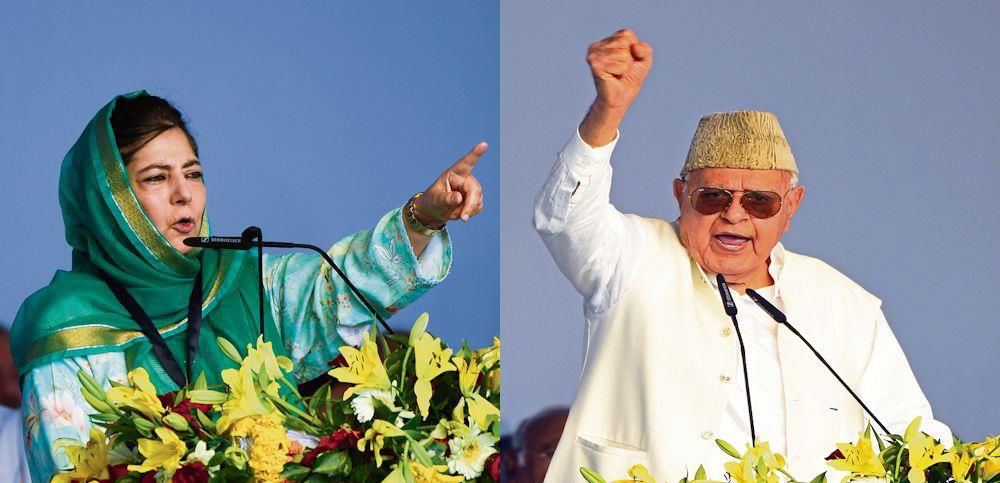
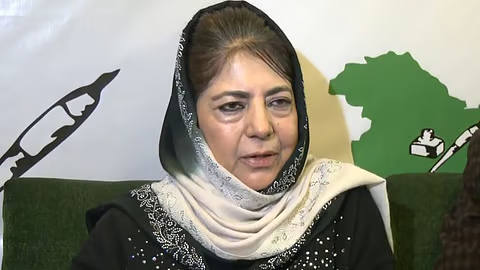
Reacting on X, she accused the BJP of becoming “insecure” and alleged that it was now policing the vocabulary used by Muslims.
She argued that Muslim identity was increasingly being subjected to scrutiny not merely in matters of food, clothing and marriage, but even in ordinary language.
Her formulation was deliberately broader than the Bushra Bano case.
“First our food, clothes and marriage, now even our vocabulary and our votes are being policed. Insecurity, thy name is BJP.”
She also said it was striking that three expressions invoking peace, divine will and gratitude could become politically contentious.
Mehbooba’s comments are, of course, a political accusation rather than an established finding about the BJP’s motives in the Bano case.
But they illustrate why the controversy has resonated beyond West Bengal.
For her, the issue is about whether Muslims can retain visible elements of their cultural and religious identity while occupying positions representing the Indian state.
Where does an officer’s personal identity end and official neutrality begin?
That is the more difficult question underneath the political argument.
Civil servants are expected to maintain political neutrality and discharge their duties impartially.
But neutrality does not necessarily mean the absence of personal religious identity.
An IPS officer can be Muslim, Hindu, Sikh, Christian or belong to another faith while performing the same constitutional duties.
The more specific question is whether religious language used in a personal or motivational communication constitutes a breach of official neutrality.
The controversy has produced competing interpretations.
The Hindu Legal Fund’s complaint argued that a serving officer representing the Indian state should maintain neutrality in public communication and use national expressions.
Critics of that argument point to the distinction between partisan political messaging and ordinary religious greetings.
The fact that an officer says “Assalamu Alaikum” does not, by itself, establish that the officer is advocating a political programme or discriminating against another community.
At the same time, whether an officer’s social-media activity falls within applicable service-conduct rules is ultimately a question of the relevant rules and their application—not simply of political interpretation.
The “routine transfer” explanation remains central
The West Bengal government’s position deserves equal attention.
Officials have not acknowledged that Bano was moved because of the controversy.
A senior officer told the Hindustan Times that it was a “routine transfer.” The formal order described the move as being in the “public interest.” The same reshuffle involved two West Bengal Police Service officers.
This creates two competing narratives.
The first is the government’s:
This was an administrative reshuffle, and the timing is coincidental.
The second is the opposition’s:
The transfer came immediately after an organised complaint over Bano’s religious expressions, making the timing difficult to ignore.
At present, publicly available reporting does not establish the second claim as fact.
That unresolved question is what keeps the controversy alive.
Why the BJP has become central to the controversy
The BJP’s role in the episode is also more complicated than the transfer itself.
The West Bengal government is led by Chief Minister Suvendu Adhikari, who is also a BJP leader. Mehbooba therefore interprets the episode through the broader political contest over Muslim identity and political representation.
Her comments also referred to an alleged remark by Adhikari describing an election as a “test” of Muslim loyalty, which she characterised as a veiled threat to Muslims. Multiple reports carried this part of her statement, but the claim should be treated as Mehbooba’s characterisation of Adhikari’s remarks, rather than independently adopting that interpretation.
The two issues are consequently being combined in Mehbooba’s political argument:
religious language in public life + political rhetoric around Muslim voting behaviour.
Together, she argues, they point to a broader atmosphere of scrutiny.
Why the controversy resonates in Kashmir
For Mehbooba Mufti, the issue has particular political resonance.
Kashmir’s politics has long included debates over religious identity, cultural expression, political representation and the relationship between Muslims and the Indian state.
The PDP has historically positioned itself around the political representation of Kashmir’s Muslim-majority population while also participating in electoral politics within India’s constitutional framework.
By commenting on Bano’s transfer, Mehbooba is extending that political argument beyond J&K.
Her message is effectively that minority identity should not become a liability in public life.
That is a political position, and it fits into the PDP’s wider criticism of what it regards as growing scrutiny of Muslim cultural practices.
The controversy is also about an IPS officer’s public identity
There is another dimension that makes the Bano case particularly sensitive.
She was not merely a private citizen making a religious greeting.
She was an IPS officer, appearing in uniform, speaking about her professional journey and addressing students and civil-service aspirants.
That makes the question of public-service conduct legitimate.
But the distinction between professional neutrality and religious erasure is equally important.
A secular public institution does not necessarily require its officers to conceal their faith.
The more appropriate institutional question is whether an officer’s conduct affects impartiality, official discipline, public confidence or compliance with applicable service rules.
Those are standards that can be applied consistently across religions.
That last point matters because a rule concerning religious expression in public service should not be selectively applied to one community.
The social-media dimension
The Bano controversy also demonstrates how social media can rapidly transform a personal communication by a public official into a political controversy.
A video aimed at students became the subject of public criticism.
The video was subsequently widely circulated, including by accounts opposed to Bano’s language.
The issue then moved from social media to political statements and national news coverage.
This creates a new challenge for public servants.
An officer’s public social-media presence can be interpreted as official communication even when the original purpose is personal, educational or motivational.
At the same time, treating every personal expression by a government employee as an official institutional statement could substantially narrow the space for ordinary human expression.
The boundary between the two is increasingly difficult to maintain in the social-media age.
A debate about secularism in practice
India’s constitutional framework guarantees freedom of conscience and religion while requiring the state to maintain institutional neutrality.
That creates a delicate balance.
A government officer must not use official authority to favour one religion over another.
But an officer’s mere possession or expression of religious identity is not automatically equivalent to religious discrimination.
The Bushra Bano controversy therefore raises a question larger than one transfer:
Can an Indian public servant remain fully secular and institutionally neutral while also remaining visibly and personally rooted in his or her own faith?
The answer in a constitutional democracy should turn on conduct, applicable rules and equal treatment—not simply on whether a particular word comes from one religious vocabulary or another.
Why the allegations need evidence
The political stakes make it especially important not to turn suspicion into established fact.
There are several things that are documented:
Bano was transferred.
She had served as Kharagpur Additional SP for roughly two-and-a-half months.
She had posted a video discussing her UPSC journey.
The video contained Islamic greetings and expressions.
A Hindu-rights group objected and reportedly complained to the state Home Secretary.
The transfer followed shortly afterwards.
The government described the transfer as routine and in the public interest.
What has not been established publicly is that the government transferred Bano because she said “Assalamu Alaikum”, “InshaAllah” or “JazakAllah”.
That distinction is essential.
It allows the controversy to be discussed seriously without turning an allegation into a fact.
The larger political argument over Muslim identity
Mehbooba’s intervention reflects a familiar strand of Indian political debate: whether questions that appear to concern administration or public conduct are sometimes carrying a deeper contest over cultural identity.
Her claim is that Muslim citizens increasingly find aspects of ordinary life—food, clothing, marriage, language and voting—being treated as political questions.
The BJP and its supporters have frequently presented their own arguments through the language of national identity, cultural integration and institutional neutrality.
The clash between those frameworks is now appearing in increasingly ordinary spaces.
A greeting.
A dress.
A food choice.
A marriage.
A social-media post.
Or a vote.
Each can become politically charged when it is interpreted as representing something larger than the individual act.
What the Bano episode ultimately reveals
The controversy surrounding Bushra Bano is still developing, and the factual question of why she was transferred remains unresolved in the public record.
That uncertainty should not obscure the larger issue.
India’s civil services are institutions expected to represent citizens of every religion. Their credibility depends partly on the perception that professional standards are applied consistently.
At the same time, public officials remain citizens with personal histories, languages, cultures and faith traditions.
The difficult task is to maintain institutional neutrality without turning personal identity itself into evidence of institutional bias.
Mehbooba Mufti has chosen to frame the Bano controversy as evidence of a broader political effort to scrutinise Muslim identity. The West Bengal government, meanwhile, has maintained that the transfer was routine.
Between those two positions lies the unanswered question: was the timing merely administrative coincidence, or did the controversy influence the decision?
Until documentary evidence or an official explanation establishes a connection, that question remains open.
What is already clear is that a few familiar words—Assalamu Alaikum, InshaAllah and JazakAllah—have become the centre of a much wider debate over religion, public service, political identity and the meaning of neutrality in contemporary India.