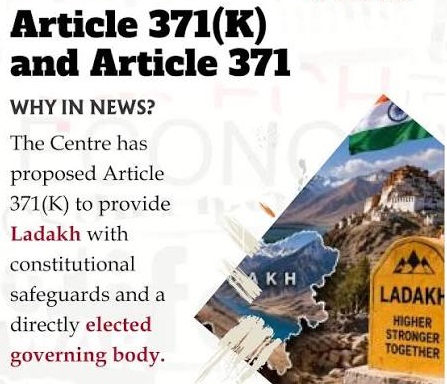
Article 371K for Ladakh: What the Proposed Constitutional Safeguard Could Change
By: Javid Amin | 19 September 2026
Centre’s proposed model promises a directly elected UT-level body with powers over land, culture, forests and natural resources — but finances, executive authority, bureaucracy and policing remain at the negotiating table
For years, Ladakh’s political movement has revolved around a deceptively simple question: who should have the final say over the region’s land, resources, culture and future?
Since Ladakh became a Union Territory without a legislature in October 2019, that question has grown increasingly contentious.
What initially appeared to many in Leh as an administrative recognition of Ladakh’s distinct identity gradually produced a different concern — the region had gained Union Territory status but had lost the legislative representation it previously had as part of Jammu and Kashmir.
The resulting movement has demanded different forms of protection, from statehood to inclusion under the Sixth Schedule of the Constitution, along with safeguards for land, employment, culture, ecology and political representation.
Now, after years of negotiations and growing public pressure, the Centre has put a new idea on the table: a proposed Article 371K specifically designed for Ladakh.
The proposal is significant because it does not simply reproduce an existing constitutional arrangement.
Instead, the Centre and Ladakh representatives are discussing what officials have described as a sui generis — or uniquely designed — governance model for the Union Territory.
At the heart of that model would be a directly elected UT-level body with legislative powers over specified subjects, including land, culture and language, forests, environment and natural resources.
But there is an important caveat.
Article 371K does not yet exist in the Constitution.
No final draft has been placed before the public or Parliament. The precise composition, powers, financial authority and relationship with the existing Leh and Kargil Autonomous Hill Development Councils are still being discussed.
That makes the current moment less a constitutional settlement than the beginning of a potentially important negotiation.
What Is Article 371K?
Article 371K is the proposed name for a new constitutional provision intended to create special safeguards specifically for Ladakh.
The Centre’s proposal emerged from discussions between the Ministry of Home Affairs and representatives of the Leh Apex Body (LAB) and Kargil Democratic Alliance (KDA).
According to the details reported from the September discussions, the proposed framework would establish a directly elected governing body at the Union Territory level.
The body would have legislative authority over areas such as:
- land;
- transfer and protection of property;
- culture and language;
- forests;
- environment;
- natural resources; and
- other matters connected with Ladakh’s distinctive local interests.
The proposal is therefore considerably more substantial than simply giving the existing Hill Councils additional administrative responsibilities.
It attempts to create a new constitutional layer between Ladakh’s local institutions and the Union government.
The exact shape of that layer, however, remains undecided.
Why Does Ladakh Need a Special Constitutional Arrangement?
To understand the current proposal, it is necessary to go back to 2019.
On October 31, 2019, the Union Territory of Ladakh formally came into existence following the Jammu and Kashmir Reorganisation Act, 2019.
Unlike Jammu and Kashmir, which became a Union Territory with a legislature, Ladakh was created as a Union Territory without a legislature.
The Ministry of Home Affairs continues to describe Ladakh in precisely those terms.
The arrangement left Ladakh with two existing Autonomous Hill Development Councils — one in Leh and another in Kargil — but without a territorial legislature.
That distinction became increasingly important.
A Hill Council can administer specified local functions, but it does not possess the same constitutional and legislative position as a state legislature or a legislature of a Union Territory such as Jammu and Kashmir.
For many Ladakh residents, therefore, the question was no longer simply whether Ladakh had a separate administrative identity.
It was whether that identity came with sufficient democratic control over the decisions affecting the region.
From UT Status to the Demand for Safeguards
The political reaction to the 2019 reorganisation was not uniform.
In Leh, the creation of a separate Union Territory had initially been welcomed by many who had long sought separation from Jammu and Kashmir’s administrative structure.
Kargil’s political response was more sceptical.
Over time, however, concerns emerged across both districts about land ownership, employment opportunities, demographic change, environmental pressures and the absence of an elected legislative institution.
This eventually brought Leh and Kargil’s political groups closer together.
The Leh Apex Body and Kargil Democratic Alliance became the principal platforms representing the movement in negotiations with the Centre.
Their demands have included:
- statehood for Ladakh;
- Sixth Schedule protection;
- safeguards for land and employment;
- a Public Service Commission;
- stronger political representation; and
- greater local control over development.
The Centre’s proposed Article 371K is therefore emerging against the backdrop of a movement whose original demands have generally been broader than the present proposal.
What Does the Sixth Schedule Have to Do With It?
The Sixth Schedule is important because it provides constitutionally protected autonomous arrangements for tribal areas in Assam, Meghalaya, Tripura and Mizoram.
It allows the creation of autonomous district and regional councils with specified legislative, judicial and administrative powers.
For Ladakh’s movement, the Sixth Schedule has become attractive because the region has a distinctive tribal, cultural and ecological character and because activists have argued that ordinary administrative safeguards are insufficient to protect land and local identity.
The demand for Sixth Schedule status has consequently remained one of the central pillars of the movement.
The proposed Article 371K is different.
Rather than extending the Sixth Schedule to Ladakh, the Centre is discussing a new constitutional mechanism designed specifically for the Union Territory.
That distinction matters.
If eventually enacted, 371K would not simply make Ladakh another Sixth Schedule area. It would create a separate constitutional model.
How Article 371 Became a Framework for Special Safeguards
The proposed Article 371K is part of a much larger constitutional history.
The Constitution already contains a series of special provisions under Article 371 and Articles 371A to 371J.
These provisions emerged at different points in India’s political and constitutional development and respond to the particular circumstances of different states.
For example:
Article 371 contains special provisions for Maharashtra and Gujarat.
Article 371A provides special constitutional protections for Nagaland, particularly concerning religious and social practices, customary law and ownership and transfer of land and resources.
Article 371G provides special safeguards for Mizoram.
Article 371H contains provisions concerning Arunachal Pradesh.
Article 371J provides special provisions relating to the Hyderabad-Karnataka region, now known as the Kalyana Karnataka region.
The important point is that Article 371 is not a single uniform model.
It is a constitutional family of arrangements developed for different political, cultural and administrative circumstances.
That is why the proposed 371K is being described as tailor-made for Ladakh rather than as a straightforward copy of another state’s model.
The Most Important Feature: A Directly Elected UT-Level Body
Perhaps the biggest departure from the present system would be the creation of a directly elected Union Territory-level body.
At present, Ladakh has no territorial legislature.
The proposed arrangement would change that — but not by converting Ladakh into a conventional Union Territory with a legislature.
That distinction is crucial.
The model under discussion is being described by the Ladakh administration as neither full statehood nor a standard UT-with-legislature arrangement.
Instead, it would create a new institutional structure specifically for Ladakh.
Chief Secretary Ashish Kundra said the proposed model would be unique and would include a legislative body at the UT level.
The government has also said that discussions are aimed at securing constitutional and legislative safeguards for land, culture, heritage, natural resources, environment and employment.
What Would the New Body Control?
Based on the information that has emerged from the negotiations, the strongest areas of proposed authority are local resources and identity.
Land
Land is among the most politically sensitive issues in Ladakh.
The movement has repeatedly expressed concern about the possibility of outside ownership, commercial pressure and demographic change.
Giving the proposed body legislative authority over land and transfer of property could therefore become one of the most consequential elements of the eventual settlement.
But the exact scope of that authority remains to be negotiated.
Culture and Language
Ladakh is culturally diverse, with distinct linguistic and religious traditions across Leh and Kargil.
Constitutional protection could allow locally elected representatives to have greater control over policies concerning language, heritage and cultural institutions.
Forests and Environment
This is particularly important because Ladakh is an ecologically fragile high-altitude region.
Climate change, glacier retreat, water stress, tourism expansion, road construction and infrastructure development have all increased pressure on the region.
A constitutional role in environmental governance could give local institutions greater influence over development decisions.
Natural Resources
Control over natural resources could become another major pillar of the proposed framework.
But again, the eventual division of authority between the Union government, the UT administration, the Hill Councils and the proposed elected body has not yet been settled.
What Is Still Missing?
This is where the Article 371K proposal becomes much more complicated.
The September discussions have produced an outline, not a finished constitutional arrangement.
Several major questions remain open.
Who Controls the Money?
A legislative body without adequate financial authority could have limited practical power.
Ladakh representatives have sought executive, budgetary, planning and financial powers for the proposed body.
Reports indicate these issues remain unresolved.
That means one of the biggest questions is still unanswered:
Will the new elected institution have the financial resources necessary to implement the laws and policies it makes?
The distinction between having legislative authority on paper and having the financial capacity to exercise that authority will be critical.
What About the Bureaucracy?
Another unresolved question concerns the executive machinery.
A legislature can pass laws, but implementation depends on officials.
If the bureaucracy remains primarily under the control of the UT administration and the Lieutenant Governor, the elected body could have legislative powers without corresponding executive control.
The eventual division of authority between elected representatives and the administration will therefore determine how much practical autonomy 371K provides.
This is one reason Ladakh’s representatives are seeking clarity before accepting a final framework.
And What About Police and Law and Order?
Police and public order are among the most sensitive subjects in the entire debate.
At present, Ladakh is a Union Territory without a legislature and key administrative powers remain with the Union Territory administration under the constitutional and statutory framework applicable to Union Territories.
The proposed 371K model has not yet settled the question of policing and public order.
That means the proposal cannot currently be described as giving Ladakh complete political autonomy.
It would instead create constitutional protection in selected areas while leaving other major functions within the existing administrative structure.
That distinction will likely become one of the most closely contested parts of the negotiations.
The Hill Councils Problem
Ladakh already has two important local institutions:
- LAHDC Leh
- LAHDC Kargil
The arrival of a directly elected UT-level body raises an obvious institutional question:
What happens to the Hill Councils?
Will they continue with their existing powers?
Will some functions move upward to the UT-level institution?
Will the councils receive additional authority?
How will the councils and the new body divide subjects?
These are not technical details.
They could determine whether the proposed system produces greater decentralisation or simply creates another layer of government.
The Ladakh administration has confirmed that representatives have been asked to prepare a draft examining the structural relationship and distribution of powers between the Hill Councils and the proposed UT-level body.
Why the September 2025 Violence Still Matters
The current negotiations cannot be separated from the events of September 2025.
On September 24, 2025, protests in Leh over statehood and constitutional safeguards turned violent.
Four people were killed during the unrest, while dozens were injured.
The violence marked a major escalation in Ladakh’s political movement.
Climate activist Sonam Wangchuk, who had been associated with the movement and was undertaking a hunger strike, was subsequently arrested under the National Security Act.
The government accused him and politically motivated groups of contributing to the unrest; Wangchuk and his supporters rejected the allegation that he was responsible for inciting the violence.
The September 2025 events demonstrated that the disagreement over Ladakh’s constitutional future had moved well beyond routine administrative negotiations.
A year later, the issue remains politically unresolved.
The Ladakh administration has recently announced compensation for the families of those killed and for injured persons, reflecting the continuing significance of the episode.
2026: From Protest Politics to Constitutional Negotiation
The September 2026 discussions represent a different phase.
Instead of merely discussing whether Ladakh should receive safeguards, the Centre and Ladakh representatives are now discussing the architecture of those safeguards.
The September 9 meeting examined the proposed elected body, its composition and its relationship with existing institutions.
The Centre has sought inputs on questions including:
- what the body should be called;
- how it should be constituted;
- how representation should work;
- what its powers should be;
- how it should relate to the Hill Councils; and
- what executive and financial authority it should possess.
This is important because it means the negotiations have moved from broad political demands toward institutional design.
But they have not yet reached a final agreement.
October Talks Could Be Crucial
The next round of discussions is expected in October 2026.
The Ladakh administration has said representatives have been asked to prepare a draft document examining the relationship between the existing Hill Councils and the proposed UT-level body.
That document could become important in determining whether the two institutional structures complement each other or compete for authority.
The October talks are therefore likely to focus less on the headline phrase “Article 371K” and more on the details hidden beneath it.
Who makes the law?
Who controls the money?
Who appoints officials?
Who implements decisions?
Who controls land?
Who regulates natural resources?
Who oversees policing?
And ultimately, how much power will elected representatives actually possess?
What Constitutional Amendment Would Be Required?
If the proposal ultimately takes the form of a constitutional amendment, it would have to go through the constitutional amendment procedure laid down under Article 368.
A constitutional amendment generally requires a special majority in Parliament — a majority of the total membership of each House and at least two-thirds of members present and voting.
Whether ratification by state legislatures would additionally be required would depend on the specific constitutional provisions being amended.
That means the final text of the proposed Article 371K will matter.
At present, it is premature to describe the amendment as a completed constitutional arrangement because no final draft has yet been produced. The Ladakh administration itself has stressed that constitutional safeguards require an established legal and parliamentary process, including broad political consensus and parliamentary consideration.
Statehood vs 371K: What Is the Difference?
This is perhaps the most important political distinction.
Statehood would fundamentally change Ladakh’s constitutional position by making it a state with its own legislature and a wider range of constitutional powers.
A conventional Union Territory with a legislature would provide an elected legislative institution while retaining the Union Territory framework.
Article 371K, as currently proposed, would be something different.
It would retain Ladakh’s status as a Union Territory but create a special constitutional arrangement and a directly elected body with specified legislative powers.
That is why officials have repeatedly described the proposed model as sui generis.
It is not being presented as statehood.
It is not simply a replication of the Jammu and Kashmir UT model.
And it is not identical to Sixth Schedule governance.
It is an attempt to create a fourth kind of arrangement tailored specifically to Ladakh.
What Ladakh’s Civil Society Groups Are Still Asking
The LAB and KDA have been central to negotiations, but the proposed framework does not automatically end their demands.
Their longstanding demands have included statehood and Sixth Schedule protection.
Consequently, a new constitutional arrangement will ultimately be judged by whether it addresses the underlying concerns that produced the movement in the first place.
Those concerns include:
Political representation:
Will Ladakhis have meaningful elected authority over regional affairs?
Land:
Can local communities protect land ownership and prevent unwanted demographic or commercial pressures?
Employment:
Can local people receive effective safeguards in government employment?
Culture:
Can Ladakh protect its languages, traditions and heritage?
Environment:
Can fragile ecosystems be protected from unregulated development?
Finance:
Will elected representatives control enough resources to implement their decisions?
Administration:
Will bureaucracy remain accountable to elected representatives?
Security:
Where will policing and public-order powers ultimately reside?
These questions explain why the existence of the phrase “Article 371K” does not itself settle the political dispute.
A Possible Middle Ground — But Details Will Decide It
The proposed model can be understood as an attempt to bridge two competing positions.
On one side is the demand for significantly greater democratic and constitutional autonomy.
On the other is the Centre’s existing position that Ladakh should remain a Union Territory rather than become a state.
Article 371K potentially creates space between those positions.
But whether it actually becomes that bridge depends on the powers written into the final constitutional and legislative framework.
A directly elected body with substantial authority over land, resources, culture and environment could represent a significant change from the present system.
A body with limited financial and executive authority, however, could leave many of the concerns that fuelled the movement unresolved.
That is why the title of the proposal matters less than the distribution of powers inside it.
The Ladakh Question Has Entered a New Phase
Ladakh’s political journey since 2019 has passed through several stages.
The creation of the Union Territory generated initial enthusiasm in parts of the region.
That was followed by concerns about the absence of a legislature, demands for constitutional safeguards and the mobilisation of Leh and Kargil civil society.
By 2021, the movement had consolidated around a broader set of political demands.
Talks with the Centre followed, including the establishment of a high-powered committee in 2023.
The September 2025 violence marked the most serious rupture between the movement and the authorities.
Now, in 2026, negotiations have entered a more technical but potentially more consequential stage: designing the institution itself.
Ladakh’s Constitutional Future Will Be Decided in the Details
The proposed Article 371K is therefore neither a finished constitutional settlement nor simply a symbolic announcement.
It is a framework being negotiated.
The Centre has agreed in principle to explore a directly elected UT-level body and constitutional safeguards for several areas central to Ladakh’s identity and resources.
But the unresolved questions are precisely those that determine how much autonomy the new institution would actually possess.
Land can be protected by law.
Culture can be protected constitutionally.
Natural resources can be regulated locally.
But the practical power to govern requires money, officials, executive authority and institutional accountability.
Those questions remain open.
The October talks may therefore prove more important than the initial announcement itself.
For Ladakh, the debate is no longer simply about whether the region deserves safeguards.
It is increasingly about what those safeguards will actually allow its people to govern.
And until the constitutional text, institutional structure and division of powers are settled, Article 371K remains what it is today: a proposed model, not yet a constitutional guarantee.


