Ruckus in J&K Assembly as BJP Raises Governance Issues, Opposition Demands Statehood
By: News Desk | 21 September 2026
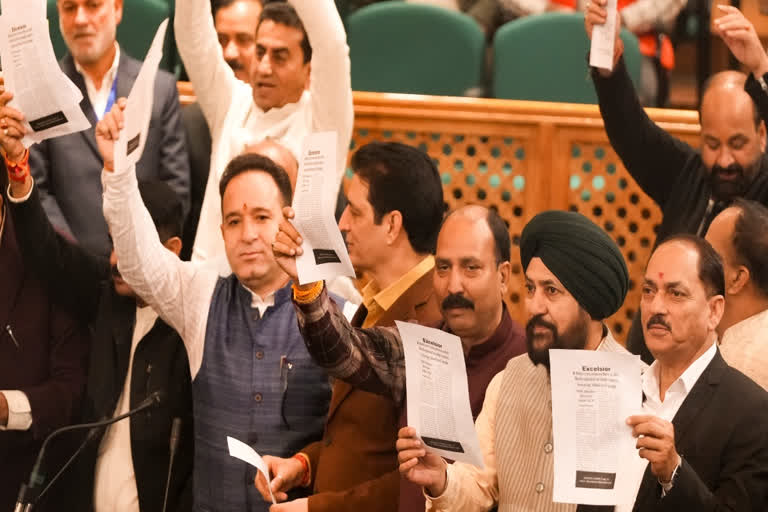
Srinagar: The Jammu and Kashmir Legislative Assembly opened its autumn session on Monday amid loud protests, competing slogans and a sharp political clash between the BJP opposition and the ruling benches, turning the first day into a test of the government’s handling of public grievances and the unresolved question of statehood.
The BJP, led by Leader of Opposition Sunil Sharma, disrupted Question Hour over issues including electricity tariffs, regularisation of daily wagers, National Health Mission employees, outsourcing of government jobs, drinking water and other governance concerns. BJP legislators eventually entered the Well of the House with placards and slogans, prompting repeated appeals from Speaker Abdul Rahim Rather to return to their seats. The House was eventually adjourned for the day.
But the confrontation quickly acquired a second dimension.
As BJP members attacked the Omar Abdullah government over what they described as failures in governance, National Conference and Congress legislators, joined by other members, shifted the political spotlight towards the Centre’s continued delay in restoring Jammu and Kashmir’s statehood.
The result was an unusual confrontation in which both sides claimed to be speaking for public concerns, but from sharply different political positions.
BJP Turns Question Hour Into a Protest
The trouble began soon after the obituary references and the start of Question Hour.
BJP legislators rose from their seats and began raising issues concerning employees, electricity and public services. According to reports from inside the House, the protesters demanded justice for daily wagers and NHM employees and objected to the recent electricity tariff increase. They also raised concerns about outsourcing of government jobs and the availability of water and electricity.
The slogans were deliberately focused on everyday governance.
Among those raised was the Hindi slogan, “Jo Sarkar Na De Sakhe Bijli Pani, Woh Sarkar Nakami”, questioning a government that cannot provide electricity and water.
The BJP legislators also demanded action for daily wagers and NHM workers.
The Speaker continued with Question Hour despite the protest, while ministers responded to questions raised by members. BJP lawmakers later entered the Well, escalating the confrontation.
Speaker Rather repeatedly asked the protesting legislators to return to their seats and warned that action could follow if they refused.
They did not immediately comply.
The disruption eventually forced the House to adjourn.
Sunil Sharma Accuses Government of Failing on Basic Issues
Outside the Assembly, Sunil Sharma expanded the BJP’s attack.
The Leader of Opposition accused the Omar Abdullah government of failing to fulfil promises made to voters and said basic public services remained unresolved nearly two years into its tenure.
He specifically highlighted unemployment, power tariffs, water supply, daily wagers and outsourcing of government jobs. He also accused the administration of failing to address the concerns of various categories of workers. These were Sharma’s political allegations, rather than independently established findings.
The BJP’s strategy was therefore relatively clear.
Instead of allowing the session to become dominated by constitutional questions, it attempted to put the government’s administrative record at the centre of the opening day’s proceedings.
For the BJP, the argument is that the elected government must answer for issues that fall within its sphere of responsibility.
For the ruling benches, however, the limitations imposed by Jammu and Kashmir’s present Union Territory structure remain an important part of the explanation.
That difference was at the heart of Monday’s confrontation.
Statehood Becomes the Counter-Slogan
As BJP legislators continued their protest, CPI(M) MLA Mohammad Yousuf Tarigami challenged them to add another demand to their slogans: restoration of statehood.
Tarigami, who is part of the ruling coalition, pointed out that two years had passed since the elected government took office without statehood being restored.
The intervention changed the character of the protest.
Congress MLAs including Irfan Hafiz Lone and Iftikhar Ahmad also raised the statehood issue, while other members joined the demand. National Conference legislators subsequently raised slogans seeking restoration of Jammu and Kashmir’s statehood.
What began as a confrontation over electricity, jobs and public services therefore turned into a wider political argument over who holds responsibility for Jammu and Kashmir’s current administrative structure.
NC Turns the BJP Protest Back on the Centre
The National Conference’s response was effectively to redirect the criticism.
NC legislators argued that the BJP’s protest over governance could not be separated from the fact that Jammu and Kashmir continues to function as a Union Territory rather than a state.
The political argument from the ruling side is straightforward: if the Centre restored statehood, an elected government would have greater institutional authority to govern.
BJP legislators rejected the attempt to make statehood the answer to every governance question.
Sunil Sharma argued that the Union government remains committed to restoring statehood and questioned whether the J&K government could continue to use the absence of statehood as an explanation for every administrative problem.
That exchange exposes one of the central political disputes in present-day Jammu and Kashmir.
The Omar Abdullah government says the reduced powers of a Union Territory government constrain its ability to act.
The BJP argues that the elected administration must still answer for matters within its control.
Both arguments can coexist, but the dividing line is precisely where responsibility lies for a particular decision.
Electricity Tariff Becomes a Major Flashpoint
Electricity emerged as one of the most immediate public issues inside the House.
The BJP opposed the recent tariff increase and linked it to complaints about electricity supply. Reports from the Assembly said the party demanded a rollback of the hike.
The tariff revision, however, was not imposed simply through a political decision by the Omar Abdullah government.
The Joint Electricity Regulatory Commission is the regulatory authority responsible for approving electricity tariffs in the Union Territories of Jammu and Kashmir and Ladakh. The latest tariff revision therefore has a regulatory as well as political dimension.
That distinction is important in the Assembly debate.
The political question is whether consumers can afford the revised tariffs and whether the quality and reliability of supply justify the additional burden.
The administrative question is how the government is managing subsidies, electricity distribution losses and the financial health of the power sector.
The opposition is likely to keep the focus on the consumer.
The government will have to explain the broader economics behind the tariff structure.
Daily Wagers and NHM Workers Add Pressure
The BJP’s decision to foreground daily wagers and NHM employees also reflects a longstanding employment problem in Jammu and Kashmir.
Thousands of workers have spent years seeking regularisation, improved service conditions or greater employment security.
National Health Mission workers are particularly important because they occupy frontline positions in the public health system, while daily wagers and other temporary workers have become a recurring issue in successive governments.
The BJP used their protests to argue that the government had failed to address promises made to employees.
The government, meanwhile, maintains that it is willing to answer questions and address issues through legislative mechanisms.
Deputy Chief Minister Surinder Choudhary told the protesting opposition members that the government was prepared to respond to their questions if they were raised one by one. He accused the BJP of being more interested in disruption than resolution.
That disagreement is likely to continue throughout the session.
Congress Finds Itself Between Alliance Politics and Statehood
Congress’s position adds another layer to the Assembly arithmetic.
The party is politically allied with the National Conference but has not joined the Omar Abdullah Cabinet. Congress has maintained that it will not accept ministerial berths until statehood is restored.
On Monday, Congress legislators joined the statehood demand during the uproar.
That does not mean Congress and the NC are identical on every issue. Rather, statehood remains one of the areas where the two parties have a common political position.
The Assembly confrontation therefore also demonstrated an important feature of the current House: the statehood demand can unite parties that remain divided on other questions.
The BJP’s protest was aimed at the Omar Abdullah government.
The response from the ruling benches shifted the focus towards the Union government.
Congress and NC members consequently found common ground in demanding restoration of statehood, even as the broader political contest between the parties remains more complicated.
The Real Battle Is Over Responsibility
Monday’s ruckus was more than a routine Assembly disruption.
It revealed a fundamental political argument over accountability in post-2019 Jammu and Kashmir.
The 2024 election restored an elected legislature after a long period without an elected government. But the constitutional status of the region remains that of a Union Territory.
That creates a divided political narrative.
When roads are damaged, water supply fails or recruitment is delayed, the public naturally looks towards the elected government.
But when the government argues that its powers are restricted by the Union Territory structure, responsibility becomes more difficult to assign.
The BJP’s position is that this cannot become an excuse for administrative failures.
The NC and its allies argue that the absence of statehood itself is an important institutional limitation.
This is likely to remain one of the defining political debates of the session.
What Happens Next in the Assembly?
The first day’s disruption could set the tone for the remaining proceedings, but the larger test will be whether the House eventually moves from slogans to answers.
The Assembly has a substantial list of public questions and legislative business before it.
Among the issues likely to remain prominent are:
- electricity tariffs and power supply;
- regularisation of daily wagers;
- NHM, ASHA and other frontline workers;
- outsourcing of government employment;
- recruitment and unemployment;
- drinking-water availability;
- infrastructure and public services;
- reservation policy;
- and restoration of Jammu and Kashmir’s statehood.
The BJP has demonstrated that it intends to aggressively scrutinise the government.
The ruling NC is equally determined to keep statehood at the centre of the political conversation.
Congress has signalled that its alliance with the NC will not prevent it from raising public concerns.
And smaller parties and individual legislators have their own issues to place before the House.
A Stormy Beginning, but the Bigger Test Lies Ahead
The first day of the J&K Assembly’s autumn session ended much earlier than the political arguments surrounding it.
The House was adjourned after the BJP’s protest disrupted Question Hour. But the underlying issues remain unresolved.
For the BJP, the immediate test is whether it can turn concerns over jobs, tariffs, workers and basic services into sustained legislative scrutiny.
For the Omar Abdullah government, the challenge is to demonstrate that it can answer those questions with concrete measures rather than political counterattacks.
For Congress and the NC, statehood remains the larger political demand.
And for the people watching the proceedings, the distinction between the two debates may matter less than the outcome.
They need electricity that is affordable and available, public services that function, recruitment that is transparent and workers who know where they stand.
The Assembly’s first day showed just how sharply divided the political narratives remain.
The rest of the session will show whether those divisions produce substantive answers or simply more noise.

