899 Jobs, 1 Lakh Promise: Sajad Lone Questions NC’s Employment Record in J&K
By: News Desk | 21 September 2026
Srinagar: A government recruitment debate in the Jammu and Kashmir Legislative Assembly has turned into a fresh political confrontation over one of the National Conference’s most prominent election promises — creating one lakh jobs for young people.
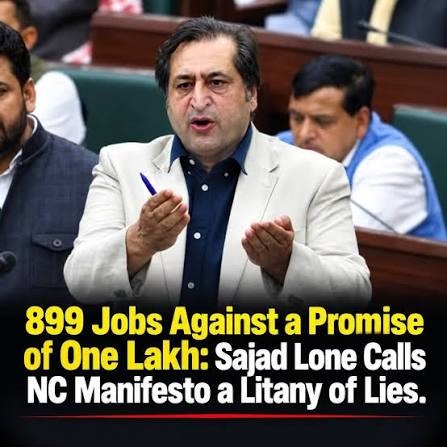
Peoples Conference president and Handwara MLA Sajad Gani Lone has seized on government figures presented in the Assembly to question the pace of job creation under the National Conference-led government. Lone calculated that if the government continues creating new posts at the pace reflected in the latest figures, it would take 222.46 years to reach the one-lakh target promised in the NC’s 2024 election manifesto.
The figure is political rhetoric built around official numbers rather than a government forecast. But it has nevertheless landed with considerable force because employment was one of the central concerns around the 2024 J&K Assembly election, and the NC manifesto explicitly promised one lakh jobs.
The Assembly data also presents a more complicated picture than the headline figure alone suggests.
The government has reported 899 new posts created across departments since October 16, 2024, while recruitment agencies have finalised 7,580 selections during the same period. A total of 14,270 vacancies were referred to the Jammu and Kashmir Public Service Commission and Jammu and Kashmir Services Selection Board for recruitment.
That distinction — between new posts created, vacancies referred and selections finalised — is central to understanding the political dispute.
The number that triggered Lone’s attack
The immediate controversy began after the government provided recruitment-related information in response to a question raised by Lone in the Assembly.
According to the government figures reported from the Assembly, 899 new posts have been created across various departments since October 16, 2024.
The largest share came from Health and Medical Education, with 485 posts. Housing and Urban Development accounted for another 266, while Law, Justice and Parliamentary Affairs created 82. Jal Shakti added 43 posts and the Department of Disaster Management, Relief, Rehabilitation and Reconstruction created 16. Smaller numbers were reported from several other departments.
Lone used the 899 figure against the NC’s electoral commitment of 100,000 jobs.
His calculation was straightforward: if 899 new posts represented roughly the current annualised pace, reaching 100,000 at that rate would take more than two centuries.
He put the figure at 222.46 years and sharply criticised the ruling party’s employment record, calling the NC manifesto a “litany of lies.” Those are Lone’s political characterisations, not findings established by the Assembly data itself.
The calculation nevertheless illustrates the gap between the scale of the promise and the number of new posts created so far.
But 899 new posts does not mean only 899 people were recruited
This is where the employment debate requires some care.
The government has separately informed the Assembly that 7,580 selections were finalised by JKPSC and JKSSB since October 2024.
Of these, JKPSC finalised 1,768 selections, while JKSSB finalised 5,812.
That number is substantially higher than 899 because the two figures measure different things.
The 899 figure refers to new posts created by departments.
The 7,580 figure refers to recruitment selections finalised by the two recruitment agencies.
A government can fill an existing vacant post without creating a new post. Consequently, it would be misleading to describe the Assembly data simply as saying that the government has “given only 899 jobs”.
What the 899 figure does show is the number of new sanctioned posts created during the period covered by the government reply. Lone’s 222-year calculation is based on that number.
That distinction is important for readers because political claims around employment can easily blur together job creation, recruitment and vacancy filling.
The 1 lakh promise was part of the NC’s 2024 manifesto
The National Conference’s employment commitment is not in dispute.
Its 2024 Assembly election manifesto promised one lakh jobs for youth and proposed passing a Jammu and Kashmir Youth Employment Generation Act.
The party also promised to fill vacant government posts within 180 days of assuming office. The Indian Express reported the manifesto as saying the party would provide one lakh jobs in the government sector and formal scheme-driven ventures.
This wording matters.
The one-lakh commitment was broader than simply creating 100,000 brand-new government posts. The manifesto described the pledge in terms of government-sector and formal scheme-driven employment.
Therefore, the present Assembly data on newly created departmental posts cannot by itself establish that exactly 899 of the promised one lakh jobs have been delivered.
Lone’s argument is a political interpretation of the recruitment figures, not a formal government audit of progress against every component of the manifesto commitment.
A second pressure point: 40,672 vacancies
Lone’s criticism did not stop at the one-lakh figure.
He also pointed to the government’s reported backlog of vacant positions.
According to figures cited in the Assembly debate, 40,672 posts remain vacant.
The reported breakdown is:
- 24,427 non-gazetted posts
- 3,318 gazetted posts
- 12,927 multi-tasking staff posts
Lone contrasted this with the NC’s manifesto commitment to fill government vacancies within 180 days.
That creates another politically potent comparison.
The manifesto set a very compressed timeframe for clearing vacancies. The government’s latest figures show that a substantial number of posts remain vacant.
But again, the raw vacancy figure needs context.
Vacancies do not necessarily represent positions that can be filled immediately. Recruitment requires sanctioned posts, requisitions, eligibility rules, reservation rosters, examinations, selection processes, verification and appointment orders. Some vacancies can also arise during the period in which other vacancies are being filled.
The relevant question for assessing the government’s performance is therefore not simply how many posts remain vacant on a particular date, but how many vacancies existed when the government took office, how many have since been referred, how many selections have been completed and how many appointments have actually been issued.
14,270 vacancies were referred for recruitment
One of the most significant numbers in the government’s Assembly response is arguably the 14,270 vacancies referred to JKPSC and JKSSB since October 2024.
Of these, 1,852 vacancies were referred to JKPSC, while 12,418 were referred to JKSSB.
The category-wise figures also show that recruitment is taking place across multiple reservation categories and Open Merit.
For JKPSC, the government listed 855 Open Merit vacancies alongside vacancies under SC, ST, OBC, ALC/IB, RBA, EWS and other categories.
For JKSSB, 5,173 vacancies were listed under Open Merit, alongside vacancies under SC, ST, ST-2, OBC, ALC/IB, RBA and EWS categories.
That information is particularly relevant because the reservation system itself has become a major political issue in J&K.
For young applicants, therefore, the employment debate is not only about the total number of jobs. It is also about how vacancies are distributed, how many are available under Open Merit, how reservation categories are applied and how quickly recruitment processes move from notification to appointment.
Why the jobs debate matters so much in J&K
The political importance of employment in Jammu and Kashmir goes well beyond election rhetoric.
Government employment has traditionally been highly sought after in the region because it offers comparatively stable income and long-term security.
For thousands of educated young people, recruitment examinations can represent years of preparation.
A delayed examination, a changed eligibility condition, an unresolved reservation roster or a prolonged selection process can therefore have consequences far beyond a government file.
The wider employment challenge is also considerably larger than the number of government vacancies.
A government can create posts and conduct recruitment, but it cannot solve youth unemployment entirely through public-sector hiring. Sustainable employment also depends on private investment, tourism, manufacturing, information technology, agriculture and horticulture, entrepreneurship and formalisation of the wider economy.
That is why the NC’s one-lakh promise was politically significant: it was presented against a backdrop of widespread concern over employment opportunities.
The distinction between “jobs created” and “jobs filled” will shape the political debate
The latest Assembly figures effectively create two parallel stories.
The first is the story Lone is highlighting:
899 new posts have been created since October 2024.
The second is the government’s broader recruitment record:
7,580 selections have been finalised by JKPSC and JKSSB, while 14,270 vacancies have been referred to the recruitment agencies.
Neither number should simply be substituted for the other.
The 899 figure is relevant to the question of new sanctioned posts.
The 7,580 figure is relevant to recruitment selections.
The 14,270 figure indicates the scale of vacancies referred for recruitment.
And the 40,672 figure reflects the reported vacancy backlog.
Taken together, these figures show an administration dealing with a substantial recruitment pipeline while also facing criticism over the speed at which employment commitments are being fulfilled.
Political pressure on Omar Abdullah’s government
The controversy arrives at a politically sensitive time for Chief Minister Omar Abdullah’s government.
Employment was among the major promises made by the National Conference during the 2024 election campaign. Two years into the government’s tenure, opposition parties are increasingly using Assembly questions and government data to measure progress against those promises.
Lone’s intervention gives the Peoples Conference a particularly sharp line of attack because the figures he cited came through a question in the Assembly.
This allows the opposition to frame its criticism around government-provided information rather than estimates generated outside the legislature.
The NC government, however, has a broader record to point to, including recruitment selections completed by JKPSC and JKSSB and thousands of vacancies referred for further recruitment.
The political argument is therefore likely to continue over what should count as delivery.
Is the benchmark new posts created?
Selections finalised?
Appointments actually issued?
Vacancies cleared?
Or the wider employment generated through government schemes and the private sector?
Until that distinction is clearly established, both sides can point to different numbers.
The application-fee issue adds another layer
Lone also raised the issue of application fees for government recruitment.
He alleged that the NC had promised to waive fees for job applicants but that government responses to an earlier Assembly question showed that substantial amounts had nevertheless been collected.
This allegation requires separate verification from the underlying recruitment data and should not be treated as established solely on the basis of Lone’s statement.
Still, the issue fits into a wider political concern: for unemployed young people, even the cost of applying for multiple competitive examinations can become significant when recruitment cycles are long and uncertain.
The debate over fees therefore connects with the larger question of whether recruitment systems should minimise financial barriers for applicants.
What the numbers reveal — and what they do not
The latest figures provide a useful snapshot, but they do not by themselves provide a complete audit of the NC government’s employment promise.
They establish that:
899 new posts were created across government departments since October 16, 2024.
7,580 selections were finalised by JKPSC and JKSSB during the period.
14,270 vacancies were referred to the two recruitment agencies.
40,672 posts were cited by Lone as remaining vacant.
The figures do not, by themselves, establish how many of the one lakh promised employment opportunities have been delivered across all categories mentioned in the manifesto.
That is the key qualification behind the political headline.
From election promise to Assembly accountability
The bigger story here is not simply Lone’s 222-year calculation.
It is the transformation of an election promise into a question of legislative accountability.
During elections, large employment targets can be politically attractive because they speak directly to the aspirations of young voters.
Once a government takes office, however, the questions become much more technical:
How many jobs have been sanctioned?
How many vacancies existed?
How many were referred?
How many examinations were conducted?
How many selections were finalised?
How many candidates actually received appointment orders?
How many positions were created specifically as part of new employment schemes?
And how does the government define the one-lakh target?
Those are the numbers that will ultimately determine whether the manifesto commitment is being fulfilled.
A jobs promise now facing a harder test
Sajad Lone’s 222.46-year calculation has given the J&K employment debate a striking political headline. But beneath that headline lies a more substantive issue.
The Assembly data confirms that only 899 new posts were created across departments since October 2024, while thousands of recruitment selections have also been finalised and 14,270 vacancies have been referred to the two principal recruitment agencies.
The figures therefore point to both activity and a substantial gap between the scale of the government’s employment challenge and the scale of new posts being created.
For the National Conference government, the political task now is to explain how the one-lakh employment commitment is being measured and what concrete timetable exists for achieving it.
For Sajad Lone and other opposition leaders, the Assembly numbers provide a platform to keep pressing the government on the pace of delivery.
And for J&K’s young job aspirants, the debate ultimately comes down to something much less abstract than political arithmetic:
When a promised job becomes a recruitment notification, when that notification becomes a selection, and when that selection finally becomes an appointment.
That is where the difference between an election promise and an employment programme will eventually be measured.