PDP Moves Privilege Motion Against J&K Chief Secretary, Law Secretary Over J&K Statehood Resolution Row
By: Javid Amin | 30 September 2026
Srinagar: The political confrontation over Jammu and Kashmir’s demand for restoration of full statehood has moved into a new institutional phase, with PDP legislator Waheed-ur-Rehman Para submitting a privilege motion against Chief Secretary Atal Dulloo and Law Secretary Achal Sethi over their communications to the Assembly Speaker concerning the statehood resolution.
The move follows an unusual episode during the Jammu and Kashmir Legislative Assembly’s autumn session in which the two senior officials reportedly communicated to the Assembly Secretariat that Chief Minister Omar Abdullah’s statehood resolution should not be taken up because the matter was sub judice.
The communications became public during the Assembly debate after Omar Abdullah disclosed that he had not been aware of the Law Secretary’s opinion to the Speaker. He questioned how senior officials could advise the Speaker against taking up a resolution moved by the elected Chief Minister, who also holds the Law portfolio.
The controversy has now evolved from a dispute over the wording and admissibility of a political resolution into a wider question about the relationship between the elected Legislature, the executive bureaucracy and the office of the Speaker in Jammu and Kashmir’s Union Territory framework.
Para’s motion does not establish that either official committed a breach of privilege. It asks the Speaker to examine whether their actions amounted to interference with the privileges and authority of the House.
Para’s Privilege Motion Puts Legislature-Bureaucracy Relationship Under Spotlight
In his notice to Speaker Abdul Rahim Rather, Para argued that the power to initiate, deliberate upon, amend and adopt resolutions is a core function of an elected legislature.
He maintained that while government officers can provide administrative or legal advice within their official responsibilities, such advice cannot become a mechanism for restricting or questioning the Assembly’s authority.
“The power of an elected Legislature to initiate, deliberate upon, amend and adopt resolutions is a core parliamentary function,” Para wrote, according to the text reported by The Indian Express. He added that official advice could not be allowed to become an instrument for constraining the legislative privileges and authority of the House.
Para has consequently asked the Speaker to examine the episode under the applicable privilege rules.
The immediate question is therefore not whether the officials agreed with the resolution, but whether they crossed the institutional line between providing legal advice and attempting to influence or constrain legislative proceedings.
That distinction could become central if the matter proceeds before the Assembly’s Committee of Privileges.
How the Statehood Resolution Triggered the Dispute
The controversy originated with Omar Abdullah’s resolution seeking the “immediate and urgent restoration” of full statehood to Jammu and Kashmir.
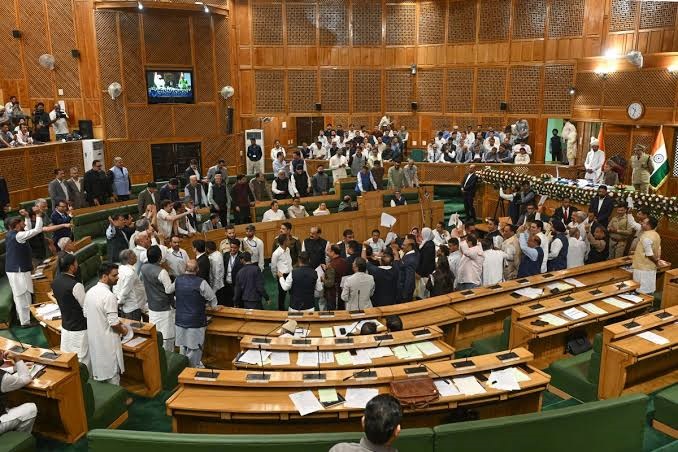
The resolution was introduced in the Assembly on September 25 and admitted for discussion. The House subsequently debated it and passed it on September 28 after BJP legislators protested and walked out. The final resolution also referred to earlier Assembly resolutions of June 2000 and November 2024, which became a major point of contention between the government benches and the BJP.
But shortly before the House took up the resolution, the Assembly Secretariat received communications from Law Secretary Achal Sethi and Chief Secretary Atal Dulloo arguing that the matter was sub judice and should not be taken up.
According to reports, the letters were sent after the Speaker had already admitted the resolution for discussion.
Speaker Abdul Rahim Rather subsequently described the intervention as unprecedented, saying he was unaware of a precedent in which the bureaucracy had written to the Assembly Secretariat seeking to prevent House business from proceeding.
That assertion has become an important part of the political dispute, although whether the communications actually amounted to an improper interference remains a matter for the appropriate Assembly process.
Omar Abdullah Questions How the Letters Were Sent
The episode took a particularly political turn because Omar Abdullah said he had not known that the Law Secretary had sent an opinion to the Speaker.
Abdullah, who also holds the Law portfolio, questioned how the Law Secretary could independently send an opinion opposing consideration of a resolution moved by the Chief Minister.
He similarly questioned the Chief Secretary’s communication and asked on whose instructions the officials had acted.
The Chief Minister linked the controversy directly to Jammu and Kashmir’s status as a Union Territory.
His argument was that the episode illustrated the limitations faced by an elected government when the region does not enjoy the institutional position of a full state.
The political significance of that argument is considerable. The statehood debate had already focused on the distribution of powers between the elected government and the Union administration. The letters added a more immediate question: who has the authority to determine whether an Assembly resolution can be debated?
Speaker’s Role Becomes Central
The dispute has placed Assembly Speaker Abdul Rahim Rather at the centre of an institutional question.
Under the Jammu and Kashmir Reorganisation Act, 2019, the Legislative Assembly has freedom of speech subject to the Act and the rules and standing orders governing its proceedings. The Act also provides for rules regulating the procedure and conduct of Assembly business.
This framework is important because a government department’s legal opinion is not, by itself, the same thing as a binding direction to the Legislature.
Indeed, during the controversy, National Conference MLA Mubarak Gul said the opinion provided by the officials was not binding on the House.
The statehood resolution was subsequently debated and passed despite the communications.
That outcome does not, however, resolve whether the officials were entitled to send the communications in the first place. That is a separate institutional question.
What Does “Sub Judice” Mean in This Context?
The officials’ reported argument was that the statehood issue was sub judice.
That phrase does not automatically mean that every political or legislative discussion touching on the subject is prohibited.
Whether a matter is genuinely barred from legislative discussion depends on the specific issue pending before a court, the relief being sought, the nature of the proposed Assembly action and the applicable rules governing legislative proceedings.
A legal officer can advise a government institution that a proposed action raises a judicial or constitutional issue. But the existence of such an opinion does not automatically determine what the Speaker or the House must do.
This distinction is particularly important in the present controversy.
The Assembly’s resolution was a political demand to the Government of India for restoration of statehood. It did not itself restore statehood, amend the Constitution or issue a judicial determination.
The resolution was eventually adopted by the House and forwarded as its institutional demand.
The BJP Takes a Different Position
The dispute has not produced a united political response.
While several non-BJP parties criticised the officials’ communications and demanded action, the BJP defended the position taken by the Law Secretary and Chief Secretary.
Leader of Opposition Sunil Sharma argued that the Law Department’s opinion supported the BJP’s contention that the resolution was legally problematic. He went further, saying that if the Assembly passed the resolution despite that opinion, questions should arise about the Speaker’s position and the Chief Minister’s decision to bring it before the House.
The BJP had already opposed the statehood resolution because of its references to earlier resolutions dealing with autonomy and special constitutional status.
It has maintained that it supports restoration of statehood but objects to what it sees as an attempt to link that demand with the pre-2019 constitutional framework.
The bureaucratic controversy has therefore become an extension of an existing political divide.
For the non-BJP parties, the issue is principally about legislative authority and the role of elected representatives.
For the BJP, the officials’ objections reinforce its position that the statehood resolution went beyond a straightforward demand for restoration of statehood.
Congress and People’s Conference Join the Debate
The issue quickly moved beyond the PDP.
Congress MLA Irfan Hafeez Lone questioned the authority of government officials to independently advise the Speaker on the admissibility of a resolution and called for the matter to be referred to the Privileges Committee.
People’s Conference president and MLA Sajad Gani Lone also criticised the episode, arguing that if the government believed the officials had undermined the House, it should demonstrate its authority by acting against them rather than using that authority against legislators.
His intervention added another layer to the controversy because the People’s Conference has also been critical of the government’s handling of the statehood debate.
The emerging alignment is therefore unusual: legislators belonging to different political parties have raised questions about the role of the bureaucracy, while the BJP has taken the opposite position.
The Legal Question: Advice or Interference?
At the heart of the dispute is a relatively narrow but constitutionally significant question.
Were the two officials simply exercising their duty to provide legal advice, or were they attempting to interfere with the Assembly’s functioning?
There is a legitimate administrative role for government officers in advising on legal and constitutional questions.
A Law Secretary can be expected to flag potential legal problems. A Chief Secretary can communicate on matters involving administration and government functioning.
Therefore, the mere fact that an official disagrees with a proposed Assembly resolution—or provides an opinion on its legality—does not automatically amount to contempt of the House or breach of privilege.
The circumstances become different if an official attempts to direct the Speaker or prevent the House from exercising a function that belongs to it.
That is why the actual contents of the letters are likely to matter considerably if the privilege proceedings move forward.
The distinction between “the department’s legal advice is that the resolution should not be taken up” and “the Assembly cannot take up the resolution” is institutionally important.
The former is advice.
The latter could raise a much more serious question about the limits of executive authority over legislative proceedings.
What the J&K Reorganisation Act Says About Legislative Privilege
The legal framework does provide the Assembly with parliamentary privileges.
Section 30 of the Jammu and Kashmir Reorganisation Act, 2019 provides for freedom of speech in the Legislative Assembly, subject to the Act and the rules and standing orders governing its procedure. The Act also contains provisions dealing with the Assembly’s rules of procedure and restrictions on discussion.
The Assembly has also constituted a Committee on Privileges for the 2026-27 period, chaired by Justice (retd.) Hasnain Masoodi. The committee has already been dealing with other alleged breach-of-privilege matters involving government officials, demonstrating that the mechanism is an active part of the present Assembly’s institutional functioning.
That precedent is relevant to what may happen next.
A privilege notice does not itself establish wrongdoing. It provides the Assembly with a mechanism to determine whether the conduct complained of interfered with the rights, authority or functioning of the House.
What Happens If the Speaker Takes Up the Matter?
The next step lies with Speaker Abdul Rahim Rather.
The Speaker can consider whether the notice raises a genuine question of privilege and whether it should proceed under the Assembly’s rules.
If the matter is referred to the Committee on Privileges, the committee can examine the communications, seek explanations from the officials and consider the circumstances in which the letters were sent.
The committee’s examination would be particularly important because it could establish several facts that are currently contested or incomplete:
- Who authorised the communications?
- Were they sent as formal government advice or as independent departmental opinions?
- Had the Speaker or Assembly Secretariat requested such advice?
- What precisely did the officials mean by describing the matter as sub judice?
- Did either official ask the Speaker to exercise a power they did not possess?
- Had the resolution already been formally admitted for discussion?
- Did the communications seek to prevent debate or merely flag a legal concern?
Those questions are more consequential than the political rhetoric surrounding the controversy.
A Privilege Motion Is Not a Finding of Guilt
This distinction will be important as the controversy develops.
Para’s motion is a request for privilege proceedings. It is not a judicial ruling and does not establish that Dulloo or Sethi breached the Assembly’s privileges.
Similarly, the BJP’s claim that the officials’ position demonstrated the illegality of the resolution is a political and legal argument, not a binding judicial determination.
The Assembly itself will have to determine whether a breach of privilege occurred under its applicable rules.
If the matter reaches the Privileges Committee, the officials would have an opportunity to explain the basis for their communications.
That process could ultimately produce a finding either way.
Why the Episode Matters Beyond the Statehood Resolution
The immediate controversy concerns one resolution.
Its wider implications, however, extend to the functioning of Jammu and Kashmir’s elected government under the Union Territory structure.
The Assembly’s autumn session officially ran from September 21 to September 30. The Assembly’s own National eVidhan portal records 90 members and lists the statehood resolution, proposed amendments and daily business during the session.
The session ended on September 30, but the dispute over the officials’ communications may continue beyond the sitting of the House.
At a broader level, the episode raises a question that has repeatedly surfaced since the restoration of an elected government: how should authority be divided between elected ministers, the Lieutenant Governor’s administration, senior civil servants and the Legislature while Jammu and Kashmir remains a Union Territory?
That question is separate from the constitutional debate over Article 370 and autonomy, but the two discussions increasingly overlap in political debate.
The Statehood Row Has Now Acquired an Institutional Dimension
The original statehood resolution was already politically contentious.
The BJP objected to references to the 2000 autonomy resolution and the 2024 special-status resolution. Amendments seeking references to Article 370, Article 35A and other aspects of the earlier constitutional arrangement were also proposed but not pressed after Omar Abdullah urged members to keep the focus on statehood.
The bureaucratic intervention has added an entirely different dimension.
The question is no longer only whether Jammu and Kashmir should regain statehood or whether the resolution’s language was appropriate.
It is now also about who has the authority to determine what the elected Assembly may debate.
That is why the privilege motion could prove more significant than its immediate political origins suggest.
If the Speaker or Privileges Committee concludes that the officials merely supplied bona fide legal advice, the episode could end as an institutional disagreement over procedure.
If, however, it finds that the communications amounted to an attempt to obstruct or constrain the House, the dispute could establish an important precedent for relations between Jammu and Kashmir’s bureaucracy and Legislature.
The Road Ahead
The autumn session has ended, but the institutional questions raised during it have not necessarily disappeared.
The statehood resolution has already been passed and represents the Assembly’s formal demand for restoration of full statehood. The controversy over the officials’ communications now places the Speaker and potentially the Privileges Committee in a new position.
For Waheed Para and other legislators supporting the privilege motion, the issue is about protecting the authority of an elected House.
For the officials involved, the eventual question will be whether their communications were legitimate expressions of legal and administrative advice or crossed into interference with legislative proceedings.
For the BJP, the episode reinforces its argument that the statehood resolution itself raised legal and constitutional concerns.
And for the wider political system in Jammu and Kashmir, the dispute highlights a structural tension that has existed since the return of an elected government under the Union Territory framework.
The immediate controversy may be over two letters.
The larger issue is about where the line lies between executive advice and legislative authority.
That line will ultimately have to be clarified through the Assembly’s own procedures, the applicable constitutional and statutory framework, and—if the dispute eventually reaches the courts—the judiciary.
For now, however, one point remains clear: Waheed Para’s privilege motion has opened a new chapter in the J&K statehood controversy, but no breach of privilege has yet been established.