Flydubai Pilot Attack: Emergency Codes, Locked Cockpit Doors and the Aviation-Security Lessons Behind the Iran Question
By: Javid Amin | 30 September 2026
A violent cockpit struggle on a Dubai-to-Tel Aviv Flydubai flight has raised fresh questions about aviation security, insider threats and the limits of post-9/11 cockpit protection. As Israel investigates whether the incident was an attempted terrorist attack, Benjamin Netanyahu says authorities will “get to the root” of the case — including whether there were accomplices or any Iranian connection. But for now, an Iranian role remains unproven.
A routine commercial flight from Dubai to Tel Aviv suddenly became an aviation emergency on September 30 when a violent confrontation erupted inside the cockpit of Flydubai Flight FZ1073.
The Boeing 737 was carrying 174 people when the aircraft experienced a dramatic loss of altitude after an alleged attack by one pilot against the other. Emergency transponder codes were activated, Israel scrambled fighter aircraft amid the hijacking alert, and the plane eventually diverted to Tabuk in northwestern Saudi Arabia, where it landed safely.
The immediate crisis ended without a mass-casualty disaster.
But the questions surrounding it are only beginning.
Why did the aircraft transmit both 7700 and 7500, the internationally recognised emergency and unlawful-interference codes? How did passengers and other crew members manage to intervene inside a highly secured cockpit? Why has Israel raised the possibility of Iranian involvement? And what does the incident reveal about the vulnerabilities that remain inside modern commercial aviation more than two decades after the September 11 attacks?
At the centre of the investigation is an extraordinary possibility: the threat was allegedly not someone trying to break into the cockpit.
It was already inside.
The Flydubai flight that suddenly turned into an aviation emergency
Flydubai Flight FZ1073 departed Dubai International Airport for Ben Gurion Airport in Tel Aviv on September 30.
Flydubai initially confirmed that the aircraft had experienced an incident while en route and subsequently landed safely at Tabuk Airport in Saudi Arabia. The airline said all passengers were safe and accounted for and that it was cooperating with the relevant authorities.
The company did not initially provide details about what had happened inside the aircraft, urging caution until investigators established the facts.
Those details emerged through Israeli officials, passengers and subsequent reporting.
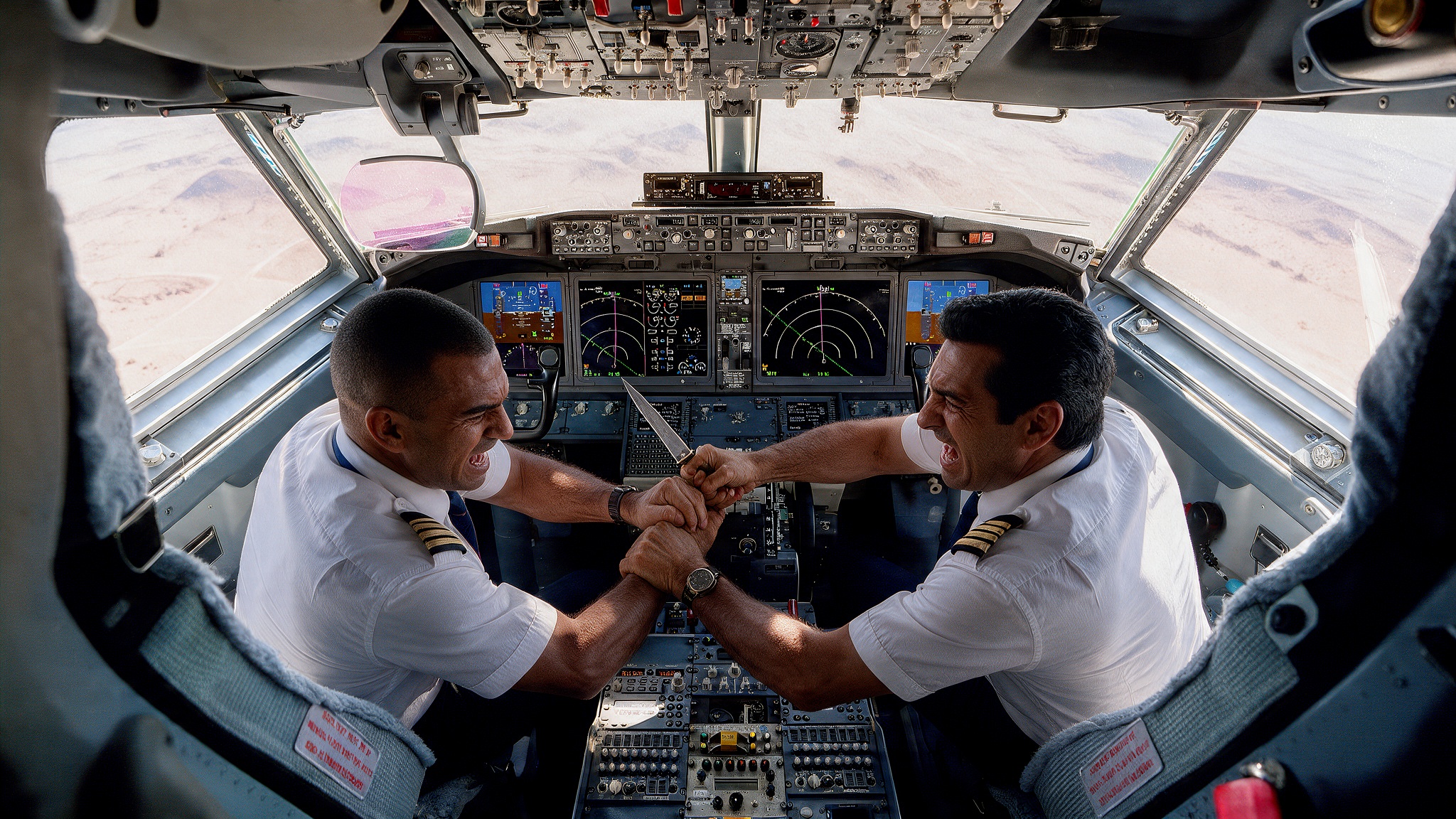
According to those accounts, a violent confrontation took place inside the flight deck. The co-pilot allegedly attacked the captain, who was seriously injured.
The aircraft then entered a steep descent.
Passengers described a sudden and frightening change in the aircraft’s movement as the plane lost thousands of feet of altitude in a very short period.
The emergency was no longer simply a dispute between two crew members.
There was now a civilian aircraft carrying 174 people whose flight path and control appeared to be in jeopardy.
The captain’s actions may have changed the outcome
The captain, identified as Indian national Smit Machchhar, was seriously injured during the confrontation.
Yet according to accounts from passengers and officials, he was still able to play a crucial role in preventing the situation from becoming catastrophic.
He reportedly managed to open the cockpit door, allowing passengers and other crew members to enter.
That moment was decisive.
Several passengers moved toward the flight deck and helped restrain the alleged attacker. Other Flydubai pilots who were travelling as passengers also became involved in regaining control of the aircraft.
One passenger later described grabbing the attacker and pulling him away from the controls, while another attempted to help stabilise the aircraft.
What followed was an unusual combination of professional aviation expertise and civilian intervention.
The injured captain, other qualified crew members and passengers collectively helped prevent a potentially fatal loss of control.
The aircraft eventually diverted to Tabuk and landed safely.
Captain Machchhar was taken to hospital in Saudi Arabia.
His actions have since drawn public praise from both Indian and Israeli leaders.
Why the numbers 7700 and 7500 caused such alarm
For most passengers, numbers appearing on an aircraft’s transponder are invisible.
For air-traffic controllers and air-defence authorities, however, they can carry enormous significance.
The aviation system uses specific transponder codes — often called squawk codes — to communicate emergency conditions.
7700: General emergency
7700 is used to indicate a general emergency.
It can cover a wide range of situations, including serious technical failures, medical emergencies or other circumstances in which an aircraft requires urgent assistance.
International aviation procedures recognise 7700 as the general emergency code.
7500: Unlawful interference
7500 is different.
It is internationally associated with unlawful interference, commonly understood as a hijacking or forced takeover situation.
The FAA describes Code 7500 as an indication that an aircraft is being hijacked or forced toward a new destination. ICAO procedures similarly identify 7500 with unlawful interference.
That is why the Flydubai incident immediately became an aviation-security emergency.
Flight-tracking information indicated that FZ1073 transmitted emergency signals including 7700 and 7500 during the crisis.
Once 7500 appeared, authorities could not assume they were dealing with an ordinary technical problem.
They had to consider the possibility that someone had attempted to take control of the aircraft.
Israel scrambled fighter jets as the hijacking alarm unfolded
The aircraft was travelling toward Israel when the emergency signals appeared.
That made the situation particularly sensitive.
Israel has one of the world’s most security-conscious aviation environments, and an aircraft bound for Ben Gurion Airport transmitting a hijacking-related code would inevitably trigger a serious response.
Israeli fighter aircraft were scrambled as authorities attempted to establish what was happening.
From outside the aircraft, the picture looked frighteningly familiar:
An Israel-bound commercial plane.
A sudden and severe loss of altitude.
A 7500 unlawful-interference signal.
An unknown situation inside the cockpit.
And a region already experiencing intense military tensions.
The truth, however, was more complicated.
The apparent hijacking threat was allegedly coming from inside the flight deck itself.
The locked cockpit problem
Modern commercial aircraft cockpits are not ordinary doors.
They are security barriers.
And that is largely because of what happened on September 11, 2001.
Before 9/11, the aviation industry had spent decades dealing with hijackings in which attackers generally sought political concessions, prisoner releases, asylum or changes of destination.
The underlying assumption was that a hijacking could eventually be negotiated to a safe landing.
The 9/11 attacks destroyed that assumption.
The attackers were not trying to bargain.
They were trying to turn passenger aircraft into weapons.
The subsequent transformation of aviation security was enormous.
Cockpit doors were strengthened.
Access procedures were tightened.
Crew training was changed.
Passenger and baggage screening systems were expanded.
The entire concept of the flight deck changed from a relatively accessible operational area into a heavily protected security zone.
The US 9/11 Commission documented how the pre-2001 system had been based on a “Common Strategy” of accommodating hijackers and getting aircraft safely to the ground. After the attacks, the security philosophy fundamentally changed.
The cockpit door became one of the most important physical barriers in civil aviation.
But what happens when the threat is already inside?
That question has haunted aviation security since another tragedy more than a decade later.
On March 24, 2015, Germanwings Flight 9525 crashed in the French Alps.
The co-pilot deliberately locked the captain out of the cockpit and continued controlling the aircraft until it crashed.
All 150 people aboard died.
The incident exposed a different kind of vulnerability.
The reinforced cockpit door worked.
It kept the captain out.
But that was precisely the problem.
The person controlling the aircraft was already inside.
The tragedy prompted the European Aviation Safety Agency to recommend that airlines ensure that at least two authorised people, including at least one qualified pilot, be present in the cockpit at all times, or introduce equivalent risk-reduction measures.
EASA later moved toward a more flexible, risk-based approach, taking into account crew security screening, psychological support, employment conditions and other organisational factors.
The lesson was uncomfortable but unavoidable:
A cockpit can be made extremely secure against outsiders while remaining vulnerable to an insider.
From 9/11 to Germanwings — and now Flydubai
The evolution of cockpit security can be understood through three major phases.
Before 9/11: Stop the hijacker from taking control
Traditional aviation security focused heavily on preventing hijackers from entering the cockpit and on negotiating with them if they succeeded.
After 9/11: Keep the cockpit sealed
The terrorist attacks transformed the cockpit into a hardened security compartment.
The overriding concern became preventing unauthorised people from reaching the controls.
After Germanwings: Consider the insider
The Germanwings disaster demonstrated that the person behind the cockpit door could also become the threat.
Flydubai: A new combination of problems
The Flydubai incident brings several of those challenges together.
The alleged attacker was reportedly a member of the flight crew.
The aircraft entered a dangerous descent.
The cockpit became the centre of a violent struggle.
And passengers ultimately became part of the emergency response.
That combination will inevitably attract the attention of aviation-security specialists.
This is not the first time pilots have threatened their own aircraft
Aviation history contains several examples of crew members becoming the source of a serious security threat.
In 2014, an Ethiopian Airlines co-pilot took control of an aircraft while the captain was outside the cockpit and diverted it to Geneva.
In 2015, the Germanwings co-pilot deliberately crashed the aircraft after locking the captain out.
In 2013, the captain of Mozambique Airlines Flight 470 deliberately altered the aircraft’s flight path and crashed the plane.
In 2023, an off-duty Alaska Airlines pilot travelling in an extra cockpit seat allegedly attempted to interfere with the aircraft’s engine systems. He was restrained by the crew and the aircraft landed safely.
These incidents are different in their circumstances, motives and outcomes.
But they share one crucial characteristic:
The threat originated from someone who had legitimate access to the flight deck.
That is considerably more difficult to prevent than a conventional attempted cockpit breach.
Netanyahu brings Iran into the investigation
The aviation-security story has now collided with Middle Eastern geopolitics.
Israeli Prime Minister Benjamin Netanyahu has said Israel intends to investigate the incident thoroughly.
Netanyahu said authorities would get to the “root” of the attacker and determine whether he had accomplices.
He also raised the possibility of an Iranian connection.
But there is an important qualification.
When asked whether there was evidence that Iran was behind the incident, Netanyahu said it was too early to say.
That means the Iran question is currently an investigative possibility rather than an established conclusion.
The distinction matters.
The incident itself is well established.
The alleged attack inside the cockpit is the subject of an active investigation.
But a link to the Iranian state, an Iranian organisation or Iranian operatives has not been publicly demonstrated.
Why Iran has entered the conversation
The Iranian angle cannot be separated from the extraordinary geopolitical environment in which the incident occurred.
The aircraft was travelling from the UAE to Israel.
Israel and Iran are engaged in an intense strategic confrontation.
The broader Middle East is experiencing overlapping conflicts involving Iran, Israel, armed groups, airspace restrictions, missile threats and heightened security measures.
In that environment, an unexplained attack involving an Israel-bound civilian aircraft immediately carries a geopolitical dimension.
Investigators will therefore have to establish whether the incident was:
- an individual act;
- a criminal act;
- an ideologically motivated attack;
- an act of terrorism;
- an insider attack unrelated to any outside organisation;
- or something involving additional actors.
Only evidence from the investigation can distinguish between those possibilities.
At present, publicly available evidence does not establish an Iranian role.
The nationality of the suspected attacker adds another layer
Israeli officials have identified the alleged attacker as an Omani national, according to reporting.
That detail has attracted considerable attention because the aircraft originated in the UAE and was headed for Israel, while the emergency landing took place in Saudi Arabia.
The investigation consequently crosses several jurisdictions.
The UAE is relevant because the aircraft departed from Dubai.
Saudi Arabia is relevant because the aircraft landed in Tabuk and the suspect was initially questioned there.
Israel is relevant because the aircraft was headed for Ben Gurion Airport and most passengers were Israeli.
The nationality and background of the alleged attacker, his employment history, security clearance and possible motives will therefore become central parts of the investigation.
Saudi Arabia suddenly became the safe harbour
There is also a remarkable geopolitical dimension to the emergency landing.
The aircraft was diverted to Tabuk, in northwestern Saudi Arabia.
Saudi authorities received the aircraft, treated passengers and provided emergency assistance.
The incident therefore created an unusual operational connection between Israel-bound passengers and Saudi authorities at a moment of heightened regional tension.
Saudi Arabia and Israel do not have formal diplomatic relations.
Yet aviation emergencies operate according to different imperatives.
When a civilian aircraft is in distress, the immediate priority is getting it safely onto the ground.
That is what happened in Tabuk.
The passengers were subsequently transported onward to Israel.
Flydubai suspends Israel flights
The incident has already produced a direct aviation consequence.
Flydubai suspended flights to and from Israel while the investigation continues.
The airline said it was working with relevant authorities and stressed that its priority was the safety of passengers and crew.
Israel has also moved toward strengthening security checks involving pilots operating flights into the country.
That response could become more significant if investigators uncover shortcomings in crew screening, cockpit access, security procedures or information-sharing.
Could cockpit security rules change again?
It is too early to know whether the Flydubai case will lead to new international aviation rules.
But several areas are likely to receive renewed scrutiny.
Pilot security screening
Airlines already conduct extensive checks on flight crews.
The incident could prompt questions about how those systems identify potential security risks without compromising legitimate privacy and employment rights.
Mental-health and behavioural support
Aviation regulators have long wrestled with how to encourage pilots to seek help when they are struggling without creating systems that discourage them from reporting problems.
The Germanwings tragedy demonstrated the consequences of failing to identify certain risks.
But screening for mental-health conditions is complicated and cannot simply be reduced to a checklist.
Cockpit access
The Flydubai incident could revive questions about how passengers or cabin crew can reach a cockpit during an extreme emergency without undermining the security protections created after 9/11.
Emergency-entry procedures
A modern aircraft must protect the cockpit from attackers while ensuring that an incapacitated crew can be assisted.
Those objectives can sometimes pull in opposite directions.
Crew-to-crew security
Most aviation-security systems are designed around passengers, airport security and external threats.
The Flydubai case highlights the need to consider what happens when the threat comes from someone who already has authorised access.
The remarkable role of ordinary passengers
Perhaps the most human part of the story is what happened inside the cabin.
Passengers were not trained flight crew.
They had no responsibility for flying the aircraft.
Yet when they realised that the cockpit had become the centre of a potentially catastrophic emergency, several reportedly moved toward the flight deck.
Some helped restrain the attacker.
One passenger attempted to help control the aircraft.
Other off-duty pilots aboard the aircraft contributed their aviation knowledge.
And the injured captain reportedly helped make it possible for others to enter.
It was an extraordinary example of an emergency in which the formal hierarchy of aviation safety was suddenly disrupted.
The survival of everyone aboard ultimately depended on a chain of actions involving trained pilots, cabin crew and passengers.
Why the cockpit door remains at the centre of the story
There is an important paradox here.
The cockpit door is supposed to keep people out.
But in an extreme emergency, someone may need to get in.
That problem became particularly clear after Germanwings.
If the door is too easy to breach, an external attacker can gain access.
If it is too difficult to breach under any circumstance, passengers and crew may be unable to respond if a pilot becomes incapacitated or dangerous.
The answer cannot simply be “make the door stronger.”
It requires a broader security architecture involving:
people + procedures + technology + training + screening + emergency protocols.
The Flydubai incident is therefore much bigger than one aircraft.
It is another reminder that aviation security is an evolving contest between new threats and systems designed to stop older ones.
What investigators still need to establish
The most important unanswered questions are now likely to determine the direction of the investigation.
What exactly happened inside the cockpit?
Flight-data and cockpit-voice recordings, physical evidence and witness accounts should help reconstruct the sequence.
Who initiated the emergency signals?
Investigators will need to establish how and when the 7700 and 7500 codes were selected.
What caused the dramatic descent?
The aircraft’s flight-control data should provide a detailed record of the sequence.
How was the cockpit door opened?
This could be crucial for understanding how passengers were able to enter.
Why did the alleged attacker act?
The motive remains one of the central unanswered questions.
Was anyone else involved?
Netanyahu has specifically raised the possibility of accomplices.
Was there an external organisation behind the incident?
That remains unresolved.
Was Iran involved?
At present, this is an allegation or investigative possibility, not an established fact.
The Iran question could become the most sensitive part of the case
The aviation investigation and the geopolitical investigation are likely to proceed on parallel tracks.
For aviation authorities, the priority will be reconstructing what happened aboard the aircraft and determining how the emergency developed.
For Israeli security agencies, the questions may extend further:
Was the alleged attacker acting alone?
Was there ideological motivation?
Was there foreign direction?
Was there an organisation behind the incident?
Or was the event entirely unrelated to the wider Israel-Iran confrontation?
Those questions cannot be answered simply by looking at the flight path or the identity of the passengers.
They require evidence.
That is why Netanyahu’s statement that Israel will “get to the root” of the case is politically significant, but his accompanying warning that it is too early to say whether Iran was involved is equally important.
A new chapter in the long history of aviation security?
Every major aviation disaster or attempted attack leaves behind a lesson.
The hijackings of the 1960s and 1970s produced new procedures.
The attacks of September 11 produced hardened cockpit doors and a radically different security philosophy.
Germanwings forced regulators to examine the risks associated with a lone pilot controlling an aircraft.
Other incidents have pushed aviation authorities to examine pilot screening, mental-health support, cockpit access and emergency intervention.
The Flydubai incident now raises another question:
How do you secure a cockpit when the person who has legitimate authority to be there may suddenly become the threat?
There is no simple answer.
Aviation is built around layers of protection. No single door, transponder code, screening process or pilot check can eliminate every possible risk.
What happened aboard FZ1073 demonstrates why those layers have to work together.
The larger Middle East picture
The Flydubai incident also illustrates something larger about today’s Middle East.
Commercial aviation now operates through one of the world’s most strategically sensitive regions.
Dubai is a global aviation hub.
Saudi Arabia is expanding its role as a major regional transport and economic centre.
Israel remains under intense security pressure.
Iran is at the centre of a wider strategic confrontation with Israel and the United States.
Air routes that appear routine on a flight map can cross a geopolitical landscape shaped by military alerts, diplomatic disputes and competing security systems.
The fact that a Dubai-to-Tel Aviv aircraft ended up making an emergency landing in Saudi Arabia is therefore more than a curious detail.
It is a snapshot of how deeply interconnected the region’s economies, transport networks and security concerns have become.
The immediate crisis is over. The investigation is not.
The passengers of Flight FZ1073 survived.
The aircraft reached the ground safely.
The injured captain survived the attack.
The alleged attacker was detained.
But the investigation now has to answer questions that extend far beyond one cockpit.
If the incident proves to have been the act of a lone individual, aviation authorities will still have to examine whether existing insider-threat protections were sufficient.
If investigators establish terrorism, the security implications will be broader.
If evidence eventually establishes a foreign connection, including an Iranian role, the consequences could move beyond aviation and into the already tense strategic relationship between Israel and Iran.
For now, however, that final possibility remains unproven.
What is known is already extraordinary enough:
A commercial aircraft carrying 174 people experienced a violent cockpit crisis, issued the aviation world’s most serious security signals, plunged thousands of feet, diverted into Saudi Arabia and survived.
And once again, the aviation industry is being reminded of a lesson it has learned repeatedly over the past quarter-century:
The biggest security threat is not always the person trying to get into the cockpit. Sometimes, the hardest threat to detect is the one who is already inside.