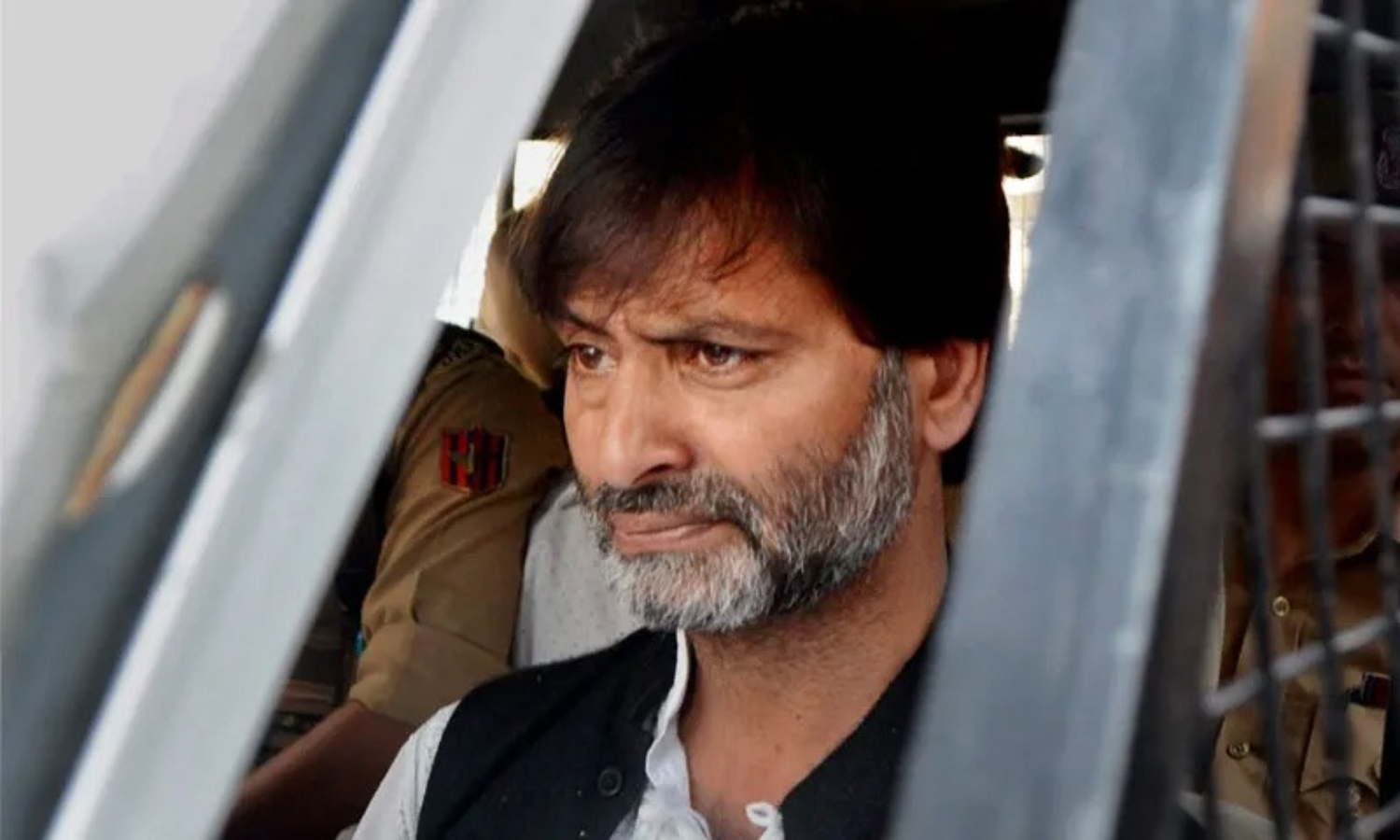
Yasin Malik PMLA Case: Delhi Court Orders Charges Against 7 in Hawala Funding Case
By: News Desk | 02 October 2026
New Delhi/Srinagar: A Delhi court has ordered the framing of money-laundering charges against jailed Jammu and Kashmir Liberation Front (JKLF) chief Yasin Malik and six others in a case arising from allegations that funds were received from Pakistani establishments through hawala channels and used to support separatist and subversive activities in Jammu and Kashmir.
Special NIA Judge Prashant Sharma, in an order passed on September 9 and made public on October 1, held that there was sufficient material on record to raise a “strong suspicion” against all seven accused for an offence under Section 3 of the Prevention of Money Laundering Act (PMLA), punishable under Section 4.
The development adds another layer to a long-running series of terror-funding and separatism-related cases involving several prominent figures from Jammu and Kashmir. The proceedings are separate from the earlier NIA terror-funding case in which Malik was convicted and sentenced to life imprisonment in 2022.
Who Are the Seven Accused?
The court has ordered charges to be framed against:
- Mohammad Yasin Malik, chief of the banned JKLF
- Zahoor Ahmad Shah Watali
- Abdul Rashid Sheikh, popularly known as Engineer Rashid and a sitting Lok Sabha member from Baramulla
- Shabir Ahmad Shah
- Naval Kishore Kapoor
- Masarat Alam Bhat
- M/s Trison Farms and Constructions Pvt Ltd
The case therefore brings together individuals associated with different strands of the broader political, separatist and alleged funding networks that investigators have examined over the years.
Engineer Rashid’s inclusion is particularly notable because he is a sitting Member of Parliament. He has been in custody in a separate NIA terror-funding case since 2019, although courts have granted him limited periods of interim bail on specific occasions.
What Did the ED Allege?
The Enforcement Directorate’s case centres on alleged movement of money through hawala and other channels.
According to the prosecution, the accused allegedly received funds from Pakistani establishments and other sources, which were subsequently routed, transferred, concealed, possessed or used through different conduits.
Investigators have alleged that the money was intended to support a separatist agenda and subversive activities in Jammu and Kashmir. The ED has put the alleged proceeds of crime generated in the underlying scheduled offences at approximately ₹8.94 crore.
The prosecution has also alleged that cash couriers acted as intermediaries in moving funds from the Pakistan High Commission in New Delhi to members of the Hurriyat leadership, including Yasin Malik.
These are prosecution allegations at this stage. The court’s decision to frame charges means that the material placed before it was sufficient to proceed to trial; it does not by itself establish that each allegation has been proved beyond reasonable doubt.
The ₹8.94-Crore Money Trail
The alleged financial trail is at the heart of the PMLA proceedings.
The ED has claimed that criminal activities connected with the scheduled offences generated proceeds of crime amounting to ₹8,94,87,639. Investigators allege that the money was subsequently handled through multiple channels and forms.
Reports based on the prosecution’s case have also said that Malik allegedly received foreign funds through intermediaries, including money allegedly routed through Zahoor Watali.
The Hindu’s reported account of the court proceedings further indicates that the ED alleged Malik received approximately ₹15 lakh through Watali during 2015-16, with the agency putting the total amount allegedly received by Malik at about ₹30.75 lakh. These figures are allegations forming part of the prosecution case, rather than judicial findings of fact.
The larger question before the court is therefore not simply whether money moved, but whether the alleged transactions constitute “proceeds of crime” and whether the accused knowingly participated in processes that amount to money laundering under the PMLA.
Why the Court Used the Phrase “Strong Suspicion”
The phrase used by Special Judge Prashant Sharma is legally significant but should not be confused with a finding of guilt.
The court concluded that there was prima facie sufficient material creating a strong suspicion against all seven accused for an offence under Section 3 of the PMLA, which carries punishment under Section 4.
At the stage of framing charges, the court does not conduct the same final assessment of evidence that would be required at the conclusion of a trial.
In practical terms, the court has found that the prosecution’s material is sufficient for the case to proceed rather than terminating the proceedings at the charge stage.
The prosecution will still have to establish its case during trial, while the accused retain the opportunity to challenge the allegations and evidence.
The Case Goes Back to the 2017 NIA Investigation
The PMLA proceedings originate from an NIA case registered in 2017 concerning alleged terror financing and separatist activities in Jammu and Kashmir.
The underlying NIA case invoked provisions dealing with criminal conspiracy as well as multiple sections of the Unlawful Activities (Prevention) Act.
The ED subsequently initiated proceedings under the PMLA to investigate the alleged proceeds of crime arising from those scheduled offences and to trace their movement through different financial and other channels.
This distinction is important.
The NIA investigation and the ED’s money-laundering investigation are related, but they operate under different statutory frameworks. The NIA case focuses on the underlying criminal and alleged terror/separatist activities, while the PMLA proceedings concern the alleged laundering of proceeds connected with scheduled offences.
Yasin Malik’s Earlier Terror-Funding Conviction
The latest PMLA proceedings also need to be understood against the backdrop of Malik’s earlier conviction.
In May 2022, an NIA Special Court convicted Malik in the Hurriyat terror-financing case after he pleaded guilty to charges in that case. The court subsequently sentenced him to life imprisonment for offences under the IPC and UAPA, along with other prison terms and a fine.
That earlier case concerned allegations of raising and receiving funds through illegal channels for separatist and terrorist activities.
The current PMLA proceedings are nevertheless a distinct legal proceeding. The fact that Malik is already serving a life sentence does not eliminate the need for the prosecution to establish the separate money-laundering allegations in the present case.
Formal Framing of Charges Delayed Over Security
The court had scheduled the formal framing of charges for September 30.
However, the accused could not be physically produced before the court because of security-related considerations. The court consequently directed the Enforcement Directorate to obtain the accused persons’ signatures on the charge documents at the prisons where they are lodged.
The matter has now been listed for further proceedings on October 30, 2026.
The procedural development means that the September 9 judicial determination to proceed with framing charges is already on record, while the physical/formal process was affected by custodial and security arrangements.
A Case Involving Both Separatist Figures and a Sitting MP
One of the notable aspects of the case is the combination of long-standing separatist figures and Engineer Rashid, who entered electoral politics and was elected to the Lok Sabha from Baramulla in 2024.
Rashid has consistently contested the allegations against him in his separate NIA case. His inclusion in the present PMLA proceedings means that the financial allegations will now form part of another judicial process involving the sitting parliamentarian.
His parliamentary status does not alter the legal standard applicable to the case. Like the other accused, he will have the opportunity to contest the allegations through the judicial process.
What Does the PMLA Case Actually Have to Establish?
At its core, a money-laundering prosecution has to establish the statutory elements of the offence rather than merely demonstrate that funds existed or changed hands.
The prosecution’s allegations revolve around three interconnected questions:
Where did the money originate?
Investigators allege that funds came from Pakistani establishments and other foreign or unlawful sources.
How did the money move?
The ED alleges that hawala operators, cash couriers and other conduits were used to transfer and distribute the funds.
How were the funds allegedly used or handled?
The agency alleges that the money was ultimately used, possessed, transferred or dealt with in ways connected to the alleged separatist and subversive activities.
The trial will determine how much of this alleged chain can ultimately be established through admissible evidence.
Hawala Allegations and the Broader Funding Investigation
The alleged use of hawala channels is central to the prosecution narrative.
Hawala systems can involve informal value-transfer arrangements outside conventional banking channels, making the reconstruction of a financial trail dependent on a combination of documentary evidence, statements, communications, cash movements and other investigative material.
In this case, investigators have alleged that cash couriers collected funds and delivered them to members of the Hurriyat leadership.
The prosecution has also relied on material that it says points to efforts to raise funds abroad for separatist and unlawful activities. Reports on the case have referred to emails allegedly associated with Malik as part of the ED’s investigation.
Whether these individual pieces of evidence establish the offences alleged against each accused is ultimately a matter for the trial court.
The Legal Position: Charges Are Not a Conviction
The distinction between framing of charges and conviction is particularly important in a case carrying major political and security implications.
The September 9 order means the court found sufficient prima facie material to proceed against the accused.
It does not mean that the court has finally determined that every allegation made by the ED is true.
The prosecution must still present evidence during trial. The accused can challenge the prosecution’s evidence, cross-examine witnesses where applicable, contest the interpretation of financial records and present their defence.
Only after the judicial process is completed can a final determination of guilt or innocence be made.
Why the Case Matters Beyond the Courtroom
The latest development extends a legal process that has continued for nearly a decade and keeps the question of alleged financial networks behind separatist activity in Jammu and Kashmir before the courts.
It also illustrates how the post-2017 counter-terror financing investigations have evolved beyond arrests and conventional criminal charges into detailed scrutiny of financial transactions, intermediaries, properties and alleged proceeds of crime.
For the authorities, the PMLA route provides a separate legal mechanism for pursuing alleged financial infrastructure associated with scheduled offences.
For the accused, the proceedings represent another opportunity to challenge the prosecution’s reconstruction of the alleged funding network and the legal basis on which individual transactions have been linked to money laundering.
What Happens on October 30?
The next scheduled date of proceedings is October 30, 2026.
The immediate procedural focus will be on completing the charge-related formalities and moving the case forward.
The larger trial will then have to address the prosecution’s evidence concerning the alleged origin, movement and use of the funds, the role attributed to each accused and the connection between the alleged proceeds of crime and the scheduled offences.
For Kashmir’s long-running political and security history, the case is significant not simply because of the names involved, but because it places an alleged financial network under continued judicial scrutiny.
The central issue now moves from whether the case should proceed to the more demanding question of what the prosecution can ultimately prove in court.
Bottom Line
The Delhi court’s latest order marks an important procedural step in the PMLA case against Yasin Malik and six others. The court has found prima facie material and a strong suspicion sufficient to proceed with charges under Sections 3 and 4 of the PMLA.
But the case remains a trial matter.
The allegations of Pakistani funding, hawala transfers, ₹8.94 crore in alleged proceeds of crime and the roles attributed to individual accused will have to be tested through the judicial process. The next scheduled proceedings are on October 30, when the case is expected to move further beyond the charge-framing stage.

