Cockroach Janta Party Protest Delhi: Leaders Freed as Supreme Court Steps In
By: Javid Amin | 11 October 2026
Three leaders freed, a Sunday sitting at the Supreme Court, and a capital still under watch: the fight over Chief Election Commissioner Gyanesh Kumar is now a fight over the right to protest itself.
It began as a joke with a sting. Now it is one of the most closely watched street movements in India.
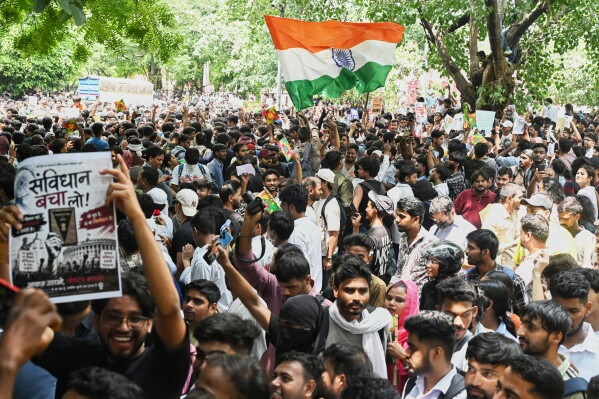
The Cockroach Janta Party (CJP), a satirical, youth-led movement founded online on 16 May 2026 by political communications strategist Abhijeet Dipke, spent the weekend at the centre of a standoff with Delhi Police. Its demand: the resignation of Chief Election Commissioner Gyanesh Kumar. The response on the streets: barricades, prohibitory orders, detentions, and by Sunday, the country’s top court stepping in.
Here is what we could verify, and where reports differ.
What Happened on Saturday: Barricades, Detentions and a Gurdwara Hideout
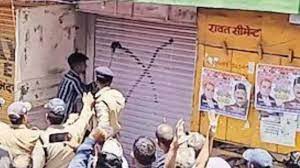
On Saturday, 10 October, police denied permission for the CJP rally, blocked access to Jantar Mantar and enforced prohibitory orders across central Delhi. Early reports put the number of people detained at around 500, with scenes near Connaught Place and Shivaji Stadium metro station. Some protesters, wearing helmets fitted with cockroach antennae, reportedly took shelter in a gurdwara to avoid being picked up.
One figure in the circulating summary needs a caution: it speaks of “thousands” detained. Credible reports we found put Saturday’s count at roughly 500, with over 100 more detained on Sunday. Until police publish a consolidated number, “hundreds” is the safer word.
The Airport Arrests: Three Leaders, 24 Hours
The most dramatic moment came before the march began. Dipke and fellow leaders Saurav Das and Ashutosh Ranka were taken into custody after flying into Delhi from Mumbai. Dipke’s own account, as relayed by Al Jazeera, was that police had entered the flight to arrest them.
The three were held under preventive provisions of the Bharatiya Nagarik Suraksha Sanhita (Sections 126 and 170), produced before a Special Executive Magistrate and released on Sunday, 11 October, after nearly 24 hours. The condition: no breach of peace for one year. Their legal team, led by CJP legal affairs head Ratna Singh, confirmed the release.
The Supreme Court Moves: “Peaceful Gatherings Should Not Mean Detention”
Alongside the street action, a legal one was building. Senior advocate and Trinamool MP Menaka Guruswamy approached the Supreme Court over police action against protesters and opposition leaders, including former chief ministers. A bench of Justices Joymalya Bagchi and V. Mohana held a special Sunday sitting.
Live coverage reports that the court directed that people gathering peacefully should not be detained and that authorities must allow free movement, subject to ordinary traffic regulation. A separate contempt petition names the Union Home Secretary, the Delhi Police Commissioner and the DMRC chairperson, alleging non-compliance with earlier court orders. We have not seen the full written order, so the exact wording matters and should be checked before quoting.
Journalists in the Frame
The detention of reporters has become its own controversy. The Committee to Protect Journalists counted six journalists detained during the protests; the summary we were given says “around a dozen.” Press bodies have objected strongly, arguing that press freedom cannot depend on special accreditation. Most of those held were reportedly released later. The honest position: at least six, possibly more, with no official tally yet.
From Voter Rolls to Civil Liberties: How the Story Shifted
The original grievance centres on Gyanesh Kumar’s leadership of the Election Commission. The summary links this to alleged irregularities in the Special Intensive Revision (SIR) of electoral rolls. That connection is plausible, but we did not independently confirm it in this round of checks, so treat it as the movement’s framing.
What is clear is the shift in the conversation. With leaders detained at an airport, journalists picked up and the Supreme Court convened on a Sunday, the debate has widened from “what is wrong with the electoral rolls” to “how much room does dissent get in the capital.” Opposition parties, student groups and civil rights organisations have leaned into that second framing.
The official position, as relayed in the summary, is that restrictions were needed to maintain law and order. Police did deny permission and impose prohibitory orders, which is consistent with that stance.
Delhi on Sunday: Open, but Watched
Reports describe a heavy security presence around Jantar Mantar, Connaught Place and other central locations, with barricades and diversions persisting even after the leaders’ release. The expectation among police is smaller, scattered gatherings rather than one large rally, a tactic activists tend to adopt when a main venue is sealed. Specific details about metro reopenings and individual junctions came from a single source, so commuters should check live transit and traffic advisories.
Analysis: Three Fronts, One Question
Politics. Opposition leaders can now argue the crackdown, not the original demand, is the story. That broadens support well beyond CJP’s core.
Law. The courts, from a magistrate’s bench to the Supreme Court, are now where detention powers and the right to assemble get tested.
Perception. The satirical branding that once made CJP easy to dismiss has become an asset: a cockroach-antennae helmet is instantly recognisable in a way a party flag is not.
The government can still say it prevented a mass gathering at Jantar Mantar. But a crackdown that fills courtrooms and press-club statements may have bought a longer fight rather than ended one.
What to Watch Next
- The Supreme Court’s written order and any follow-up hearing on the contempt petition
- Whether police publish a consolidated count of detentions and journalists held
- Whether CJP’s one-year peace condition shapes its next steps
- Whether protests spread beyond Delhi