Delhi Police register cases over the Opposition’s ‘March for Democracy’ to the Supreme Court, while fresh detentions deepen the confrontation over protest restrictions and alleged electoral-roll irregularities
By: Javid Amin | New Delhi | 13 October 2026
Delhi Police have registered four FIRs in connection with the INDIA bloc’s “March for Democracy” towards the Supreme Court, citing alleged violations of prohibitory orders under Section 163 of the Bharatiya Nagarik Suraksha Sanhita (BNSS). In a separate development, Cockroach Janta Party (CJP) leaders Saurav Das and Ashutosh Ranka were detained after party activists entered the Jantar Mantar premises, challenging the site’s recent removal from Delhi’s list of designated protest venues.
The two developments have intensified tensions in the capital as opposition parties and activists continue to protest against alleged irregularities in the Special Intensive Revision (SIR) of electoral rolls and demand the resignation of Chief Election Commissioner Gyanesh Kumar.
The latest confrontation also raises a broader question about how public demonstrations can be regulated while preserving the right to peaceful political expression.
Four FIRs Over INDIA Bloc’s March to the Supreme Court
Delhi Police registered four FIRs following Monday’s INDIA bloc march through central Delhi towards the Supreme Court, according to police sources cited in media reports.
The cases were reported at the Connaught Place, Tilak Marg, Mandir Marg and Barakhamba police stations. Police cited alleged violations of prohibitory orders imposed under Section 163 of the BNSS.
The march brought opposition leaders, party workers and supporters into central Delhi to challenge the Election Commission’s handling of the SIR exercise. The mobilisation was part of the broader campaign seeking greater transparency in electoral-roll revisions and accountability for alleged voter deletions.
Section 163 empowers an authorised magistrate to issue orders in urgent cases of nuisance or apprehended danger. Such orders can restrict certain activities or assemblies when legally justified by public-order concerns. Registration of an FIR, however, records allegations and initiates legal proceedings; it does not by itself establish that an offence has been proved.
The precise allegations against individual participants, the evidence collected by investigators and the subsequent legal proceedings will determine how the cases develop.
The FIRs come at a sensitive moment, with the Opposition taking its electoral-roll concerns to the Supreme Court and the police enforcing restrictions on demonstrations in the capital.
‘Jantar Mantar Has Been Reclaimed’: CJP Leaders Enter the Site
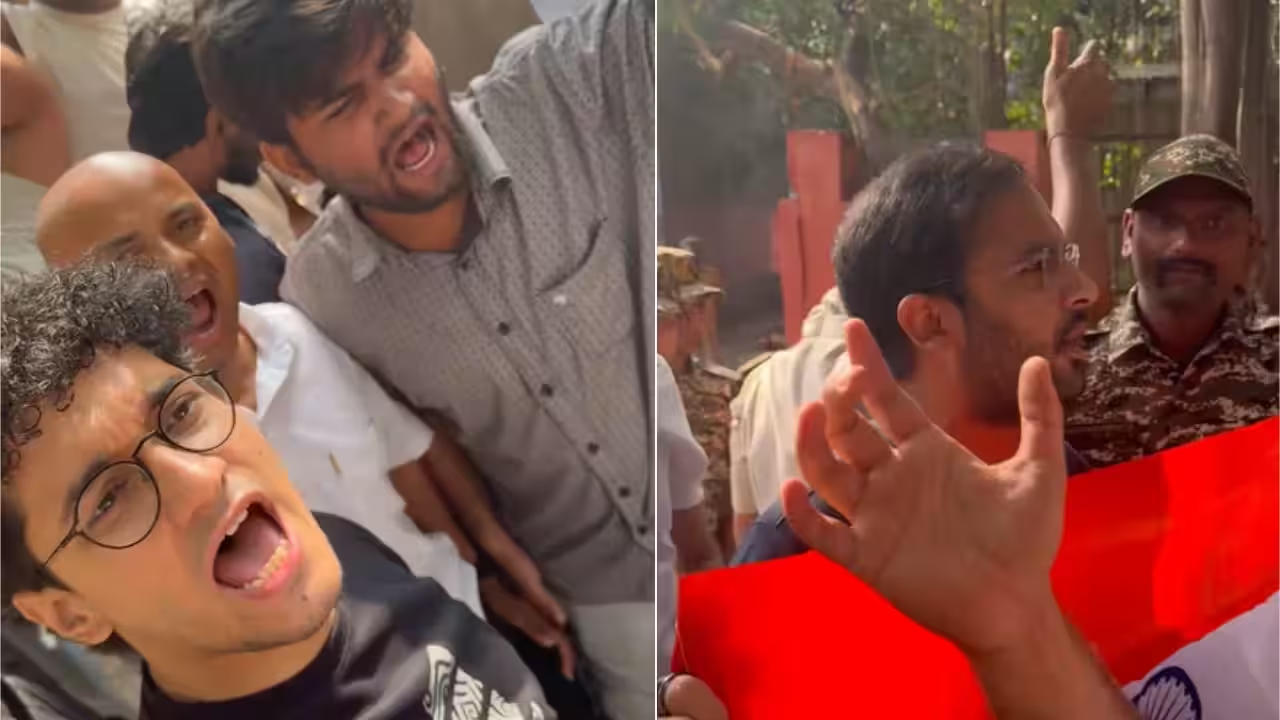
The day’s other major development unfolded at Jantar Mantar, where CJP leaders Saurav Das and Ashutosh Ranka, along with fellow activists, attempted to enter the premises after Delhi Police removed the venue from the list of designated protest sites.
Videos and social media posts circulated by the activists showed members of the group climbing over gates or barricades and entering the area carrying the Indian Tricolour. The group raised patriotic slogans and renewed its demand for the resignation of Chief Election Commissioner Gyanesh Kumar.
Das subsequently announced the entry on social media, declaring: “Jantar Mantar has been reclaimed.” He said the activists were being detained after entering the site and urged young supporters to continue the campaign.
Ranka also described the action as a breach of what he called the protest site’s restrictions. Police detained the activists after they crossed the cordon, according to media reports.
The episode represents a direct challenge to the revised arrangements governing demonstrations in Delhi. For CJP, the entry was a symbolic assertion that removing a venue from the official list cannot extinguish public opposition. For the authorities, the issue involves enforcing the new site designation and maintaining security around a sensitive area of central Delhi.
The activists’ claim of having “reclaimed” Jantar Mantar is a political description of their action, rather than a change in the site’s official status. The police order removing the venue from the designated list remained the operative arrangement at the time of the reported incident.
Why Jantar Mantar Was Removed as a Protest Venue
Delhi Police announced on October 12 that Jantar Mantar Road would no longer be a designated site for protests and demonstrations. The decision followed a review of alternative venues by a committee constituted by the Union Ministry of Home Affairs.
Under the revised arrangement, three locations were designated for demonstrations:
- Ramlila Ground in central Delhi.
- Burari Ground in north Delhi.
- CBD Ground in east Delhi.
The order, issued by Delhi Police Commissioner Anurag Kumar, modified an earlier standing order governing designated protest sites. Police said detailed procedures for organising demonstrations at the new locations would be issued separately.
The change marks a significant shift in Delhi’s protest landscape. Jantar Mantar has long been associated with political campaigns, public-interest demonstrations and movements seeking government accountability. Its location in central Delhi has made it a prominent gathering point for activists and opposition groups.
The relocation of demonstrations raises practical questions about accessibility, visibility and the ability of protesters to bring their demands to public attention. Supporters of alternative venues may argue that larger grounds can help manage crowds and reduce disruption to traffic and nearby businesses. Critics, however, may question whether sites farther from central institutions offer the same opportunities for visibility and engagement.
CJP has opposed the decision, describing it as an arbitrary restriction on the right to protest. The authorities have pointed to the revised arrangement and alternative venues as the framework for future demonstrations.
The central issue is whether the new system provides a meaningful and workable opportunity for peaceful assembly while addressing legitimate public-order concerns.
CJP’s Campaign Against the Election Commission
The immediate political backdrop to the Jantar Mantar action is CJP’s campaign against alleged irregularities in the SIR of electoral rolls.
The party has demanded the resignation of Chief Election Commissioner Gyanesh Kumar, arguing that the revision process raises serious questions about the accuracy of voter lists and the risk of eligible electors being excluded.
Electoral-roll revision is a routine but consequential part of election administration. It is intended to keep voter lists accurate by accounting for deaths, changes of residence, duplicate entries and other relevant circumstances. But when large numbers of names are removed or records are changed, the process requires transparency, reliable verification and accessible remedies for people who believe their enrolment has been wrongly affected.
CJP and other critics have called for greater accountability and clearer explanations of the changes. Their allegations must be assessed against documentary evidence and the Election Commission’s official records; the existence of a political dispute does not itself establish that unlawful deletions have occurred.
The controversy has nevertheless become a wider test of confidence in the electoral process. Voters need to know how to check their enrolment status, challenge errors and secure corrections within the applicable deadlines.
The protest movement is therefore seeking not only political accountability but also answers about the safeguards governing electoral-roll revision.
INDIA Bloc’s March Adds to Pressure on the Election Commission
The INDIA bloc’s “March for Democracy” has brought the electoral-roll dispute into a larger opposition campaign.
Led by senior opposition figures, the march towards the Supreme Court was intended to draw attention to allegations concerning the SIR exercise and seek judicial scrutiny of the Election Commission’s actions. Opposition leaders have argued that electoral transparency is essential to maintaining public trust in elections.
The campaign has unfolded alongside protests by CJP activists, creating two parallel fronts of opposition pressure: a political mobilisation in the streets and a legal challenge through the courts.
The registration of FIRs over the march adds a legal dimension to the confrontation. The police action and the activists’ claims of restrictions on dissent are likely to remain part of the political debate as the underlying electoral issues move through legal and institutional channels.
It is important, however, to distinguish between the separate events. The four FIRs relate to the INDIA bloc’s march, while the latest detentions at Jantar Mantar followed CJP activists’ reported entry into the premises. Both incidents occurred amid the wider dispute over electoral-roll revisions and protest restrictions, but they are not the same case.
A Debate Over Public Order and the Right to Dissent
The latest developments have shifted attention from electoral-roll revisions alone to the rules governing demonstrations in the national capital.
Authorities have the responsibility to maintain public order, manage traffic and protect sensitive government areas. They can regulate public gatherings through lawful orders and reasonable conditions. At the same time, peaceful assembly and political expression are protected by the Constitution, subject to the restrictions permitted by law.
The difficult question is how those responsibilities should be balanced in practice.
A protest-site designation does not remove every power to regulate an assembly, nor does the withdrawal of a venue’s designated status automatically settle every legal question surrounding an attempted demonstration. The circumstances of the event, the applicable orders, the conduct of participants and the actions of police all matter.
Similarly, an FIR is not a conviction, and a detention does not by itself prove that the person detained committed an offence. The legal basis for each action and the evidence supporting any allegation remain important.
For the authorities, clear communication about protest permissions, alternative venues and the legal basis for restrictions can help reduce uncertainty. For organisers, compliance with applicable orders and a commitment to peaceful mobilisation can help ensure that their message remains focused on the issues they seek to raise.
What Happens Next?
The immediate developments to watch include the status of the detained CJP activists, the progress of the four FIRs and any further attempts by the party to organise demonstrations at Jantar Mantar or the newly designated venues.
The broader electoral dispute will depend on the evidence presented, the Election Commission’s explanations and any directions issued by the courts. The political debate is likely to continue as opposition leaders seek scrutiny of the SIR process and authorities defend the need to regulate demonstrations.
The confrontation illustrates how a dispute over voter lists can expand into a larger argument about democratic accountability, the independence of institutions and the space available for public dissent.
For the moment, CJP’s entry into Jantar Mantar has delivered a powerful symbolic message for its supporters, while the FIRs against the INDIA bloc march signal that the legal consequences of the wider mobilisation are also unfolding.
Whether the confrontation leads to greater transparency or deeper political polarisation will depend on what happens next: the evidence brought forward, the responses provided by institutions and the extent to which both public order and peaceful democratic participation are protected.

