Saudi Arabia Under Pressure: Houthi Attacks Test Vision 2030, Airport Security and Regional Stability
By: Javid Amin| 25 October 2026
Saudi Arabia is confronting a growing security challenge that reaches far beyond the battlefield. A series of attacks targeting airports, energy infrastructure and strategic facilities has put pressure on the kingdom’s efforts to maintain public safety, protect international investment and advance its ambitious Vision 2030 economic transformation programme.
The latest developments have also brought the consequences of the regional conflict closer to ordinary people. Airport disruptions have complicated international travel, Indian nationals have been injured in attacks, and Umrah pilgrims from India have faced cancellations and uncertainty over their return journeys.
One of the clearest signs of the mounting pressure came on October 19, when Saudi Arabia’s flagship Future Investment Initiative (FII) conference, widely known as Davos in the Desert, was postponed until 2027. The gathering had been scheduled for October 26–29 and was expected to bring major international investors, financial executives and business leaders to Riyadh. The announcement came amid escalating attacks and growing security concerns.
The challenge for Riyadh is increasingly complex. The kingdom must protect its population and strategic infrastructure while preserving the confidence of international businesses, maintaining energy exports and avoiding a wider regional confrontation.
For India, the stakes are equally significant. The safety of Indian expatriates, the uninterrupted movement of oil and other goods, and the travel arrangements of thousands of pilgrims are all linked to developments across the Gulf.
Saudi Arabia Attacks: Why the Security Situation Has Become More Serious
Saudi Arabia’s current security concerns stem from a broader escalation involving Yemen’s Houthi movement, which is aligned with Iran, and the Saudi-led coalition supporting Yemen’s internationally recognised government.
In recent months, attacks attributed to the Houthis have affected Saudi military, civilian and energy-related infrastructure. The campaign has included strikes on Riyadh’s King Khalid International Airport and other strategically important locations, according to international reporting and Saudi official statements.
The consequences have been tangible.
An attack on Riyadh’s airport on October 10 resulted in multiple casualties. Saudi Arabia subsequently reported further attacks on civilian and strategic infrastructure, while the United Kingdom updated its travel advice to warn of an elevated threat to airports, ports, military installations and energy facilities across the kingdom.
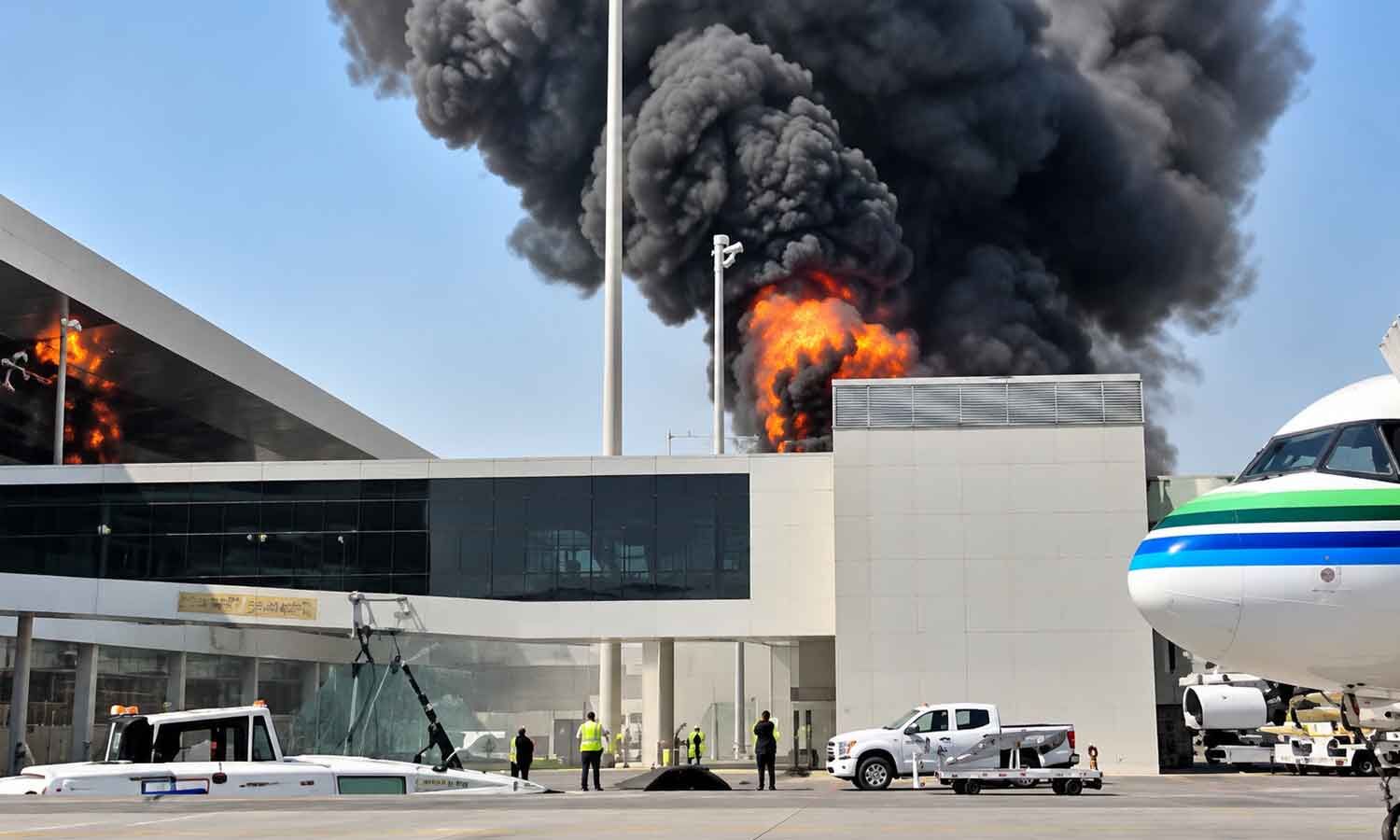
Dammam, in the Eastern Province, has also been affected. Saudi Arabia’s General Authority of Civil Aviation reported an attack on King Fahd International Airport on October 21. In a subsequent statement dated October 22, the authority raised the death toll to two, including an Indian national, while eight people remained injured. It also said airport operations had resumed and air traffic had returned to normal.
Separately, an attempted drone strike at the Shaybah oilfield resulted in two foreign nationals being killed and two others, including an Indian citizen, being injured after debris from an interception caused a fire. Saudi authorities said the incident did not disrupt oilfield operations.
These incidents underline an important distinction: the kingdom’s principal institutions continue to function, but the risks to specific facilities and the people who use or work at them have increased.
The immediate concern is no longer limited to whether an incoming missile or drone can be intercepted. Authorities must also account for falling debris, fires, airport closures, emergency medical response and the possibility of repeated attacks on different locations.
The Houthi Threat and the Risk of a Wider Regional Conflict
The Houthi movement has emerged as a central factor in the latest deterioration of Saudi Arabia’s security environment.
The group has previously used missiles and drones against targets in Saudi Arabia. Its military activities form part of a wider regional confrontation involving Iran, Gulf states and international powers. Saudi Arabia’s role in Yemen’s conflict also means that its security concerns cannot be separated from developments across its southern border.
The Saudi-led coalition has condemned attacks on civilian airports and facilities, describing them as threats to civilian safety and aviation security. The coalition has also said it is acting against Houthi military capabilities.
Yet attribution must be assessed separately for each incident. While several recent attacks have been attributed to the Houthis in official statements or reporting, not every newly reported strike has been independently verified, and some claims have not received immediate confirmation from Saudi authorities.
On October 26, Reuters reported that the Houthis claimed to have attacked Saudi Arabia’s East-West oil pumping stations and Riyadh airport. Saudi authorities had not immediately confirmed those reported attacks, leaving their impact unverified at the time of publication.
That distinction is important. A claim of responsibility does not automatically establish the extent of damage, the success of an attack or the interruption of operations.
The broader strategic danger is that continued strikes could encourage retaliatory action, increase the involvement of regional powers and make de-escalation more difficult. Saudi Arabia has strong reasons to defend its territory, but a prolonged confrontation could carry substantial human and economic costs.
For Riyadh, the challenge is to strengthen deterrence without allowing the conflict to undermine the country’s wider economic and diplomatic priorities.
Vision 2030 Faces a Test of Investor Confidence
Saudi Arabia’s Vision 2030 programme is designed to reshape the country’s economy, reduce its dependence on oil revenues and develop new sources of growth through tourism, technology, entertainment, sport, logistics and international investment.
The programme is also central to Crown Prince Mohammed bin Salman’s long-term economic strategy. Its success depends not only on capital and infrastructure but also on the perception that Saudi Arabia is a stable place to live, work, invest and conduct business.
That is why the postponement of the Future Investment Initiative has attracted particular attention.
The FII is one of the kingdom’s most prominent platforms for promoting investment opportunities and connecting Saudi institutions with international financial markets. Its tenth edition had been scheduled to take place in Riyadh from October 26 to 29, 2026.
Organisers announced that the conference would be postponed until 2027. Their public explanation focused on ensuring the event delivered its expected scale, quality and impact, rather than explicitly attributing the decision to security threats. However, Reuters and other international reporting linked the postponement to the deteriorating security environment and concerns among prospective participants.
The distinction matters. The postponement is confirmed, but the organisers’ formal explanation should not be confused with the wider reporting about the circumstances surrounding the decision.
Nevertheless, the timing creates an uncomfortable contrast for Saudi Arabia. The kingdom has invested heavily in presenting itself as a destination for global capital, major sporting events, tourism and large-scale development. A prominent international business gathering being delayed during a period of repeated attacks inevitably raises questions about security and business continuity.
Could the attacks affect foreign investment?
Investors generally assess several factors before committing capital to a country: expected returns, regulatory certainty, political stability, infrastructure quality and the ability to protect personnel and assets.
A security crisis does not automatically make an investment destination unattractive. Large markets can continue attracting capital during periods of geopolitical tension, particularly where governments maintain effective institutions and economic opportunities remain compelling.
However, repeated attacks can change the calculation.
International businesses may reconsider travel arrangements, require additional security measures, delay major announcements or seek greater assurances before sending senior executives into affected areas. Insurance costs and contingency planning can also become more important.
For Saudi Arabia, the central issue is whether the present situation remains a temporary disruption or becomes a prolonged source of uncertainty.
Vision 2030 has multiple pillars, and the postponement of one conference does not establish that the overall programme is failing. But the episode demonstrates that even ambitious economic reforms remain exposed to developments beyond the government’s direct control.
Saudi Oil Infrastructure: Why the Stakes Extend Beyond the Kingdom
Saudi Arabia remains one of the world’s most important oil producers and a major influence on global energy markets. Protecting its production facilities, pipelines and export infrastructure is therefore a national security priority with international economic consequences.
The Shaybah oilfield illustrates the challenge. Although an attempted drone strike resulted in casualties, Saudi authorities reported that oilfield operations continued without disruption. That is an important indication of operational resilience, but it does not eliminate the broader risk posed by repeated attacks.
The kingdom’s energy security depends on a network of interconnected assets rather than individual oilfields alone. Production sites, processing facilities, pipelines, storage terminals and export ports must all function together to sustain reliable deliveries.
An attack on one facility may have limited consequences if alternative capacity is available. A coordinated or sustained campaign against several critical points could create a very different situation.
The strategic importance of alternative export routes
Saudi Arabia operates an East-West pipeline system that can transport crude from the kingdom’s eastern production areas towards the Red Sea, providing an alternative to shipping all exports through the Persian Gulf.
This infrastructure offers strategic flexibility, particularly when maritime security in and around the Strait of Hormuz becomes a concern.
However, alternative routes are not a complete substitute for an entirely secure energy network. Their usefulness depends on available capacity, the condition of pumping stations, terminal facilities, shipping access and the security of the route itself.
The October 26 Houthi claim concerning the East-West oil pumping stations therefore deserves close attention, but it must be treated cautiously. Reuters reported that Saudi authorities had not immediately confirmed the claimed attack or its effects. It would be premature to conclude that the pipeline suffered damage or that oil exports were interrupted.
What could happen to global oil prices?
Oil markets respond to both actual supply disruptions and expectations about future risks.
If Saudi production or exports were significantly reduced, buyers could seek alternative supplies, potentially pushing prices higher. The scale and duration of any price movement would depend on the volume affected, available spare production capacity, commercial inventories and the wider international supply-demand balance.
Shipping costs, insurance premiums and delivery times could also rise if maritime threats intensified.
At present, however, the reported attacks do not establish a sustained interruption to Saudi oil exports. Claims that a major supply crisis has already begun would go beyond the available evidence.
The more defensible conclusion is that Saudi Arabia’s energy infrastructure faces heightened security risks, while the immediate market consequences depend on whether those risks translate into verified damage or lost production.
Aviation Disruptions: What Travellers Need to Know
Airports have become one of the most visible points of pressure during the current crisis.
The attacks on Riyadh and Dammam demonstrate how security incidents can affect civilian aviation even when the immediate target or damage is confined to a particular facility.
Airport operations may be suspended temporarily while authorities conduct safety inspections. Airlines can cancel or divert flights, and passengers may face missed connections, additional accommodation expenses or difficulties arranging onward travel.
Saudi authorities reported that King Fahd International Airport in Dammam had resumed normal operations after the October 21 attack, despite the casualties and damage. That does not guarantee that every route or airline service is operating without disruption elsewhere in the kingdom.
Travellers should therefore distinguish between an airport being operational and their individual flight being confirmed.
Before travelling, passengers should:
-
Check their airline’s latest flight status directly.
-
Confirm airport and terminal details before departure.
-
Keep booking references, travel documents and airline contact information accessible.
-
Ask the airline or travel agent about rebooking, refunds and accommodation if a flight is cancelled.
-
Follow instructions issued by Saudi authorities and relevant diplomatic missions.
Foreign governments have also updated their travel advice. The UK’s official guidance warns of an elevated threat to airports, ports and energy infrastructure and says further attacks and aviation disruption are possible. Travellers should consult the latest official guidance applicable to their nationality and destination.
These precautions are not an indication that every part of Saudi Arabia is unsafe. They are practical steps for dealing with a situation in which conditions and flight schedules may change quickly.
Indian and Kashmiri Umrah Pilgrims: A Growing Travel Concern
For Indian nationals, the consequences of the regional security situation extend beyond the headlines.
Saudi Arabia hosts a large Indian expatriate population, while Indian Muslims travel to the kingdom throughout the year for Umrah. Any disruption to flights serving Jeddah, Madinah, Riyadh or Dammam can affect workers, tourists, families and pilgrims.
The issue has become particularly important for travellers from Jammu and Kashmir, where Umrah journeys often involve organised groups, connecting flights and arrangements made through tour operators.
India’s Consulate General in Jeddah issued advisories in October urging pilgrims affected by flight cancellations to review their travel arrangements and remain in contact with their airlines and service providers. The mission also maintained assistance channels in Jeddah and Makkah.
By October 24, India’s Ministry of External Affairs reported that approximately 3,000 stranded Umrah pilgrims had returned to India on available flights during the preceding week. This was in addition to more than 10,000 pilgrims who had travelled home on their previously booked journeys during the same period.
The ministry said Indian diplomatic missions were coordinating with airlines and tour operators to facilitate the return of others affected by the disruptions. It also reported that alternative flight options remained available, subject to seats and airline requirements.
These figures provide important context. The disruptions have affected a substantial number of travellers, but they do not mean that all Umrah pilgrims are stranded or that every flight to and from Saudi Arabia has been suspended.
What should affected pilgrims do?
Pilgrims from Kashmir and elsewhere in India who are already in Saudi Arabia should maintain contact with their airline, tour operator and the Indian diplomatic mission.
Those facing difficulties with extended accommodation or other pilgrimage services have also been advised to contact Saudi Arabia’s Ministry of Hajj and Umrah through its Pilgrim Care Centre at 1966, according to the reported Indian consular guidance.
Anyone planning to travel should verify the current status of their specific flight rather than relying on older schedules or social media posts.
Passengers should also retain receipts, booking references and relevant communications in case they need to pursue refunds or reimbursement.
For families in Jammu and Kashmir, timely and accurate information is especially important when elderly relatives, children or large groups are travelling together. Tour operators should communicate cancellations promptly and explain available alternatives clearly.
Indian nationals should follow the latest embassy and consulate advisories, avoid sharing unverified security reports and use official assistance channels for personal or travel-related emergencies.
Saudi Arabia’s Political Strategy: Defence Without a Wider War
Saudi Arabia faces a difficult strategic balancing act.
The kingdom must defend its territory and critical infrastructure, reassure residents and foreign workers, protect its economic interests and maintain relations with international partners. At the same time, it has strong reasons to avoid a prolonged conflict that could threaten trade, investment and regional stability.
The relationship between Saudi Arabia and Yemen’s Houthi movement has been shaped by years of conflict, border insecurity and regional competition. Saudi Arabia intervened militarily in Yemen in 2015 as part of a coalition supporting the internationally recognised government against the Houthis.
Diplomatic efforts in subsequent years created hopes of reducing the conflict. The current escalation has complicated that objective by bringing attacks on Saudi infrastructure back to the centre of the security debate.
The kingdom’s response will depend partly on the scale and frequency of further attacks, the effectiveness of its defensive systems and the diplomatic options available to contain the confrontation.
Relations with the United States and regional partners
Saudi Arabia maintains important security and economic relationships with the United States and other international partners. These relationships can support intelligence sharing, defensive capabilities, diplomatic coordination and the protection of commercial routes.
However, outside support does not remove the kingdom’s need to make its own strategic decisions.
A more forceful response could strengthen deterrence but might also intensify retaliation. A restrained response could leave the government facing questions about its ability to protect critical infrastructure.
The challenge is to establish credible security without allowing the conflict to dictate every aspect of domestic and economic policy.
The postponement of the FII conference demonstrates how regional insecurity can interfere with international business even without a complete breakdown of government functions. It also gives Riyadh an incentive to restore confidence through visible security measures, transparent communication and diplomatic engagement.
What the Crisis Means for India’s Economy
India’s interests in Saudi Arabia are substantial and extend well beyond the safety of its citizens.
The two countries have close energy and commercial ties, while Saudi Arabia is an important destination for Indian workers. Disruption in the kingdom can therefore affect several areas of Indian economic life simultaneously.
Oil prices are one of the principal concerns. A sustained interruption to Saudi supplies could raise India’s import bill and put additional pressure on inflation, fuel costs and the current account. The effect would depend on the extent of the disruption and conditions in the wider oil market.
The welfare of Indian expatriates is another priority. Attacks affecting airports, industrial facilities or residential areas can place Indian nationals at risk and complicate emergency assistance.
Travel and pilgrimage services face more immediate operational pressures. Cancelled flights can increase costs for passengers and tour operators, particularly when alternative seats are limited or travellers need additional accommodation.
Trade and shipping also matter. A prolonged regional confrontation could increase insurance and transport costs, potentially affecting the movement of goods across Gulf routes.
These are genuine areas of exposure, but their consequences should not be overstated. The existence of a security threat does not automatically mean that Indian oil supplies have been interrupted, that trade has stopped or that every Indian national in Saudi Arabia is in danger.
India’s practical priority is to maintain communication with Saudi authorities, protect its citizens and keep travel and commercial arrangements functioning wherever possible.
Is Saudi Arabia Still Stable?
The answer depends on what is meant by stability.
Saudi Arabia continues to have functioning state institutions, an established economic system and the administrative capacity to manage public services. The resumption of airport operations in Dammam and the reported continuation of oilfield activity at Shaybah show that disruption at individual facilities does not necessarily translate into a nationwide shutdown.
But institutional continuity is not the same as an absence of security risk.
Repeated attacks can affect public confidence, create uncertainty for businesses and place additional pressure on emergency services. The postponement of a flagship investment conference and the difficulties experienced by international travellers demonstrate that the effects can extend beyond the immediate locations struck.
It would therefore be inaccurate to describe the kingdom as either completely unaffected or on the verge of collapse.
The more balanced assessment is that Saudi Arabia remains operational while facing an elevated external security threat with potentially significant economic and diplomatic consequences.
The scale of those consequences will depend on what happens next: whether further attacks are confirmed, whether critical facilities sustain damage, whether oil production or exports are interrupted, and whether diplomatic efforts can prevent a wider confrontation.
What to Watch in the Coming Days
Several developments will help determine whether the current situation stabilises or deteriorates.
-
Official confirmation of new attacks: Reports of strikes on airports, pipelines or energy facilities should be assessed against statements from Saudi authorities and independently verified reporting.
-
Airport operations: Travellers should monitor airline notices and official airport information for cancellations, diversions and the resumption of services.
-
Oil production and exports: Verified information about damage, lost output or shipping disruption will be more meaningful than speculation about possible supply shortages.
-
Diplomatic developments: Any negotiations or de-escalation measures involving Saudi Arabia, Yemen’s Houthi movement, Iran and international partners could influence the security outlook.
-
Indian consular assistance: Updates on flight availability and the return of affected Umrah pilgrims will remain important for families and travel operators in India.
-
The rescheduled FII conference: The new date and format of the Future Investment Initiative will offer a useful indication of how organisers intend to restore confidence among international delegates.
These indicators provide a more reliable basis for assessing the situation than unverified claims circulating online.
Conclusion: Saudi Arabia’s Security Challenge Is Also an Economic Test
Saudi Arabia’s current crisis is about more than missiles, drones and the protection of individual facilities. It is a test of the kingdom’s ability to preserve economic confidence while managing a volatile regional conflict.
Vision 2030 depends on the country’s ability to attract investment, expand tourism, develop new industries and strengthen its role in international trade. Those ambitions can continue during periods of geopolitical tension, but repeated attacks make them more difficult to pursue.
The postponement of the Future Investment Initiative is a visible reminder of that vulnerability. The incidents at Riyadh and Dammam airports, the casualties near Shaybah and the disruption experienced by Umrah pilgrims show how security developments can affect businesses and ordinary people in different ways.
For India, the immediate priorities remain clear: protect Indian nationals, support affected pilgrims, maintain reliable travel information and monitor any verified impact on energy supplies.
For Saudi Arabia, the task is more complicated. It must demonstrate that its infrastructure can withstand continued pressure, maintain essential services and prevent the current confrontation from undermining its long-term economic transformation.
The kingdom has not ceased functioning, and the available evidence does not establish a nationwide economic shutdown or a sustained interruption to oil exports. But neither can the present threat be dismissed as a series of isolated incidents with no wider consequences.
The decisive question is whether Saudi Arabia can contain the security crisis without allowing it to become a prolonged obstacle to Vision 2030, regional trade and public confidence.