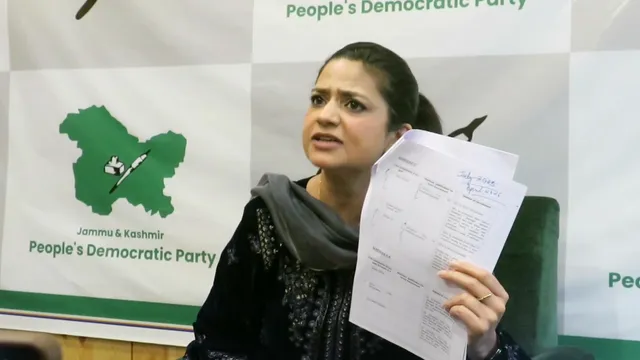
J&K Recruitment Delays: PDP Questions Hiring Practices as Educated Youth Await Government Jobs
By: News Desk | 22 October 22 2026
Srinagar: The People’s Democratic Party (PDP) has intensified its criticism of recruitment practices in Jammu and Kashmir, questioning delays in government examinations, the growing reliance on outsourced manpower and the future facing thousands of educated young people waiting for employment.
The controversy has gained momentum after PDP MLA from Pulwama Waheed-ur-Rehman Parra highlighted figures relating to recruitment conducted by the Jammu and Kashmir Public Service Commission (JKPSC) and the Jammu and Kashmir Services Selection Board (JKSSB). According to figures he cited from the government’s response in the Assembly, the two agencies advertised 15,964 posts between 2023 and 2026, received approximately 21.12 lakh applications and collected nearly ₹114 crore in application fees. Parra also raised concerns over 38 pending JKPSC examinations and the commission functioning without a chairman.
The PDP has separately accused the National Conference-led government of relying on outsourcing and allegedly non-transparent hiring arrangements instead of filling vacancies through established recruitment channels. The party has claimed that around 25,000 jobs have been filled through such arrangements without adequate transparency. The government has rejected allegations of irregularities, arguing that outsourcing is distinct from illegal appointments and that its recruitment processes follow approved procedures.
At the heart of the dispute is a question with consequences extending well beyond the exchange between political parties: can Jammu and Kashmir’s recruitment system provide timely, transparent and fair opportunities to the young people who depend on it?
Over 21 Lakh Applications for 15,964 Posts: What the Recruitment Figures Reveal
The figures cited by Parra offer a snapshot of the scale of demand for government employment in Jammu and Kashmir.
Posts advertised
15,964
Applications received
21.12 lakh
Application fees collected
₹114 crore
Pending JKPSC examinations
38
Figures cited by PDP MLA Waheed-ur-Rehman Parra for the 2023–2026 recruitment period. Application and examination figures are not equivalent to the number of unique candidates or appointments completed.
The numbers illustrate the intense competition for public-sector employment. However, applications are not the same as individual candidates: one applicant may apply for several posts, and a single recruitment process may involve multiple examinations or stages.
The distinction matters because the total number of applications cannot, by itself, establish how many people remain unemployed or how many vacancies have actually been filled.
Nevertheless, the figures raise legitimate questions about recruitment timelines, examination management and communication with candidates.
When an advertisement is issued, aspirants typically plan their preparation around an expected schedule. They may spend money on coaching, travel, accommodation, application fees and study materials while postponing other employment opportunities.
If examinations, results or appointments are delayed, that investment can become increasingly difficult to sustain.
Parra has urged Lieutenant Governor Manoj Sinha and Chief Minister Omar Abdullah to intervene and address the uncertainty faced by candidates. His criticism also focuses on the leadership vacancy at JKPSC, which he argues raises questions about the functioning of an institution responsible for public recruitment.
The central issue is not simply how many examinations have been announced. It is whether recruitment agencies can provide predictable schedules and complete the process within reasonable timeframes.
JKPSC and JKSSB Under Scrutiny Over Pending Recruitment
The recruitment controversy involves two institutions with distinct responsibilities.
The JKPSC handles recruitment and selection for posts within its jurisdiction, including various gazetted services. The JKSSB conducts recruitment for posts assigned to it under the applicable rules. Both play important roles in ensuring that public appointments follow established selection procedures.
According to figures reported by Hindustan Times on October 3, 2026, the government informed the Assembly that JKSSB conducted 124 examinations for 11,003 posts during the period under review, with 9,38,777 candidates appearing. The board collected approximately ₹89.50 crore in examination fees and refunded around ₹1.36 crore, while 13 examinations were postponed.
Parra separately cited 245 JKPSC recruitment examinations covering 4,961 posts and approximately ₹24.43 crore in fees. He said 38 examinations remained pending and questioned why the commission was functioning without a chairman.
These figures need to be read carefully. The number of examinations conducted does not necessarily indicate that every recruitment process has been completed, while a pending examination does not automatically mean that an entire recruitment cycle has failed. Selection, document verification, legal challenges, administrative approvals and appointment orders can all affect the final timeline.
Even so, the government should be able to explain the status of individual recruitment processes, particularly where candidates have waited for extended periods.
A publicly accessible recruitment dashboard showing advertised posts, examination dates, results, selection lists, appointment orders and reasons for delays would help reduce uncertainty.
It would also allow candidates to distinguish between a process that is progressing through normal administrative stages and one that has become stalled.
The Outsourcing Controversy: Transparency or a Backdoor to Employment?
Alongside examination delays, the PDP has mounted a separate campaign against the use of outsourced manpower in government departments.
The party alleges that approximately 25,000 jobs have been outsourced or filled without sufficient transparency, arguing that qualified candidates are being denied fair access to opportunities. During a protest in Srinagar in June, PDP leaders accused the government of bypassing regular recruitment channels and favouring politically connected individuals. These remain allegations by the opposition, not established findings of wrongdoing.
The government has rejected the charge that outsourcing automatically amounts to illegal recruitment.
In June, Chief Minister Omar Abdullah’s adviser Nasir Aslam Wani defended the government’s approach, saying the administration was following approved procedures and working towards filling 40,000 vacancies. Government representatives also argued that the practice of outsourcing manpower predated the current National Conference government.
This disagreement reflects an important distinction in public administration.
Outsourcing is not inherently the same as making an illegal appointment. Government departments may engage private agencies to provide support staff or other manpower under applicable contracts and procurement rules. Regular recruitment to sanctioned government posts, meanwhile, follows the relevant service rules and selection procedures.
The real questions are whether the correct procedure was followed, whether the positions were classified and advertised appropriately, whether contractual terms were respected and whether the process provided the transparency required by law.
The political controversy cannot be settled merely by describing all outsourced employment as illegal or by assuming that every outsourced appointment is necessarily fair.
A credible assessment requires department-wise information: the number of people engaged, the nature of their work, the duration of their contracts, the agencies involved, the method of selection and the legal or administrative basis for the engagement.
Such disclosure would help establish whether outsourcing is being used to meet legitimate short-term staffing needs or whether it is replacing regular recruitment in ways that undermine equal opportunity.
Why Government Jobs Carry Such Weight in Kashmir
The intensity of the debate reflects the importance of public employment in Jammu and Kashmir.
Government positions are often seen as a source of stable income, predictable service conditions and long-term financial security. For families that invest heavily in a child’s education, a government appointment can represent the culmination of years of preparation.
Competitive examinations have consequently become a major part of life for many graduates. Candidates often prepare for multiple recruitment tests while balancing family responsibilities and financial constraints.
But the number of available positions is limited, and public employment cannot absorb every graduate entering the labour market.
This makes the pace of recruitment particularly consequential. Delays can leave qualified candidates waiting for results or appointments while new cohorts of graduates continue to enter the market.
A report published by Deccan Herald in June cited government figures showing that 3,70,811 educated young people were registered as unemployed in Jammu and Kashmir as of January 2025, including more than 1.13 lakh graduates and postgraduates. The report also referred to a Mission YUVA baseline survey that identified approximately 4.73 lakh people willing to work but without employment.
These figures describe different measures and should not be added together. Employment-exchange registrations cover people recorded in official databases, while survey-based estimates use a different methodology. Neither figure should be treated as a complete count of every unemployed person without examining the underlying definitions.
Even with those limitations, the available figures underline the scale of the employment challenge.
The solution cannot rest entirely on increasing government recruitment. It also requires stronger private-sector employment, viable businesses, entrepreneurship, investment and opportunities that allow educated young people to use their qualifications productively.
At the same time, broader economic initiatives cannot excuse avoidable delays or a lack of transparency in public recruitment.
Mehbooba Mufti Backs Protesting Agriculture Graduates
The wider employment debate has also drawn attention to the grievances of agriculture graduates seeking changes to the rules governing recruitment to Agriculture Extension Officer (AEO) and Junior Agriculture Extension Officer (JAEO) cadres.
On October 17, PDP president and former chief minister Mehbooba Mufti urged the administration to address the concerns of agriculture graduates who, according to Kashmir Life, had been staging a peaceful protest for 27 days.
Mufti called for a review of SRO-433 and SRO-442, which govern the two cadres, arguing that qualified graduates should have fair opportunities to enter public service rather than face prolonged uncertainty.
The protest highlights a specific dimension of the recruitment debate: the relationship between professional qualifications and the eligibility criteria used for public appointments.
Agriculture graduates train for careers that can contribute to agricultural extension, farmer support, rural development and the dissemination of scientific farming practices. Disputes over recruitment rules can therefore affect not only the candidates themselves but also the availability of trained personnel for public-sector agricultural services.
The administration must assess such demands against the applicable service rules, staffing requirements and legal framework. Any proposed revision should be explained clearly, including how it would affect existing candidates and future recruitment.
For the graduates, the immediate demand is for clarity and a fair resolution. For the government, the challenge is to ensure that qualified applicants receive a transparent explanation of the selection framework and that legitimate grievances do not remain unresolved indefinitely.
Mufti’s intervention has brought the issue into the wider political debate, connecting the graduates’ specific demands with the PDP’s broader criticism of employment policy in Jammu and Kashmir.
Political Promises and the Pressure on Omar Abdullah’s Government
The recruitment dispute has become a significant test of the National Conference-led government’s credibility.
The party returned to power after the 2024 Assembly elections amid expectations of progress on employment, governance and political issues. Its government now faces pressure to demonstrate that those expectations are translating into measurable outcomes.
The opposition’s criticism focuses on two related questions: whether regular recruitment is proceeding quickly enough, and whether the use of outsourcing is reducing opportunities for candidates seeking government positions through formal selection procedures.
The government’s defence rests on its claim that outsourcing must be distinguished from illegal appointments, that existing procedures are being followed and that a wider programme to fill vacancies is underway.
Both the allegations and the response require scrutiny against verifiable records.
If the government says recruitment is proceeding in phases, it should publish a clear timeline and identify the posts covered by each stage. If the PDP alleges backdoor appointments, it should provide specific, verifiable evidence for the departments and positions concerned.
Political accountability is strongest when broad claims can be tested against documented facts.
The issue also illustrates the limits of political rhetoric. Accusing the government of favouritism does not establish wrongdoing, just as announcing recruitment targets does not prove that the promised appointments have been completed.
For job aspirants, the relevant measures are straightforward: how many vacancies have been advertised, how many examinations have been completed, how many selection lists have been issued, and how many successful candidates have actually joined their posts?
What Needs to Change in Jammu and Kashmir’s Recruitment System?
The continuing dispute points to several practical steps that could improve public confidence.
First, recruitment timelines should be published and updated. Candidates need clear information about examination dates, results, document verification and appointment orders. Where delays occur, agencies should explain the reasons and provide revised schedules.
Second, vacancies and outsourced engagements should be disclosed separately. This would help the public understand which positions are regular government posts, which are contractual engagements and which are supplied through private manpower agencies.
Third, recruitment institutions need adequate leadership and administrative capacity. Any prolonged vacancy in a senior institutional position should be addressed transparently, particularly when the institution is responsible for conducting examinations and managing large recruitment processes.
Fourth, complaints should receive timely responses. Candidates need accessible channels to challenge errors, obtain information about recruitment status and raise concerns over eligibility or selection procedures.
Finally, employment policy must extend beyond government vacancies. Investment, entrepreneurship, private-sector hiring and skills development are necessary if Jammu and Kashmir is to create opportunities for a growing pool of educated young people.
These measures would not eliminate competition for government jobs. They would, however, make the process more predictable and give candidates greater confidence that opportunities are being allocated according to established rules.
The Road Ahead: Fair Recruitment Could Help Restore Youth Confidence
The PDP’s criticism has put recruitment delays and outsourcing back at the centre of Jammu and Kashmir’s political debate. But the consequences extend beyond the contest between the National Conference government and its opponents.
For young people preparing for competitive examinations, uncertainty can mean years of waiting without knowing when a selection process will conclude. For families, it can mean continued financial pressure. For public institutions, prolonged delays risk weakening confidence in the fairness and effectiveness of recruitment.
The latest figures cited by Parra provide a starting point for examining the problem, but the next step must be greater transparency. The government needs to clarify the status of pending examinations, explain its outsourcing policies and publish measurable progress on recruitment commitments.
The PDP, meanwhile, will need to support its allegations of irregular appointments with verifiable evidence if it wants to establish wrongdoing rather than merely intensify the political dispute.
Ultimately, Jammu and Kashmir needs an employment system in which qualifications, eligibility and transparent selection procedures determine access to public opportunities. It also needs a broader economic strategy capable of creating jobs beyond government departments.
For the region’s educated youth, the central demand is neither complicated nor unreasonable: a fair opportunity to compete, a recruitment process that moves forward on time, and clear answers when the system falls behind.
Whether the government can deliver on these expectations will remain an important measure of its performance in the months ahead.
Follow Us on WhatsApp
Get Breaking News, Exclusive Updates & In-Depth Analysis from Kashmir and beyond, delivered straight to your phone.
Join our WhatsApp Channel: Follow Now


