Farooq Abdullah Questions Centre’s ‘Foreign Hand’ Narrative, Demands Evidence Behind Delhi Protest Claims
By: News Desk | 23 October 2026
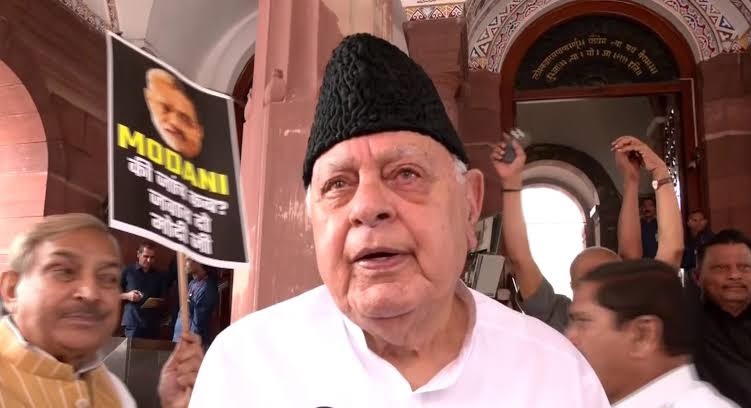
National Conference president Farooq Abdullah has challenged the Union government to identify the country allegedly interfering in India’s internal affairs, accusing the Centre of repeatedly invoking the idea of a “foreign hand” whenever it faces political pressure. His remarks, delivered to reporters in Srinagar on October 23, have intensified the debate over political accountability, public protests and the government’s response to dissent.
For Abdullah, the central question is straightforward: if foreign interference is being alleged, the government should identify the alleged actors and present evidence. His criticism also raises a broader democratic question—how should a government distinguish genuine external interference from domestic political opposition and public dissatisfaction?
The National Conference leader also linked the international situation to the economic pressures facing ordinary people, calling for an end to the Middle East conflict and arguing that prolonged hostilities could worsen inflation and hardship.
Farooq Abdullah’s ‘Foreign Hand’ Remark: What Triggered the Political Row?
The immediate backdrop to Abdullah’s criticism is a series of protests in New Delhi over the revision of electoral rolls and demands for the resignation of Chief Election Commissioner Gyanesh Kumar.
BJP president Nitin Nabin had accused opposition leaders and the Cockroach Janta Party (CJP) movement of attempting to destabilise the country with the backing of foreign powers. He warned that the party would deal firmly with forces operating inside or outside India that it considered a threat.
His criticism was not simply about the use of a particular phrase. It questioned whether allegations of foreign interference were being used to explain away political discontent without adequately examining its domestic causes.
That distinction matters. Foreign interference is a legitimate national-security concern when supported by credible evidence. But an allegation, by itself, does not establish that an external power is responsible for a protest or political movement.
Delhi Protests and Electoral Roll Revisions: The Wider Context
The political dispute cannot be understood without examining the controversy surrounding India’s electoral rolls.
Protests intensified in October as opposition parties and civil society groups raised concerns about the revision of voter lists and called for accountability from the Election Commission. Demonstrators demanded the resignation of Chief Election Commissioner Gyanesh Kumar, alleging that the changes could affect electoral fairness.
Reuters reported on October 10 that more than 2,000 protesters were detained in Delhi as authorities imposed extensive security restrictions to prevent a planned demonstration. The measures included a heavy deployment of police and paramilitary personnel, the closure of parts of central Delhi and the suspension of mobile internet services in the affected area.
According to figures cited by Reuters from Election Commission data, approximately 130 million voter entries were removed during the verification exercise. The Commission’s explanation, as reported by Reuters, included entries relating to people who had relocated, could not be traced or had died. The Commission also said eligible voters whose names were incorrectly removed could re-enrol.
It is within this contested political environment that Abdullah’s challenge to the foreign-interference narrative has gained significance.
‘Name the Country’: Why Evidence Matters in a Democracy
Abdullah’s central demand was direct: if the government believes another country is interfering in India’s internal affairs, it should name that country.
His argument reflects a basic principle of public accountability. Governments possess intelligence resources and security information that are not always available to the public. They may sometimes have legitimate reasons to withhold operational details. Nevertheless, serious allegations require a credible evidentiary basis.
There is a difference between identifying suspicious activity, investigating possible foreign links and publicly declaring that a protest movement is part of an external conspiracy.
The first two can be essential functions of national security. The third, if advanced without sufficient supporting information, risks turning a security concern into a political accusation.
A responsible assessment would distinguish between several questions:
-
Is there verifiable evidence of foreign funding, direction or coordination?
-
Does that evidence establish a connection to specific protesters or organisations?
-
Are the allegations based on official investigations, documented financial transactions or other independently verifiable material?
-
Could the protests also be explained by domestic grievances, political mobilisation or dissatisfaction with government decisions?
These questions do not presume that foreign interference is impossible. Nor do they establish that the allegations are false. They identify what needs to be demonstrated before a claim can be accepted as fact.
For Abdullah, the problem is that repeatedly invoking an unnamed foreign actor can shift public attention away from the government’s own decisions. His remarks suggest that political authorities should examine the reasons behind public dissatisfaction instead of treating dissent primarily as a threat.
The Government’s Position and the Opposition’s Counterargument
The controversy presents two competing interpretations of the protests.
The BJP’s position, as reflected in Nabin’s public remarks, is that political opposition and protest activity may be exploited by forces seeking to destabilise India. From a national-security perspective, governments have a responsibility to investigate credible indications of foreign involvement, particularly where allegations involve unlawful funding, coordinated disinformation or attempts to undermine public order.
The distinction becomes especially important when allegations involve large numbers of people or entire organisations.
A government can investigate unlawful activity without assuming that every participant in a demonstration shares the same intentions. Similarly, opposition parties can question government conduct without dismissing genuine security concerns as politically motivated.
The available reporting confirms that BJP leaders raised allegations of foreign backing and that Abdullah challenged the government to substantiate them. It does not, by itself, establish that a foreign country orchestrated the protests or conclusively disprove the possibility of outside involvement.
That evidentiary distinction should remain central to coverage of the controversy.
Farooq Abdullah’s Political Message: Look Inward Before Blaming Others
Abdullah’s criticism also reflects a longstanding debate in Indian politics over the relationship between government authority and public dissent.
Political leaders often interpret demonstrations through competing frameworks. Those in power may view disruptive protests as attempts to weaken institutions or obstruct governance. Opposition parties may see the same demonstrations as evidence that people feel unheard or believe established channels of accountability are failing.
Neither interpretation should automatically be accepted without examining the facts.
A protest can be politically organised and still reflect genuine grievances. It can also contain unlawful conduct that warrants investigation without making every participant responsible for it.
The challenge for any democratic government is to distinguish among these possibilities.
Abdullah argued that the Centre should examine its own conduct when confronted with political difficulties. His remarks place the focus on accountability: whether authorities have adequately addressed the concerns driving demonstrations and whether their public statements are supported by verifiable evidence.
The political impact of his comments will depend partly on how the government and other parties respond. If officials provide credible evidence of external involvement, that information would deserve serious scrutiny. If allegations remain vague, questions about their purpose and reliability are likely to continue.
Why the Controversy Matters for Jammu and Kashmir
For Jammu and Kashmir, debates over national security, political dissent and the legitimacy of public grievances carry particular weight.
The region has experienced decades of conflict, security operations and political disputes over its relationship with the Union government. The constitutional changes of August 2019, when the Centre revoked Jammu and Kashmir’s special status under Article 370 and reorganised the former state into two Union Territories, remain a major point of political disagreement.
Against that background, statements by the National Conference leadership on national political issues often resonate beyond the immediate controversy in Delhi.
Abdullah’s remarks reinforce the party’s broader emphasis on political accountability and the need to address grievances through democratic processes. They also place the National Conference in opposition to a political narrative that associates protest activity with foreign interference.
However, the current controversy should not be conflated with every security-related allegation concerning Jammu and Kashmir. Each case requires its own evidence, context and assessment.
The broader lesson is that national security and democratic accountability are not necessarily opposing objectives. A government can investigate genuine threats while allowing lawful dissent and ensuring that allegations against individuals or groups are not treated as proven before the evidence is established.
For residents of Jammu and Kashmir, where security concerns and political representation remain sensitive issues, that balance is particularly consequential.
Middle East Crisis: Abdullah Warns of Inflation and Global Hardship
Abdullah also addressed the escalating conflict in the Middle East, calling for an end to hostilities and criticising US President Donald Trump’s role in the crisis.
He argued that prolonged conflict was contributing to global hardship and warned that inflation would disproportionately affect poorer sections of society. He also said Iran had the right to defend itself and urged an end to the fighting.
The connection between war and household finances is significant. Conflict involving major energy-producing regions can disrupt oil and gas supplies, raise transportation and insurance costs, unsettle financial markets and increase uncertainty for businesses.
If energy prices rise, the consequences can extend well beyond fuel bills. Higher freight costs may affect food distribution and the prices of essential goods, while businesses facing increased expenses may pass some of those costs on to consumers.
Lower-income households are often more exposed to these pressures because a larger proportion of their income goes towards food, transport and other necessities.
For India, which imports substantial quantities of crude oil, sustained disruption to global energy supplies can create additional pressure on the import bill, inflation management and government finances. The eventual impact depends on the duration and intensity of the conflict, global supply conditions, currency movements and domestic policy responses.
These are potential economic transmission channels, not proof that every increase in prices is caused by the Middle East conflict. Inflation has multiple domestic and international drivers.
Abdullah’s warning nevertheless highlights an important point: the consequences of geopolitical confrontation are not confined to the countries directly involved. Ordinary households in distant regions can also bear the financial cost.
His comments on Iran should also be understood as a political position rather than a comprehensive assessment of the legal issues surrounding the conflict. The right of a state to defend itself is subject to the applicable rules of international law, including the UN Charter and international humanitarian law. The legality of particular military actions depends on the circumstances and the conduct involved.
From Political Rhetoric to Public Accountability
The dispute over the foreign-hand narrative ultimately raises a question that extends beyond one political leader or one round of demonstrations: what standard of evidence should public officials meet when making serious allegations?
In a democracy, governments must be able to protect national security. But the credibility of those efforts depends on the quality of the evidence, the fairness of investigations and the distinction between lawful opposition and unlawful activity.
Opposition leaders, in turn, have a responsibility to challenge official claims on the basis of facts rather than simply replacing one unsupported assertion with another.
The public interest is best served when competing claims can be tested against documents, credible reporting, official records and independent scrutiny.
In the present case, the political dispute is clear. BJP leadership has alleged that foreign forces are involved in efforts to destabilise the country, while Abdullah has demanded that the alleged external actors be identified. What remains essential is a clear distinction between those political claims and what has been independently established.
Without that distinction, the debate risks becoming a contest of slogans rather than an examination of evidence.
What Happens Next?
The immediate question is whether the allegations of foreign interference will be accompanied by specific, verifiable evidence and whether the authorities will provide further clarification about the claims made against protest organisers and opposition leaders.
The electoral controversy also requires attention to its underlying issues. Voters need reliable information about changes to electoral rolls, accessible procedures for correcting errors and confidence that eligible citizens can exercise their franchise.
At the same time, allegations of unlawful conduct at demonstrations should be investigated through established legal processes, with responsibility determined on the evidence rather than political affiliation.
For the Centre, transparent communication could help distinguish legitimate security concerns from claims that remain unsubstantiated in the public domain. For the opposition, sustained scrutiny of electoral procedures and government conduct would be more persuasive when supported by verifiable facts.
Abdullah’s intervention has placed the burden of explanation at the centre of the political debate. Whether the controversy leads to greater clarity or simply deepens the confrontation between the government and its critics will depend on what follows the rhetoric.
Conclusion: The Evidence Must Matter More Than the Allegation
Farooq Abdullah’s challenge to the Centre over its alleged foreign-hand narrative is part of a wider political argument about accountability, dissent and national security.
His demand that the government identify the country supposedly interfering in India’s affairs puts a simple but important question before the public: when a serious accusation is made, what evidence supports it?
The Delhi protests, the dispute over electoral roll revisions and the competing claims of the ruling party and opposition have made that question particularly urgent. At the same time, the allegations must be assessed carefully, without presuming either that foreign interference occurred or that it could not have occurred.
Abdullah’s separate warning about the Middle East conflict adds another dimension, reminding policymakers that geopolitical instability can affect household budgets and economic security far beyond the battlefield.
Ultimately, democratic confidence depends on more than the strength of political rhetoric. It requires credible evidence, transparent institutions, accountable leadership and the ability to distinguish legitimate dissent from demonstrable wrongdoing.
Follow Us on WhatsApp
Get Breaking News, Exclusive Updates & In-Depth Analysis from Kashmir and beyond, delivered straight to your phone.
Join our WhatsApp Channel: Follow Now


