BJP Says Cabinet Expansion Cannot Hide Governance Questions as Omar Abdullah Prepares Reshuffle
By: News Desk | 26 October 2026
Jammu/Srinagar: The much-awaited Cabinet expansion in Jammu and Kashmir has triggered a fresh political confrontation, with the Bharatiya Janata Party (BJP) accusing the ruling National Conference (NC) government of failing to adequately address public expectations, fulfil its election commitments and respond to allegations of corruption and reported differences within its ranks.
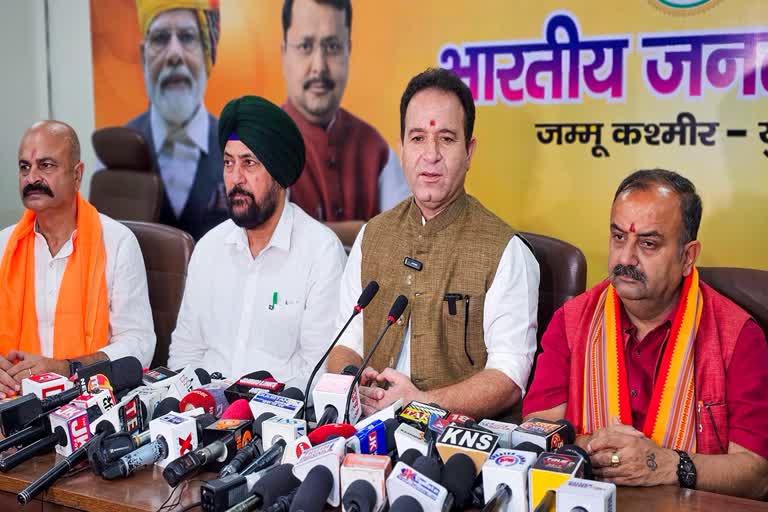
Senior BJP leader and Udhampur East MLA Ranbir Singh Pathania said the expansion of the Council of Ministers should not be treated as a substitute for effective governance. He argued that changes in ministerial positions would have little meaning unless accompanied by visible progress on the commitments made to voters and greater transparency in the functioning of the government.
The criticism comes as Chief Minister Omar Abdullah prepares to expand and reshuffle his Council of Ministers for the first time since his government took office in October 2024. The swearing-in ceremony is scheduled for 10:30 a.m. on Tuesday at Lok Bhavan in Srinagar, according to reports citing the official invitation. The exercise is expected to take the Council of Ministers to its maximum permitted strength.
Pathania’s remarks place the spotlight on a wider question facing the elected government: whether the Cabinet reshuffle will strengthen its capacity to govern and improve public confidence, or primarily serve as an exercise in managing competing political demands within the ruling party.
The BJP’s accusations remain political claims and should not be treated as proof of wrongdoing. However, the controversy highlights the scrutiny that accompanies a major ministerial reshuffle, particularly when questions about electoral commitments, recruitment, public services and accountability remain part of the political debate.
Pathania Questions Election Promises and Government Accountability
In remarks reported by Kashmir News Service (KNS), Pathania said the government must explain what action it has taken on commitments made before the 2024 Assembly elections. He also referred to corruption allegations reportedly raised against ministers and concerns said to have emerged during discussions among National Conference legislators at Dachigam.
Pathania questioned whether the government was giving greater attention to the distribution of ministerial positions than to the expectations of the people. He maintained that allegations of corruption should be investigated fairly and that responsibility should be fixed wherever wrongdoing is established.
The distinction is important. Allegations, political criticism and verified findings are not the same. Any specific claim of corruption requires evidence and a fair investigation before conclusions can be drawn. The BJP has demanded answers from the government, but the allegations cited in its criticism should not, by themselves, be interpreted as established misconduct.
For the government, the political challenge is to respond with clear information rather than allow the controversy to be settled entirely through competing statements. Where allegations have been formally raised, the public interest lies in knowing whether they have been examined, what procedures were followed and whether any action was warranted.
The issue also extends beyond the conduct of individual ministers. Voters generally judge a government by whether its promises translate into practical improvements in everyday life. Employment opportunities, timely recruitment, public services, economic support and the handling of local grievances all contribute to perceptions of performance.
A Cabinet reshuffle can change who holds responsibility for these areas. It cannot, on its own, demonstrate that the administration has delivered results.
Cabinet Expansion Exposes the Challenge of Balancing Political Aspirations
The Cabinet expansion has been preceded by speculation over which legislators would receive ministerial positions and how the National Conference leadership would accommodate competing claims within the party.
Chief Minister Omar Abdullah had said that the list of incoming ministers had been finalised after consultation with NC president Farooq Abdullah. In the days before the scheduled ceremony, he also asked party colleagues to stop sending messages and making repeated approaches regarding ministerial berths, indicating that the decision-making process had reached its final stage.
The remarks drew attention to the pressure faced by party leaders when the number of available ministerial positions is limited but the expectations of elected representatives are extensive.
Under Section 53 of the Jammu and Kashmir Reorganisation Act, 2019, the Council of Ministers cannot exceed 10 per cent of the total membership of the Legislative Assembly. With the Assembly comprising 90 members, the permitted maximum is nine ministers, including the Chief Minister.
That limit creates a difficult political calculation. The leadership must consider experience, administrative ability, regional representation, party loyalty and the aspirations of legislators who may have expected a role in the government.
A reshuffle can also create disappointment among those who are not selected or whose portfolios change. Such reactions are a familiar feature of coalition and party management, but prolonged dissatisfaction can become a political liability if it affects coordination or weakens confidence in the leadership.
The BJP has portrayed the competition for ministerial positions as evidence of internal discord in the NC. The ruling party’s internal deliberations, however, cannot automatically be taken as proof of a breakdown in governance. The more meaningful test will be whether the reshuffle results in a stable Council of Ministers capable of functioning effectively.
Who Is Expected to Join the Council of Ministers?
Ahead of Tuesday’s ceremony, media reports identified four National Conference legislators as likely inductees: Ali Mohammad Sagar, Mir Saifullah, Shamim Firdous and Altaf Ahmad Wani, popularly known as Altaf Kalloo. Reports also indicated that an incumbent minister could be dropped as part of the reshuffle.
These names were reported ahead of the scheduled oath-taking. The final composition of the Council of Ministers and any changes to ministerial portfolios should be confirmed through the official announcement following the ceremony.
The exercise is expected to fill the available positions and take the Council to its permitted maximum strength of nine members, including the Chief Minister. That would give the government a larger ministerial team, although the number of ministers alone does not determine the quality of administration.
The significance of the expansion will depend on how responsibilities are allocated, whether departments receive clear direction and whether ministers are able to respond to issues within their portfolios. Effective governance requires not only political representation but also administrative coordination, measurable targets and public accountability.
For the NC leadership, the task is therefore twofold: accommodate party expectations while ensuring that the reshuffled team is equipped to meet the demands of government.
The Election Manifesto Remains a Political Benchmark
The BJP’s demand for answers on pre-election commitments points to one of the most important measures of any elected administration: the distance between what a party promises during an election and what it delivers after taking office.
The National Conference’s 2024 manifesto included commitments on employment, social welfare and Jammu and Kashmir’s political status, among other issues. Its stated priorities included pursuing the restoration of Articles 370 and 35A, seeking the restoration of statehood and creating one lakh jobs.
These commitments differ in their nature and in the extent to which they can be implemented through decisions taken by the elected government alone. Some require administrative action or budgetary support, while others involve constitutional, legal or political processes beyond the direct control of the Council of Ministers.
That distinction does not remove the government’s responsibility to explain its progress. It does, however, make it necessary to assess each commitment on its own terms rather than treat all promises as equally straightforward to implement.
For example, employment commitments can be assessed through recruitment notifications, completed selection processes, appointments and job creation. Welfare commitments can be evaluated through eligibility rules, budget allocations, implementation schedules and the number of beneficiaries reached. Political commitments require clarity about the steps taken, the institutional processes involved and the constraints encountered.
A transparent progress report would give the public a clearer picture of what has been achieved, what remains pending and why delays have occurred.
The BJP’s criticism raises the political pressure on the government to provide such explanations. Whether the opposition’s claims are persuasive will depend partly on the evidence it presents, while the government’s credibility will depend on the quality of its response.
Corruption Allegations Require Evidence, Not Political Assumptions
Corruption has become part of the BJP’s attack on the NC government, with Pathania calling for allegations to be investigated impartially and accountability fixed wherever wrongdoing is established.
The principle of impartial investigation is central to public accountability. Allegations involving public officials should be examined through appropriate procedures, with conclusions based on evidence rather than political affiliation.
At the same time, allegations should not be dismissed merely because they originate from an opposition party. Where specific and credible information is available, the government should explain whether the matter has been referred to the appropriate authority and what process will be followed.
Public confidence is best served by a system in which neither accusations nor denials are treated as substitutes for evidence. If an allegation is substantiated, the findings and resulting action should be made clear within the limits of the law. If it is not substantiated, that outcome should also be communicated responsibly.
For the Omar Abdullah government, a credible response would involve addressing specific allegations through verifiable facts and established procedures. For the BJP, scrutiny of the government carries greater weight when criticism is supported by documentary evidence and precise questions about official decisions.
The larger issue is institutional credibility. Accountability must be consistent and should not depend on whether the person under scrutiny belongs to the ruling party or the opposition.
Cabinet Reshuffle and the Limits of Political Optics
A Cabinet expansion often creates a moment of renewed political attention. New appointments can signal a change in priorities, offer representation to constituencies that felt overlooked and bring different experience into the administration.
But the public impact of a reshuffle depends on what follows the ceremony.
If departments receive clear targets, pending matters are addressed and ministers communicate openly about progress, the expansion may help improve administrative performance. If the exercise changes positions without producing measurable results, criticism is likely to continue.
This is particularly relevant in Jammu and Kashmir, where residents expect progress on employment, public services, infrastructure, economic opportunity and governance. The administration must also work within the institutional framework that governs the Union Territory, where the elected government’s powers are not identical to those of a full-fledged state government.
The government has previously cited Jammu and Kashmir’s Union Territory status and the resulting division of responsibilities as constraints on some decisions. Such institutional limits are relevant to evaluating performance, but they do not remove the need for clarity about the decisions that fall within the elected administration’s authority.
The key question is whether the reshuffled Council of Ministers can convert political authority into effective administration. This involves setting priorities, coordinating with departments, addressing public complaints and explaining delays in decisions that affect people’s lives.
Political representation matters, but it is only one component of governance. The ability to deliver is what ultimately gives ministerial appointments their public value.
BJP-NC Political Contest Intensifies
The BJP’s criticism reflects the broader contest between the ruling National Conference and its principal political opponents over governance, credibility and the interpretation of the government’s record.
For the BJP, the Cabinet expansion provides an opportunity to question whether the ruling party is managing internal demands at the expense of public priorities. By raising election promises and corruption allegations, the opposition is seeking to frame the reshuffle as a political exercise that must be judged against the government’s performance.
For the National Conference, the immediate challenge is to complete the expansion while maintaining cohesion among its legislators and demonstrating that the new ministerial arrangement can function effectively. The leadership must balance competing political expectations without allowing the reshuffle to overshadow its administrative responsibilities.
The allegations of internal differences remain part of the political dispute. Their significance will be clearer if they translate into sustained public dissent, difficulties in decision-making or visible disruption to government functioning. Competition for ministerial positions alone is not sufficient to establish that the government is unable to govern.
The public will also look beyond the exchanges between party leaders. Political statements may dominate the news cycle, but citizens are more likely to judge the administration through its handling of daily concerns, the availability of public services and the progress of promised initiatives.
What Should the Public Watch After the Expansion?
Once the new ministers take office, several practical indicators will help establish whether the reshuffle has made a difference.
First, delivery on election commitments. The government should provide clear updates on major promises, with timelines and measurable progress wherever possible.
Second, administrative performance. Departmental priorities, pending files, service delivery and responses to public grievances will offer a more meaningful picture than the number of ministers inducted.
Third, transparency on allegations. Specific allegations of wrongdoing should be addressed through fair and credible procedures, with the government communicating the status of relevant inquiries where appropriate.
Fourth, coordination within the ruling establishment. A stable Cabinet should be able to make decisions, resolve disagreements through institutional channels and maintain a consistent direction across departments.
Finally, public engagement. Elected representatives should have avenues to raise local concerns, while the administration should communicate decisions and implementation progress in a manner accessible to residents.
These indicators would allow the government’s performance to be assessed on evidence rather than political claims alone.
Conclusion: Appointments Are Only the Beginning
The BJP’s attack has added a sharper political edge to Jammu and Kashmir’s Cabinet expansion, with Ranbir Singh Pathania demanding answers on election promises, corruption allegations and reported differences within the National Conference.
The reshuffle is an important organisational decision for the Omar Abdullah government, particularly because the limited number of ministerial positions makes political accommodation difficult. Yet the exercise should ultimately be judged by its administrative consequences rather than the political negotiations that preceded it.
The BJP has a legitimate role in questioning the government’s record, but allegations require evidence and should not be confused with established findings. The ruling NC, meanwhile, must respond to scrutiny with transparent information, measurable progress and a clear account of what it has delivered.
For the people of Jammu and Kashmir, the central issue is not simply who enters the Cabinet or which minister receives a particular portfolio. It is whether the government can turn its electoral commitments into tangible outcomes, address public concerns and demonstrate that accountability applies to everyone in public office.
The swearing-in ceremony may mark the completion of the Cabinet expansion. The more consequential test begins afterward: whether the new ministerial arrangement leads to better governance, clearer accountability and results that residents can see in their daily lives.

