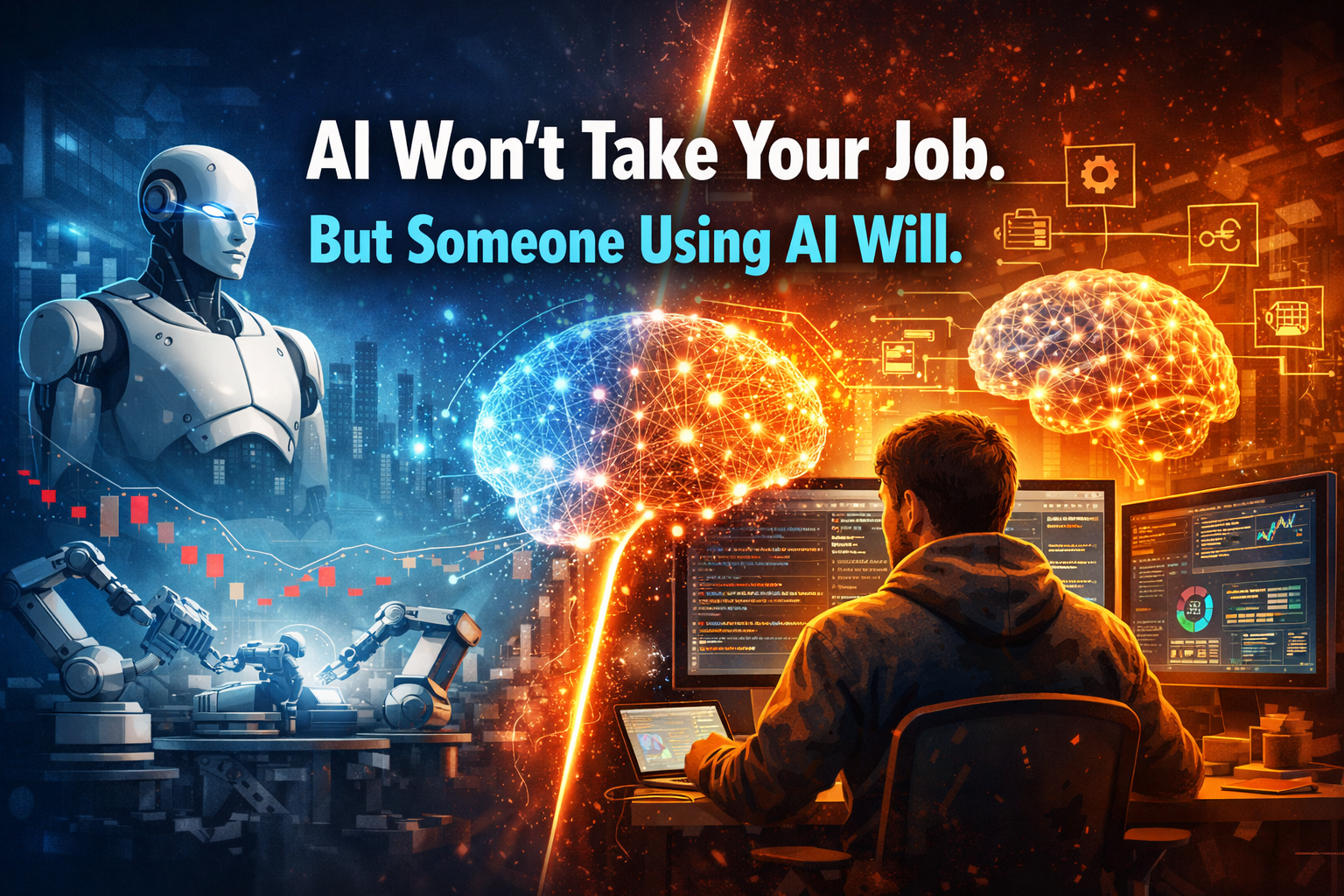
AI Won’t Take Your Job, But Someone Using AI Might: A Career Guide for Students and Young Professionals
The biggest threat to your career is not artificial intelligence. It is refusing to learn it. Here are the careers, skills and first steps that matter now, and how young people everywhere can make the most of them.
By: Javid Amin | Technology & Careers | October 2026
“The question is no longer whether AI will change your career. The question is whether you will change with AI.”
The Sentence Every Worker Should Think About
You may have already heard it, in one form or another: AI won’t take your job, but someone who uses AI might. The idea has been popularised by economists and business leaders in recent years, and it has stuck because it captures something simple and a little uncomfortable.
The tool is not the competitor. The colleague, classmate or rival candidate who learns to use the tool well is.
Think of the last time a new technology arrived at work. When spreadsheets replaced paper ledgers, accountants who learned them became faster and more valuable. Those who refused did not lose their jobs to Excel. They lost them to people who could do the same work in half the time.
Artificial intelligence is the same story, only moving much faster, and touching almost every profession at once: teaching, journalism, banking, healthcare, law, design, farming and tourism.
This guide explains what is changing, why students should act now, which careers are growing, which skills matter more than a degree certificate, and what young people can do about it today.
How AI Is Changing Workplaces
For most people, AI at work does not look like a robot taking a desk. It looks like quieter changes:
- Writing and communication: Drafting emails, reports and summaries in minutes instead of hours.
- Data and decisions: Sorting through thousands of rows of numbers to spot patterns a person might miss.
- Customer service: Chat assistants handling routine questions so human staff can focus on complex ones.
- Design and marketing: Creating first drafts of images, ad copy and social media plans quickly.
- Software and IT: Helping developers write, test and fix code faster.
- Security: Flagging unusual activity on networks, while also giving attackers new tools, which raises the demand for defenders.
What does the data say about jobs overall? The World Economic Forum’s Future of Jobs Report 2025, based on a survey of more than 1,000 large employers, expects about 170 million new jobs to be created globally by 2030 while 92 million are displaced, a net gain of 78 million. It estimates that roughly 22 percent of today’s jobs will be disrupted. The report also found that AI and big data, followed by networks and cybersecurity and technological literacy, are the fastest-growing skills.
There is a sobering side too. The same research found that a large share of employers, around four in ten, expect to reduce staff in some areas where AI can automate tasks. The honest summary is this: AI will create jobs, remove some, and change most. The people who prepare will be on the right side of that change.
Why Students Must Learn AI Tools Now
If you are a student, you have a rare advantage: time. Here is why using it well matters.
1. Employers increasingly expect it. Many job listings now mention comfort with digital and AI tools, even for non-technical roles. Being able to say “I use AI to research, analyse and draft, and I check its work” sets you apart from candidates who cannot.
2. It speeds up learning itself. AI tools can explain a difficult concept in simple words, generate practice questions, help you plan revision and give feedback on your writing. Used honestly, they are like a patient tutor available at any hour.
3. It builds judgement, if you use it wisely. AI makes mistakes and can state wrong things with great confidence. Learning to question, verify and improve its answers is a skill in itself, and employers value it.
4. It levels the field. A student in a small town with a phone and an internet connection can now access learning resources that were once limited to big-city institutions.
A word of caution: learning AI does not mean letting AI do your thinking. Submitting copied AI output as your own work is dishonest, and it also leaves you unable to explain or defend what you submitted. Use it as an assistant, not a substitute for your own mind.
Five Emerging Careers Worth Watching
Here are five career directions where AI is reshaping demand. None of them is a guaranteed shortcut, but each one rewards people who build real skills.
1. AI Prompt Engineer (or AI Specialist)
This role is about getting reliable, high-quality results from AI systems by writing clear instructions, testing different approaches and refining outputs. A practical note: “prompt engineer” as a standalone job title is still evolving, and in many organisations prompt skills are becoming part of broader roles such as AI specialist, product analyst or content lead. Treat prompting as a core skill to add to a solid foundation, not as a replacement for one.
Skills to build: clear writing, logical thinking, basic understanding of how AI models work, testing and documentation.
2. Data Analyst
Businesses, hospitals, banks, schools and government departments all collect more data than they can read. Data analysts turn it into insight. The World Economic Forum places data analysts and big data specialists among the fastest-growing roles through 2030.
Skills to build: Excel, SQL, a data visualisation tool such as Power BI or Tableau, basic Python, and the ability to explain findings in plain language.
3. Cybersecurity Expert
More digital services mean more things to protect. Banking apps, online learning platforms, e-commerce and government portals all need people who can defend them. Networks and cybersecurity rank as the second-fastest-growing skill area in the World Economic Forum’s findings.
Skills to build: networking basics, operating systems, ethical hacking fundamentals, security tools, and certifications such as CompTIA Security+ or similar entry-level credentials.
4. AI Content Strategist
Anyone can now produce text and images in seconds, which makes quality and trust more valuable than ever. An AI content strategist plans what to say, for whom, and how, using AI to speed up production while a human protects accuracy, originality and brand voice. This path suits students of journalism, languages, marketing and literature.
Skills to build: strong writing and editing, SEO basics, fact-checking, audience research and ethical use of AI.
5. Automation Specialist
Many offices still run on repetitive manual work: copying data between sheets, sending routine emails, processing forms. Automation specialists design systems that handle this work automatically, saving time and reducing errors. Low-code and no-code tools have made this field accessible to people without a computer science degree.
Skills to build: process thinking, workflow tools, spreadsheets, basic scripting and problem-solving.
Skills That Matter More Than Degrees
Degrees still matter. They open doors, build discipline and are required for many roles. But on their own, they are no longer enough. Employers are asking a sharper question: what can you actually do?
The World Economic Forum’s research points the same way. Skills gaps were named the biggest barrier to business transformation by 63 percent of employers, and analytical thinking was the most sought-after core skill, seen as essential by around seven in ten. Technical skills grow fast, but they work best when paired with human ones.
Skills that give you an edge:
- Analytical thinking: breaking a problem down and reasoning through it.
- AI and digital literacy: using tools confidently and safely.
- Communication: explaining ideas clearly in writing and speech, in English and in your own language.
- Creativity and curiosity: asking better questions than the machine does.
- Adaptability and lifelong learning: being willing to relearn.
- Ethics and judgement: knowing when not to trust the output.
- Collaboration: working well with people, which no tool replaces.
How to prove skills without a fancy job title: build a small portfolio. A student who has analysed a real dataset, written a researched article, built a simple automation or completed a recognised certification can show evidence. A certificate says you attended. A portfolio shows what you can do.
How Young People Can Benefit From This Shift
AI skills can be learned from almost anywhere, which makes them especially valuable for young people in smaller towns and regions where local job options are limited. A student with a phone, a basic laptop and steady learning habits can now reach training that was once limited to big-city institutions.
1. Use government and institutional programmes. A national AI skilling programme aimed at ten lakh youth was launched in January 2026. FutureSkills PRIME, the Government of India’s digital skilling platform, offers courses in AI and data analytics, and NIELIT centres and local colleges often run short certificate courses. Ask your institution what is available.
2. Learn with free and low-cost resources. Many reputable platforms offer free introductory courses in data, AI and cybersecurity. Start with one skill and finish it before moving to the next.
3. Combine AI with local strengths. Every region has its own strengths, whether agriculture, tourism, crafts, trade or small manufacturing. AI can help with analysing market prices and weather data, writing multilingual content, planning marketing for small sellers, or automating orders and invoices. Young people who combine local knowledge with digital skills will find opportunities outsiders miss.
4. Think freelance, remote and entrepreneurial. Content strategy, data work, design support and automation services can be offered to clients anywhere. AI can lower the cost of starting a small business.
5. Build a community. Form study groups, college clubs and local meet-ups. Learning is faster and less lonely together.
A realistic note on obstacles. Internet speed and reliability, access to devices and limited local employers are real barriers for many young people, especially women and those in remote areas. They are not reasons to give up, but reasons for institutions, colleges and local leaders to invest in digital access and mentoring. Individuals can help by sharing what they learn with others.
A Simple 30-Day Starter Plan
If you are not sure where to begin, try this.
Week 1: Explore. Use a general-purpose AI assistant daily for study, writing or research. Notice where it helps and where it makes mistakes.
Week 2: Choose a direction. Pick one of the five careers above that matches your interests. Watch two or three beginner tutorials about it.
Week 3: Start a small project. Analyse a simple dataset, write and fact-check an article, or automate one routine task.
Week 4: Show your work. Put your project on a simple portfolio page or LinkedIn. Ask a teacher or mentor for feedback.
Then keep going. Consistency beats intensity.
Common Mistakes to Avoid
- Believing the fear and doing nothing. Anxiety without action helps no one.
- Believing the hype and chasing shortcuts. No course turns anyone into a six-figure expert in a month.
- Collecting certificates without building anything. Projects matter more.
- Trusting AI blindly. Always verify facts, figures and sources.
- Ignoring human skills. Communication and judgement are what machines cannot easily copy.
- Waiting for the perfect time. There is not one. Start small, start today.
Frequently Asked Questions
Will AI take away my job? Some tasks will be automated, and some roles will shrink. But research such as the World Economic Forum’s expects more jobs to be created than lost globally by 2030. The safer position is to learn how AI applies to your field.
Do I need to know coding to work with AI? Not always. Roles in content, strategy, analysis and automation can begin with little or no coding, though basic Python or SQL helps in data and technical roles.
Which career should a student choose first? Choose based on your strengths: analytical students may enjoy data analysis, detail-oriented students may like cybersecurity, and strong writers may like content strategy. You can change direction later.
Can students in remote areas learn AI? Yes. Many courses are online and free or inexpensive. A reliable connection helps, so use college labs, libraries or skill centres when needed.
Is a degree still necessary? For many careers, yes, but skills and proof of work increasingly decide who gets hired and who grows.
Final Thoughts
AI is not a distant storm. It is already part of how work is done. The good news is that it is also a ladder, and anyone willing to climb can use it.
You do not need to become a scientist or a coder. You need to become a learner: curious, careful and consistent. Learn the tools. Build real skills. Protect your honesty and your judgement. Help others rise with you.
Because in the end, the question is no longer whether AI will change your career. The question is whether you will change with AI.
Special Advice for Kashmiri Youth
Kashmir’s young people bring real strengths to this moment: a strong culture of education, many speakers of several languages, and a home region rich in crafts, horticulture, tourism and storytelling. Pair those strengths with digital skills and you can build a career that does not depend on a single employer, or a single vacancy, to begin.
- Keep your goals, but add a second route. If you are preparing for a government job, keep going, and build a skill in data, content, cybersecurity or automation alongside it. It is useful on any path.
- Aim for work that travels. Many AI-related roles can be done remotely, so look for clients and employers beyond the Valley.
- Turn local knowledge into an advantage. Apple and saffron markets, handicraft exports, tourism and multilingual content all need people who understand both the place and the technology.
- Plan around connectivity. Download lessons when your connection is good, use college labs and skill centres, and learn in small, steady blocks.
- Use what already exists nearby. NIELIT’s AI lab in Srinagar, FutureSkills PRIME courses and entrepreneurship efforts such as Mission YUVA are worth exploring. Ask your college about short certifications.
- Learn together. Start a study circle, find a mentor who works outside the Valley, and pass on what you learn to the next student.
Start small: one course, one project, one portfolio piece at a time. The change is already here, and Kashmir’s youth are well placed to meet it.

