After Shiv Market Blaze, Jammu and Kashmir Faces Fresh Fire-Safety Questions
By: News Desk | 26 October 2026
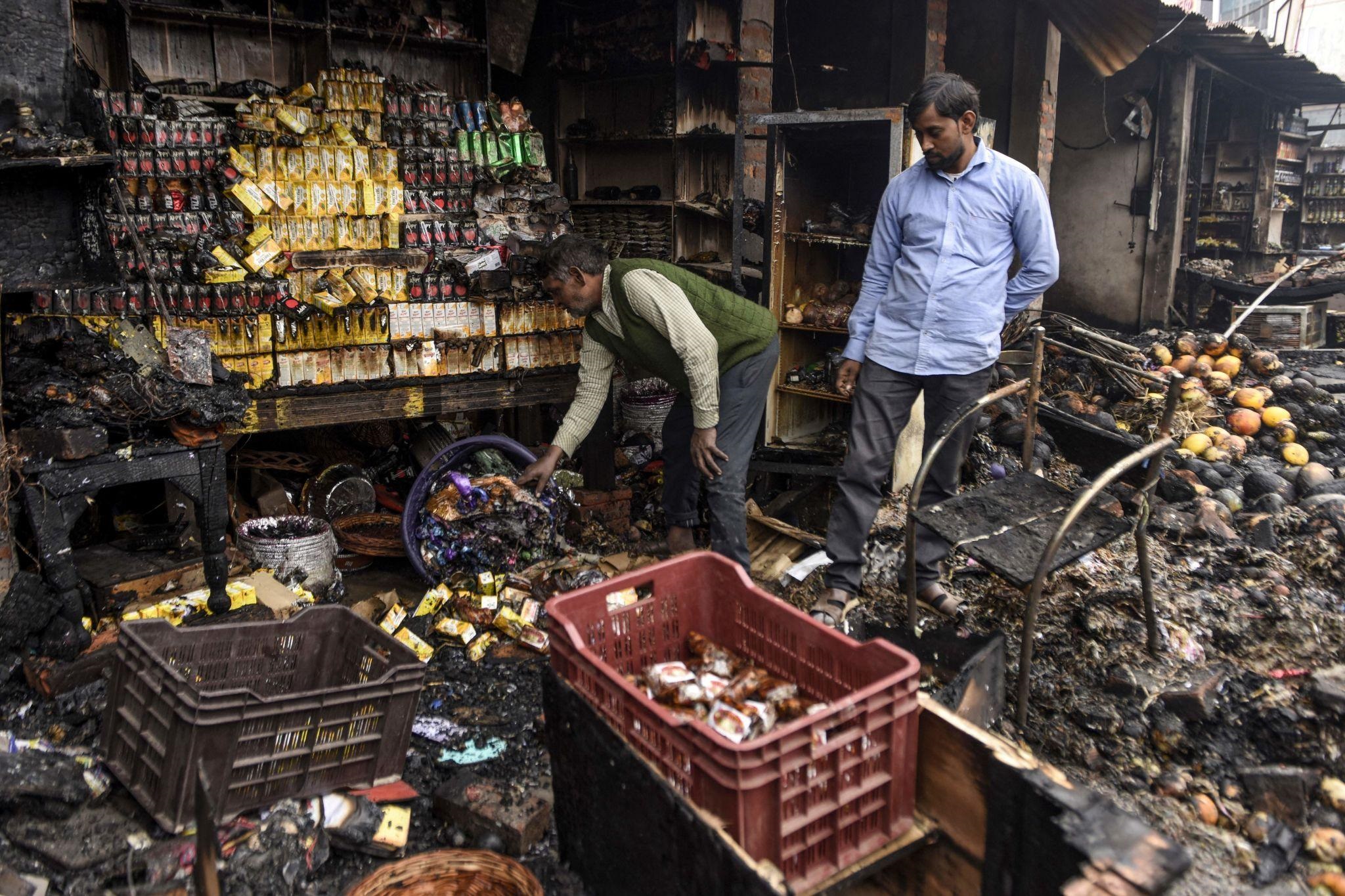
Jammu: The flames are gone, but the devastation at Jammu’s Shiv Market tells a story that is far from over. Where traders were selling dry fruits, blankets, shawls and garments just hours earlier, charred structures, twisted metal sheets and piles of debris now mark the remains of a once-bustling commercial centre opposite Jammu Railway Station.
A massive fire broke out at Shiv Market late Sunday night, October 25, and destroyed an estimated 35 to 40 shops. Firefighters battled the blaze for several hours before bringing it under control in the early hours of Monday. No casualties were reported, but the financial losses are expected to be substantial. The final value of the damage has not yet been established.
Years of investment, accumulated stock, business relationships and daily earnings have been wiped out for many shopkeepers. Employees who depended on these establishments for their wages now face uncertainty, while families whose livelihoods were tied to the market must begin considering how to recover.
The fire has also revived a wider concern across Jammu and Kashmir: whether crowded commercial areas, ageing electrical installations and restricted emergency access are receiving the attention they need before disaster strikes.
A suspected short circuit has emerged as a possible explanation for the Shiv Market blaze, but investigators have yet to establish the cause conclusively. The immediate facts are devastating enough. The larger questions concern prevention, accountability and whether the next fire can be stopped before it consumes another market.
Shiv Market Fire: How the Blaze Spread Through Jammu’s Commercial Hub
According to reports citing Fire and Emergency Services officials, the fire broke out at approximately 10:30 pm to 10:45 pm on Sunday. It spread rapidly through the market, where shops stocked with dry fruits, blankets, shawls, clothes, garments and other goods stood close together.
Strong winds reportedly helped the flames spread. The concentration of merchandise and the proximity of neighbouring establishments added to the risk as the fire moved through the commercial stretch.
One of the biggest obstacles was the narrow approach to the affected section of the market. Firefighters reportedly had to approach the blaze from the rear because reaching the shops directly was difficult.
That detail matters. In a crowded market, the effectiveness of a firefighting operation depends not only on the number of vehicles available but also on whether crews can reach the burning structures, position equipment and deliver water quickly enough.
Despite the scale of the destruction, officials reported no casualties. That is an important outcome amid an incident that could have posed a serious threat to shopkeepers, workers, emergency personnel and people living or staying nearby.
But the absence of reported casualties does not diminish the economic damage. For dozens of businesses, the working day that ended on Sunday night has been followed by the prospect of rebuilding from almost nothing.
Thirty to Forty Shops Destroyed, Hundreds of Livelihoods Under Pressure
The scale of the damage became clearer on Monday morning, when shopkeepers returned to inspect what remained of their establishments.
The market, which had served customers for decades, was left with burnt shop structures, damaged roofing and heaps of debris. Traders attempted to assess the condition of their premises and recover whatever goods or belongings had survived.
For many, the loss is more complicated than the destruction of a physical shop.
Merchandise represents capital tied up in stock. Shop fittings, storage arrangements and equipment require further investment. Some businesses may also have outstanding payments to suppliers, rent obligations or other financial commitments that continue even when trading stops.
The impact reaches beyond the owners.
Employees, helpers, loaders, transporters, suppliers and other workers depend on commercial activity for their income. Deccan Herald’s reporting highlighted concerns that around 300 livelihoods could be affected by the destruction. That figure should be treated as an estimate rather than a final count of people who have lost their jobs or income.
The timing makes the setback particularly painful. Shiv Market benefits from its location near the railway station, where passengers, visitors and pilgrims contribute to the flow of customers. Traders interviewed after the fire described their hopes for stronger sales during the festive season and the difficulty of facing such extensive losses just as business opportunities were expected to improve.
A market is more than a collection of shops. It is a network of people whose incomes depend on one another. When dozens of establishments are destroyed together, the financial shock can travel through that network for weeks or months.
For the affected traders, the first step towards recovery must be an accurate assessment of losses, followed by clear information about available assistance and the practical steps required to resume business.
Short Circuit Suspected, but the Exact Cause Remains Unconfirmed
Preliminary accounts have pointed towards a possible short circuit in one of the shops as the source of the fire. BJP MLA Vikram Randhawa also cited a suspected electrical fault when describing how the flames may have spread to adjoining establishments. However, the official cause has not been conclusively established.
Electrical faults are a recognised fire hazard in commercial buildings. Damaged wiring, loose connections, overloaded circuits and defective appliances can generate heat capable of igniting nearby combustible material. In markets that store fabrics, blankets, packaging, timber or other flammable goods, a fire can grow rapidly once ignition occurs.
But suspicion is not proof. Investigators must determine where the fire began, what ignited the first materials and whether an electrical fault or another source was responsible. The findings should guide any subsequent safety inspections or enforcement action.
The incident also raises a broader question about electrical safety in older commercial properties. Are installations being inspected regularly? Are shops using wiring and circuit protection suited to their actual electrical loads? Are building owners addressing faults before they become dangerous?
These questions deserve answers even before the final investigation report is released. They should be examined across vulnerable markets as a preventive measure, not used to assign unverified blame for this particular fire.
Narrow Market Lanes Complicate Firefighting
One of the most significant details emerging from the Shiv Market incident is the difficulty firefighters reportedly faced in reaching the affected shops.
Emergency teams had to approach the fire from the rear because the narrow access route made a direct approach difficult.
In densely packed commercial areas, access can determine how quickly crews contain a fire. Fire tenders require adequate space to manoeuvre, while firefighters need clear routes to position hoses and reach the affected buildings.
Parked vehicles, goods placed outside shops, temporary structures and encroachments can make an already difficult situation worse. Even a short obstruction can force emergency crews to find another route or reposition equipment.
The solution cannot be limited to clearing roads after a fire breaks out. Municipal authorities and market associations need to identify critical access routes in advance, ensure that emergency approaches remain clear and assess where additional firefighting infrastructure may be necessary.
Markets that cannot accommodate large fire tenders may require location-specific response plans, suitable access improvements and other arrangements developed with Fire and Emergency Services.
The purpose is not to disrupt commercial activity unnecessarily. It is to ensure that a busy market remains accessible when lives and livelihoods are at risk.
Omar Abdullah Directs Assistance to Affected Traders
Chief Minister Omar Abdullah expressed anguish over the destruction at Shiv Market and directed the administration to extend all possible assistance to affected shopkeepers.
Divisional Commissioner Jammu Vikas Kundal, the Deputy Commissioner Jammu and other senior officials visited the site to assess the damage and assured traders of administrative support. Officials said the extent of the losses was still being assessed.
The assurances are an important first step, but affected businesses will need clarity about what assistance is available and how quickly the process can move forward.
PTI-based reporting by NDTV said the administration indicated that financial assistance would be considered under the State Disaster Response Fund and other government schemes. The precise eligibility, amount and conditions applicable to individual traders will depend on the relevant provisions and the official assessment.
A transparent process should establish the number of affected businesses, the extent of structural and stock damage, the documentation required from claimants and the time frame for decisions.
Authorities should also explain whether affected traders can access temporary business space or other practical support while damaged premises are assessed and repaired.
For a small trader, assistance delayed by weeks or months may come too late to prevent the loss of customers, suppliers or employees. Speed matters, but so does fairness. Decisions must be based on verified losses and clearly communicated rules.
Fire at Shiv Market Raises Questions for Jammu and Kashmir’s Older Markets
The Jammu blaze has renewed attention on a problem that extends beyond one commercial area.
Many established markets across Jammu and Kashmir have developed over decades. Their layouts, storage practices, electrical infrastructure and surrounding streets may not have been designed for the scale of modern commercial activity.
In parts of Srinagar’s older urban areas, closely spaced structures, timber construction and narrow lanes can complicate emergency access. Commercial districts in Jammu also face challenges where shops and stored merchandise occupy tightly packed spaces.
These characteristics do not automatically mean that a building is unsafe. The actual risk depends on its construction, electrical installation, fire protection, storage arrangements and compliance with applicable requirements.
Nevertheless, the Shiv Market fire offers a reason to review high-risk locations systematically.
Authorities could begin with markets that combine substantial combustible stock, high occupancy, limited emergency access and buildings with known safety deficiencies. Inspections should assess electrical systems, fire extinguishers, alarms, evacuation routes, water availability and the ability of emergency vehicles to reach the premises.
The results should lead to action. Identifying a hazard is of limited value if it remains uncorrected, while issuing a notice is not the same as verifying compliance.
Regular inspections, documented follow-up and coordination between building authorities, electricity distribution agencies and Fire and Emergency Services would provide a more practical approach than relying on awareness campaigns alone.
The Wider Pattern: When Fire Becomes a Recurring Public-Safety Concern
The tragedy at Shiv Market has also arrived amid wider concerns over fire incidents in Jammu and Kashmir, including the recent blaze at Kaka Sarai in Srinagar.
The two incidents occurred in different places and circumstances, and their causes should not be assumed to be identical. But both demonstrate how a fire can threaten multiple establishments and place substantial demands on emergency responders.
There is a familiar cycle to many major fire incidents: flames break out, firefighters rush to the scene, damaged properties are inspected, political representatives express concern and affected families appeal for assistance.
Then the immediate headlines fade.
The more important test comes afterward. Are fire audits conducted? Are electrical hazards corrected? Are emergency access routes kept clear? Are shopkeepers given practical guidance? Do authorities review the response and implement lessons from the incident?
Without that follow-through, public concern risks becoming temporary, returning only when another blaze destroys property or threatens lives.
A sustained prevention programme should treat each major fire as an opportunity to identify weaknesses across the wider system, while respecting the evidence and avoiding premature conclusions about individual cases.
What Needs to Happen Next
The immediate response at Shiv Market must now be followed by a recovery and prevention plan.
-
Complete the damage assessment: Establish the number of destroyed and damaged shops, document losses and communicate the findings to affected traders.
-
Establish the cause: Release the findings of the fire investigation when available, distinguishing confirmed evidence from preliminary suspicion.
-
Clarify financial assistance: Explain the applicable relief provisions, eligibility requirements and procedures for affected businesses.
-
Review emergency access: Examine the narrow approach routes and identify practical improvements for firefighters.
-
Audit vulnerable markets: Prioritise electrical safety, combustible storage, fire protection and evacuation arrangements in densely packed commercial areas.
-
Track corrective action: Publish meaningful updates on inspections and safety improvements rather than allowing the issue to disappear after the immediate emergency.
These measures cannot undo the destruction of Shiv Market. They can, however, help reduce the likelihood of another commercial disaster and give affected traders a clearer route towards recovery.
Fire, Fire, Fire: How Many More Warnings Will It Take?
Fire. Fire. Fire.
Another blaze. Another market reduced to ashes. Another group of traders standing on the road, staring at the remains of businesses they spent years building. Another set of families wondering how they will pay their bills, support their children and start again.
For the shopkeepers of Shiv Market, the fire is no longer just a news story. It is the sudden loss of income, investment and security. Behind every burnt shop is a person who may have borrowed money to buy stock, a worker who depended on a daily wage, a supplier waiting for payment or a family whose future depended on the business surviving.
The sight of people standing helplessly beside charred buildings should prompt more than sympathy. It should prompt action.
When flames spread through a crowded market, firefighters are left battling the immediate emergency. But the conditions that make such disasters especially destructive must be addressed long before the next emergency call arrives.
Jammu and Kashmir cannot afford to treat every major fire as an isolated tragedy followed by assurances and temporary relief. Each incident must lead to a serious examination of electrical safety, building conditions, emergency access and enforcement. Prevention must become a routine public responsibility, not an activity that gathers momentum only after a disaster.
The final cause of the Shiv Market fire remains to be established, and the affected traders deserve a fair assessment, timely assistance and a realistic opportunity to rebuild. They also deserve to know that lessons from their losses will not be forgotten.
Fire does not wait for inspections, paperwork or promises. The question is whether the system will act before the next blaze begins.
For the traders standing on the road today, rebuilding their lives is the immediate challenge. For the administration, the challenge is to ensure that tomorrow does not bring another market, another livelihood and another community reduced to ashes.


