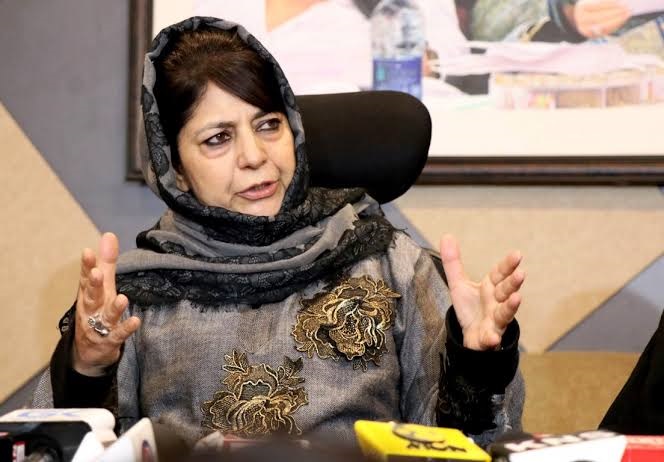
Kashmir Needs Political Engagement, Not Just Security Measures: Mehbooba Mufti
By: Javid Amin | 26 October 2026
PDP chief says restrictions and security measures cannot replace political engagement; Article 370, public trust and democratic rights remain at the centre of the debate
Srinagar: Peoples Democratic Party (PDP) president and former Jammu and Kashmir Chief Minister Mehbooba Mufti has accused the BJP-led Central government of mistaking public silence for normalcy, arguing that restrictions, security measures and investigations cannot substitute for meaningful political dialogue in Jammu and Kashmir.
Speaking at a party gathering on Accession Day on Monday, Mufti said the region continued to face suspicion, restrictions and questions over political rights nearly eight decades after its accession to India. She called on the people of the country to look beyond the apparent absence of widespread protests and consider the political concerns that, in her assessment, remain unresolved.
“The BJP mistakes this silence for acceptance and assumes that the situation has become normal. But this is not normality; it is fear,” she said.
Mufti’s remarks have brought longstanding questions about Jammu and Kashmir’s constitutional position, public confidence, security policies and political representation back into focus. Her central argument was that the absence of visible dissent should not automatically be interpreted as public satisfaction with the existing political arrangement.
The PDP chief also questioned why Kashmir receives attention in national and international political discussions while, according to her, meaningful debate within the Union Territory remains limited.
Her comments reflect the PDP’s longstanding opposition to the abrogation of Article 370 in August 2019 and its demand for a political approach that places dialogue, democratic participation and public trust at the centre of efforts to address Jammu and Kashmir’s concerns.
Accession Day Revives Debate Over Kashmir’s Political Relationship With India
October 26 is observed as Accession Day in Jammu and Kashmir, marking the date in 1947 when Maharaja Hari Singh signed the Instrument of Accession to India.
For decades, the political meaning of accession and the constitutional arrangements governing Jammu and Kashmir have remained subjects of debate. Regional parties, including the PDP and National Conference, have repeatedly argued that the region’s special constitutional position formed an important part of its relationship with the Union.
Addressing the gathering, Mufti recalled the circumstances surrounding accession and argued that the people of Jammu and Kashmir had placed their trust in India’s democratic institutions and political leadership.
She referred to Articles 370 and 35A, which formed part of the constitutional framework that governed Jammu and Kashmir before the Centre’s August 2019 decisions. Article 370 provided for the region’s special constitutional status, while Article 35A, introduced through a presidential order, supported special rights and privileges for permanent residents under the earlier framework.
Mufti argued that these arrangements were linked to concerns over land ownership, employment opportunities and the protection of the region’s distinct circumstances.
The Centre’s 2019 decision to effectively abrogate Article 370 and reorganise the former state into the Union Territories of Jammu and Kashmir and Ladakh fundamentally changed that framework. The decision remains politically contentious, although the Supreme Court upheld the abrogation in December 2023.
For the PDP, the changes represent a loss of constitutional safeguards and political autonomy. The BJP, by contrast, has defended the decision as a step towards national integration, improved governance and expanded development opportunities.
This difference continues to shape political debate in Jammu and Kashmir, including discussions about statehood, democratic representation and the relationship between the elected government and the Union government.
‘Kashmir Is Discussed Everywhere, But Not Here’
One of Mufti’s key arguments was that Jammu and Kashmir is frequently discussed by political leaders and governments outside the region, but that people living there have insufficient opportunities to debate their own political future.
She referred to discussions about Kashmir at international forums and during election campaigns in other parts of India. Yet, she argued, debate within Jammu and Kashmir is too often framed through investigations by central agencies, anti-terror legislation, detentions under the Public Safety Act and curfews.
The concern she raised goes to the heart of a longstanding political question: whether security-led governance can provide a durable solution to a conflict that also has constitutional, political and public-trust dimensions.
Security measures are intended by authorities to address specific threats and maintain public order. However, critics argue that when restrictions or investigations are perceived as excessive or insufficiently accountable, they can deepen public alienation rather than strengthen confidence in institutions.
Mufti’s position is that political engagement must be treated as an essential part of governance, not as an option to be considered only after security concerns have been addressed.
Her remarks also highlight a wider question about the space available for peaceful political disagreement. A functioning democratic system requires the ability to debate public policy, criticise governments and raise grievances within the law. How that space is maintained while addressing legitimate security threats remains a central challenge for Jammu and Kashmir.
Security Checks, Police Summons and Passport Concerns
Mufti also expressed concern about what she described as continued suspicion towards the people of Jammu and Kashmir.
She referred to reports of assaults on Kashmiris outside the Union Territory, including in Haryana, and raised questions about passport-related difficulties, police summons and frequent security checks.
According to her, young people seeking opportunities for education or employment outside the region face obstacles that reinforce the feeling that they are being treated differently from other citizens.
She also spoke about people who had surrendered years ago but, she alleged, continued to be summoned to police stations. Her remarks suggested that the effects of earlier periods of conflict remain present in the lives of individuals and families, even when their immediate circumstances have changed.
These concerns require careful examination on a case-by-case basis. Passport verification, police inquiries and security checks can arise under different legal and administrative circumstances; their existence alone does not establish that every action is unjustified. At the same time, allegations of arbitrary restrictions or unequal treatment merit scrutiny by the relevant authorities.
For Jammu and Kashmir’s young population, the ability to pursue education, employment and travel without unnecessary barriers is an important part of economic and social participation.
Mufti’s intervention therefore connects security policy with a broader question of public confidence: how can institutions maintain security while ensuring that residents feel their rights are respected and that administrative decisions are fair, proportionate and accountable?
Political Dialogue Versus a Security-Centred Approach
The PDP chief accused the Central government of relying too heavily on investigative agencies, security forces and restrictive laws instead of engaging with political representatives and the public.
She questioned the deployment of security personnel around public gatherings, arguing that such arrangements could reinforce perceptions of mistrust.
Her criticism reflects a longstanding debate over the balance between security and political engagement in Jammu and Kashmir. Successive governments have faced the challenge of responding to militancy and security threats while also addressing political grievances and protecting civil liberties.
The two responsibilities are not necessarily incompatible. Authorities can take lawful steps to prevent violence while also enabling peaceful political activity, public consultation and dialogue with elected representatives.
The central disagreement is over whether the current balance is appropriate and whether existing measures are helping build lasting confidence.
For critics such as Mufti, security arrangements alone cannot resolve questions concerning political autonomy, constitutional protections and the future relationship between Jammu and Kashmir and New Delhi. They argue that durable stability requires a credible political process in which residents can express concerns and participate in decisions affecting their lives.
The government’s position has generally emphasised security, development and integration following the 2019 constitutional changes. The effectiveness of either approach, however, must ultimately be assessed through outcomes, including public safety, institutional accountability, economic opportunities and the ability of democratic processes to function.
Article 370 Remains at the Centre of the Dispute
Mufti’s criticism of the government is closely connected to her opposition to the abrogation of Article 370.
Before August 2019, Article 370 provided the constitutional framework for Jammu and Kashmir’s special status within India. The subsequent presidential and parliamentary measures removed that arrangement and led to the reorganisation of the former state into two Union Territories.
The BJP-led government has argued that the changes strengthened integration with India and created conditions for development and more uniform application of national laws. The PDP and other critics have maintained that the changes weakened the region’s political autonomy and undermined public confidence.
The legal position must be distinguished from the political disagreement. In December 2023, the Supreme Court upheld the constitutional validity of the Centre’s decision to abrogate Article 370. The judgment did not eliminate political debate over the consequences of that decision, but the former special-status arrangement has not been restored.
Statehood is a separate issue. The demand for the restoration of statehood to Jammu and Kashmir remains an important political question and should not be confused with the legal status of Article 370.
For Mufti and the PDP, the continuing debate is about more than a constitutional provision. It concerns the degree of political autonomy available to the region, the relationship between local representatives and the Centre, and whether people believe their political concerns are being heard.
These questions continue to influence the wider discussion about governance and public trust in Jammu and Kashmir.
Can Silence Be Taken as Evidence of Normalcy?
Mufti’s most striking assertion was that the absence of visible protest should not be treated as proof that political grievances have disappeared.
The distinction matters because public order and public satisfaction are not the same thing. A region may experience fewer demonstrations at a particular moment without every underlying political concern having been resolved.
Equally, silence by itself cannot establish that people are living in fear. Assessing public sentiment requires a broader understanding of local conditions, freedom of expression, political participation, public opinion and the ability of residents to raise grievances without intimidation.
Mufti’s statement is therefore best understood as a political warning against equating the absence of unrest with a complete resolution of the region’s concerns.
The argument also raises questions about how normalcy should be assessed. Measures such as security incidents, public services, employment, tourism and economic activity offer part of the picture. Other indicators include the functioning of democratic institutions, public confidence in law enforcement, freedom of peaceful expression and the responsiveness of political leadership.
No single indicator can fully capture the situation. A credible assessment requires attention to both security conditions and the political and social experiences of residents.
Why Political Engagement Matters for Jammu and Kashmir
Political dialogue can serve several purposes in a region where constitutional questions, security concerns and public grievances overlap.
First, it provides a channel through which disagreements can be addressed without being reduced to confrontation. Elected representatives and government officials can discuss disputed policies, identify areas of common ground and clarify what changes are legally or administratively possible.
Second, dialogue can help distinguish between concerns that require immediate administrative action and those that need a longer political process. Issues such as passport delays, allegations of harassment or problems involving police procedures may require specific responses, while questions about statehood and constitutional arrangements involve broader political and legal considerations.
Third, engagement can help build confidence when it is transparent and produces measurable outcomes. Meetings alone are unlikely to resolve public mistrust if they are not followed by clear explanations, accountable decisions or progress on agreed issues.
Dialogue does not require every participant to agree. Its value lies in providing a structured and peaceful means of addressing disagreements while recognising the legal framework within which decisions must be made.
For Jammu and Kashmir, the challenge is to ensure that security concerns, constitutional disputes and public grievances are addressed through appropriate channels rather than treated as interchangeable problems.
Current Scenario: A Renewed Call for Trust and Democratic Engagement
As of October 26, 2026, Mehbooba Mufti’s remarks have renewed attention to the PDP’s demand for a political approach to Jammu and Kashmir’s unresolved concerns.
Her intervention places public trust, the legacy of Article 370’s abrogation, security practices and political dialogue at the centre of the debate. It also reflects the continuing divide between regional parties that seek a greater role for political engagement and the BJP-led Centre’s defence of the post-2019 constitutional framework.
The Supreme Court’s 2023 judgment settled the principal constitutional challenge to the abrogation of Article 370, but it did not end political disagreement over the region’s future. The demand for statehood, questions about democratic representation and debates over the relationship between security policy and civil liberties remain part of the political landscape.
Whether Mufti’s call leads to a wider discussion will depend on the response of the Centre, regional political parties and elected representatives. Any meaningful process would need to identify specific issues for discussion, clarify the powers and responsibilities of the institutions involved, and provide a credible way to assess progress.
The broader question is whether stability will be measured only by the absence of visible unrest or also by the strength of democratic participation, public confidence and institutional accountability.
Mufti’s message is that lasting peace cannot be built on silence alone. For Jammu and Kashmir, the challenge remains to create conditions in which security and democratic engagement reinforce one another, allowing political disagreements to be addressed without compromising public safety or constitutional governance.


