Sunil Sharma Intensifies Attack on Omar Abdullah, Says Governance Has Been Reduced to ‘Loyalty Parades’
By: Javid Amin | 02 June 2026
Opposition Leader Accuses NC Government of Focusing on Political Optics While Public Concerns Continue to Mount
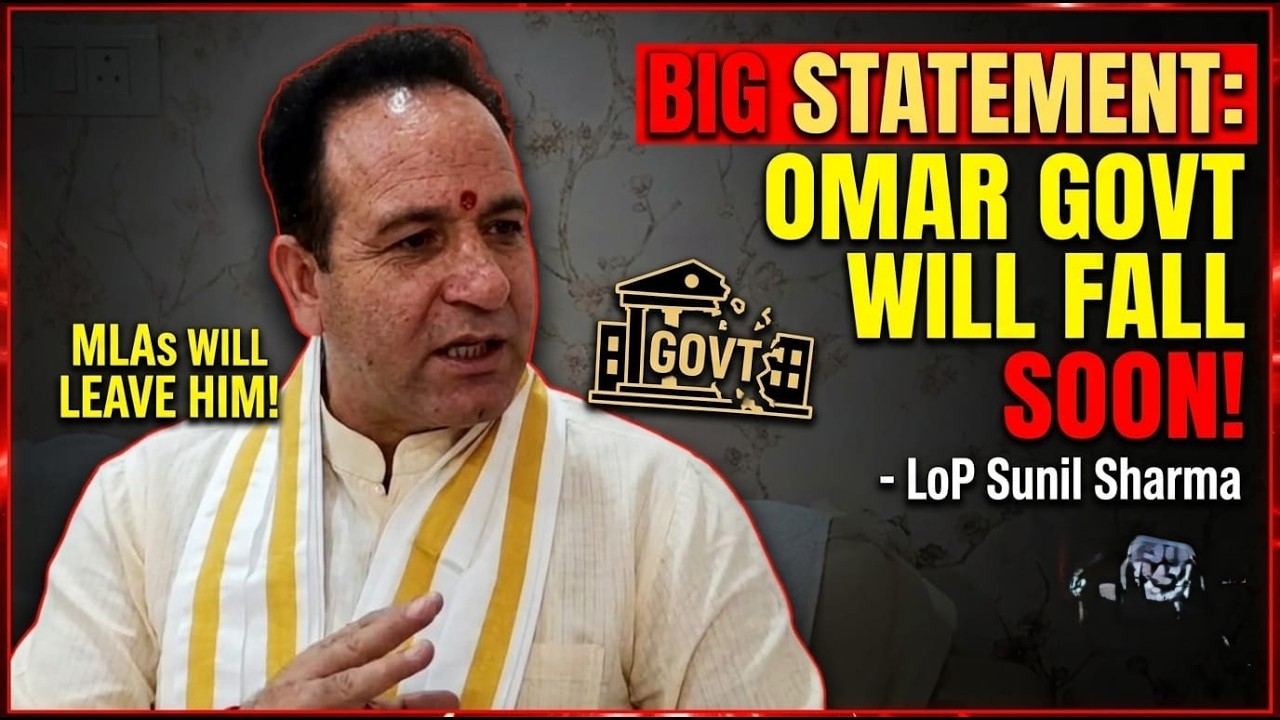
Srinagar: As political temperatures continue to rise ahead of the crucial June 3 meeting convened by Chief Minister Omar Abdullah, Leader of Opposition Sunil Sharma has launched a scathing attack on the National Conference-led government, accusing it of prioritizing “loyalty parades” over effective governance.
In one of his strongest criticisms yet, Sharma alleged that the government is increasingly focused on demonstrating political unity and loyalty rather than addressing pressing public concerns such as unemployment, infrastructure deficiencies, flood preparedness, and administrative efficiency.
His remarks add another layer to the escalating political contest involving the ruling Jammu & Kashmir National Conference (NC), the Bharatiya Janata Party (BJP), and the People’s Democratic Party (PDP), with each side attempting to shape public perception ahead of key political developments.
‘Governance Cannot Be Reduced to Political Spectacles’
According to Sharma, the government appears more concerned with orchestrating displays of political solidarity than delivering tangible outcomes for citizens.
The BJP leader argued that while public expectations remain high, many residents continue to seek answers on issues directly affecting their daily lives.
Among the concerns highlighted by Sharma were:
- Rising unemployment among youth
- Delays in infrastructure projects
- Urban and rural development challenges
- Flood management and disaster preparedness
- Delivery of public services
- Administrative responsiveness
He contended that governance should be judged by measurable outcomes rather than symbolic demonstrations of party unity.
The remarks reflect a broader opposition strategy aimed at portraying the Omar Abdullah administration as overly focused on political messaging.
June 3 Meeting Comes Under Opposition Scrutiny
The criticism is particularly significant because it comes just ahead of the Chief Minister’s meeting with legislators in Srinagar.
Officially, the gathering has been described as an exercise focused on governance coordination, public welfare, and developmental priorities.
However, opposition leaders have sought to cast the meeting in a different light.
Sharma suggested that such exercises risk becoming political showcases if they fail to translate into concrete policy decisions and administrative reforms.
The BJP’s argument is straightforward: internal political consultations are important, but they must ultimately produce visible improvements in governance.
By framing the meeting as a “loyalty parade,” Sharma is attempting to challenge the government’s narrative and shift public attention toward governance outcomes.
BJP’s Broader Narrative Against the NC
The latest remarks fit into a wider BJP strategy of portraying the National Conference as a party driven by symbolism and legacy politics.
Governance Versus Optics
The BJP has repeatedly argued that governments should be evaluated on delivery rather than political messaging.
Sharma’s comments reinforce that narrative by suggesting that public concerns are being overshadowed by political theatre.
Questioning Administrative Performance
The opposition continues to highlight areas where it believes government performance can be challenged, particularly in employment generation, infrastructure development, and disaster preparedness.
Positioning BJP as an Alternative
By criticizing both governance style and political priorities, the BJP is seeking to present itself as a more results-oriented alternative.
This messaging is likely to intensify as political competition in Jammu and Kashmir becomes increasingly polarized.
Sharma Dismisses Mehbooba Mufti’s Unity Appeal as ‘Drama’
BJP Leader Rejects PDP Chief’s Call for a Ladakh-Style Joint Outreach to the Centre
In a separate but related political intervention, Sunil Sharma also targeted PDP president Mehbooba Mufti over her recent appeal for a united political outreach to the Centre.
Mehbooba had urged mainstream political parties, including the National Conference and Congress, to emulate the coordinated efforts of Ladakh’s civil society groups in engaging with New Delhi on constitutional safeguards and democratic issues.
However, Sharma dismissed the initiative as “drama,” arguing that the appeal was more about political positioning than meaningful action.
His response highlights the skepticism with which rival parties are viewing Mehbooba’s latest political initiative.
Ladakh Comparison Sparks Political Debate
At the centre of Mehbooba’s appeal is the recent engagement between the Centre and Ladakh-based platforms such as the Leh Apex Body and the Kargil Democratic Alliance.
The perceived progress achieved through that process has generated widespread debate in Jammu and Kashmir.
Mehbooba argues that Ladakh’s success demonstrates the effectiveness of collective action and a unified political voice.
Sharma, however, believes that merely invoking the Ladakh example is insufficient without genuine political consensus and concrete proposals.
The disagreement reflects a broader debate over how Jammu and Kashmir’s political leadership should engage with the Centre.
Competing Narratives Define J&K Politics
The latest exchange reveals three competing political narratives currently shaping Jammu and Kashmir’s political landscape.
National Conference’s Position
The ruling NC continues to project itself as the party focused on governance, development, statehood restoration, and institutional stability.
PDP’s Position
Mehbooba Mufti is attempting to position herself as a catalyst for political unity and collective engagement on constitutional and democratic issues.
BJP’s Position
The BJP, through leaders like Sunil Sharma, is challenging both parties by portraying the NC as ineffective and the PDP as politically opportunistic.
These competing narratives are likely to dominate political discourse in the weeks ahead.
Public Sentiment and Governance Expectations
Beyond political rhetoric, voters remain focused on practical concerns.
Across Jammu and Kashmir, citizens continue to prioritize issues such as:
- Employment opportunities
- Infrastructure development
- Flood protection measures
- Economic growth
- Healthcare services
- Education
- Administrative accountability
Political analysts note that while sharp political exchanges attract attention, public opinion is often shaped more by governance outcomes than by political slogans.
This reality places pressure on all parties to move beyond rhetoric and demonstrate tangible results.
Risks of Escalating Political Polarization
The growing war of words carries risks for the broader political environment.
Governance May Be Overshadowed
As parties focus on attacking rivals, substantive policy discussions could receive less attention.
Deepening Political Divides
The increasingly confrontational language risks further polarizing political discourse across Jammu and Kashmir.
Public Cynicism
Repeated political accusations without corresponding policy action can contribute to voter frustration and political disengagement.
Observers caution that citizens ultimately expect solutions rather than perpetual political confrontation.
What Happens Next?
With the June 3 legislators’ meeting approaching, attention is now focused on how the government responds to mounting criticism from the opposition.
Key questions include:
- Will the government announce new governance initiatives?
- Can the National Conference counter the opposition’s “optics over governance” narrative?
- How will Omar Abdullah respond to Mehbooba Mufti’s unity appeal?
- Will opposition parties intensify pressure on governance and public service delivery?
The answers could significantly influence the next phase of political discourse in Jammu and Kashmir.
Conclusion
Sunil Sharma’s twin attacks on Omar Abdullah and Mehbooba Mufti reflect the increasingly competitive nature of Jammu and Kashmir’s political landscape. By describing the government’s activities as “loyalty parades” and dismissing Mehbooba’s unity initiative as “drama,” the BJP has sought to position itself as a critic of both the ruling establishment and opposition outreach efforts.
As the June 3 meeting unfolds, the central challenge for all political actors will be convincing the public that their actions extend beyond political messaging and translate into meaningful governance outcomes. In the end, voters are likely to judge leaders not by rhetoric alone, but by their ability to address the economic, social, and developmental concerns facing Jammu and Kashmir.