Oil Prices Surge Across India: Fuel Hikes Spark Inflation Wave, Airline Cutbacks, and Economic Anxiety
By: Javid Amin | 30 May 2026
Four Consecutive Fuel Price Hikes Push India Into a New Inflation Cycle
India is facing a fresh economic challenge as soaring petrol and diesel prices begin to ripple through nearly every sector of the economy. What started as a series of fuel price revisions has evolved into a broader inflationary shock, affecting transportation, agriculture, aviation, retail markets, and household budgets.
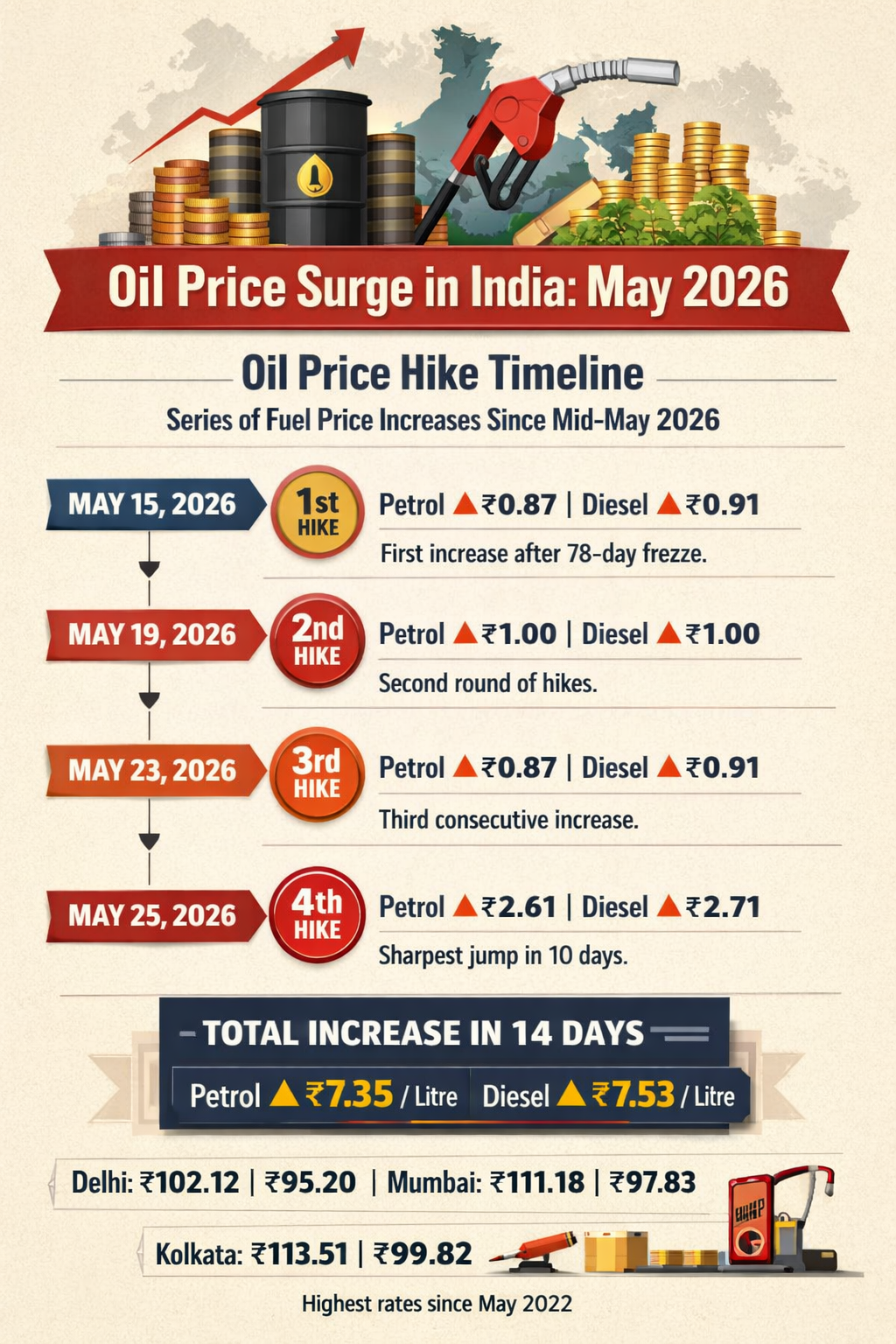
Since May 15, 2026, fuel prices have risen four times, pushing petrol and diesel rates to their highest levels in nearly four years. The cumulative increase of ₹7.35 per litre for petrol and ₹7.53 per litre for diesel has intensified concerns among consumers, businesses, and policymakers alike.
From rising grocery bills and costlier travel to mounting pressure on farmers and transport operators, the fuel surge is increasingly being viewed not merely as an energy issue but as a significant economic challenge with nationwide implications.
India’s Fuel Price Surge: A Timeline of Rapid Increases
After remaining largely unchanged for nearly 78 days, fuel prices began rising sharply in mid-May as international crude oil markets entered a period of extraordinary volatility.
Timeline of Fuel Price Hikes
| Date | Petrol Increase | Diesel Increase |
|---|---|---|
| May 15, 2026 | ₹0.87/litre | ₹0.91/litre |
| May 19, 2026 | Around ₹1/litre | Around ₹1/litre |
| May 23, 2026 | ₹0.87/litre | ₹0.91/litre |
| May 25, 2026 | ₹2.61/litre | ₹2.71/litre |
Total Increase Since May 15
- Petrol: +₹7.35/litre
- Diesel: +₹7.53/litre
The latest increase has pushed fuel prices in several metropolitan cities beyond psychologically important thresholds, creating concern among both consumers and businesses.
Current Fuel Prices Across Major Indian Cities
Petrol and Diesel Rates as of May 29, 2026
| City | Petrol (₹/Litre) | Diesel (₹/Litre) |
|---|---|---|
| Delhi | 102.12 | 95.20 |
| Mumbai | 111.18 | 97.83 |
| Kolkata | 113.51 | 99.82 |
| Chennai | 107.85 | 99.66 |
| Bengaluru | 110.89 | 98.80 |
| Hyderabad | 115.69 | 103.82 |
The figures represent the highest fuel prices witnessed since 2022 and have significantly increased transportation and operational costs across sectors.
What Is Driving the Fuel Price Surge?
Global Crude Oil Shock
The biggest factor behind India’s fuel price escalation is the dramatic rise in international crude oil prices.
Global energy markets were shaken after escalating tensions in West Asia disrupted major shipping routes. The closure and instability surrounding the Strait of Hormuz—a critical oil transit corridor through which roughly one-fifth of the world’s petroleum supplies pass—triggered panic across energy markets.
As a result, Brent crude surged above $100 per barrel and at certain points crossed the $126 mark, creating substantial pressure on oil-importing nations like India.
For an economy that imports more than 85 percent of its crude oil requirements, such price spikes inevitably translate into higher domestic fuel costs.
Rupee Depreciation Increases Import Bills
The situation has been compounded by the weakening of the Indian rupee.
Oil purchases are denominated in US dollars. When the rupee loses value against the dollar, India must spend more to import the same quantity of crude oil.
The dual impact of higher crude prices and a weaker currency has significantly increased the import burden on the country and oil marketing companies.
Mounting Losses for Oil Marketing Companies
Industry estimates suggest that oil marketing companies (OMCs) absorbed losses ranging between ₹750 crore and ₹1,000 crore per day during the prolonged price freeze earlier this year.
As global crude prices continued climbing, maintaining artificially low retail fuel prices became increasingly difficult. The phased increases introduced since May 15 are widely viewed as an effort to gradually recover those losses while avoiding a single massive price shock.
Inflation Spreads Beyond Fuel Pumps
Transportation Sector Feels the Immediate Impact
Transportation is among the first sectors to experience the effects of rising fuel costs.
Bus operators, taxi services, ride-hailing platforms, freight companies, and logistics providers depend heavily on petrol and diesel. As operating expenses increase, businesses are often forced to pass costs on to customers.
Expected Consequences
- Higher bus fares
- Increased taxi and cab charges
- Costlier freight movement
- Rising delivery expenses
- More expensive inter-city travel
Since transportation serves as the backbone of India’s supply chain, rising fuel costs eventually affect almost every product reaching consumers.
Airlines Cut Services as Aviation Fuel Costs Soar
One of the most visible consequences of the oil shock is emerging in India’s aviation sector.
Aviation turbine fuel (ATF), already one of the largest operating expenses for airlines, has become substantially more expensive following the crude oil surge.
Several airlines have reportedly begun rationalizing routes, reducing frequencies on less profitable sectors, and adjusting schedules to contain costs.
Impact on Air Travelers
- Higher airfares
- Reduced flight frequencies
- Fewer regional connections
- Increased travel costs for families
- Potential decline in tourism traffic
Industry analysts warn that prolonged high fuel prices could further pressure airlines already operating on thin profit margins.
Agriculture Faces Rising Costs at Every Stage
Farmers Under Fresh Financial Pressure
Diesel remains the lifeline of Indian agriculture.
It powers:
- Irrigation pumps
- Tractors
- Harvesting machinery
- Transportation vehicles
- Cold-chain logistics
As diesel prices rise, the cost of cultivation increases substantially.
Farmers are now confronting higher operational expenses at a time when many are already dealing with fluctuating crop prices, climate-related uncertainties, and rising input costs.
The result is shrinking profit margins and greater financial stress across rural communities.
Food and Essential Commodities Become More Expensive
The Inflationary Ripple Effect Reaches Households
Fuel price increases rarely remain confined to fuel stations.
When transportation becomes more expensive, businesses throughout the supply chain face higher costs. These additional expenses eventually translate into higher prices for consumers.
Commodities Most Likely to Be Affected
- Vegetables
- Fruits
- Milk and dairy products
- Grains
- Packaged foods
- Household essentials
- Consumer goods
Even modest increases in logistics costs can significantly influence retail prices, especially in a country as geographically vast as India.
Economists describe this process as “cost-push inflation,” where higher production and transportation costs drive broader price increases throughout the economy.
Indian Households Feel the Pressure
Rising Costs Force Families to Reprioritize Spending
For millions of families, the fuel price surge is creating a direct impact on monthly budgets.
Households are now spending more on:
- Daily commuting
- School transportation
- Food purchases
- Utility services
- Delivery charges
- Travel expenses
As essential expenditures rise, discretionary spending often declines.
Retailers across various sectors are already reporting more cautious consumer behavior, with families postponing non-essential purchases and prioritizing necessities.
Such shifts in spending patterns can slow broader economic activity, particularly in consumer-driven sectors.
Political Debate Intensifies
Government and Opposition Clash Over Fuel Pricing
The fuel price hikes have once again become a major political issue.
Opposition parties argue that ordinary citizens are bearing the burden of global volatility and have called for tax reductions and relief measures.
Government officials, meanwhile, maintain that India’s fuel pricing mechanism is linked to international market conditions and note that domestic price increases remain lower than those witnessed in several other oil-importing nations.
The debate is expected to intensify if crude prices remain elevated in the coming weeks.
Risks Ahead for India’s Economy
Travel Slowdown Could Impact Tourism and Business
Higher fuel prices and rising airfares could discourage discretionary travel, affecting tourism-dependent regions and businesses connected to hospitality, aviation, and transport.
States heavily dependent on domestic tourism may face reduced visitor spending if travel costs continue rising.
Supply Chain Stress May Deepen
As logistics expenses increase, companies may be forced to adjust distribution networks, inventory management strategies, and pricing structures.
Prolonged fuel inflation could create additional bottlenecks in the movement of essential commodities and manufactured goods.
Public Frustration Could Grow
History shows that sustained fuel price increases often become politically and socially sensitive issues.
If prices continue to rise while inflation remains elevated, public dissatisfaction may increase, leading to demands for government intervention and additional relief measures.
Conclusion: A Fuel Crisis Turning Into an Economy-Wide Challenge
The sharp increase in petrol and diesel prices since mid-May 2026 has become much more than a fuel story. It is now a developing economic challenge influencing transportation, agriculture, aviation, retail markets, and household finances.
With crude oil prices remaining volatile, inflationary pressures spreading across sectors, and consumers already feeling the squeeze, India faces a delicate balancing act between market-linked pricing and protecting citizens from escalating living costs.
The coming weeks will be crucial. If global oil markets stabilize, inflationary pressures may ease. However, if crude prices remain elevated or geopolitical tensions worsen, the fuel shock could evolve into a broader economic slowdown affecting businesses, consumers, and growth prospects across the country.