Promises in Limbo: Kashmir’s Politics of Delay and the Growing Crisis of Public Trust
By: Javid Amin | 03 June 2026
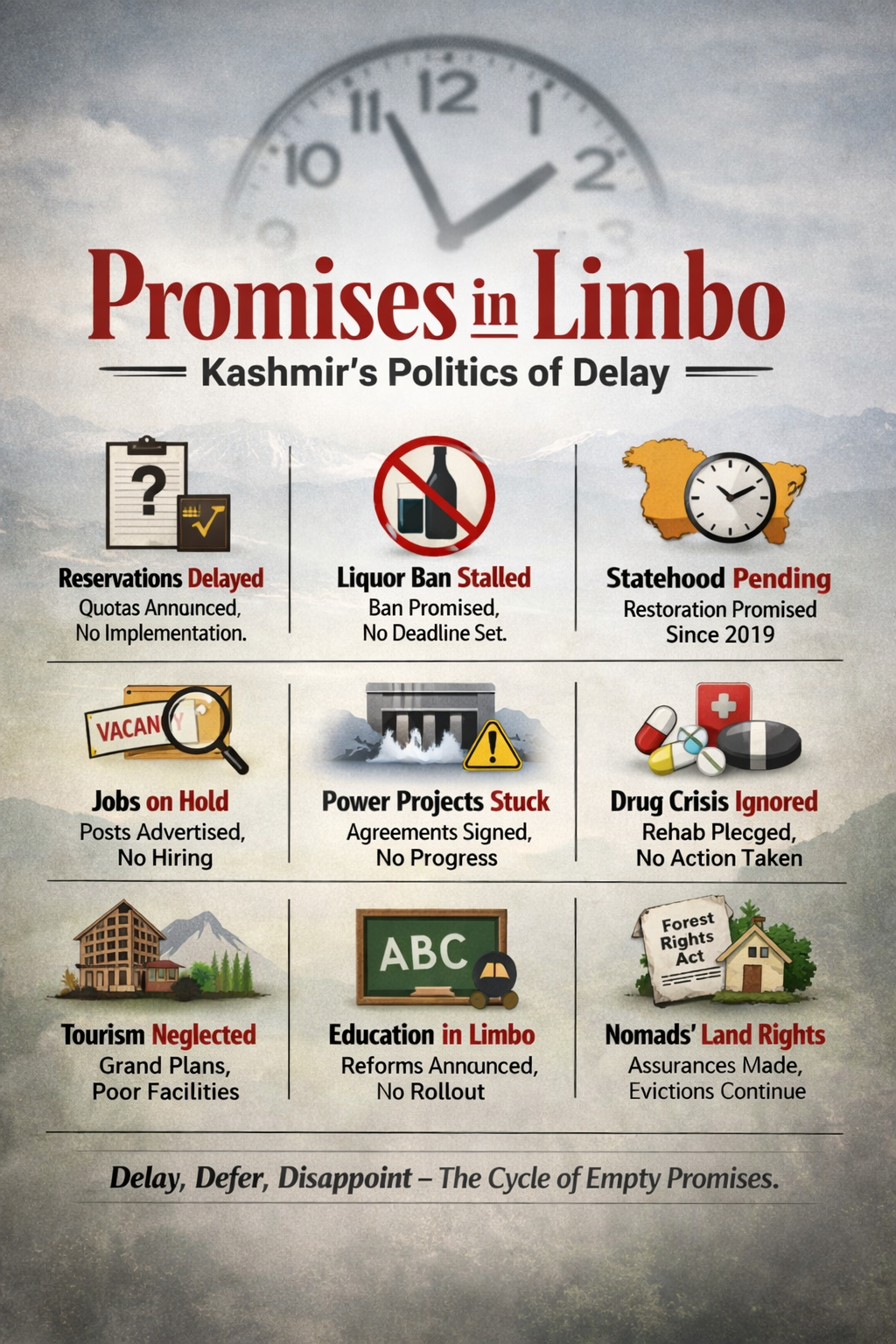
Promises in Limbo: Kashmir’s Politics of Delay
Announcements Are Made, Headlines Are Created, Expectations Rise — But Delivery Often Remains Elusive
In Jammu and Kashmir, political promises rarely die. Instead, they linger.
They reappear in speeches, election campaigns, legislative debates, press conferences, and official statements. They are announced with urgency, discussed with optimism, and often welcomed by citizens desperate for solutions.
Then comes the familiar cycle.
Committees are formed. Reviews are initiated. Consultations are promised. Files move between departments. Deadlines quietly disappear.
Months become years.
And the promise remains exactly where it started — suspended somewhere between commitment and implementation.
Whether the issue is statehood restoration, reservations, employment, tourism infrastructure, education reform, or the growing drug crisis, citizens across Jammu and Kashmir increasingly find themselves confronting a governance culture where announcements arrive faster than outcomes.
The result is not merely administrative delay.
It is a growing crisis of trust.
Statehood: The Promise That Defines an Era
No political commitment has carried greater emotional and constitutional significance than the promise of restoring Jammu and Kashmir’s statehood.
Since the reorganization of the former state in 2019, political parties across ideological lines have repeatedly described statehood restoration as essential for democratic accountability and institutional stability.
The issue has featured prominently in election campaigns, public rallies, legislative speeches, and meetings with New Delhi.
Yet despite repeated assurances over the years, no official timeline has emerged.
For many citizens, the debate has gradually shifted from whether statehood will return to when it will return.
That uncertainty has created frustration across political and social sections of society.
Statehood remains the most visible example of a promise whose destination is clear but whose roadmap remains undefined.
Reservations: Announcements Without Clarity
The reservations debate has become another example of governance trapped between declaration and execution.
Successive announcements and discussions have raised expectations among various communities seeking greater representation and opportunities.
However, questions continue to persist:
- What exactly will change?
- Which communities will benefit?
- What will be the percentage allocation?
- When will implementation begin?
Without clear answers, every announcement generates hope while simultaneously creating confusion.
For affected communities, uncertainty often proves as frustrating as outright rejection.
Employment: The Cost of Delayed Opportunities
Few issues carry greater political importance than employment.
Government recruitment drives, job packages, and vacancy announcements frequently make headlines. Thousands of posts are often cited as evidence of commitment toward youth welfare.
Yet on the ground, many recruitment processes continue to face delays.
Examinations are postponed.
Selection lists take time.
Departments await approvals.
Administrative bottlenecks slow implementation.
For a generation confronting limited opportunities, delayed recruitment is not merely a bureaucratic issue.
It directly affects livelihoods, career planning, and economic stability.
In Kashmir’s political landscape, employment promises have become one of the most closely scrutinized measures of governmental credibility.
The Drug Crisis: Recognition Without Adequate Response
Political leaders across party lines now acknowledge that substance abuse represents one of the most serious social challenges facing Jammu and Kashmir.
The crisis is no longer denied.
It is discussed openly in the Assembly, government departments, religious institutions, schools, and civil society forums.
Yet recognition alone cannot solve the problem.
Families affected by addiction continue to raise concerns about:
- Limited rehabilitation facilities
- Insufficient mental health support
- Resource constraints
- Lack of trained professionals
- Inadequate preventive interventions
While awareness has increased significantly, implementation often struggles to match the scale of the challenge.
The gap between diagnosis and treatment remains substantial.
Tourism: Big Vision, Uneven Reality
Tourism remains one of Jammu and Kashmir’s most important economic sectors.
Official announcements frequently envision world-class destinations, modern infrastructure, enhanced visitor experiences, and sustainable tourism growth.
There is undeniable progress in some areas.
Visitor numbers have risen dramatically in recent years.
New destinations are receiving attention.
Investment interest has grown.
However, infrastructure challenges remain visible across numerous locations.
Issues frequently raised include:
- Road connectivity
- Waste management
- Parking facilities
- Public conveniences
- Emergency services
- Sustainable planning
The challenge is no longer attracting tourists.
It is ensuring that infrastructure keeps pace with growing demand.
Education Reform: Modernization Moving in Slow Motion
Educational modernization has become a recurring theme in policy discussions.
Digital classrooms.
Smart learning systems.
Curriculum reforms.
Technology integration.
Skill-based education.
These initiatives frequently feature in official plans and announcements.
However, implementation remains uneven.
Urban institutions often move faster than rural schools.
Connectivity challenges persist.
Teacher training gaps remain.
Infrastructure disparities continue to affect outcomes.
As a result, educational reform often advances in pockets rather than through a uniform transformation.
Nomadic Communities and the Question of Land Rights
Among the most sensitive issues is the ongoing debate surrounding land rights for nomadic and tribal communities.
The discussion frequently references legal protections, welfare measures, and rights-based approaches.
Yet concerns continue to emerge regarding:
- Evictions
- Demolition drives
- Access to land
- Administrative ambiguity
- Implementation inconsistencies
For affected communities, policy declarations often appear disconnected from experiences on the ground.
The resulting uncertainty deepens feelings of vulnerability and exclusion.
Liquor Ban: A Promise Without a Calendar
The demand for restrictions on liquor sales periodically resurfaces in political discourse, often accompanied by assurances intended to address concerns raised by religious and social organizations.
However, a critical question remains unanswered:
What is the implementation plan?
Without a defined framework, timeline, or enforcement roadmap, the debate remains largely symbolic.
The issue demonstrates a broader pattern in politics where announcements generate immediate headlines but leave difficult policy decisions unresolved.
Why Delays Have Become a Political Problem
Delays are not unique to Jammu and Kashmir.
Every government faces administrative constraints, legal complexities, and financial limitations.
However, what distinguishes the current environment is the accumulation of unfinished promises.
When citizens repeatedly hear commitments without witnessing corresponding outcomes, skepticism becomes inevitable.
The consequences include:
Erosion of Public Trust
People become less willing to believe future announcements.
Political Cynicism
Citizens begin viewing promises as political exercises rather than genuine commitments.
Reduced Institutional Credibility
Governments, departments, and political parties all suffer reputational damage.
Growing Public Frustration
Expectations rise with every announcement, making eventual disappointment more intense.
The Politics of Perpetual Review
One recurring feature of governance across political administrations has been the reliance on extended consultation processes.
Committees.
Expert panels.
Departmental reviews.
Inter-agency consultations.
While such mechanisms are often necessary, they can also become tools for postponement.
Citizens increasingly question whether some issues are being solved or simply studied indefinitely.
A review process is valuable only when it leads to decisions.
Without implementation, consultation risks becoming another form of delay.
The Real Crisis Is Not Delay — It Is Uncertainty
Most citizens understand that major reforms take time.
What fuels frustration is uncertainty.
People can adapt to long timelines if those timelines are transparent.
They struggle when deadlines constantly shift, announcements change, and priorities remain unclear.
The absence of certainty affects:
- Students planning careers
- Job seekers awaiting recruitment
- Businesses considering investment
- Families seeking stability
- Communities awaiting policy decisions
In many cases, uncertainty itself becomes a social and economic burden.
Conclusion: Trust Cannot Be Governed Through Announcements Alone
Jammu and Kashmir’s political history is filled with ambitious promises, transformative visions, and bold declarations.
Many of those commitments were made with genuine intent.
Some have delivered results.
Others remain trapped in administrative limbo.
The central challenge facing today’s political leadership is not making new promises.
It is completing old ones.
Citizens are no longer measuring governments by announcements, memorandums, or slogans.
They are measuring them by execution.
Because ultimately, a promise delayed for too long begins to resemble a promise denied.
And when that happens repeatedly, the greatest casualty is not a policy—it is public trust.