Vande Mataram Row at IFFJK 2026: NC-Congress Clash Exposes Fresh Faultline in J&K Alliance
By: News Desk | 09 September 2026
A film festival opens, and an old political fault line returns
SRINAGAR, September 10, 2026: The opening of Jammu & Kashmir’s first International Film Festival was supposed to be about cinema.
There were films from dozens of countries, a red carpet, celebrated filmmakers, cultural performances and an ambitious attempt to place Kashmir on the international creative map.
Instead, one of India’s oldest national songs has become the centre of a fresh political confrontation.
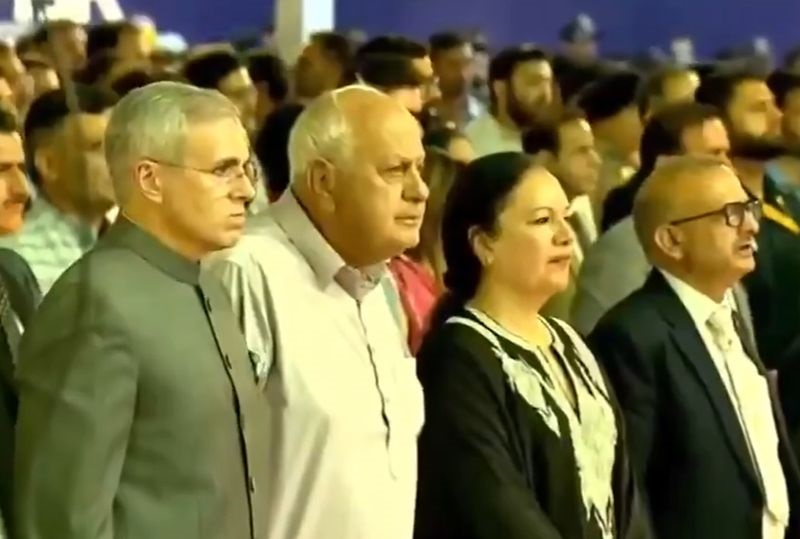
The full rendition of “Vande Mataram” at the inauguration of IFFJK 2026, in the presence of Chief Minister Omar Abdullah and National Conference president Farooq Abdullah, has triggered a public exchange between the ruling National Conference and its Congress ally.
What initially looked like a ceremonial detail has quickly developed into something larger: a disagreement over national symbolism, constitutional pluralism and the political limits of a coalition whose partners do not always share the same ideological instincts.
The irony is difficult to miss.
At a festival intended to showcase Kashmir’s stories to the world, the political conversation has once again turned inward, towards the question of identity.
What actually happened at the IFFJK inauguration?
The flashpoint came on September 7, when the complete version of Vande Mataram was played during the inaugural ceremony of IFFJK in Srinagar.
Omar Abdullah and Farooq Abdullah were present and stood during the rendition. The presence of senior NC leaders and the use of the unabridged version subsequently drew criticism from Congress leaders.
The issue was not that Vande Mataram was played.
The dispute was over which version was used.
Congress leaders argued for the historically adopted version consisting of the first two stanzas, while the NC defended the playing of the complete song at an official government function.
That distinction is crucial to understanding the row.
It is also why describing the controversy simply as “NC versus Congress over Vande Mataram” misses the deeper argument.
This is a dispute about the meaning of national symbols in a politically and religiously diverse country.
Congress: National symbols must accommodate India’s diversity
J&K Congress president Tariq Hameed Karra was among the most prominent Congress voices to object.
Karra argued that the national song’s place in public life evolved through India’s freedom struggle and constitutional history. In his view, the version traditionally adopted for national functions represented a compromise designed to preserve the song’s patriotic significance while remaining sensitive to India’s religious diversity.
He argued that national symbols gain strength when they make citizens feel included rather than asking diversity to adjust to the symbol.
His formulation was deliberately different from the language of outright opposition to patriotism.
Karra said the controversy was “not about patriotism”, but about the constitutional temperament with which patriotism should be expressed in a plural republic.
Congress general secretary K C Venugopal also criticised the use of the unabridged song, asking the NC to respect the historical position associated with the Congress’s 1937 decision.
That position has become a central part of the Congress argument.
Why does Congress refer to 1937?
The history of Vande Mataram is complicated.
Written by Bankim Chandra Chattopadhyay and published in Anandamath, the song became a powerful symbol during India’s freedom struggle.
It was sung at Congress sessions and became closely associated with anti-colonial mobilisation.
But parts of the complete song contain religious imagery that later became a source of concern among sections of India’s Muslim community.
During the late colonial period, the Congress leadership therefore moved towards using the opening stanzas in public political settings.
Congress now points back to that history to argue that limiting the rendition was not an act of disrespect to the song.
It was an attempt to reconcile nationalism with religious pluralism.
Historical records from the Constituent Assembly period also show that the first verse of Vande Mataram was used in formal proceedings.
The political disagreement today is partly about how that historical compromise should be understood in 2026.
NC’s answer: This is an official-event protocol, not a political test
The National Conference did not accept Congress’s criticism.
NC chief spokesperson Tanvir Sadiq argued that the party had a clear position on the issue and defended the full rendition at official events.
The NC’s argument was that the complete national song can be played at a government function without compelling individuals to sing it.
That distinction between playing the song and forcing people to sing it has become central to the NC’s defence.
The party also pointed to Congress-ruled states.
Sadiq shared videos appearing to show Telangana Chief Minister A Revanth Reddy and Karnataka Deputy Chief Minister D K Shivakumar participating in events where the full version was played, asking why Congress was objecting to the same practice in Jammu & Kashmir.
The political counter-argument was straightforward:
If a particular protocol is acceptable in other parts of India, the NC asked, why should Jammu & Kashmir be treated differently?
That question has allowed the NC to shift the debate from identity politics to consistency in government protocol.
The legal and official-protocol question
This is one of the most important parts of the controversy, because the political rhetoric has sometimes blurred the distinction between a national symbol, an official protocol and an individual’s obligation to sing.
The Ministry of Home Affairs issued updated orders relating to the National Song in 2026. The official document sets out the complete lyrics of Vande Mataram as the official version and provides instructions concerning occasions on which the song is played or sung and the decorum expected during such occasions.
The government has also been marking the 150th anniversary of Vande Mataram, giving the song unusually high national visibility in 2025-26. The Union government’s Republic Day 2026 arrangements, for example, explicitly placed the anniversary at the centre of the celebrations.
But the political dispute in Kashmir goes beyond protocol.
It is about whether the complete version should become the default expression at public events, particularly in a region where questions of identity and representation have historically carried extraordinary political weight.
That is why the disagreement has travelled so quickly from a film festival stage to the alliance’s political arena.
The NC’s counterattack exposes the coalition’s awkward middle ground
The NC’s response was not simply defensive.
It turned the argument back on Congress.
If Congress-led governments elsewhere have participated in events where the full song was played, NC leaders argued, then objecting specifically when the same thing happens in J&K appears inconsistent.
NC leader Gagan Bhagat made essentially this argument, saying national protocol cannot change according to geography.
There is a political calculation behind that response.
The National Conference has long occupied a complicated space in Indian politics, balancing regional identity with participation in India’s constitutional and electoral system.
The party does not want to appear unwilling to respect national symbols.
At the same time, it has historically built much of its political identity around the distinctiveness of Jammu & Kashmir.
The Vande Mataram dispute places those two instincts in direct proximity.
For Congress, the problem is equally complicated
Congress is facing its own balancing act.
At the national level, it does not want to be portrayed as hostile to Vande Mataram, a song deeply embedded in India’s freedom movement.
At the same time, the party wants to preserve its historical argument that the first two stanzas were deliberately adopted as the appropriate public version because of India’s religious diversity.
Its 1937 position therefore becomes politically important.
The party’s argument is not that Vande Mataram has no place in public life.
It is that the historical compromise around the song should be respected.
That position is particularly sensitive in Jammu & Kashmir, where Congress is governing alongside the NC rather than opposing it.
The Omar Abdullah factor
The controversy has inevitably drawn attention to Omar Abdullah.
The Chief Minister was present at the IFFJK inauguration when the full version was played and stood during the rendition alongside his father, Farooq Abdullah.
The Chief Minister himself has not been at the centre of the public exchange in the same way as Karra and Tanvir Sadiq.
That is politically significant.
Omar’s government depends on cooperation between the NC and Congress, even though the two parties maintain distinct political identities and ideological positions.
A symbolic dispute such as this does not automatically threaten the government.
But it does demonstrate the limits of ideological uniformity inside the coalition.
This is not the first disagreement between NC and Congress
The two parties entered government together after the 2024 Assembly elections, but their alliance has never meant complete political convergence.
The NC’s politics remain rooted in J&K’s regional aspirations, while Congress operates within a broader national political framework.
On many governance questions, the distinction may remain invisible.
On issues involving identity, constitutional interpretation, national symbols or the politics of the Union Territory, it becomes much harder to conceal.
That is why the Vande Mataram controversy has attracted disproportionate attention compared with the immediate issue itself.
The song is the trigger.
The underlying issue is the coalition’s ideological distance.
Kashmir’s political history makes symbolism unusually powerful
In many parts of India, a disagreement over which version of a patriotic song is played at a cultural event might remain a minor political argument.
In Kashmir, symbolism carries a different weight.
The region’s political history has been shaped by competing ideas of regional identity, Indian federalism, autonomy, secularism and national integration.
That history means cultural symbols can quickly become political symbols.
A song played at a government function can therefore be interpreted differently by different constituencies.
For one side, it represents national unity.
For another, the question is whether national unity should require a particular cultural formulation.
The two positions can exist simultaneously without either side necessarily rejecting patriotism.
That is precisely why the dispute is more complicated than the slogans being exchanged on social media suggest.
BJP sees an opportunity in the alliance dispute
Predictably, the NC-Congress disagreement has also opened space for the BJP.
The party has used the dispute to attack Congress, particularly over its position on the complete rendition of Vande Mataram.
The broader BJP argument is that opposition to the full song reflects a reluctance to embrace national symbols.
Congress, meanwhile, rejects that framing and insists that its position comes from the historical and constitutional evolution of the song.
The political contest is therefore expanding beyond the ruling alliance.
It has become part of a larger national argument over patriotism, secularism and the interpretation of national symbols.
PDP adds another layer to the dispute
The People’s Democratic Party has also entered the conversation.
PDP legislator Waheed Para criticised the NC, arguing that the party’s position on Vande Mataram represents another instance of the NC moving closer to the BJP’s political narrative.
That criticism is significant because it shows how the controversy can hurt the NC from two directions.
Congress questions the wisdom of the full rendition.
The PDP uses the NC’s defence of it to accuse the party of abandoning positions associated with the Valley’s political identity.
The NC, consequently, finds itself trying to occupy a narrow political space between national protocol and regional expectations.
What does this mean for the NC-Congress government?
It would be an exaggeration to suggest that a dispute over Vande Mataram alone could bring down the J&K government.
There is no evidence at present that either party is contemplating withdrawal from the alliance.
The more realistic concern is cumulative.
Coalition governments are tested less by one disagreement than by repeated disagreements that begin to undermine trust.
The Vande Mataram row shows that NC and Congress can publicly disagree on questions that touch their respective core constituencies.
That does not make the alliance unworkable.
But it does make the alliance more politically delicate.
The bigger tests are likely to come on governance, employment, economic policy, statehood, Centre-state relations and issues specific to Jammu & Kashmir.
An unusual backdrop: a festival meant to unite through culture
There is an unmistakable irony in the timing.
IFFJK was designed to project Kashmir as a creative sanctuary, a place where filmmakers from different countries could meet and exchange ideas.
Chief Minister Omar Abdullah had used precisely that language at the opening, arguing that Kashmir should be seen as more than a filming location.
Vidhu Vinod Chopra, meanwhile, described his participation as a homecoming and urged Kashmiri youngsters to recognise their own storytelling potential.
But the festival’s opening ceremony has now produced a political story of its own.
The cinema was supposed to bring different cultures together.
The song has reminded everyone how difficult questions of identity can remain.
What the controversy reveals about Kashmir politics
The deeper lesson is not that NC and Congress disagree.
They have always been different parties.
The more important lesson is that Jammu & Kashmir’s political centre remains deeply sensitive to questions of identity and national symbolism.
The NC cannot afford to appear detached from national institutions.
Congress cannot afford to surrender its argument about pluralism.
The BJP wants to turn the issue into a test of nationalism.
The PDP wants to portray the NC as compromising its regional political inheritance.
And the public is left watching a dispute that began at a cinema festival and rapidly acquired a national political dimension.
That is the nature of symbolism in Kashmir.
The unresolved question: where does protocol end and politics begin?
There is one question at the heart of the controversy that remains larger than the immediate exchange between the two allies:
Should national symbols be treated primarily as matters of official protocol, or should their public rendition continue to reflect the historical compromises that helped make them acceptable across India’s diverse society?
The NC’s answer currently leans towards protocol and uniformity.
Congress’s answer stresses historical evolution, pluralism and freedom of conscience.
Neither side is likely to abandon its position quickly.
And that is why the IFFJK controversy may not disappear when the festival closes.
A political storm inside a cultural celebration
The first International Film Festival of Jammu & Kashmir was supposed to announce a new Kashmir to the world.
A Kashmir of cinema, creativity, tourism, artistic exchange and local storytelling.
Instead, its opening has also provided a reminder of the Kashmir that Indian politics has struggled to negotiate for decades.
The Vande Mataram row does not by itself signal the collapse of the NC-Congress alliance.
But it exposes something more important: the alliance has boundaries.
On development and day-to-day governance, those boundaries may remain manageable.
On questions of national identity, religious symbolism and the political meaning of Kashmir, they can become sharply visible.
For now, the two partners remain together in government.
But the disagreement has established a useful political warning sign.
The NC and Congress may share power in J&K, but they do not necessarily share the same language on identity.
And in Kashmir, identity is rarely just another political issue.
It is often the issue beneath all the others.