Delhi Pellet Injuries Revive an Amritsar Doctor’s Painful Kashmir Memories | Dr Indu Singh’s Story
By: Javid Amin | 29 July 2026
A 19-Year-Old, a Damaged Eye, and a Decade-Old Wound That Never Fully Healed
Some injuries don’t just hurt the person who receives them. They reopen wounds in people who witnessed hundreds of similar ones, years earlier, in a different part of the country.
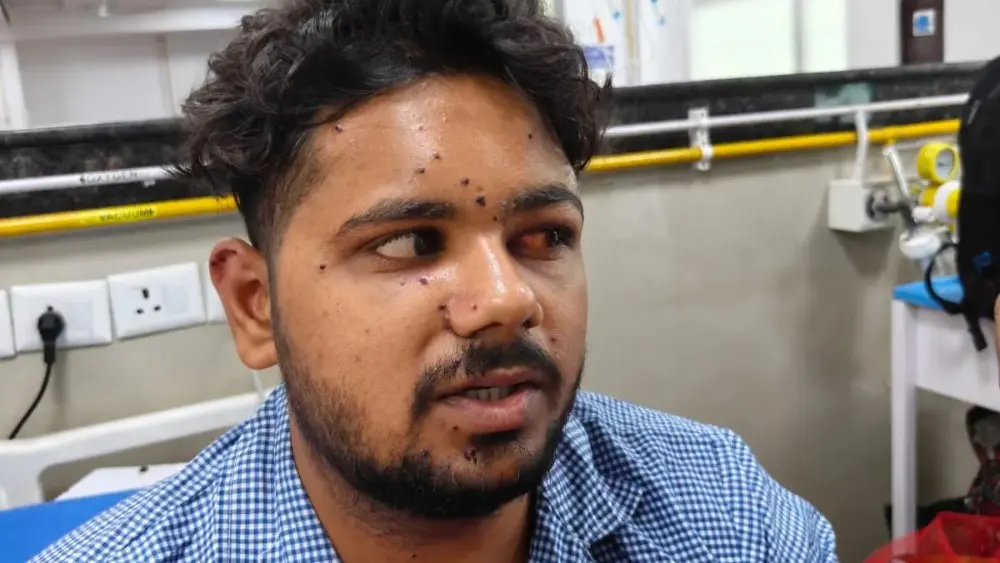
That’s exactly what happened to Dr Indu Singh, a veteran eye surgeon in Amritsar, when news broke of a 19-year-old student sustaining a pellet gun injury — including damage to an eye — during a protest at Delhi’s Jantar Mantar on July 20, 2026. For most people, it was a troubling headline. For Dr Singh, it was a jolt straight back to 2016, to a hospital ward in Punjab that once received young Kashmiri patients in groups of five and six, their eyes torn apart by metal pellets.
This is the story of that memory, what it reveals about the human cost of “non-lethal” crowd-control weapons, and why a single case in the national capital has reignited a debate that many in Kashmir hoped had been settled for good.
Who Is Dr Indu Singh?
Dr Singh runs the Daljit Singh Eye Hospital in Amritsar, an institution founded by his father-in-law, the late Padma Shri recipient Dr Daljit Singh — a name that carries real weight in Indian ophthalmology circles. Over the years, the hospital became an unlikely frontline medical centre for a conflict unfolding hundreds of kilometres away, as Kashmiri families crossed into Punjab seeking specialised eye care that wasn’t always available closer to home.
Between 2016 and 2017 — the peak years of pellet gun use in the Kashmir Valley — Dr Singh personally treated nearly 450 victims from Kashmir. That is not a rounded-off estimate for effect; it is the number attached to years of documented, hands-on surgical care for patients whose eyes had been shredded by metal shot fired from pump-action shotguns.
“We Could Tell a Major Incident Had Taken Place” — Life Inside the Ward
Dr Singh has described that period as an emotionally exhausting one for his entire medical team — not just clinically demanding, but psychologically heavy in a way that stayed with the staff long after each case was closed.
The pattern, as he recalls it, became grimly predictable. Young boys with pellet wounds to their eyes wouldn’t arrive one at a time. They came in clusters — five, six at once — a rhythm so consistent that the hospital staff could gauge the scale of unrest back in Kashmir simply by counting how many patients walked through the door that day, often before any news bulletin confirmed what had happened.
It’s worth pausing on that detail, because it captures something statistics alone can’t: a hospital in Punjab effectively became an informal barometer for violence in another state, purely through the flow of young, blinded patients.
The Weapon Behind the Wounds: A Short History of the Pellet Gun in India
To understand why this memory is so raw, it helps to understand the weapon itself.
Pellet guns were first deployed for crowd control in Kashmir in 2010, introduced as a supposedly less-lethal alternative to live ammunition after live fire had caused a wave of civilian deaths during protests that year. The logic was straightforward on paper: pellets, unlike bullets, were meant to disperse crowds without killing.
In practice, the weapon’s design made that distinction far less clean. A single cartridge releases dozens of metal pellets in a wide, uncontrolled spread — which meant that instead of a single targeted wound, victims frequently sustained dozens of penetrating injuries at once, often concentrated around the face and upper body simply because of where crowds instinctively raise their hands or turn their heads.
The weapon’s use intensified dramatically after 2016, when the killing of militant commander Burhan Wani triggered months of widespread unrest across the Kashmir Valley. Hospital and human rights data from that period vary depending on the source and methodology, but they consistently point to a devastating scale: multiple independent tallies — from Srinagar’s SMHS Hospital, the Jammu & Kashmir State Human Rights Commission, and international rights groups — recorded somewhere between roughly 1,100 and over 1,700 eye injuries in the months following Wani’s death, out of several thousand pellet-related injuries overall. Even accounting for the discrepancies between these counts, every credible source agrees on one thing: this was injury on a mass scale, concentrated overwhelmingly among young people.
What Actually Happened in Delhi on July 20
The Jantar Mantar incident that triggered Dr Singh’s memories involved a 19-year-old student who sustained a pellet gun injury, including damage to an eye, during a protest in the national capital. Multiple protesters at the same demonstration reported pellet-related wounds.
Notably, Delhi Police have denied that pellet guns were used during the protest — even as the injuries reported by demonstrators appeared consistent with pellet wounds. That denial is significant, because it places this incident in genuinely disputed territory: unlike the 2016 Kashmir unrest, where the use of pellet guns by security forces was openly acknowledged and even publicly defended by officials, the Delhi case involves an active disagreement over whether the weapon was used at all.
This is an important, honest distinction to draw. Kashmir’s pellet gun history is extensively documented, with officials, courts, and rights bodies engaging directly with the scale and consequences of the weapon’s use. The Delhi case, by contrast, remains contested — which is precisely why it has triggered renewed public debate rather than settled conclusions.
Why This Story Resonates Beyond One Doctor’s Memory
For medical professionals, cases like this raise a quiet but persistent ethical tension: doctors are trained to treat injuries, not to adjudicate how they were caused. Yet when the same category of wound — young patients, catastrophic and often irreversible eye damage, caused by a crowd-control weapon — keeps recurring across different states and years, it’s difficult for the people stitching those wounds shut to see it as unconnected, isolated incidents.
For human rights advocates, the Delhi case has become a fresh reference point in a long-standing campaign. Groups that spent years documenting pellet injuries in Kashmir have consistently argued that a weapon capable of causing permanent blindness has no place in routine crowd control, regardless of where in the country it’s deployed. The core of that argument doesn’t hinge on politics — it rests on the basic, well-documented medical reality that pellet wounds to the eye rarely heal cleanly, if at all.
For the general public, Dr Singh’s recollection does something that statistics struggle to do: it personalises scale. “Hundreds of eye injuries” is a number. “Young boys arriving in groups of five or six, and knowing before the news confirmed it” is a memory — and memories are what make policy debates feel urgent rather than abstract.
The Bigger Question: Is “Non-Lethal” Ever Truly Non-Lethal?
Pellet guns were introduced under the promise of being a safer alternative to bullets. Nearly a decade and a half of medical evidence — spanning Srinagar’s largest hospitals to a private eye clinic in Amritsar — tells a more complicated story: a weapon can avoid killing outright and still permanently blind, disfigure, and traumatise the people it hits.
That gap between “non-lethal” and “non-harmful” is exactly where this debate lives. A pellet gun may not show up as a fatality statistic, but for a 14-year-old who lost her sight in Shopian in 2016, or a 19-year-old now nursing a damaged eye in Delhi, the distinction offers little comfort.
What Comes Next
As of now, the Delhi case remains unresolved — with police denial on one side and visible, documented injuries on the other. What is certain is that the underlying question hasn’t gone away: whether crowd-control weapons capable of permanent physical harm should have any place in policing civilian protests, in Kashmir, in Delhi, or anywhere else.
For Dr Singh, the answer was arguably settled years ago, in an operating theatre in Amritsar, one young patient at a time. Whether policymakers reach the same conclusion is a different question entirely — but it’s one that a single injury in the capital has now forced back into public conversation.
This article is based on verified reporting, including a report published by The Tribune (India) and contemporaneous coverage of the July 20, 2026 Jantar Mantar protest. Injury figures for the 2016–17 Kashmir unrest are drawn from multiple independent sources and are presented as ranges due to documented discrepancies between hospital, government, and human rights data.