Tariq Karra on Kashmir: Third-Party Intervention Is “Failure” of Centre’s Policy
By: Javid Amin | 20 Aug 2026
Srinagar: The latest diplomatic conversation around Jammu and Kashmir has produced an unusual political irony: a senior Congress leader is arguing that any third-party involvement in Kashmir is not a diplomatic success, but evidence of New Delhi’s failure to resolve the issue on its own.
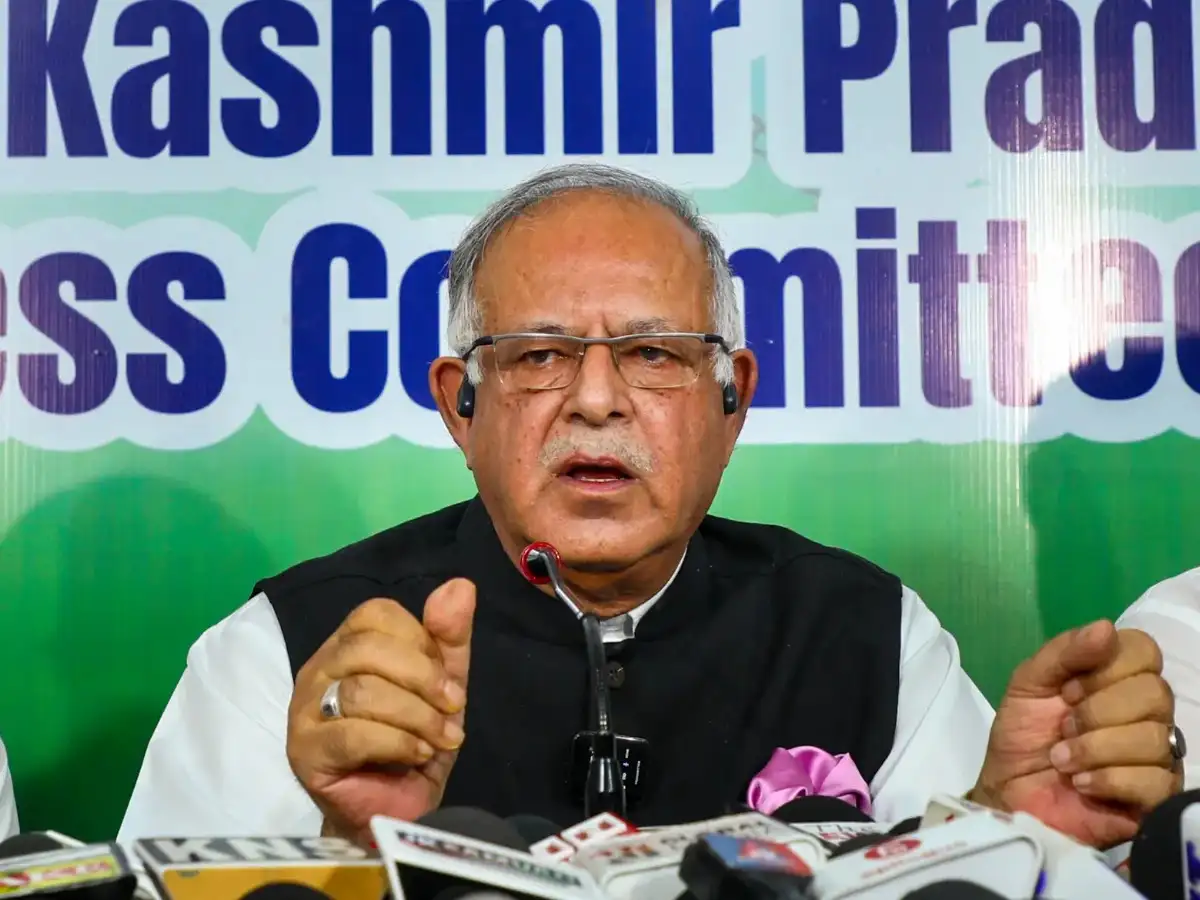
Jammu and Kashmir Pradesh Congress Committee chief and Central Shalteng MLA Tariq Karra made the argument while responding to questions about US Ambassador to India Sergio Gor’s recent visit to Kashmir and his remarks describing Jammu and Kashmir as an important part of India.
Karra’s position is significant because he did not challenge India’s sovereignty over J&K. Quite the opposite: he stressed that Kashmir “was, is and will remain” an integral part of India, while simultaneously arguing that any third-party role in the India-Pakistan or Kashmir question is unacceptable.
His intervention therefore represents a distinctly Congress-style sovereignty argument: Kashmir is India’s internal matter, and the strongest way to keep outsiders away is to resolve political grievances internally.
What Exactly Did Tariq Karra Say?
Karra’s argument was unusually direct.
Responding to questions about Ambassador Sergio Gor’s remarks in Srinagar, he said that whether it is the US ambassador, a US secretary or any other foreign diplomat, affirming that Jammu and Kashmir is part of India does not amount to a new diplomatic discovery.
According to Karra, this has always been India’s position.
The problem, he argued, arises when foreign governments begin playing a more visible role in the Kashmir discourse.
He described this as a consequence of what he called the “failed policy” of the present government, arguing that increased foreign involvement reflects weaknesses in India’s handling of the issue.
His broader message was unmistakable:
If Kashmir is India’s internal matter, it should be resolved by India.
Why Karra’s Statement Is More Nuanced Than It First Appears
At first glance, Karra’s comments could be interpreted simply as criticism of the US ambassador’s visit.
That would miss the larger point.
Karra did not argue that Sergio Gor’s statement about J&K being part of India was wrong.
Instead, he said that such a statement was nothing extraordinary because India’s position has always been that Jammu and Kashmir is an integral part of the country.
The disagreement concerns why foreign diplomats are becoming part of the conversation in the first place.
For Karra, that is where the Centre’s policy comes under scrutiny.
In other words:
The problem is not the foreign diplomat endorsing India’s position. The problem, according to Karra, is that India’s Kashmir policy has created circumstances in which foreign involvement becomes politically relevant.
That is a considerably more sophisticated criticism than simply opposing an American diplomatic visit.
Sergio Gor’s Kashmir Visit Changed the Political Conversation
The immediate backdrop is Ambassador Sergio Gor’s August 19 visit to Jammu and Kashmir.
Gor met Chief Minister Omar Abdullah in Srinagar during his first visit to the Union Territory.
Following the meeting, Gor said discussions focused on economic collaboration and opportunities benefiting both India and the United States. Omar Abdullah likewise described the engagement as positive, with tourism, horticulture and other areas of cooperation featuring in the conversation.
Gor subsequently described Jammu and Kashmir as “an important part of India” and praised efforts by the Centre and the J&K administration to improve security.
He also indicated that Washington could reconsider its travel advisory for the region if the improved security environment continues.
On the surface, this was an economic and tourism-oriented diplomatic engagement.
Politically, however, Kashmir is never simply another economic destination.
The location, timing and diplomatic symbolism inevitably generated discussion.
Omar Abdullah’s Position: Economic Engagement, Not Mediation
Omar Abdullah has been careful to frame the meeting with Gor around economic cooperation rather than Kashmir mediation.
That distinction matters.
A foreign ambassador meeting an elected Chief Minister is not, by itself, evidence of third-party mediation on Kashmir.
Diplomatic representatives routinely meet state and regional governments to discuss trade, tourism, investment, education and security.
Gor’s own public description of the meeting emphasised economic cooperation.
This gives Omar a straightforward defence:
The meeting was about development and India-US engagement, not negotiating Kashmir’s political status.
Karra’s criticism, however, is aimed at the larger diplomatic optics.
He is effectively saying that regardless of the stated agenda, Kashmir’s political sensitivity means New Delhi must ensure that foreign engagement does not evolve into a role in the underlying dispute.
Why the Shimla Agreement Matters Here
Karra’s reference to bilateralism is rooted in a long-standing Indian diplomatic position.
The 1972 Shimla Agreement between India and Pakistan established that the two countries would seek to resolve their disputes through bilateral negotiations and peaceful means.
For New Delhi, this has remained a central argument against international mediation on Kashmir.
Karra explicitly invoked this framework, saying that if the issue concerns India and Pakistan, the relevant parties are India and Pakistan, rather than third countries.
This is consistent with the traditional Congress position as well as the broader Indian state position across successive governments.
The important political distinction is that Karra is now using that doctrine to criticise the current government’s Kashmir policy.
Congress Turns the Sovereignty Argument Back on the Centre
There is an interesting political twist here.
The BJP frequently accuses opposition parties of weakening India’s position on Kashmir.
Karra is attempting to turn the argument around.
His message is essentially:
If the government claims Kashmir is firmly integrated with India, why are foreign powers becoming increasingly relevant to the Kashmir conversation?
In Karra’s formulation, foreign intervention should not be celebrated.
It should make the government uncomfortable.
Because, he argues, the need for outside involvement indicates that domestic political problems remain unresolved.
That gives Congress a sovereignty-first narrative while simultaneously attacking the Centre’s record.
But Is There Actually “Third-Party Intervention” in This Case?
This is where the facts require careful separation from political interpretation.
There is no evidence in the publicly reported Sergio Gor visit that the US ambassador offered formal mediation between India and Pakistan or between New Delhi and Kashmiri political actors.
The reported meeting with Omar Abdullah focused on economic cooperation, while Gor publicly emphasised J&K’s place within India and discussed the possibility of reviewing Washington’s travel advisory.
That makes Karra’s description of “third-party intervention” a political interpretation, rather than a description of a formal mediation process.
This distinction is important.
A foreign diplomat visiting Kashmir is not automatically the same thing as foreign mediation.
Nor is an ambassador discussing tourism, security or investment equivalent to negotiating the Kashmir dispute.
Karra’s argument is instead about the political consequences and symbolism of foreign engagement.
Pakistan’s Reaction Shows Why the Visit Was Sensitive
The diplomatic sensitivity became even clearer after Pakistan reacted to Gor’s comments.
Pakistan objected to the US envoy describing Jammu and Kashmir as an important part of India and summoned a US diplomatic representative to convey its protest.
That reaction illustrates the competing narratives surrounding Kashmir.
India’s position
New Delhi maintains that Jammu and Kashmir is an integral part of India and rejects third-party mediation.
Pakistan’s position
Islamabad continues to describe Kashmir as a disputed territory and rejects statements that appear to endorse India’s sovereignty claim.
Washington’s position in this episode
Gor’s public comments during his Kashmir visit were notably aligned with India’s position, while his reported discussions with Omar focused on economic engagement and security.
That combination makes the visit politically significant even though there was no reported mediation initiative.
A Diplomatic Message to Pakistan?
There is another interpretation worth considering.
Gor’s statement that J&K is an important part of India, delivered from Srinagar itself, inevitably carries diplomatic weight.
It came at a time when India-Pakistan tensions over Kashmir remain significant.
Pakistan’s immediate protest demonstrates that Islamabad considered the remarks important enough to respond to.
From New Delhi’s perspective, this can be viewed as a diplomatic gain.
The J&K BJP has already described Gor’s remarks as evidence of the success of India’s foreign policy and as a setback to Pakistan’s efforts to internationalise Kashmir.
Congress, however, is reading the same development through a different lens.
Karra’s argument is essentially:
India does not need foreign validation of something it has always maintained.
Karra vs BJP: Same Sovereignty Position, Opposite Political Conclusion
This is perhaps the most fascinating aspect of the controversy.
Both Karra and the BJP agree on a fundamental point:
Jammu and Kashmir is part of India.
But they reach radically different political conclusions from the same event.
BJP’s interpretation
A US ambassador affirming J&K’s place within India is a diplomatic success.
Karra’s interpretation
India should not need a foreign ambassador to reinforce a position that is already India’s sovereign position; if international actors are increasingly involved, that indicates policy failure.
This is a classic example of how the same diplomatic event can become ammunition for competing domestic political narratives.
The Congress Position: No Internationalisation, But Internal Dialogue
Karra’s statement also fits into a broader Congress argument.
Congress has traditionally opposed international mediation on Kashmir while supporting dialogue between India and Pakistan and political engagement within Jammu and Kashmir.
That distinction matters.
Rejecting third-party mediation does not mean rejecting dialogue altogether.
It means insisting that the principal actors themselves must resolve the dispute.
For Karra, that means:
- New Delhi must engage politically with J&K;
- India and Pakistan should handle bilateral matters directly;
- constitutional and political grievances within J&K should not be outsourced;
- foreign powers should not become arbiters of India’s internal affairs.
This allows Congress to simultaneously defend sovereignty and political dialogue.
The Missing Piece in the Debate: Kashmiris Themselves
Karra’s statement raises another important question.
If Kashmir is to be resolved internally, what does “internal” actually mean?
Is it simply a matter between New Delhi and Islamabad?
Or must the people of Jammu and Kashmir themselves be central participants in determining the region’s political future?
This distinction has historically divided political narratives.
India’s official position emphasises the bilateral framework with Pakistan and the constitutional status of J&K within India.
Kashmir-based political parties, however, often argue that any durable political settlement also requires meaningful engagement with the people of Jammu and Kashmir.
Karra’s emphasis on dialogue between New Delhi and the people of J&K therefore deserves attention.
It moves the discussion beyond a simple India-Pakistan binary.
The Article 370 Shadow
The political context cannot be separated from the events of August 5, 2019.
The Union government removed J&K’s special constitutional status and reorganised the former state into two Union Territories.
Since then, the political debate has increasingly focused on three interconnected demands:
Article 370 restoration.
Restoration of statehood.
Greater political autonomy and representation.
The Supreme Court upheld the 2019 constitutional changes in December 2023 while directing that statehood be restored at the earliest.
The NC government continues to campaign for statehood, while leaders such as Aga Syed Ruhullah Mehdi argue that statehood alone is insufficient and that Article 370 must remain central to the political agenda.
Karra’s intervention enters this already crowded debate.
Why Foreign Engagement Is So Sensitive in Post-2019 Kashmir
Kashmir has long attracted international attention.
But the sensitivity has increased because the region sits at the intersection of:
- India-Pakistan tensions;
- India-US relations;
- India-China strategic competition;
- terrorism and cross-border militancy;
- human rights debates;
- regional security; and
- international travel and investment.
Even a discussion about tourism can therefore acquire a political dimension.
Gor’s comments about potentially reviewing the US travel advisory are a good example.
For Kashmir’s tourism industry, that could be economically significant.
For diplomats, it is a security assessment.
For politicians, it becomes a statement about how the outside world views Kashmir.
And for Pakistan, it becomes a sovereignty issue.
The same sentence can therefore carry four different meanings depending on who is listening.
The Tourism Angle Should Not Be Ignored
There is also a practical side to Gor’s visit that can get lost in the political noise.
The US currently maintains a stringent travel advisory for J&K.
Gor indicated that Washington could review the advisory in light of what he described as improvements in security.
For Kashmir’s tourism-dependent economy, that matters.
An easing of travel restrictions could potentially encourage more American visitors, improve international confidence and strengthen the region’s tourism profile.
Omar Abdullah’s decision to highlight tourism, horticulture and economic cooperation in his engagement with Gor therefore has a clear economic rationale.
Karra’s concern is not necessarily with this economic engagement itself.
His warning is about ensuring that economic diplomacy does not drift into political mediation.
What Karra’s Criticism Means for Omar Abdullah
The Congress leader’s statement also places Omar Abdullah in an interesting political position.
Omar has repeatedly insisted that engagement with foreign diplomats does not mean internationalising Kashmir.
His meeting with Gor was framed around economic cooperation.
But as Chief Minister, he also has to attract investment and rebuild international confidence in J&K.
That creates a delicate balancing act.
He must simultaneously:
- maintain New Delhi’s constitutional framework;
- demand restoration of statehood;
- engage foreign governments economically;
- reassure Kashmir’s political constituency; and
- avoid giving the impression that foreign governments are being invited to intervene politically.
That is not an easy line to walk.
What This Means for the Centre
Karra’s criticism ultimately puts the spotlight back on New Delhi.
If the Centre’s position is that Kashmir is firmly integrated and its security situation has improved, then foreign governments should ideally see J&K through the prism of normal economic and diplomatic engagement, rather than as an unresolved international dispute.
That is precisely why Gor’s statement was welcomed by the BJP.
But Karra’s counterargument is that the government should focus on eliminating the underlying political conditions that allow Kashmir to remain a subject of international concern.
His solution is not foreign mediation.
It is domestic political resolution.
Three Competing Narratives Now Emerging
The current debate can be understood through three broad narratives.
1. The BJP narrative: Integration and normalisation
The 2019 changes strengthened India’s constitutional integration of J&K, improved security and opened the door to development and investment.
2. The Congress narrative: Sovereignty plus political resolution
Kashmir is an integral part of India, but unresolved political grievances must be addressed domestically, and foreign intervention should be rejected.
3. Regional parties’ narrative: Constitutional rights and dignity
The NC and PDP continue to argue over the extent to which the post-2019 constitutional arrangement should be challenged, with growing disagreement even within the NC over whether statehood or Article 370 should be prioritised.
These narratives overlap in some places and collide sharply in others.
The Larger Question: Can Kashmir Be “Internal” Without Being Politically Closed?
This may be the most important question emerging from Karra’s remarks.
Rejecting third-party intervention is straightforward.
But resolving Kashmir internally requires more than saying that outsiders should stay away.
It requires credible political engagement inside India.
That means addressing questions surrounding:
- statehood;
- political representation;
- constitutional rights;
- civil liberties;
- economic opportunity;
- youth alienation;
- regional disparities; and
- relations between Jammu, Kashmir and Ladakh.
If these questions remain unresolved, international interest is unlikely to disappear completely.
Foreign governments will continue to assess Kashmir through their own diplomatic, security and economic interests.
Karra’s Message Is Ultimately Directed at New Delhi
The sharpest part of Karra’s statement is therefore not his criticism of Washington.
It is his criticism of New Delhi.
His argument can be summarised in one sentence:
If India wants the Kashmir issue to remain India’s internal matter, India must create the political conditions in which Kashmir can actually be resolved internally.
That means preventing internationalisation not merely through diplomatic statements, but through political confidence-building at home.
And that is where the Congress leader’s intervention becomes more than another reaction to a visiting diplomat.
It becomes an argument about governance, federalism and political legitimacy.
Conclusion: Foreign Validation Is Not the Same as Domestic Resolution
Sergio Gor’s Kashmir visit has produced two very different political readings.
For the BJP, his declaration that Jammu and Kashmir is an important part of India is a diplomatic affirmation of New Delhi’s long-standing position.
For Pakistan, the statement was unacceptable and prompted a diplomatic protest.
For Omar Abdullah, the visit offered an opportunity to discuss tourism, investment, horticulture and wider India-US engagement.
For Tariq Karra, however, the episode carries a different lesson.
India should not need foreign diplomats to settle questions about India’s sovereignty.
If outsiders become increasingly visible in Kashmir’s political discourse, he argues, the answer is not to celebrate their involvement but to ask why the issue remains vulnerable to international attention in the first place.
That makes Karra’s position both a defence of India’s traditional bilateral approach and an attack on the Centre’s record.
The central contradiction is clear:
New Delhi wants Kashmir to be seen as normalised and firmly internal. Karra argues that genuine normalisation will come only when political grievances are addressed internally.
The Gor visit may have been about tourism and economic cooperation. But in Kashmir, even a conversation about tourism can quickly become a conversation about sovereignty.
And that is precisely why Tariq Karra’s warning has landed with such political force.