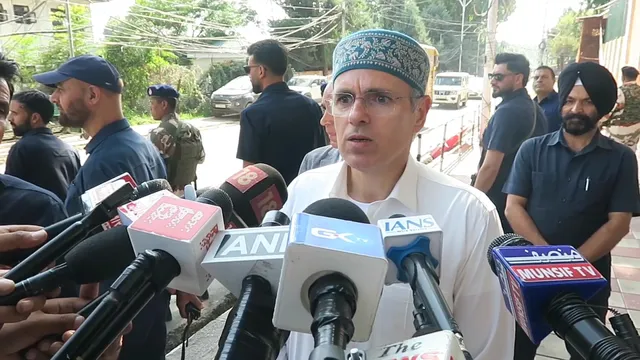
J&K Power Tariff Hike Sparks Political Storm: Omar Abdullah Defends 6.83% Rise, Opposition Says “200 Units Free” Promise Betrayed
By: News Desk | 24 Aug 2026
Srinagar: The electricity bill has suddenly become one of the sharpest political issues confronting the Omar Abdullah government in Jammu and Kashmir.
The immediate trigger is straightforward: the Joint Electricity Regulatory Commission (JERC) has approved an average 6.83% increase in electricity tariffs for J&K, with the revised rates coming into force from September 1, 2026. The decision has triggered protests by opposition parties, while Chief Minister Omar Abdullah has defended the increase as a difficult but necessary step rather than a policy the government wanted to impose.
But beneath the tariff figures lies a much bigger political problem.
The National Conference came to power in 2024 after promising up to 200 units of free electricity. That promise is now being repeatedly thrown back at the government by the BJP, PDP, Apni Party and other critics.
Omar’s response is equally direct: the NC promised free electricity, not permanently frozen electricity rates.
That distinction may be technically defensible—but politically, it has opened a difficult conversation about promises, affordability and the financial condition of J&K’s power sector.
The 6.83% Hike: What Is Actually Changing?
The first point that needs clarification is that this is not a flat 6.83% increase in every consumer’s bill.
JERC has approved an average increase of 6.83% for 2026–27. The revised tariff applies to electricity consumed from September 1, 2026, through March 31, 2027.
For metered domestic consumers, the revised energy charges are reported as:
| Monthly consumption | Earlier rate | New rate |
|---|---|---|
| Up to 200 units | ₹2.30/unit | ₹2.45/unit |
| 201–400 units | ₹4.00/unit | ₹4.20/unit |
| Above 400 units | ₹4.35/unit | ₹4.60/unit |
The fixed charge has also increased from ₹8 to ₹10 per kW per month, according to reports on the tariff order.
That means the headline 6.83% should not be interpreted as every household suddenly paying exactly 6.83% more.
The actual impact depends on consumption, connection category, fixed charges and other components of the bill.
That distinction matters because political slogans often turn an average regulatory increase into a much simpler—and more alarming—number.
When Will Consumers Actually Feel It?
The revised rates take effect on September 1.
Therefore, consumers should begin seeing the impact in bills covering consumption from that date onward, depending on their billing cycle.
For a household consuming 200 units, the energy component alone rises from approximately ₹460 to ₹490, before fixed charges and other applicable components.
For 400 units, the corresponding energy charge rises from roughly ₹1,600 to ₹1,680.
For heavier consumers, the increase is greater.
These calculations do not represent the complete electricity bill because actual bills can include fixed charges, taxes, duties and other applicable components.
So the real question for households is not simply:
“Is electricity 6.83% more expensive?”
It is:
“How much more will my particular monthly bill be?”
Omar Abdullah’s Defence: “It Was a Compulsion”
Chief Minister Omar Abdullah has made no attempt to pretend that the tariff increase is politically pleasant.
His argument is that the government had little choice.
Speaking amid the protests, Omar said the government had increased rates by only about 6% after a four-year gap and insisted that his administration had kept the increase as low as possible.
He also pointed to previous tariff increases, saying earlier governments had raised electricity rates by more than 14%, while another increase four years ago was around 15%.
His broader argument is financial:
J&K’s power sector is losing money, and unless those losses come down, the government cannot indefinitely absorb the difference between the cost of purchasing electricity and the revenue collected from consumers.
Omar said the government was not celebrating the increase and described it as a “compulsion.” He added that the need for such measures would decline if losses in the power sector were reduced.
That is the government’s strongest defence.
The Power-Sector Numbers Explain Why the Government Is Under Pressure
The problem did not begin with Omar Abdullah.
J&K’s electricity sector has struggled for years with the gap between the cost of supplying electricity and the amount recovered through billing and collection.
The J&K government’s 2025–26 Budget speech acknowledged the scale of the problem.
It said the average cost of power was around ₹7 per unit, while revenue recovery was only about ₹2.5 per unit, attributing the gap to systemic inefficiencies, high losses and low tariffs. The government also set a target of reducing Aggregate Technical and Commercial (AT&C) losses from 41% to 25%.
That is the uncomfortable economic reality behind the political argument.
If electricity costs significantly more to procure than what consumers pay, somebody has to cover the difference.
That “somebody” is ultimately the public exchequer, the power utility, or the consumer—or some combination of all three.
So Is the Tariff Hike Really Omar Abdullah’s Decision?
This is another point frequently lost in the political debate.
The tariff revision was approved by JERC, the electricity regulatory commission for Jammu and Kashmir and Ladakh.
The revised tariff is therefore a regulatory decision, not simply a Cabinet decision by Omar Abdullah’s government.
Politically, however, the NC government cannot escape responsibility.
The regulator determines the tariff.
The elected government determines the broader power-sector policy, subsidies, reforms, collection strategy and political response.
That is why opposition parties are targeting Omar.
They are not conducting a regulatory argument.
They are conducting a political accountability argument.
And Then Comes the “200 Units Free” Promise
This is where the controversy becomes much more serious for the NC.
The National Conference’s 2024 Assembly election manifesto explicitly promised 200 units of free electricity.
The manifesto’s electricity section also promised a one-time settlement of pending electricity arrears and discussed increasing J&K’s share of free power from hydropower projects.
Contemporary election coverage also reported that the NC promised 200 units of free power alongside restoration of J&K’s political and legal status and other guarantees.
So the opposition is not inventing the promise.
It exists in the party’s published manifesto.
The political dispute is instead about how, when and for whom that promise is being implemented.
Omar’s Counter: Free Electricity Does Not Mean Frozen Tariffs
This is the distinction the Chief Minister is now emphasising.
Omar has argued that the NC never promised that electricity tariffs would never increase.
The promise was to provide 200 free units to eligible households, particularly poorer households.
He has said the scheme would be implemented through solarisation rather than simply asking the power utilities to absorb the cost.
This is not an entirely new explanation.
The government had already moved towards a solar-based mechanism for the promise.
In February 2026, Lieutenant Governor Manoj Sinha announced that the Centre had approved a project to provide 200 free units to 2.23 lakh Antyodaya Anna Yojana (AAY) families in J&K under the PM Surya Ghar Muft Bijli Yojana’s Utility Led Aggregation model.
The government’s 2025–26 Budget had also proposed 200 free units per month for Antyodaya families, integrated with the rooftop-solar programme.
So there is an important factual correction to the political debate:
The current government is not simply saying “200 units are cancelled.”
It has shifted the implementation toward a targeted, solar-linked benefit for vulnerable households, rather than treating 200 free units as a universal entitlement for every household.
That distinction is politically crucial.
But There Is a Genuine Promise-vs-Implementation Problem
The NC’s manifesto said:
“Provide 200 units of electricity free.”
The current policy is more targeted, with the government’s 2026 implementation focused on AAY families.
That creates legitimate room for criticism.
A voter who understood the 2024 promise as 200 free units for every household could reasonably ask:
Why has the promise become restricted to a particular vulnerable category?
The government, meanwhile, can point to fiscal realities and the fact that universal free electricity would carry a substantial recurring cost.
This is not simply a case of the opposition “lying” about the manifesto.
Nor is it accurate to say the government has done absolutely nothing on the promise.
The reality lies somewhere in between.
Opposition Turns “200 Free Units” Into a Political Weapon
The opposition understood immediately where the government’s vulnerability lay.
The BJP, PDP, Apni Party and other parties have attacked the tariff increase while repeatedly invoking the NC’s 200-unit promise.
On August 24, PDP and Apni Party workers staged separate protests in Srinagar. Police prevented protesters from marching onto major roads.
The protests were not simply about 15 or 20 paise per unit.
They were about political credibility.
The opposition’s message is:
You promised relief. People got a tariff hike.
That is a far more emotionally powerful slogan than an argument about regulatory cost recovery.
BJP’s “Betrayal” Narrative
J&K Leader of Opposition Sunil Sharma has described the tariff hike as a betrayal, arguing that the NC sought votes by promising 200 free units and has instead presided over higher electricity bills.
The BJP has an obvious political interest here.
It wants to transform an electricity tariff decision into evidence that the NC government cannot deliver on its election guarantees.
But the BJP also has a vulnerability.
Omar has pointed out that previous governments increased electricity rates by considerably higher percentages.
That creates a counter-question:
Why was a 14–15% increase acceptable under previous administrations but a 6.83% increase now presented as a political betrayal?
That is a legitimate question.
The answer from the opposition is essentially that voters elected the NC specifically on a promise of relief.
In other words, past tariff increases do not excuse a current government’s failure to meet its promises.
PDP’s Attack Is Even More Direct
The PDP has focused heavily on the gap between the promise and the tariff hike.
Its leaders argue that households are already facing inflation, unemployment and economic pressure.
PDP workers demonstrated against the hike in Srinagar on August 24, while the party demanded its rollback.
The PDP has its own political history with free electricity promises.
Its 2024 manifesto also promised 200 free units of electricity to every household.
That is an important piece of context.
The contest over free electricity is therefore not simply:
NC versus PDP.
Both major regional parties made ambitious electricity promises.
The difference is that the NC is now in government—and therefore has to defend the economics of delivering them.
Congress Joins the Opposition
Congress, despite having contested the 2024 elections in alliance with the NC, has also opposed the tariff increase.
J&K Pradesh Congress Committee president Tariq Hameed Karra demanded an immediate rollback, calling the hike unjust and burdensome amid rising household costs.
This is politically significant.
Congress supported the NC electorally but chose not to join the NC-led government until statehood is restored.
Now it is openly criticising a major economic decision of that government.
The electricity issue therefore adds another layer of strain to an already complicated relationship between the two parties.
Apni Party Takes the Protest to the Streets
Apni Party also staged a protest at Press Enclave in Srinagar on August 24.
Party leader Mohammad Ashraf Mir described the tariff increase as anti-people and demanded its withdrawal, while also accusing the NC government of failing to deliver its election promises.
Police stopped protesters from proceeding onto the main road.
That gave the opposition protests an additional political image:
people carrying electricity bills and party flags, confronting a government that promised relief.
The Ground-Level Question: Who Will Actually Pay More?
The political debate becomes more meaningful when translated into household economics.
A household consuming 200 units will see the energy charge increase by about ₹30 under the new rate.
At 400 units, the increase in the energy component is about ₹80.
But the bill is not just the energy charge.
The fixed charge is also higher.
And households consuming more electricity will see a larger absolute increase.
For a middle-class family using heating appliances, geysers, refrigerators, washing machines and other electrical equipment, consumption can rise sharply during winter.
That is where the tariff debate becomes more politically sensitive.
Winter Could Make This Issue Much Bigger
This is the part policymakers cannot afford to ignore.
Kashmir’s winter electricity consumption can be substantially higher than summer consumption because households rely heavily on electrical heating and other appliances.
A tariff increase introduced in September therefore reaches consumers just before the colder months.
Even a relatively modest per-unit increase can become politically noticeable when consumption rises.
That could turn today’s protests into a much bigger winter issue.
The government may therefore have to prepare not only for the political fallout of the tariff order, but for the seasonal increase in household electricity demand.
Businesses Face a Different Problem
The debate is not limited to households.
Commercial consumers face different tariff structures and the impact can be considerably more significant for businesses that use electricity intensively.
For Kashmir’s economy, this matters to:
- hotels;
- restaurants;
- bakeries;
- workshops;
- small manufacturing units;
- cold-storage facilities;
- shopping establishments;
- tourism businesses;
- offices;
- hospitals and private institutions.
The tourism sector is particularly sensitive because electricity costs form part of the operating expense of hotels and guesthouses.
A tariff increase by itself will not destroy tourism.
But combined with rising food prices, labour costs, transport expenses and other operating costs, it adds another layer of pressure.
The Real Enemy May Not Be the Tariff—It May Be the Losses
This is where the debate needs to move beyond party politics.
The government cannot permanently solve the power-sector problem simply by increasing tariffs.
If technical and commercial losses remain high, consumers will continue paying for inefficiency.
The 2025–26 Budget itself acknowledged AT&C losses of around 41% and set a target of bringing them down to 25%.
That should be the real benchmark for the Omar government.
If tariffs rise but:
- theft remains unchecked,
- billing remains inaccurate,
- collection remains weak,
- transmission losses remain high,
- government departments accumulate unpaid bills,
then consumers will reasonably ask:
Why should ordinary families pay more for a system that has not become more efficient?
Smart Metering Is Part of the Larger Reform Story
The government has been pursuing 100% smart metering and stronger billing and collection mechanisms as part of its strategy to reduce losses.
The objective is straightforward:
measure what is consumed, bill accurately, collect the money and reduce leakage.
In theory, this can eventually reduce the need for tariff increases.
But there is a political catch.
Consumers experience smart meters immediately.
They experience lower AT&C losses much later.
A family receiving a higher bill today is unlikely to be comforted by a promise that power-sector efficiency will improve three years from now.
That is why the government needs to demonstrate measurable progress.
Omar’s “Previous Governments Raised Rates” Argument Has Limits
The Chief Minister is correct that previous governments also increased tariffs.
But politically, that defence cannot carry the entire argument.
A new government cannot simply say:
“They increased prices too.”
Voters expect every government to justify its own decisions.
The stronger defence would be:
“Yes, we increased tariffs—but here is exactly how much money the increase will generate, where it will go, how much losses have fallen, and when consumers can expect relief.”
That would turn a political argument into an accountability argument.
What the NC Government Needs to Explain Clearly
If Omar Abdullah wants to win this debate rather than merely survive it, his government needs to publish a simple power-sector accountability roadmap.
It should answer five questions.
1. How much additional revenue will the 6.83% hike generate?
Consumers deserve to know the financial impact.
2. What is the current total power-sector deficit?
The government should publish the latest numbers.
3. How much have AT&C losses fallen?
The 41% figure cited in the 2025–26 Budget should be updated with current data.
4. Exactly who qualifies for 200 free units?
This is perhaps the most politically important question.
5. When will the free-power scheme actually become fully operational?
A promise without a clear implementation calendar will continue to generate political anger.
The 200-Unit Promise Is Becoming the Bigger Issue
Interestingly, the tariff increase itself may not be the NC government’s biggest political problem.
The bigger problem is expectation management.
In 2024, the phrase “200 units free electricity” was simple and powerful.
People understood it immediately.
Now the policy has become more complicated:
AAY families + solarisation + PM Surya Ghar + eligibility + implementation.
That may be economically sensible.
But politically, complexity often loses to a simple promise.
The opposition has the simpler slogan:
“You promised free power. You increased the tariff instead.”
The NC needs an equally simple explanation.
Is This Really a “Betrayal”?
The answer depends on what the voter was promised.
If the promise is interpreted as:
Every household will receive 200 free units regardless of income.
Then the government’s targeted approach represents a significant narrowing of the original promise.
If the promise is interpreted as:
The government will provide 200 free units while designing a financially sustainable mechanism for those most in need.
Then the solarisation-based AAY model can be presented as implementation rather than abandonment.
The NC needs to confront this ambiguity directly.
Avoiding it will only strengthen the opposition’s narrative.
The Political Damage Could Spread Beyond Electricity
The tariff issue has arrived at a particularly sensitive time for the NC government.
The party is already under pressure over:
- unemployment;
- governance;
- statehood;
- Article 370;
- recruitment;
- security;
- infrastructure;
- power supply;
- public expectations from its 2024 manifesto.
A single tariff increase may therefore become a symbol of something larger.
For supporters, it may represent the unavoidable realities of governing.
For critics, it becomes another example of a government that promised one thing while delivering something else.
Politics is often about symbols.
And electricity bills are powerful symbols because almost every household receives one.
This Is Not Just About Omar Abdullah
There is a wider structural problem.
J&K’s power sector has been financially stressed for years.
The Union Territory purchases substantial amounts of electricity from outside its own generation capacity, while the cost-recovery problem has persisted.
J&K also has enormous hydropower potential, yet the political debate over ownership, free power share and the benefits flowing to local consumers has remained unresolved.
The NC manifesto itself promised to pursue transfer of hydropower projects to J&K and increase the free-power share.
That is a far bigger structural question than whether today’s tariff should rise by 6.83%.
The Political Equation in One Table
| Issue | Omar Abdullah / NC argument | Opposition argument |
|---|---|---|
| 6.83% tariff hike | Necessary and kept to the minimum | Burden on consumers |
| Regulatory authority | JERC approved the increase | NC government must still take political responsibility |
| 200 free units | Being implemented through targeted solarisation | Election promise was broader |
| Power losses | Need tariff reform + efficiency | Consumers shouldn’t pay for inefficiency |
| Previous governments | They raised tariffs more sharply | Past mistakes don’t justify current ones |
| Poor households | Targeted relief through AAY/solar scheme | Relief should be broader |
| Middle class | Moderate increase | Already facing inflation |
| Businesses | Financial sustainability is necessary | Higher operating costs could hurt economy |
What Happens Next?
The tariff order is already approved.
So the immediate political demand for a rollback may be difficult to translate into policy unless the government or regulator revisits the decision.
The more realistic battlegrounds are likely to be:
Implementation of the 200-unit scheme.
Eligibility criteria.
Power-sector losses.
Winter electricity supply.
Consumer billing.
Future tariff revisions.
And, crucially, whether the government can demonstrate that today’s higher tariff eventually results in a healthier electricity system.
The Real Test for Omar Abdullah: Can He Make People Believe the Pain Has a Purpose?
That is ultimately what this controversy comes down to.
Consumers can accept difficult decisions when they believe the sacrifice is necessary and temporary.
What they resist is paying more without seeing improvement.
If Omar Abdullah’s government can demonstrate:
- falling power losses;
- better supply;
- fewer outages;
- improved billing;
- stronger collection;
- transparent subsidies;
- targeted free electricity;
- and eventually lower pressure on tariffs,
then the 6.83% increase may eventually be remembered as part of a difficult reform process.
But if consumers see higher bills without better service, the political narrative will harden.
And then “compulsion” will start sounding less like an explanation and more like an excuse.
Conclusion: J&K’s Electricity Battle Is Really a Battle Over Trust
The electricity tariff controversy has moved well beyond the price of a unit of power.
It is now a test of the Omar Abdullah government’s credibility.
The government has a legitimate economic argument: J&K’s power sector carries large financial losses, tariffs have remained below the cost of supply, and reform cannot be postponed forever. The regulator has approved an average 6.83% increase, and the government says it kept the hike as low as possible.
The opposition also has a legitimate political argument: the NC campaigned in 2024 promising 200 units of free electricity, and voters are entitled to ask why they are now being asked to pay higher tariffs before that promise has been universally delivered.
Both realities can exist simultaneously.
The tariff hike may be economically explainable.
The public anger may be politically understandable.
The government’s biggest mistake would be to treat the protests merely as opposition politics.
Because electricity is different from most political issues.
People may debate Article 370.
They may argue about statehood.
They may disagree over ideology.
But when the electricity bill arrives, every household understands the issue immediately.
And that is why the 6.83% tariff hike could become much more than an economic adjustment.
It could become a referendum on a much larger question:
Did the NC government come to power to manage J&K’s existing problems—or to actually deliver the relief it promised?
The answer will not be decided in a press conference.
It will be decided in the electricity bills, power supply and household budgets of Jammu and Kashmir over the coming months.

