Kashmir’s Quiet Revolution of Compassion: Valley Rallies for War-Hit Iran
By: Javid Amin | 22 March 2026
From Gold to Gratitude — A Human Story of Sacrifice, Faith, and Cross-Border Solidarity
In the narrow lanes of Srinagar and across the towns and villages of Kashmir, a silent but powerful movement is unfolding—one defined not by slogans or politics, but by compassion.
As conflict continues to devastate parts of Iran, ordinary people in the Valley have come together in an extraordinary humanitarian effort. From gold ornaments to modest cash savings, Kashmiris are contributing what they can to support families affected by war.
The response has been deeply personal, emotional, and rooted in a shared sense of humanity that transcends borders.
Ground Zero: A Movement Begins in Srinagar
At the heart of this humanitarian drive lies Srinagar, where local mosques and neighborhood committees have transformed into hubs of relief collection.
Across the city:
- Donation boxes have been placed in mosques
- Volunteers are going door-to-door
- Committees are cataloguing and organizing contributions
This is not a state-led initiative. It is grassroots, community-driven, and largely organic.
From downtown Srinagar to peripheral neighborhoods, the atmosphere is marked by a quiet determination—people giving not because they are asked to, but because they feel compelled to.
Human Stories of Sacrifice: When Giving Hurts, Yet Heals
Among the countless contributions, one story has captured the emotional core of this movement.
A widow, living modestly, chose to donate gold jewelry gifted to her by her late husband—one of the few tangible memories she possessed.
Her act is more than charity. It is:
- A sacrifice of personal security
- A gesture of empathy across borders
- A reminder of shared human vulnerability
In Kashmir, gold and silver are not merely ornaments—they are often a family’s financial safety net, passed down through generations.
To part with them is not easy.
Yet, many families are doing exactly that.
Mosques and Mohalla Committees: The Backbone of Relief
The organizational strength behind this movement lies in local institutions.
Mosques across the Valley have taken a leading role, not just as places of worship but as centers of social mobilization.
Neighborhood (mohalla) committees have:
- Coordinated collection drives
- Ensured transparency in donations
- Facilitated storage and documentation
Volunteers describe the effort as highly disciplined and community-oriented.
There is no chaos—only coordination.
There is no compulsion—only willingness.
Iran Responds: “We Will Never Forget This Kindness”
The response from Embassy of Iran in New Delhi has been one of deep gratitude.
In an official statement, the embassy said the generosity of Kashmiris:
- “Will never be forgotten”
- Reflects profound humanitarian concern
- Symbolizes a cultural and emotional connection
Such acknowledgment elevates the significance of the donations beyond material value.
It becomes a story of people-to-people diplomacy—where ordinary citizens shape international goodwill.
Beyond Borders: Why Kashmir Feels for Iran
To an outsider, the scale and intensity of this response may seem surprising.
But in Kashmir, the connection with Iran is layered and historical.
Cultural and Religious Links
- Shared Islamic traditions
- Intellectual and spiritual exchanges over centuries
- Influence of Persian language and culture in Kashmiri heritage
Emotional Resonance
Conflicts in the Muslim world often resonate deeply in Kashmir, where global events are not seen as distant but interconnected.
The suffering in Iran is felt not as foreign tragedy—but as shared pain.
The Value of What’s Given: More Than Material Wealth
The donations being collected are not symbolic gestures alone.
They include:
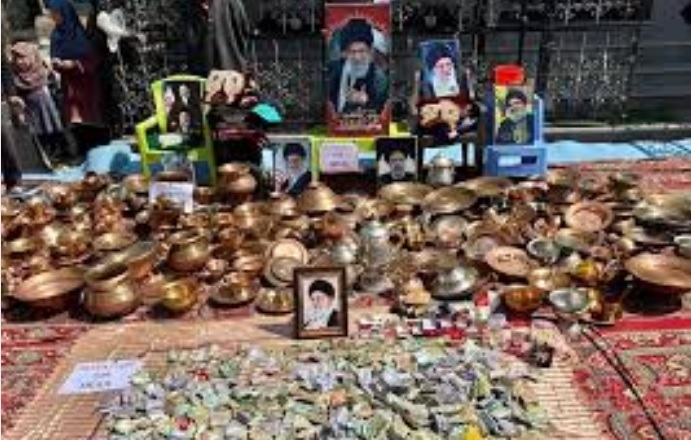
- Gold ornaments
- Silver utensils
- Copper items
- Cash savings
- Household valuables
In economic terms, these contributions represent significant personal assets.
In emotional terms, they represent trust, sacrifice, and solidarity.
Experts note that such giving reflects:
- A high level of social cohesion
- Deep empathy for crisis-affected populations
- A willingness to prioritize humanitarian values over personal security
A Grassroots Foreign Policy?
While governments engage in diplomacy through official channels, movements like these operate at a different level.
They shape what can be called “people’s diplomacy.”
Through this initiative:
- Kashmiris are expressing solidarity independent of state policy
- They are reinforcing cultural and emotional ties
- They are influencing perceptions of Kashmir globally
Such grassroots actions often carry symbolic power that formal diplomacy cannot replicate.
The Broader Context: War, Loss, and Global Attention
The ongoing conflict in Iran has resulted in:
- Civilian casualties
- Infrastructure damage
- Humanitarian crises in affected regions
As images and reports of suffering circulate globally, responses like those from Kashmir stand out.
They offer a counter-narrative—one of compassion in a time of conflict.
The Kashmiri Ethos: Giving in Times of Crisis
Kashmir has a long tradition of community support during difficult times.
Whether it is:
- Natural disasters
- Local hardships
- Global humanitarian crises
The Valley has repeatedly demonstrated a culture of collective responsibility.
This latest initiative for Iran is part of that continuum.
Conclusion: Humanity Beyond Headlines
In a world often defined by geopolitical tensions and divisions, the story emerging from Kashmir is refreshingly human.
It is not about strategy or power.
It is about people.
- A widow giving away her last gold memory
- A laborer contributing a day’s wage
- A community coming together for strangers across borders
As the Embassy of Iran in New Delhi acknowledged, such kindness is not easily forgotten.
And perhaps that is the most important takeaway.
Because long after conflicts end and headlines fade, it is these acts of humanity that endure—quietly shaping the world in ways that politics alone cannot.