Kashmir Youth Deaths Rising: Drug Crisis, Road Accidents & Mystery — What Parents Must Know Now
By: Javid Amin | 06 May 2026
The Valley Is Bleeding Quietly — And Most Parents Don’t See It
There is a particular kind of grief that visits the Kashmir Valley with disturbing regularity these days. A young man leaves home in the morning and never comes back. A teenage girl who was laughing at dinner is found unresponsive by nightfall. A college boy who seemed perfectly fine last week is gone — cause of death listed as “natural” or “accidental” in a register somewhere, the truth buried under bureaucratic language and societal shame.
This is not one story. This is hundreds of them.
Over the past year and a half, something deeply alarming has been unfolding in the Kashmir Valley — an accelerating pattern of young, otherwise healthy people dying in circumstances that raise far more questions than official records are willing to answer. Drugs. Road accidents. Mysterious illnesses. Suicides wrapped in silence. Disappearances that end with bodies pulled from canals. The causes are different on paper, but the roots are eerily similar — and they are all pointed at the same generation: Kashmir’s youth, aged roughly between 14 and 35.
This report is for their parents. But it is also for policymakers, doctors, educators, and every person who has said “not in my family” — and then quietly prayed they were right.
The Numbers That Should Shake Every Parent Awake
Kashmir’s Roads Have Become Graveyards for the Young
Let us begin with what official data actually says — because the numbers alone are disturbing enough.
Between 2019 and October 2024, Jammu and Kashmir recorded 4,899 road fatalities and over 40,000 injuries. In 2023 alone, there were 6,292 accidents resulting in 893 deaths and 8,469 injured. That works out to roughly one death every two hours on Kashmir’s roads — every single day of the year.
In 2024, the death toll sat at 831 fatalities. A marginal dip from the previous year’s peak — but still nearly three people dying every single day on the valley’s roads. And alarmingly, a staggering 95% of these accidents were linked to over-speeding, the kind of reckless, adrenaline-fuelled driving that is overwhelmingly a young person’s habit.
Baramulla district alone recorded 170 accidents in 2024, causing 35 deaths and 255 injuries. Kashmir as a whole ranks second in India for road fatalities per 10,000 registered vehicles. The most vulnerable victims? Young adults and two-wheeler users.
When two teenage boys died on the Tengpora bypass in Srinagar in November 2024 after speeding in a car they had no license to drive, SSP Traffic Muzaffar Shah said something that should be read slowly: “The society has failed us. We were expecting more responsibility from parents and society at large — but both have failed.”
Chief Minister Omar Abdullah called it heartbreaking. Mirwaiz Umar Farooq called for urgent parental caution from the pulpit of Jamia Masjid. Apni Party’s Altaf Bukhari demanded a complete ban on underage driving. The voices were loud. The deaths continue.
Why? Because despite all the official statements, thousands of parents in Kashmir still hand over motorbike keys to 15-year-olds. Still allow unlicensed teenagers to drive four-wheelers. Still excuse reckless speed as “boys being boys.” Peer pressure, indulgent parenting, absent enforcement, and broken roads have combined into a lethal cocktail — and young Kashmiris are paying for it with their lives.
The Drug Epidemic: A Generation Quietly Being Consumed
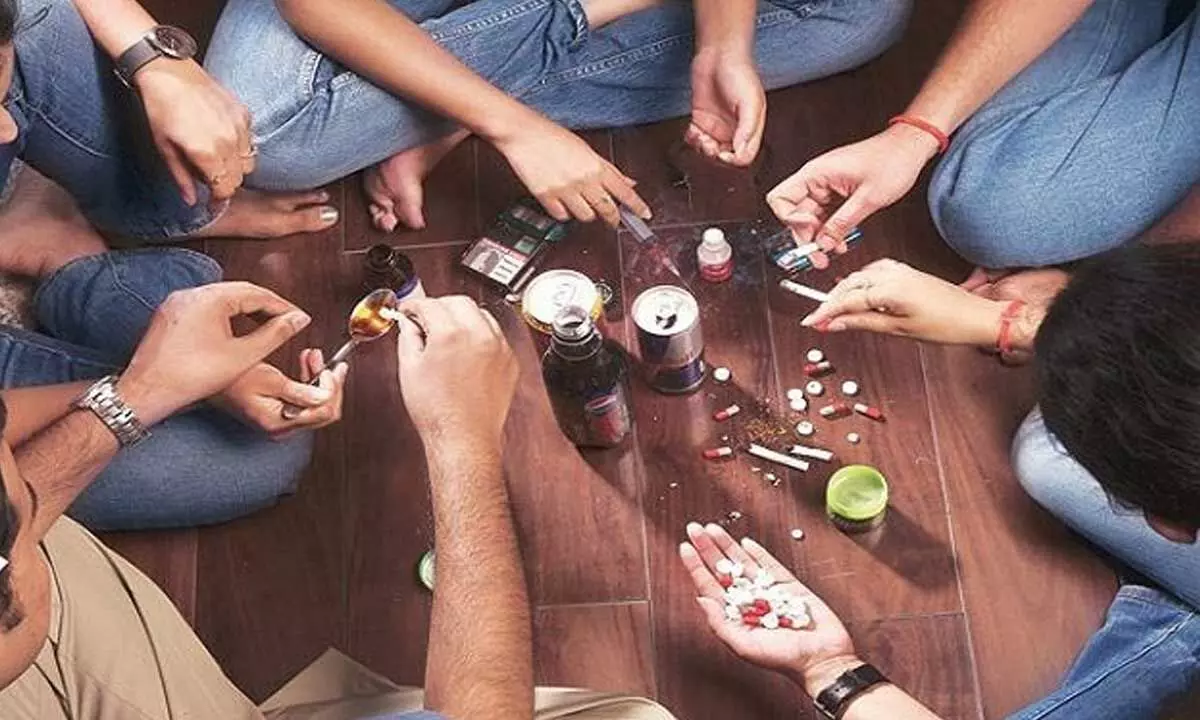
If road accidents are the visible face of Kashmir’s youth crisis, drug addiction is the hidden one — spreading in silence, behind locked bedroom doors, in borrowed syringes and whispered conversations.
The numbers are staggering. A 2023 Indian Parliament report estimated that nearly 1.35 million of Kashmir’s 12 million people were drug users — a quadrupling from an earlier survey that had put the figure closer to 350,000. The Institute of Mental Health and Neurosciences (IMHANS) at Government Medical College Srinagar found that 90% of drug users in Kashmir were aged between 17 and 33.
At Srinagar’s SMHS Hospital, the Drug De-addiction Centre attended to more than 41,000 drug-related patients in 2023 — one person brought in every 12 minutes. That was a 75% increase from 2021 figures alone. The main rehabilitation facility in Srinagar has reported a staggering 2,660% increase in patients seeking treatment since 2016.
The dominant drug is heroin. A 2022 study by the psychiatry department of Government Medical College, Srinagar found that Kashmir had overtaken Punjab — once considered the epicentre of India’s drug crisis — in heroin addiction rates. According to a 2025 report published in the Journal of Drug Issues, heroin seizures across Jammu and Kashmir grew more than fivefold in just four years — from 15 kilograms in 2018 to 80 kilograms in 2022. And seizures are just what gets caught.
The IMHANS study found a chilling pattern in when addiction starts: over two-thirds of patients had begun substance abuse between the ages of 11 and 20. Eleven. Not adults stumbling into bad choices — children.
What is fuelling this? Proximity to the so-called Golden Crescent — the Afghanistan-Pakistan-Iran triangle that produces the bulk of the world’s opium — means narcotics reach Kashmir in large volumes, cheaply and quickly. Drug peddlers are not random. They target students. They offer the first dose free. They engineer dependence deliberately.
But geography alone does not explain the scale of Kashmir’s addiction. The deeper fuel is despair.
The Hidden Background — What Is Really Killing Kashmir’s Youth?
Unemployment: The Invisible Enemy
To understand why Kashmir’s youth are dying in such numbers, you must first understand what it feels like to be young in the Valley today.
One in three young Kashmiris between the ages of 15 and 29 is unemployed. That is not a metaphor or an exaggeration — that is the official figure from India’s own statistics office. The unemployment rate in this age group reached 32% in the third quarter of 2024, double the national average.
Imagine being 23 years old. You have a degree. You have ambitions. You watched your older brother or cousin go through the same cycle — study, graduate, wait, apply, wait, get nowhere. Decades of conflict have stunted Kashmir’s private sector, limited infrastructure investment, and made the region deeply dependent on government jobs that are increasingly scarce. When the economy does show a glimmer — tourism, startups — it is snuffed out by the next round of violence, curfew, or political upheaval.
Javid Ahmed Tenga, President of the Kashmir Chamber of Commerce and Industry, summed it up plainly: “The unemployment rate among both skilled and unskilled youth in Kashmir will worsen even further, pushing more people, particularly the younger generation, into economic distress.”
When there is nothing to wake up for in the morning, the day stretches out dangerously. Idleness is not just boring — it is deadly. It is when the drug peddler at the corner becomes the most attentive presence in a young person’s life. It is when a motorbike becomes the only place a teenager feels powerful. It is when the darkness of depression starts to feel permanent.
The Mental Health Crisis: A Wound No One Talks About
Kashmir has one of the most psychologically burdened populations on earth. That is not an opinion — it is a clinical finding repeated across decades of research.
A landmark survey by Médecins Sans Frontières found that 45% of the population in the Kashmir Valley were under significant mental distress. Nearly one in five Kashmiris showed symptoms of PTSD. A third of survey respondents had contemplated suicide.
Generations of Kashmiris have grown up watching violence, experiencing loss, living under the weight of conflict, curfews, internet shutdowns, and institutional uncertainty. Children who grew up hearing gunfire are now parents raising children in a valley still deeply scarred. The trauma is intergenerational and largely untreated.
Dr. Yasir Rather, a professor in charge of psychiatry at IMHANS, has consistently warned that addiction treatment facilities are stretched beyond their capacity. There are only a handful of hospitals in all of Kashmir with inpatient facilities for severe addiction patients. Follow-up care is inconsistent. Relapse rates are high. In rural areas, access to any mental health support is almost nonexistent.
And yet the social stigma around mental illness and addiction in Kashmir remains enormous. Families hide addicted children. Parents refuse to acknowledge that their son is using drugs because the shame of it in a conservative community feels worse than the disease itself. Young people suffering from depression do not seek help because being labelled “pagal” — mad — in a small town can destroy a family’s marriage prospects and social standing.
This silence is killing people.
The Mysterious Deaths: When Even the Cause Is Unknown
Some deaths in the Kashmir Valley defy even the simple categories above — and they are perhaps the most unsettling of all.
Starting in December 2024, 17 people from the Gujjar tribal community in Kulgam district died under mysterious circumstances in just over a month. Among the victims were 13 minors. Symptoms included fever, vomiting, and severe abdominal pain before death. Investigations ruled out viral or bacterial infections. Preliminary findings pointed toward neurotoxins as a possible cause — but the exact toxin and its source remain unidentified to this day, leaving an entire community in fear.
In the same district, young men have been disappearing — walking out to attend weddings, visiting friends — and their bodies are found weeks later in canals. Official verdicts say drowning. The families and community refuse to accept that. When 18-year-old Showkat Ahmad’s body was recovered, it bore sores, a bloodied eye, peeling skin, and falling hair — hardly consistent with a simple drowning. His father Mohamad Sadiq and his community have been demanding answers that have not come.
In February 2025, 25-year-old Gujjar man Makhan Din recorded a video before taking his own life — alleging torture by security forces. Police denied it. The community did not believe the denial. This divide between official explanation and community experience is itself a form of ongoing trauma.
“Our people disappear, and we are told to stay quiet,” said Abid Awan, 18, a neighbour of Sadiq in Kulgam.
These deaths sit in a category that official data does not capture well — they are neither cleanly counted as conflict deaths, nor as suicides, nor as accidents. They exist in a grey zone that communities in the Valley know all too well: the grey zone of things that happen but are never fully explained.
What Parents Are Missing — And What They Must Do
The Signs Hidden in Plain Sight
Here is a difficult truth: in many of the deaths that have occurred across the Valley in the past year, the warning signs were visible. Parents looked at them and did not recognise them — or recognised them and chose not to act.
A teenager who suddenly becomes secretive, loses weight rapidly, and starts asking for money more often than usual. A young person whose friend circle changes overnight, who stops sleeping at normal hours, who has needle marks on his arms that he covers with long sleeves even in summer. A child who seems disconnected, emotionally flat, who has lost interest in everything they once cared about.
These are not signs of teenage mood swings. These are the early warnings of addiction.
Similarly, the teenager who borrows a vehicle late at night, who talks about racing friends on the Srinagar bypass, who doesn’t come home when he said he would — these are not signs of harmless youthful rebellion. In a valley where one person dies on the roads every two hours, that teenager is in genuine danger.
And the child who has stopped eating, stopped talking, who sits alone and stares — who says everything is fine when nothing is — that child may be sliding into a depression that, if untreated in a place with almost no accessible mental health resources, can become fatal.
Kashmiri parents are not failing their children because they do not love them. They are failing because they are not asking the right questions. Because the culture rewards silence. Because admitting your child is struggling feels like admitting you have failed as a family.
But the cost of that silence, in this valley and at this moment in history, is measured in funerals.
What the System Is (and Isn’t) Doing
To be fair, the administration is not entirely blind to the crisis.
On road safety: In 2024, authorities issued over 40,000 e-challans, seized 429 vehicles, and suspended 2,259 driving licences. In 2025, enforcement intensified further — 52,543 challans, 1,528 vehicles seized. Road accidents have declined 13.6% over three years. These are real gains. They are also insufficient, given the scale of the problem.
On drugs: The government has launched a “Nasha Mukt Jammu and Kashmir Abhiyan” campaign under Lieutenant Governor Manoj Sinha — 100-day awareness drives, coordination between police and health departments, de-addiction centres in every district. SMHS Hospital has expanded capacity. These are genuine steps.
But here is the central contradiction: if enforcement is expanding and campaigns are multiplying, why are addiction cases still rising? The answer is structural. You cannot treat despair with pamphlets. You cannot rehabilitate a young man who has no job to return to after leaving a de-addiction centre. The supply chain of narcotics runs through organised cross-border routes that local policing cannot fully disrupt. And de-addiction infrastructure, however improved, remains massively overwhelmed by demand.
As one investigative piece put it plainly: “Addiction does not grow in isolation. It takes root where pressure, uncertainty, and limited opportunity converge.” Until those root conditions are addressed — unemployment, trauma, hopelessness — the treatment centres will keep filling up faster than they can be emptied.
The Way Forward — A Roadmap for Parents, Society, and the State
For Parents: Presence Is Protection
The most powerful intervention in a young Kashmiri’s life is not a government campaign or a police crackdown. It is a parent who pays attention.
Talk to your children — not just at mealtimes, not just about school and marriage prospects, but about how they feel, who their friends are, what they are worried about, what brings them joy. Create a home where difficult conversations are possible. A child who feels heard at home is significantly less likely to seek escape in substances or reckless behaviour outside it.
Set firm boundaries around vehicles. No 15-year-old needs to drive a car. No unlicensed teenager should be on a motorbike. The SSP Traffic is right: the responsibility begins with parents. Saying no is an act of love, not restriction.
Know the signs of substance abuse. Do not assume it cannot happen in your home because you are a “good family.” Drug addiction does not discriminate by income, education, or piety. It exploits vulnerability — and every young person in the Kashmir Valley is vulnerable right now.
Take mental health seriously. If your child seems depressed, withdrawn, or hopeless, treat that as the emergency it is. Push past the stigma. Seek help. IMHANS in Srinagar, SMHS Hospital’s psychiatry department, and district hospitals all offer services. They are imperfect and overwhelmed — but they exist, and reaching out is always better than silence.
For Society: Break the Culture of Shame
The single biggest killer in Kashmir’s youth crisis is not drugs or speeding or even poverty. It is silence. The silence of families who hide addiction. The silence of communities that do not ask questions when young men disappear. The silence of a culture where mental illness is treated as a spiritual failing rather than a medical condition.
Community elders, religious leaders, teachers, and neighbours all have a role to play. The mosque and the madrassa, the school and the mohalla — these are the networks through which awareness can travel fastest. Mirwaiz Umar Farooq spoke from the pulpit about reckless driving. That kind of moral leadership, extended to mental health and addiction, can reach families that government campaigns never will.
For the State: Address Root Causes, Not Just Symptoms
The administration must move beyond campaign mode. A few urgent priorities:
Create employment that actually reaches young people. The startup ecosystem is growing — 917 startups registered in 2024 — but it benefits a narrow slice of educated, urban youth. Vocational training, rural enterprise support, and serious investment in the private sector must be expanded.
Build real mental health infrastructure. The ratio of psychiatrists to population in Kashmir is among the lowest in India. This must change urgently. Community mental health workers who can reach villages, not just hospital outpatients, are essential.
Address the crisis of accountability. Communities like the Gujjars of Kulgam will not trust the state if their children’s mysterious deaths are met with silence. Transparent investigations, honest communication, and accountability — not just denial — are what build the trust that ultimately keeps young people safe.
Conclusion: Kashmir’s Youth Are Not Expendable
There is a temptation, when living through a slow-moving crisis, to normalise it. Three road deaths a day becomes background noise. Another young man in the de-addiction ward becomes a statistic. A family’s grief becomes just one more tragedy in a valley that has seen too many.
But normalisation is not the same as acceptance, and acceptance is not the same as peace.
Kashmir’s youth are not expendable. The 17-year-old in the SMHS rehabilitation ward who still has dark circles under his eyes but who looks at his mother with something that might be hope — he is not a lost cause. The 19-year-old girl who dreams of being a flight attendant but who has never had the stability to pursue that dream — she deserves better. The young man whose body was found in a canal with no credible explanation — his family deserves answers.
Every parent in the Valley who sends a child out into the world in the morning and worries until they come home is part of this story. The worry is not irrational. But worry alone is not enough. It must become watchfulness. Watchfulness must become conversation. And conversation must become action — at home, in communities, and in the corridors of power.
The valley is losing its future, one young life at a time. Quietly. Routinely. And far too fast.
It is time to stop looking the other way.
This report is based on verified ground data, published research, parliamentary records, and field reporting from across the Kashmir Valley. Key sources include IMHANS studies, India’s National Statistics Office, Al Jazeera field investigations (April–May 2025), Kashmir Times, Greater Kashmir, Rising Kashmir, and official J&K government traffic and health data.