Ganderbal Encounter 2026: Omar Abdullah, Mehbooba Mufti Demand Probe After Family Denies Militancy Links
By: Javid Amin | 02 April 2026
A Death That Sparked Questions Across Kashmir
The killing of a young man in an alleged encounter in Central Kashmir’s Ganderbal district has ignited a fresh wave of concern over transparency and accountability in counterinsurgency operations. What began as an official claim of a successful anti-terror operation has now turned into a politically and socially sensitive controversy, with the family of the deceased strongly contesting the narrative.
At the center of the storm is Rashid Ahmad Mughal, whose death on March 31, 2026, has triggered demands for an impartial investigation—not only from his family but also from key political leaders including Omar Abdullah and Mehbooba Mufti.
What Happened: The Official Version vs Family’s Claim
Army’s Account
According to official statements, Rashid Ahmad Mughal was killed during an encounter and was identified as a “terrorist.” Such operations are part of ongoing security efforts in Jammu & Kashmir aimed at dismantling militant networks.
Family’s Version
The family, however, has categorically rejected this claim.
- They assert Rashid had no links to militancy.
- According to them, he left home on Tuesday morning and did not return.
- They claim they were later informed of his death in what authorities described as an encounter.
The stark contradiction between the two narratives has fueled public skepticism and concern.
Family Seeks Legal Action: Demand for FIR and Probe
- A police complaint has been filed, seeking registration of an FIR.
- The family is demanding a time-bound and impartial investigation.
- They want accountability for what they describe as a wrongful killing.
This legal step significantly escalates the issue, moving it from public discourse into the domain of formal investigation.
Political Reactions: Rare Convergence on Accountability
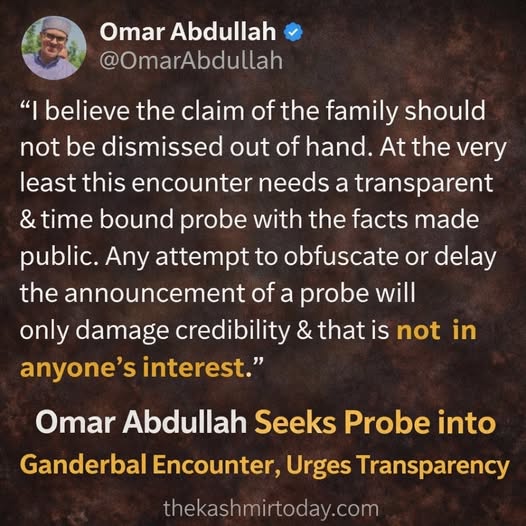
Omar Abdullah Calls for Transparency
The Chief Minister has taken a firm stance, emphasizing due process:
- Called for a transparent and time-bound probe.
- Stated that the family’s claims must not be dismissed outright.
- Warned that any delay or lack of clarity could erode public trust.
His response reflects a governance-oriented concern—balancing security operations with public accountability.
Mehbooba Mufti Questions Official Narrative
Echoing similar concerns, the former Chief Minister:
- Questioned the credibility of the official account.
- Emphasized the need to hear the family’s version.
- Joined calls for an independent investigation.
Her position aligns with a broader political narrative that has often raised concerns about alleged excesses in encounter operations.
Why This Case Matters: Beyond a Single Incident
This is not just about one encounter—it taps into a larger, longstanding issue in Kashmir.
1. Trust Deficit Between Public and Institutions
Incidents where official narratives are contested tend to deepen mistrust, particularly in conflict-sensitive regions.
2. Pattern of Contested Encounters
Over the years, several encounters in Jammu & Kashmir have sparked similar debates:
- Allegations of mistaken identity
- Claims of staged encounters
- Delays in independent verification
Each such case adds to cumulative public perception.
3. Legal and Human Rights Dimensions
Under Indian law:
- Any encounter killing can be subject to judicial or magisterial inquiry.
- The registration of an FIR is often considered a key first step in ensuring accountability.
Human rights organizations have consistently emphasized the need for:
- Independent investigations
- Protection of civilian rights
- Transparency in security operations
Ground Sentiment: Anxiety, Anger, and Demand for Justice
- Communities are closely watching how authorities respond.
- Civil society voices are calling for due diligence and fairness.
- Social media discussions indicate polarized opinions, but a common demand for clarity.
Even among those who support strong counterterrorism measures, there is recognition that credibility hinges on accountability.
The Challenge for Authorities: Balancing Security and Justice
Authorities face a complex task:
Operational Reality
- Security forces operate in a high-risk environment.
- Split-second decisions are often required during encounters.
Accountability Imperative
- Every contested killing demands transparent verification.
- Failure to address doubts can undermine long-term stability efforts.
This dual pressure makes such cases particularly sensitive.
Possible Next Steps: What to Watch
The trajectory of this case will likely depend on:
- Whether an FIR is registered
- Appointment of a magisterial or judicial inquiry
- Release of forensic and operational details
- Engagement with the family and local community
The credibility of the investigation process will be crucial in shaping public perception.
Conclusion: A Test Case for Transparency in Kashmir
The Ganderbal encounter controversy has once again placed the spotlight on a critical question: how to ensure accountability without compromising security operations.
With the family of Rashid Ahmad Mughal seeking justice and political leaders across party lines demanding a probe, this case has evolved into a significant test of institutional transparency in Jammu and Kashmir.
At its core, the issue is not just about establishing facts—it is about reinforcing trust. In regions marked by conflict and complexity, that trust is often the most fragile yet most essential foundation for peace.
Editorial Note:
This report is based on available statements from the family, political leaders, and initial official inputs as of April 2026. Developments are ongoing, and further investigation may provide additional clarity.

