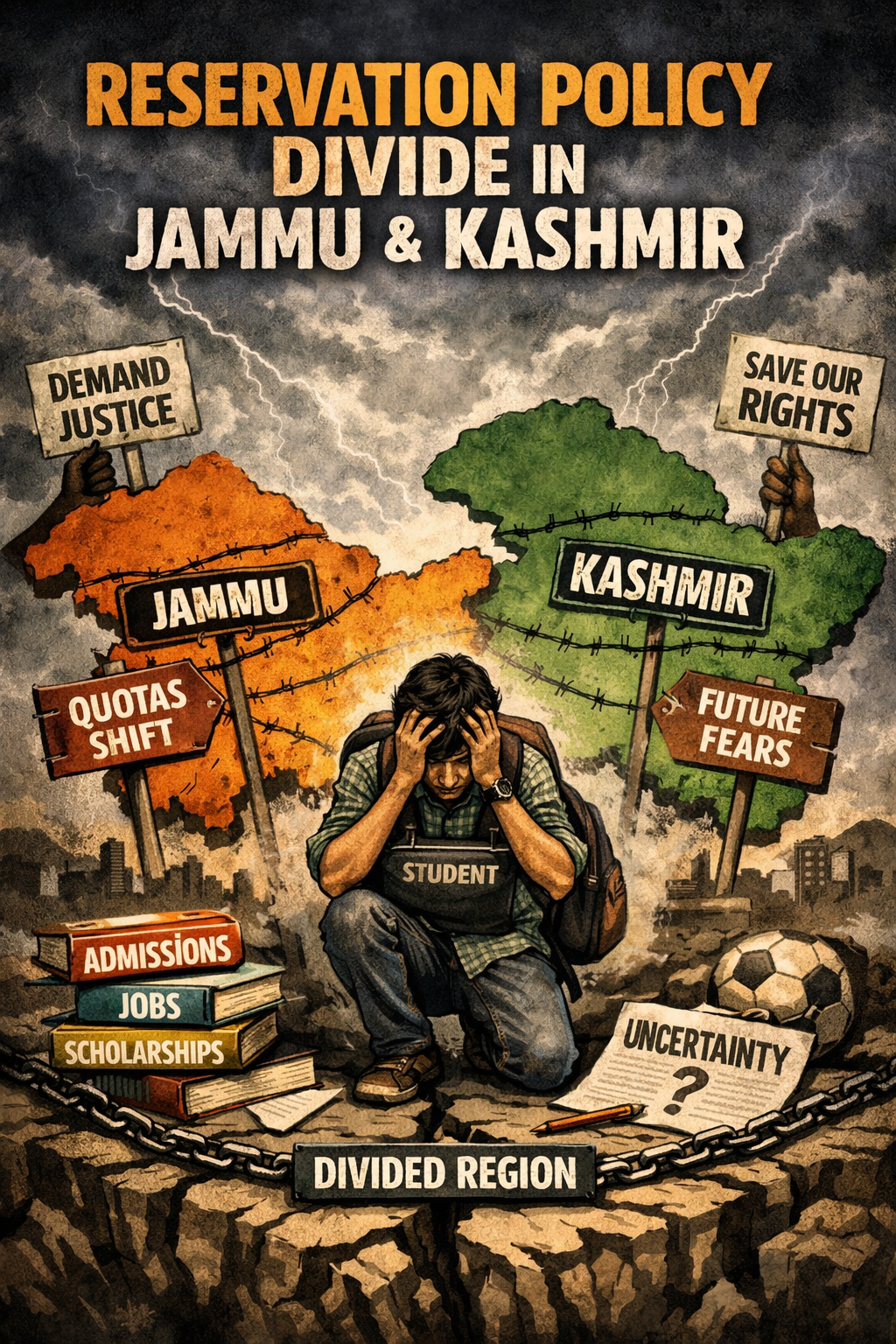
Reservation Policy Divide in Jammu & Kashmir: Students Fear an Uncertain Future
By: Javid Amin | 09 May 2026
A growing sense of uncertainty is spreading across Jammu and Kashmir as the Union Territory’s revised reservation framework continues to spark debate, anxiety, and regional polarization. What was originally projected as a measure for “inclusive representation” has now evolved into one of the most emotionally charged issues among students and educators, particularly in Kashmir Valley.
For thousands of young aspirants preparing for admissions, competitive examinations, and government recruitment, the question is no longer only about merit or opportunity — it is increasingly about identity, representation, and belonging.
A Policy Shift That Redefined the Debate
Following the constitutional changes after the abrogation of Article 370, Jammu and Kashmir witnessed major administrative and legal restructuring. Among the most consequential changes has been the expansion and recalibration of reservation categories for Scheduled Tribes (ST), Scheduled Castes (SC), Other Backward Classes (OBC), and other reserved groups.
Government authorities maintain that the revised framework aims to create a more balanced and inclusive system by extending benefits to historically underrepresented communities.
However, critics argue that the implementation has altered the competitive landscape in ways that disproportionately impact open-merit students, particularly from Kashmir Valley.
The controversy has intensified because reservation in Jammu and Kashmir has never been viewed merely as a welfare mechanism. In the region’s sensitive socio-political environment, it is also closely tied to representation, identity, and regional balance.
Students Caught Between Merit and Uncertainty
Across colleges, coaching centres, and university campuses in Srinagar, Baramulla, Anantnag, and Pulwama, conversations increasingly revolve around one issue: uncertainty about the future.
Admissions Under Pressure
Students aspiring for professional courses such as medicine, engineering, and management fear shrinking opportunities in the open merit category due to the expansion of reserved quotas.
Many students argue that the sudden restructuring has disrupted long-term academic planning.
A university aspirant from Baramulla said:
“We spend years preparing for competitive exams, but every new notification changes the entire equation. Students feel mentally exhausted.”
Scholarships and Recruitment Delays
Confusion over revised eligibility criteria and category classifications has also reportedly affected scholarship processing and recruitment procedures in some sectors.
Students claim that inconsistent interpretations of reservation rules have led to delays, uncertainty, and repeated documentation requirements.
Psychological Impact on Youth
Beyond numbers and percentages, the emotional impact is becoming increasingly visible.
Career counsellors and educators report rising levels of stress among students who already face limited employment opportunities and intense competition.
Many young people describe themselves as:
- “Disillusioned”
- “Politically unheard”
- “Unsure about their future”
For a generation already navigating unemployment and instability, the reservation debate has added another layer of insecurity.
Jammu and Kashmir: Two Different Perspectives
The reservation issue has also reopened the long-standing regional divide between Jammu and Kashmir, with both sides viewing the policy through very different lenses.
Jammu’s Perspective: Recognition After Years of Neglect
In Jammu, many communities and advocacy groups see the revised reservation structure as a long-overdue correction of historical imbalance.
Supporters argue that:
- Several tribal and backward communities remained underrepresented for decades.
- Educational and administrative opportunities were concentrated among a limited section of society.
- The new framework brings Jammu and Kashmir closer to national affirmative-action standards.
For many residents in Jammu, the policy symbolizes recognition rather than favoritism.
Kashmir’s Concern: Fear of Marginalization
In Kashmir Valley, however, concerns are more intense and emotional.
Many students and educators believe the revised framework has significantly reduced space for open competition, particularly in highly sought-after educational and professional sectors.
Some critics also fear that repeated policy changes without broad public consultation contribute to a growing perception of political and administrative disconnect.
The debate has therefore moved beyond reservation percentages and entered the realm of identity politics and regional trust.
Experts Warn of a Growing Trust Deficit
Education Activists
Education advocates caution that prolonged uncertainty can damage students’ confidence in public institutions.
They argue that when policies appear unpredictable or insufficiently explained, students begin to lose faith in systems meant to support them.
Legal Observers
Legal experts point out that reservation policies require transparent data, public consultation, and clear implementation frameworks to avoid confusion and litigation.
Several observers have also stressed the importance of balancing affirmative action with constitutional principles of equality and fairness.
Social Commentators
Analysts increasingly view the reservation debate as part of a broader trend of centralized policymaking, where local participation in sensitive decisions is perceived to be diminishing.
This perception, they warn, can deepen alienation among youth.
The Bigger Crisis: Education, Unemployment, and Identity
The reservation controversy comes at a time when Jammu and Kashmir’s youth are already confronting multiple challenges:
- Rising unemployment rates
- Competitive pressure in limited job markets
- Migration of skilled students outside the region
- Financial strain on middle-class families
- Unequal access to quality educational infrastructure
Against this backdrop, any policy affecting educational access naturally carries enormous emotional and political weight.
For many students, reservation is no longer viewed solely as an administrative mechanism — it has become symbolic of who feels included in the future of the region.
Ground Reality Across Campuses
Interactions with students and education stakeholders suggest a growing atmosphere of:
- Confusion over changing criteria
- Fear regarding reduced opportunities
- Distrust toward policymaking processes
- Anxiety about future career prospects
While some student groups demand a review of the policy structure, others call for transparent data-based dialogue rather than political rhetoric.
Observers believe the absence of meaningful engagement between policymakers and students is widening the communication gap.
Editorial Perspective: Beyond Quotas, a Battle for Confidence
The reservation debate in Jammu and Kashmir is no longer confined to statistics or legal provisions. It is increasingly about trust.
Policies intended to uplift marginalized communities must undoubtedly protect social justice. But they must also ensure transparency, balance, and public confidence — especially in a region as sensitive and diverse as Jammu and Kashmir.
When students begin to feel that opportunity is uncertain and identity determines destiny, the consequences extend far beyond admissions and employment charts.
The real challenge before policymakers is not simply distributing seats or quotas. It is preserving the belief among young people that their future still depends on effort, fairness, and hope.
Conclusion
Jammu and Kashmir’s youth stand at a critical crossroads.
For one section, the revised reservation framework represents overdue inclusion and empowerment. For another, it signals shrinking opportunities and growing exclusion.
Unless addressed through transparent dialogue, credible data, and inclusive policymaking, the divide risks deepening social and regional fault lines.
Because ultimately, the debate is not only about who receives reservation —
it is about whether an entire generation still feels represented in the future being shaped around them.


